Science
Reaction between two elements A and B, forms a compound C. A loses electrons and B gains electrons. Which one of the following properties will not be shown by compound C?
options
- It has high melting point.
- It is highly soluble in water.
- It has weak electrostatic forces of attraction between its oppositely charged ions.
- It conducts electricity in its molten state or aqueous solution
Chemical Bonding
1 Like
Answer
It has weak electrostatic forces of attraction between its oppositely charged ions.
Reason — When element A loses electrons and element B gains electrons, the compound C formed is ionic in nature. Ionic compounds are held together by strong electrostatic forces of attraction between oppositely charged ions and because of these strong forces, such compounds have high melting points, are often soluble in water and conduct electricity in the molten state or in aqueous solution.
Therefore, the property that will not be shown by compound C is having weak electrostatic forces of attraction between its ions.
Answered By
1 Like
Related Questions
The following table shows the pH values of four solutions A, B, C and D on a pH scale :

The solutions A, B, C and D respectively are of a
options
- Strong acid, weak acid, neutral, strong base
- Weak acid, neutral, weak base, strong base
- Weak acid, neutral, strong base, weak base
- Weak acid, neutral, strong base, strong acid
Consider the following reactions :
(a) Dilute hydrochloric acid reacts with sodium hydroxide.
(b) Magnesium oxide reacts with dilute hydrochloric acid.
(c) Carbon dioxide reacts with sodium hydroxide.
It is found that in each case :
options
- Salt and water is formed.
- Neutral salts are formed.
- Hydrogen gas is formed.
- Acidic salts are formed.
The metals obtained from their molten chlorides by the process of electrolytic reduction are :
options
- Gold and silver
- Calcium and magnesium
- Aluminium and silver
- Sodium and iron
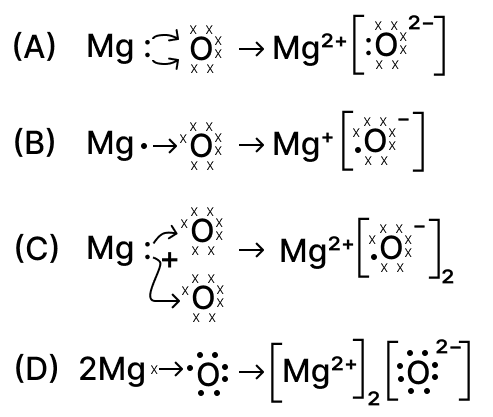
The formation of magnesium oxide is correctly shown in option :
options