
Geography
Read the passage given below and answer the questions that follow:
Mountains are most commonly formed by folding or buckling of the Earth's crust due to forces of compression. These are thus called fold mountains. This process generally happens when two plates collide or move towards each other. The collision causes the edges of the plates to be raised or uplifted to form mountains. Most fold mountains thus occur at margins of plates, notable examples being the Andes, Rockies and Himalayas. Fold mountains are of two types—
- young fold mountains such as the Himalayas and the Alps were formed a few million years ago.
- On the other hand, old fold mountains such as the Aravallis and the Urals were formed several hundred million years ago.
- Name two mountain ranges that lie on the edges of the plates.
- Draw a diagram to show a folded topography.
- What are the different types of fold mountains? Mention with example.
Earth's Landforms
5 Likes
Answer
Two prominent mountain ranges that lie on the edges of plates are the Himalayas and the Andes.
Diagram showing folded topography
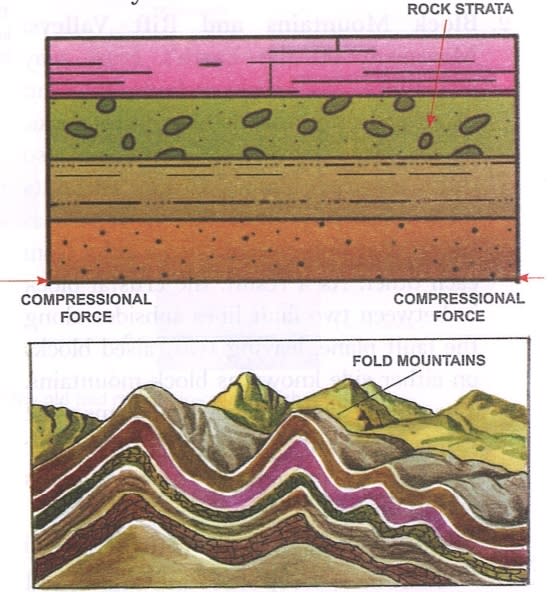
- Fold Mountains are of two types:
Young Fold Mountains —
- Formed a few million years ago.
- They have parallel ranges with steep slopes and tall peaks which remain snow-covered due to the high elevation.
- Examples: The Alps and the Himalayas
Old Fold Mountains —
- Formed several hundred million years ago.
- They have gentle slopes and low rounded peaks, since they have been worn down by agents of denudation such as rivers and glaciers over a long period of time.
- Examples — The Aravallis and the Urals
Questions 2
Explain with the help of diagrams how the following are formed.
- fold mountains
- block mountains and rift valleys
- volcanic mountains
Answer
- Fold mountains are formed by creasing or buckling of the Earth's crust due to forces of compression. This process generally happens when two plates collide or move towards each other. The collision causes the edges of the plates to be raised or uplifted to form mountains.
- Movement of the Earth's crust may sometimes cause cracks or faults to occur, resulting in the crust breaking into blocks. These large blocks of crust are also called crusted blocks. Cracks or faults most commonly occur due to tensional forces that pull crustal blocks away from each other. As a result, the crustal block in between two fault lines subsides along the fault plane, leaving two raised blocks on either side known as block mountains. The subsided block in between forms a rift valley. Thus, rift valleys, unlike other river valleys, are formed due to movements within the Earth.
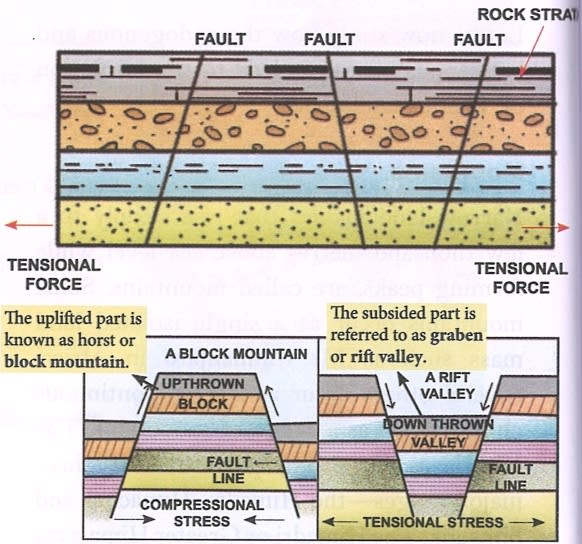
- Volcanic mountains are made up of molten materials known as magma, along with ash and small rock particles called cinders. These materials erupt from the Earth's interior through an opening known as vent. On reaching the surface, the magma cools and solidifies. With several successive eruptions, the lava piles up gradually, thereby building up a conical volcanic mountain.
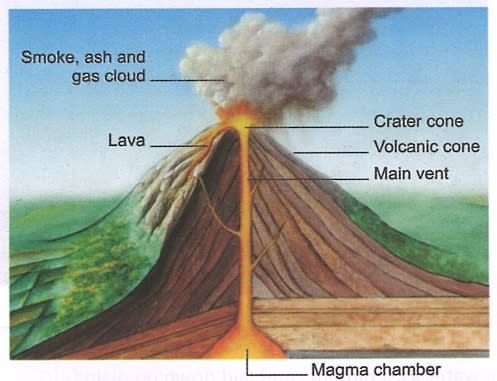
Answered By
4 Likes
Related Questions
How are mountains classified into different types according to their mode of formation?
How are plateaus beneficial for us?
How are alluvial plains formed? How are the plains most suitable for economic activities?
Explain the major differences in the way of life of the people of the mountains and plains.