
Science
A researcher carried out an experiment in which she took two carrots of similar size. She placed one carrot in plain water and the other carrot in concentrated salt solution (Fig. 2.21). After 24 hours she recorded her observations.
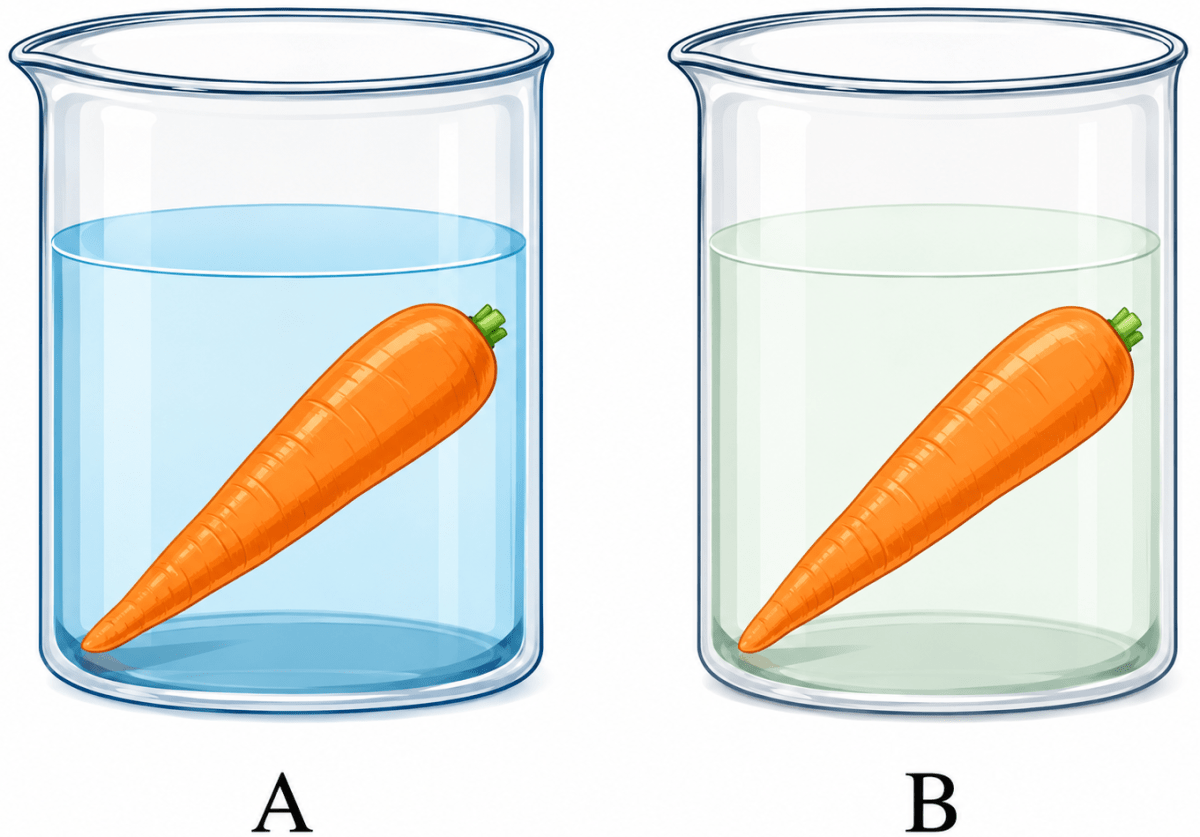
(i) What hypothesis does she want to test through this experiment?
(ii) What would you suggest for the improvement of this experiment?
(iii) Why does the carrot in plain water stay stiff and crunchy, but the carrot in concentrated salt solution become rubbery and limp?
Cell
2 Likes
Answer
(i) The hypothesis she wants to test is that water moves into or out of plant cells by osmosis depending on the concentration of the surrounding solution — that is, the firmness of the carrot depends on whether the surrounding solution is dilute or concentrated.
(ii) Improvements that can be suggested:
- Measure and record the initial and final weights of both carrots to obtain quantitative data.
- Use carrots of exactly equal size and weight.
- Keep the volume of solution, temperature and time the same for both carrots.
- Repeat the experiment a few times to make the results more reliable.
(iii) The carrot in plain water stays stiff and crunchy because plain water is a dilute (hypotonic) solution. Water moves into the carrot cells by osmosis, making the cells turgid and firm. The carrot in the concentrated salt solution becomes rubbery and limp because the salt solution is hypertonic. Water moves out of the carrot cells by osmosis, causing the cells to lose water and become flaccid, so the carrot turns limp and rubbery.
Answered By
1 Like
Related Questions
Mitochondria and chloroplasts are two important organelles in a plant cell. Discuss how these two organelles are structurally and functionally similar to each other, and different from each other.
Which of the following pairs of cell organelles contains DNA?
(i) Chloroplasts, Ribosomes
(ii) Mitochondria, Nucleus
(iii) Golgi bodies, Ribosomes
(iv) Nucleus, Lysosomes
Indicate the presence or absence of following structures in bacterial and animal cells:
Structures in a cell Bacterial cell Animal cell Chromosome Nucleus Mitochondria Golgi complex Chromoplasts Carry out the following experiment:
Take four peeled potato halves and scoop each one out to make potato cups. One of these potato cups should be made from a boiled potato. Place each of the potato cups in a beaker containing water (Fig. 2.22). Now, set up the experiment as follows:
(a) Keep Cup A empty.
(b) Add one teaspoon sugar in Cup B.
(c) Add one teaspoon salt in Cup C.
(d) Add one teaspoon sugar in the boiled potato in Cup D.
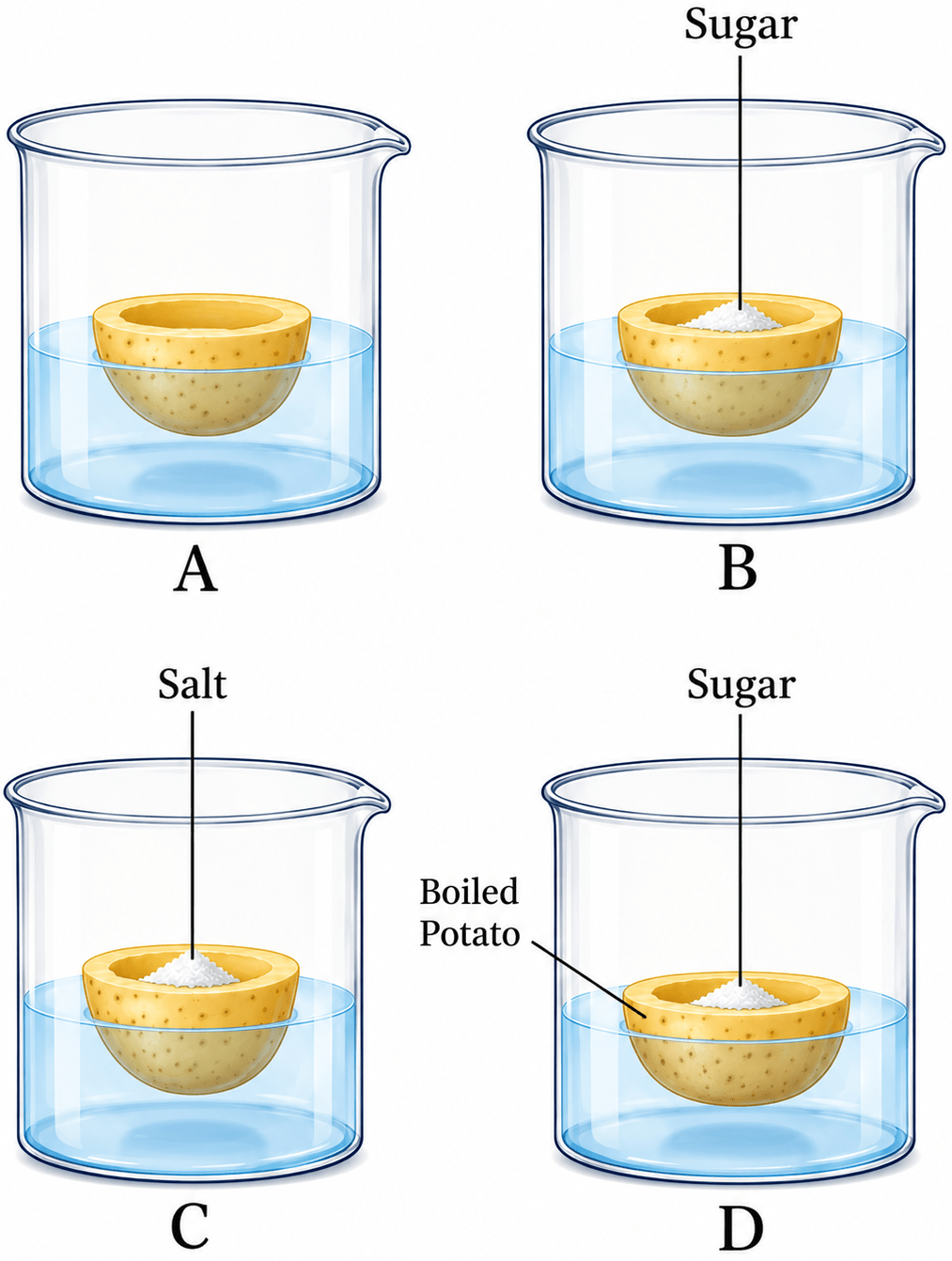
Observe the four potato cups for at least two hours and answer the following questions:
(i) Explain why water gathers in the hollowed portion of Cup B and Cup C.
(ii) Why is Cup A necessary for this experiment?
(iii) Explain why water does not gather in the hollowed portions of Cups A and D.