History & Civics
The Revolt of 1857 was the beginning of the independence struggle against the colonial rule of the British. With reference to the consequences of the Revolt, answer the following:
(i) Mention any three changes made in the administration with the end of the Company's Rule.
(ii) State any three policies promised to Indians in Queen Victoria's Proclamation.
(iii) Mention any four changes made in the army after the Revolt.
Answer
(i) Three changes made in the administration with the end of the Company's Rule are:
- The Company's Board of Control and Court of Directors were abolished. A member of the British Cabinet was appointed Secretary of State for India and made responsible for all matters related to the governance of India. He was given a Council to advise him, called the Indian Council. Thus, the ultimate power over India remained with the British Parliament.
- Actual governance was to be carried on, as before, by the Governor-General who was also given the title of Viceroy, that is, a personal representative of the Crown. Lord Canning was appointed as the first Viceroy under this Act.
- Appointments to the Civil Service were to be made by open competition under rules made by the Secretary of State.
(ii) Queen Victoria's Proclamation promised that the government of India would — ;
- follow a policy of non-intervention in social and religious matters of Indians.
- treat all subjects-Indians and Europeans-as equals (education and ability would be the basis of all appointments).
- grant a general pardon to all those who had taken part in the War except those who were found guilty of murder of British subjects.
(iii) The India army was reorganised after 1858, to prevent the reoccurrence of another uprising, in the following manner:
- The strength of European troops in India was increased. The ratio of European to Indian troops was fixed at 1:2 (Bengal army) and 2:5 (Madras and Bombay armies). Practically the same ratio was maintained till the First World War. The general principle adopted was that the number of Indian sepoys should not exceed twice that of the European troops.
- European troops were kept in key geographical and military positions.
- To desist the Indian soldiers from rising again against the British rule, the sophisticated weapons and ammunition were never placed under the charge of Indians. All Indian artillery units, with the exceptions of a few mountain units, were disbanded.
- Newspapers, journals and nationalist publications were prevented from reaching the soldiers to keep the Indian army separated from the life of the rest of the population.
Related Questions
The Council of Ministers headed by the Prime Minister aids and advises the President. In this context, answer the following questions:
(i) Mention any three points to distinguish between the Council of Ministers and the Cabinet.
(ii) Who appoints the Cabinet Ministers? Mention any two administrative powers of the Cabinet.
(iii) The President is the nominal head of the Indian Union. Mention any four functions of the Prime Minister with reference to the President.
The judiciary is the system of courts that interprets and guards the Indian Constitution. With reference to the Supreme Court of India, answer the following:
(i) What is the composition of the Supreme Court? Why is it called the Court of Record?
(ii) Explain the power of Judicial Review.
(iii) What is meant by the term Original Jurisdiction? Mention any three cases which come under this jurisdiction.
The Indian National Movement is divided into three phases. With reference to the Second Phase of the Indian National Movement, answer the following questions:
(i) Who partitioned Bengal? Mention any two points to explain the perspective of the Nationalists regarding the actual motive behind the decision of Partition.
(ii) What was the objective of the Assertive Nationalists? Mention any two contributions of Bal Gangadhar Tilak.
(iii) In which year was the Muslim League formed? Mention any three objectives of the Muslim League.
Look at the picture given and answer the following questions:
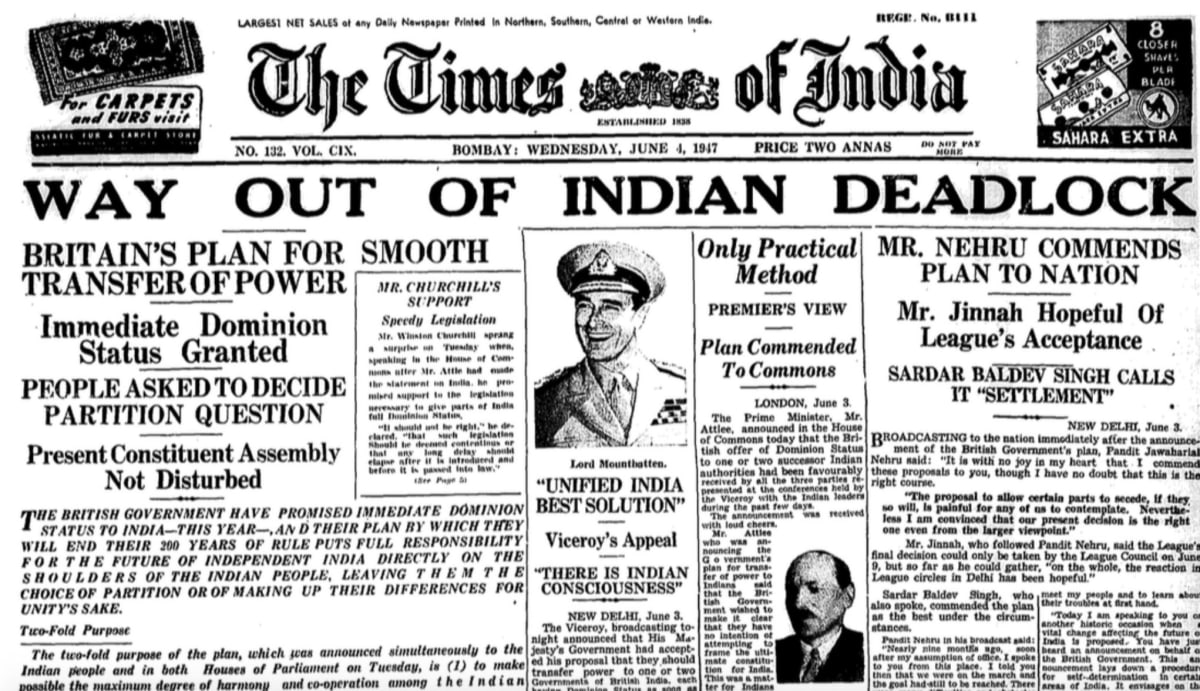
(i) Name the Viceroy who announced the plan for smooth transfer of power. Mention any two clauses of his plan with reference to the Princely States.
(ii) Mention any three reasons for the acceptance of his plan by the Congress.
(iii) Mention any four provisions of the Indian Independence Act of 1947.