
Mathematics
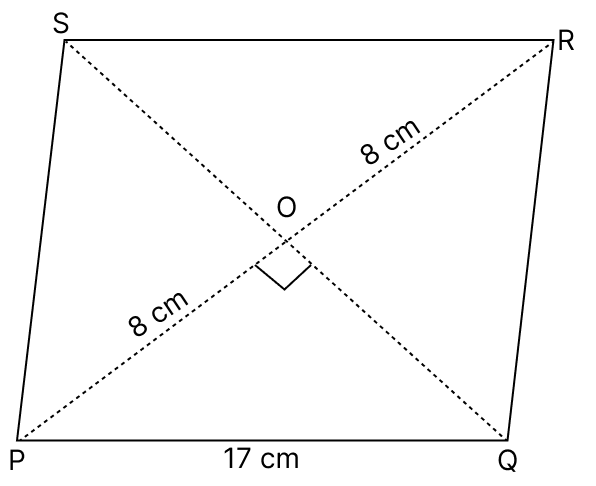
In a rhombus PQRS, side PQ = 17 cm and diagonal PR = 16 cm. Calculate the area of the rhombus.
Pythagoras Theorem
3 Likes
Answer
We know that,
The diagonals of a rhombus bisect each other at right angles.
From figure,
OP = OR = 8 cm
PQ = 17 cm
In right angled △ POQ,
Hypotenuse2 = Perpendicular2 + Base2
⇒ PQ2 = OP2 + OQ2
⇒ 172 = 82 + OQ2
⇒ 289 = 64 + OQ2
⇒ OQ2 = 289 - 64
⇒ OQ2 = 225
⇒ OQ =
⇒ OQ = 15 cm.
Since, OQ = OS = 15 cm (the diagonals of a rhombus bisect each other)
QS = OQ + OS = 15 + 15 = 30 cm
∴ Diagonals are PR = 16 cm and QS = 30 cm.
As we know,
Area of rhombus = × Product of diagonals
= = 240 cm2.
Hence, the area of rhombus = 240 cm2.
Answered By
2 Likes
Related Questions
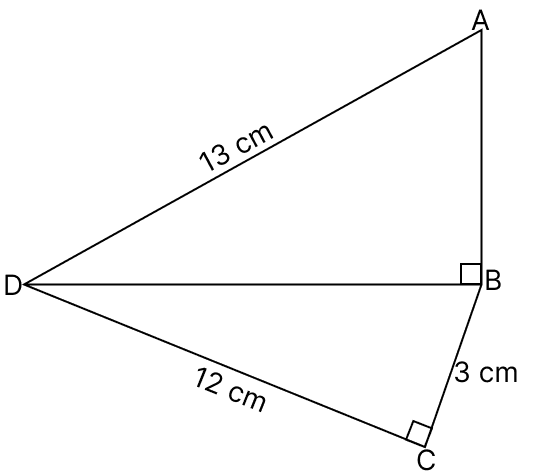
In the given figure, ABCD is a quadrilateral in which BC = 3 cm, AD = 13 cm, DC = 12 cm and ∠ABD = ∠BCD = 90°. Calculate the length of AB.
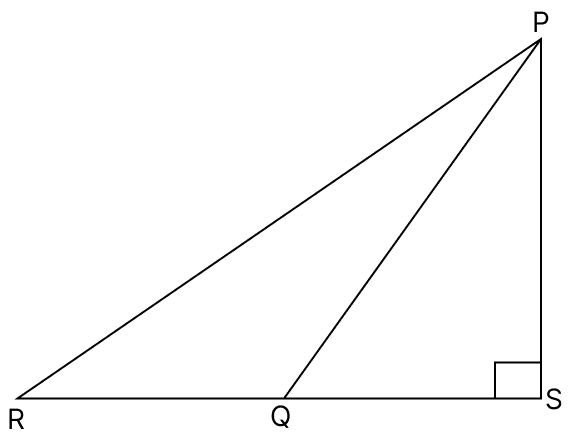
In the given figure, ∠PSR = 90°, PQ = 10 cm, QS = 6 cm and RQ = 9 cm, calculate the length of PR.
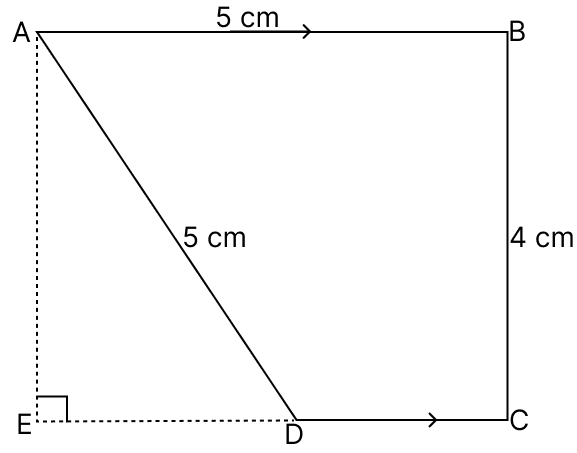
From the given figure, find the area of trapezium ABCD.
The sides of a right triangle containing the right angle are 5x cm, (3x - 1) cm. If the area of the triangle be , calculate the length of the sides of the triangle.