
Mathematics
Rohit and Vinay both opened a recurring deposit account in a bank for 2 years at 8% simple interest. Vinay deposited ₹ 300 per month. On maturity, Rohit’s interest was ₹ 800 more than Vinay’s interest. Find:
(a) interest earned by Vinay.
(b) sum deposited by Rohit every month.
Banking
5 Likes
Answer
(a) Time = 2 years = 24 months
r = 8%
P = ₹ 300 for Vinay
By formula,
I =
Substituting values, we get :
Hence, interest earned by Vinay = ₹ 600.
(b) Rohit’s interest is ₹800 more than Vinay’s.
Interest earned by Rohit = ₹600 + ₹800 = ₹1400.
Let Rohit deposit ₹P per month.
By formula,
I =
Substituting values, we get :
Hence, Rohit deposits ₹700 per month.
Answered By
1 Like
Related Questions
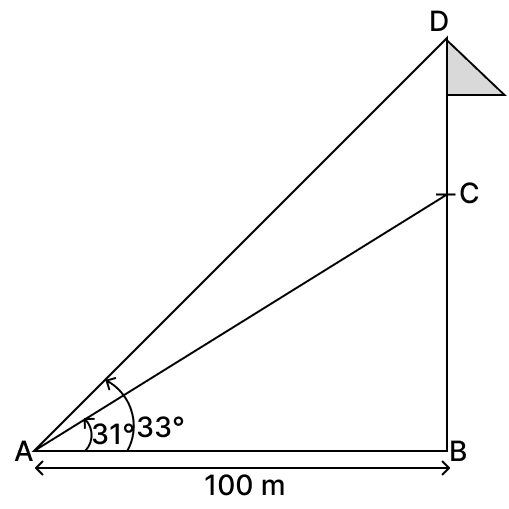
A flagpole is erected at the top of a building. The angle of elevation of the top and foot of the flagpole from a point 100 m away, on the same level as that of the foot of the building, are 33° and 31° respectively. Find the height of the flagpole. Give your answer correct to the nearest metre.
Using a graph paper, draw an ogive for the following distribution which shows a record of weight in kilograms of 100 students.
Weight (in kg) Number of students 35 – 40 4 40 – 45 6 45 – 50 10 50 – 55 24 55 – 60 26 60 – 65 17 65 – 70 8 70 – 75 5 Use your ogive to estimate the following:
(a) the median weight of the students.
(b) percentage of students whose weight is 60 kg or more.
(c) the weight above which 20% of the students lie.
The fourth term of a Geometric Progression (G.P.) is 16 and its seventh term is 128. Find its:
(a) common ratio
(b) first term
Use graph sheet for this question. Take 2 cm = 1 unit along both x and y axis. Graphically represent parallelogram OABC, where O(0, 0), A(2, 3), B(5, 3) and C(3, 0).
Reflect OABC :
(a) on the x-axis and name its image as ODEC.
(b) through the origin and name its image as OIJH.
(c) on the y-axis and name its image as OFGH.