
Chemistry
A salt solution which gives a reddish-brown precipitate with NaOH and a white precipitate with BaCl2 solution is:
- CuSO4
- Ca(NO3)2
- Fe2(SO4)3
- FeCl3
Analytical Chemistry
3 Likes
Answer
Fe2(SO4)3
Reason —
Reddish-brown ppt with NaOH indicates Fe3+ ions.
White ppt with BaCl2 indicates SO42- ions (forms insoluble BaSO4)
So the salt must contain Fe3+ and SO42-, which is Fe2(SO4)3.
Answered By
1 Like
Related Questions
The oxide which reacts with both dilute hydrochloric acid and sodium hydroxide solution to form salt and water is:
- Basic oxide
- Amphoteric oxide
- Acidic oxide
- Neutral oxide
Which of the following will occupy the volume 2.8 litres at S.T.P.?
(Atomic weight: C = 12, O = 16, Cl = 35.5, S = 32)- 2 moles of carbon dioxide
- 7.1 g of chlorine
- 8 g of sulphur dioxide
- 56 g of carbon monoxide
An alkane with molecular mass 44 is:
- CH4
- C3H8
- C4H10
- C2H6
The gas evolved in the diagrammatic set up given below turns calcium hydroxide solution milky. The gas evolved is:
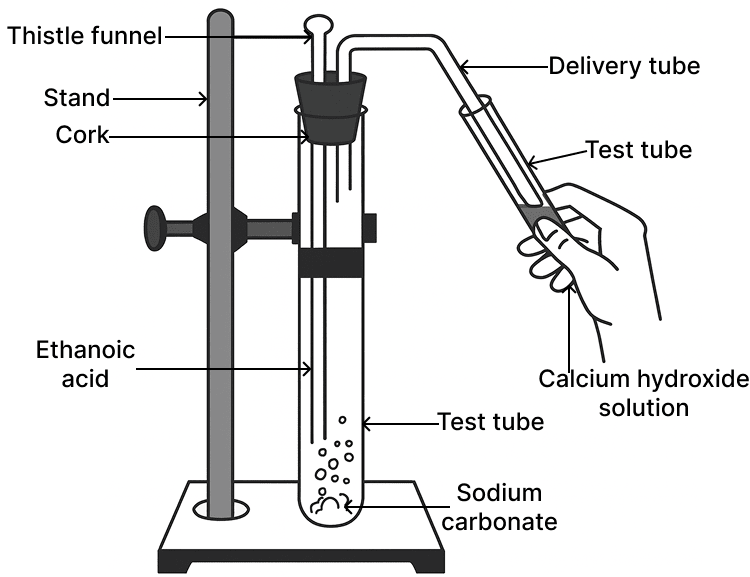
- CH4
- C2H6
- CO2
- SO2