
Chemistry
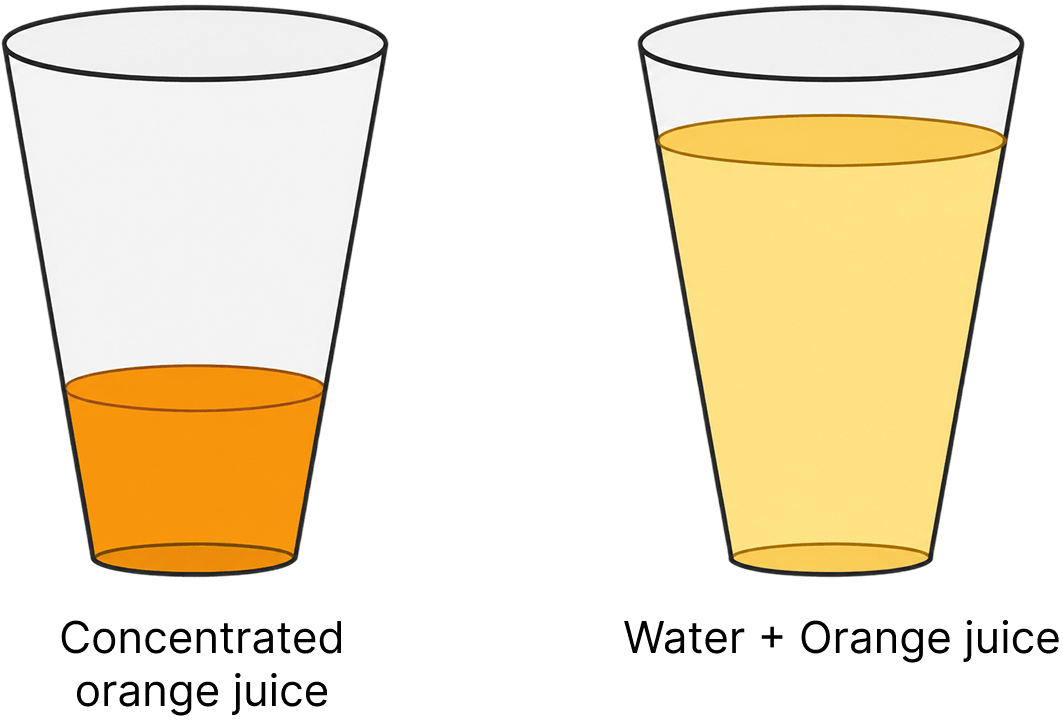
Sapna was making an orange flavoured drink. She poured 3-4 teaspoons of concentrated orange juice into a glass. She then added water until the glass was full and stirred it slowly.
(a) Explain how the orange juice spread into water.
(b) What is the effect of stirring?
(c) What is this intermixing of particles called? Name the type of substances which show this phenomenon the fastest.
(d) "There is no more movement in the liquid in the glass once the orange colour of the juice has stopped spreading."
Is this statement correct? Justify your answer.
Matter
13 Likes
Answer
(a) The particles of orange juice and water are constantly moving. Due to this random motion, the orange juice particles mix and spread throughout the water.
(b) Stirring increases the speed of mixing. It helps the orange juice particles spread faster in water.
(c) The intermixing of particles is called diffusion. Gases show diffusion the fastest.
(d) The statement is incorrect. Even when the orange colour stops spreading, the particles in the liquid are still moving continuously. The movement becomes uniform in all directions, so no visible change is seen.
Answered By
6 Likes
Related Questions
(a) Define interconversion of states of matter.
(b) Why do solids, liquids and gases differ in their physical state?
(c) Under what conditions do solids, liquids and gases change their state?
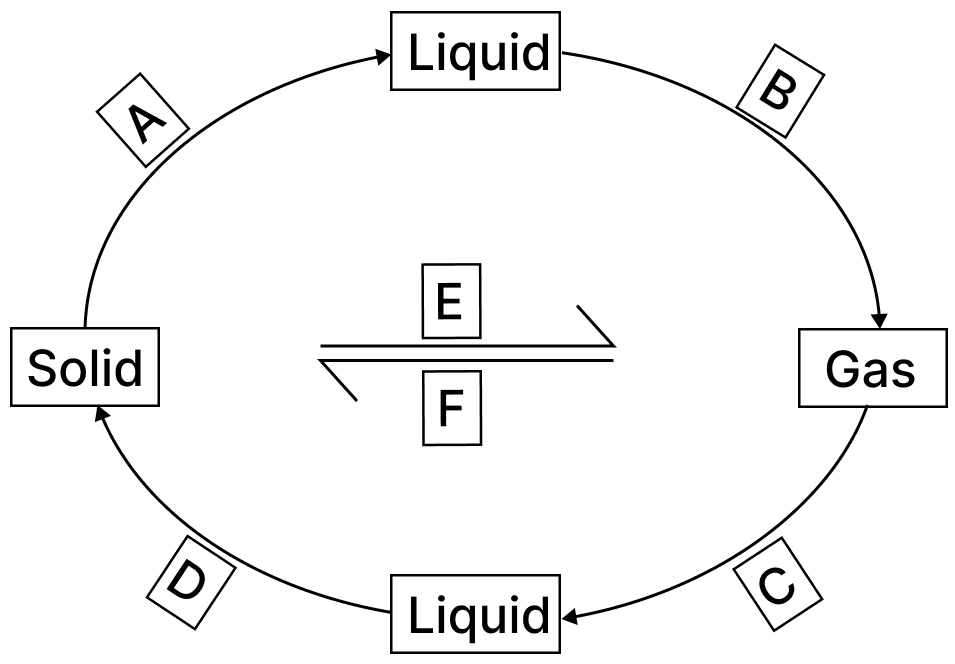
Name the processes marked as A, B, C, D, E, and F.
Give reasons:
When a stone is dipped in a glass containing some water, the level of water rises but when a spoon of sugar is added to it and stirred, the water level does not rise?
Give reasons:
A drop of ink added to water in a glass turns the whole water blue.