
Chemistry
(a) Define interconversion of states of matter.
(b) Why do solids, liquids and gases differ in their physical state?
(c) Under what conditions do solids, liquids and gases change their state?
Matter
52 Likes
Answer
(a) Interconversion of states of matter is the process by which matter changes from one state to another and back to its original state without any change in its chemical composition, when conditions are changed.
(b) Solids, liquids and gases differ in their physical state due to differences in intermolecular space, intermolecular force of attraction and the movement of their particles.
In solids, molecules are closely packed and the force of attraction is very strong. In liquids, molecules are less tightly packed and the force of attraction is weaker than in solids. In gases, molecules are far apart and the force of attraction is very weak.
(c) Solids, liquids and gases change their state by change in temperature or by applying pressure.
Answered By
28 Likes
Related Questions
Write your observation and conclusion for the following:
(a) A few marbles are put in a glass half filled with water.
(b) Ice is kept at room temperature.
State three main characteristics of the particles of matter.
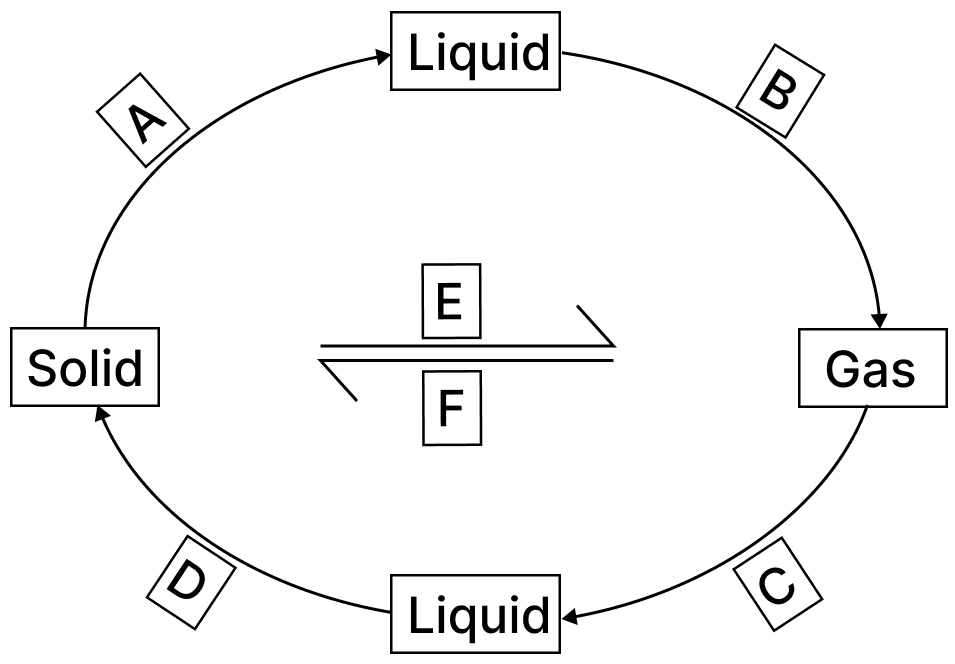
Name the processes marked as A, B, C, D, E, and F.
Give reasons:
When a stone is dipped in a glass containing some water, the level of water rises but when a spoon of sugar is added to it and stirred, the water level does not rise?