Mathematics
Show that the quadrilateral formed by joining the mid-points of the pairs of adjacent sides of a rhombus is a rectangle.

Mid-point Theorem
2 Likes
Answer
By mid-point theorem,
The line segment joining the mid points of any two sides of a triangle is parallel to the third side and is equal to half of it.
In △ABC,
Since, P and Q are the mid-points of AB and BC respectively.
PQ || AC
⇒ PQ = AC …(1)
In △ADC,
Since, S and R are the mid-points of AD and CD respectively.
SR || AC
⇒ SR = AC …(2)
From eq.(1) and (2), we have:
PQ = SR …(3)
In △ABD,
Since, P and S are the mid-points of AB and AD respectively.
PS || BD
⇒ PS = BD …(4)
In △BCD,
Since, Q and R are the mid-points of BC and CD respectively.
QR || BD
⇒ QR = BD …(5)
From eq.(4) and (5), we have:
PS = QR …(6)
From eq.(3) and (6), we have:
∴ PQRS is a parallelogram.
We know that,
Diagonals of rhombus intersect at right angles.
⇒ ∠EOF = 90°
In quadrilateral OERF,
ER || OF and EO || RF
∴ OERF is a parallelogram.
Opposite angles of a parallelogram are equal.
⇒ ∠EOF = ∠ERF = 90°
In parallelogram PQRS,
⇒ ∠QRS = ∠QPS = 90°
⇒ ∠PSR = ∠PQR = x (let)
∠QRS + ∠QPS + ∠PSR + ∠PQR = 360°
⇒ 90° + 90° + x + x = 360°
⇒ 180° + 2x = 360°
⇒ 2x = 360° - 180°
⇒ 2x = 180°
⇒ x =
⇒ x = 90°
⇒ ∠PSR = ∠PQR = 90°
Since, in parallelogram PQRS, opposite sides are equal and parallel and all the interior angles equal to 90°.
∴ PQRS is a rectangle.
Hence, proved that the quadrilateral formed by joining the mid-points of the pairs of adjacent sides of a rhombus is a rectangle.
Answered By
2 Likes
Related Questions
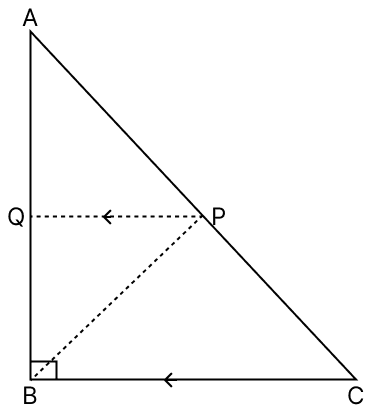
In the adjoining figure, △ABC is right-angled at B and P is the mid-point of AC. Show that, PA = PB = PC.
Show that the quadrilateral formed by joining the mid-points of the pairs of adjacent sides of a rectangle is a rhombus.

Show that the quadrilateral formed by joining the mid-points of the pairs of adjacent sides of a square is a square.
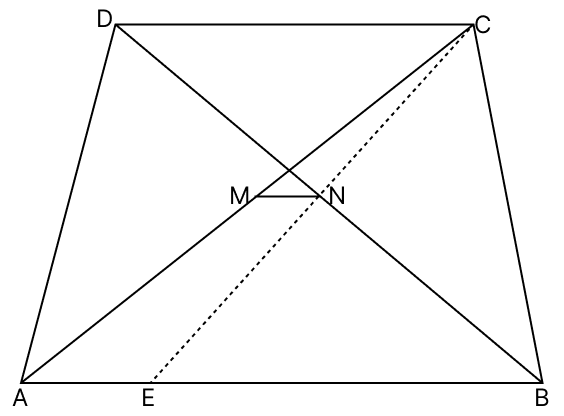
In the adjoining figure, ABCD is a trapezium in which AB || DC. If M and N are the mid-points of AC and BD respectively. Prove that MN = (AB - CD).