
Mathematics
Each side of a square ABCD is 12 cm. A point P lies on side DC such that area of △ ADP : area of trapezium ABCP = 2 : 3. Find DP.
Mensuration
1 Like
Answer
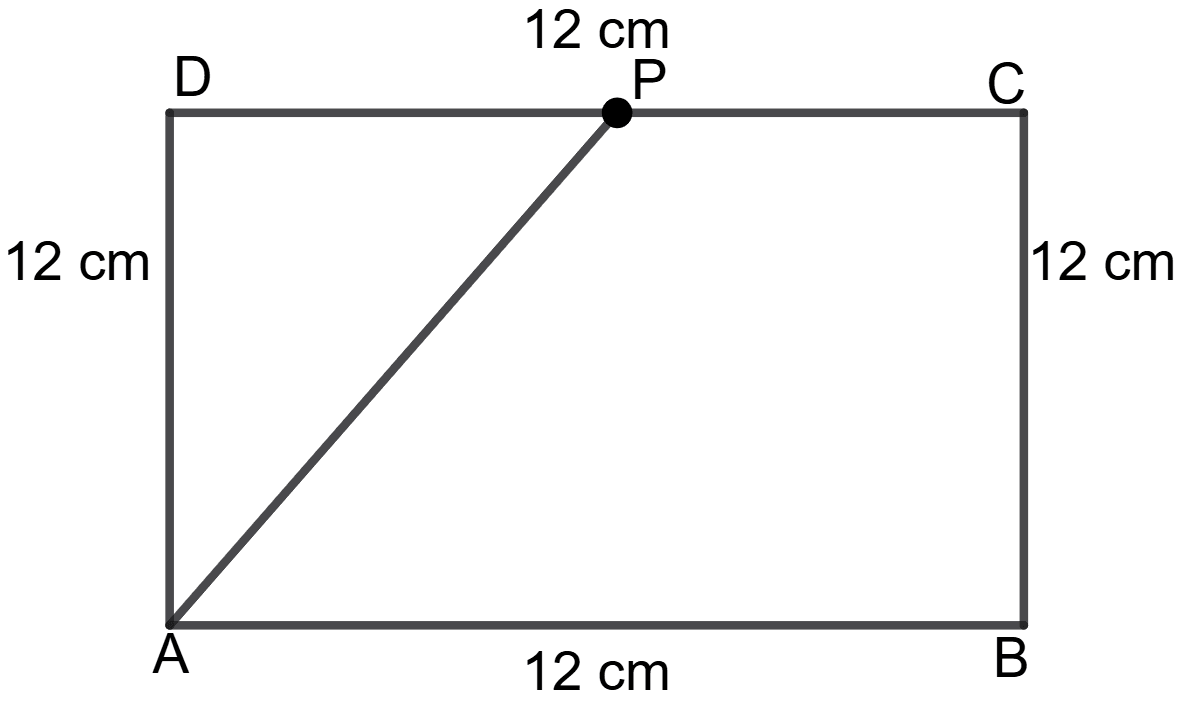
Given: AB = BC = CD = DA = 12 cm
Area of △ ADP : Area of trapezium ABCP = 2 : 3
Area of triangle = x base x height
Area of △ ADP = x DP x AD
= x DP x 12
Area od trapezium = x (sum of parallel sides) x height
Area of trapezium ABCP = x (AB + PC) x BC
= x (12 + PC) x 12
Now, substituting the values:
From figure, DC = DP + PC
⇒ 12 = DP + PC
⇒ PC = 12 - DP
Substituting this value,
Hence, the length of DP = 9.6 cm.
Answered By
1 Like
Related Questions
ABC and BDE are two equilateral triangles such that D is the mid-point of BC. If AB = 20 cm, find the area of the shaded portion. [Take √3 = 1.73]
![ABC and BDE are two equilateral triangles such that D is the mid-point of BC. If AB = 20 cm, find the area of the shaded portion. [Take √3 = 1.73]. Chapterwise Revision (Stage 2), Concise Mathematics Solutions ICSE Class 9.](https://cdn1.knowledgeboat.com/img/cm9/q100-chapterwise-revision-stage-2-maths-concise-icse-class-9-solutions-715x802.png)
Find the area and the perimeter of the following figure.
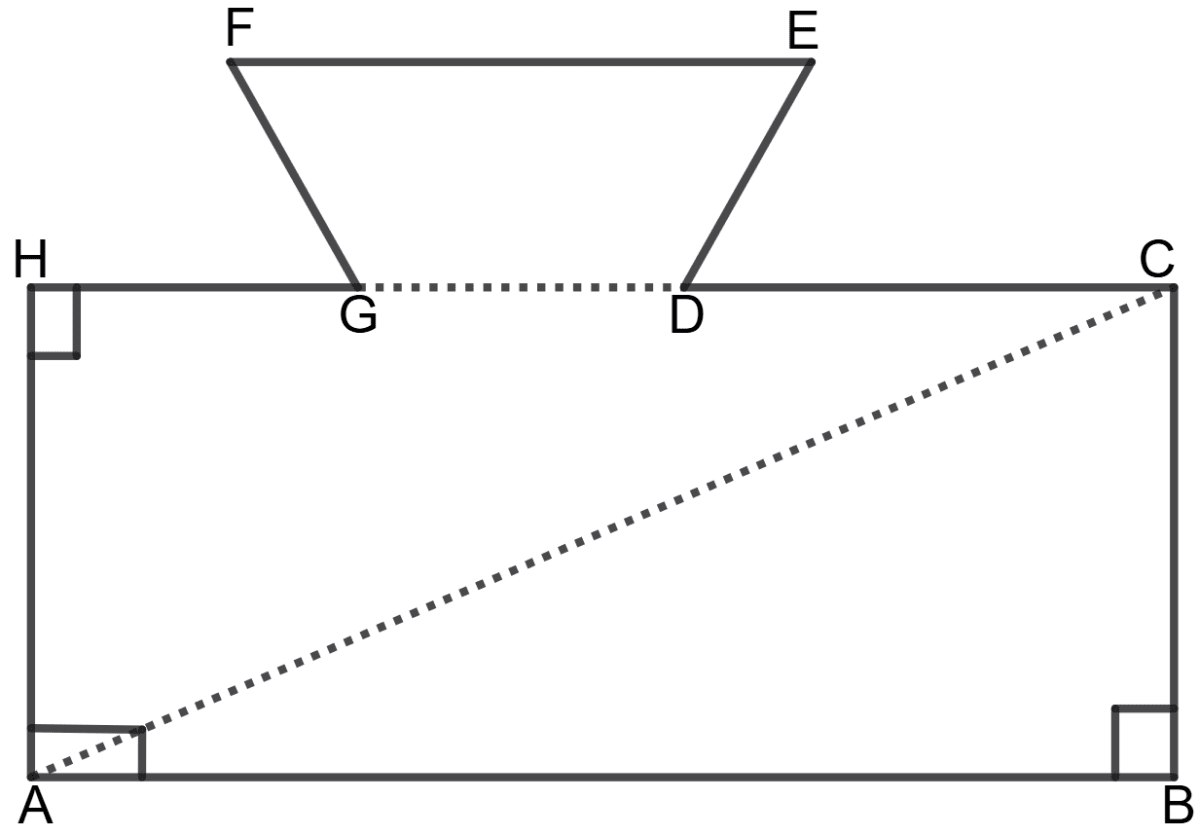
Given : AB = 12 cm, AC = 13 cm, DE = FG = 5 cm, EF = 10 cm and GD = 4 cm.
In a pentagon ABCDE, DP is drawn perpendicular to AB and is perpendicular to CE also at point Q. If AP = BP = 12 cm, EQ = CQ = 8 cm, DE = DC = 10 cm and DP = 18 cm, find the area of the pentagon ABCDE.
A rectangular park has dimensions 240 m by 200 m. A circular lawn is made inside the park. If the area of the park excluding the lawn is 32600 sq m, find the circumference of the lawn.