
Mathematics
A solid sphere is cut into two identical hemispheres.
Assertion (A): The total volume of two hemispheres is equal to the volume of the original sphere.
Reason (R): The total surface area of two hemispheres together is equal to the surface area of the original sphere.
(A) is true, (R) is false.
(A) is false, (R) is true.
Both (A) and (R) are true and (R) is the correct explanation of (A).
Both (A) and (R) are true, but (R) is not the correct explanation of (A).
Mensuration
24 Likes
Answer
By formula,
Volume of sphere =
Given,
A solid sphere is cut into two identical hemispheres.
Volume of hemisphere =
Volume of two identical hemispheres =
=
Thus, volume of a sphere = volume of two identical hemispheres.
So assertion (A) is true.
We know that,
Surface area of sphere = 4πr2
When a sphere is cut into two hemispheres, two new flat circular surfaces are created,
Surface area of a single hemisphere = Curved surface area + Area of its flat circular face
= 2πr2 + πr2
= 3πr2
Total surface area of two hemispheres = 2 × 3πr2 = 6πr2.
Thus, surface area of a single hemisphere ≠ surface area of two hemispheres.
So reason (R) is false.
(A) is true, (R) is false.
Hence, option 1 is the correct option.
Answered By
14 Likes
Related Questions
In the given diagram, the radius of the circle with centre O is 3 cm. PA and PB are the tangents to the circle which are at right angle to each other. The length of OP is:
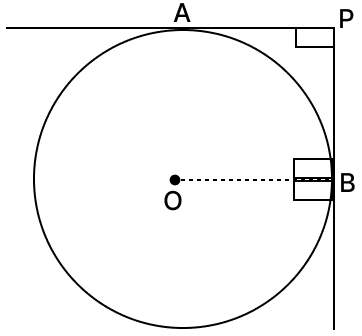
cm
3 cm
cm
cm
Assertion (A): If sec θ + tan θ = a and sec θ − tan θ = b then ab = 1.
Reason (R): sec2 θ - tan2 θ = 1
(A) is true and (R) is false.
(A) is false and (R) is true.
Both (A) and (R) are true and (R) is the correct explanation of (A).
Both (A) and (R) are true, but (R) is not the correct explanation of (A).
Given that the sum of the squares of the first seven natural numbers is 140, then their mean is :
20
70
280
980
A bag contains 3 red and 2 blue marbles. A marble is drawn at random. The probability of drawing a black marble is :
0