
Mathematics
By splitting the following figures into rectangles, find their areas (The measures are given in centimetres).
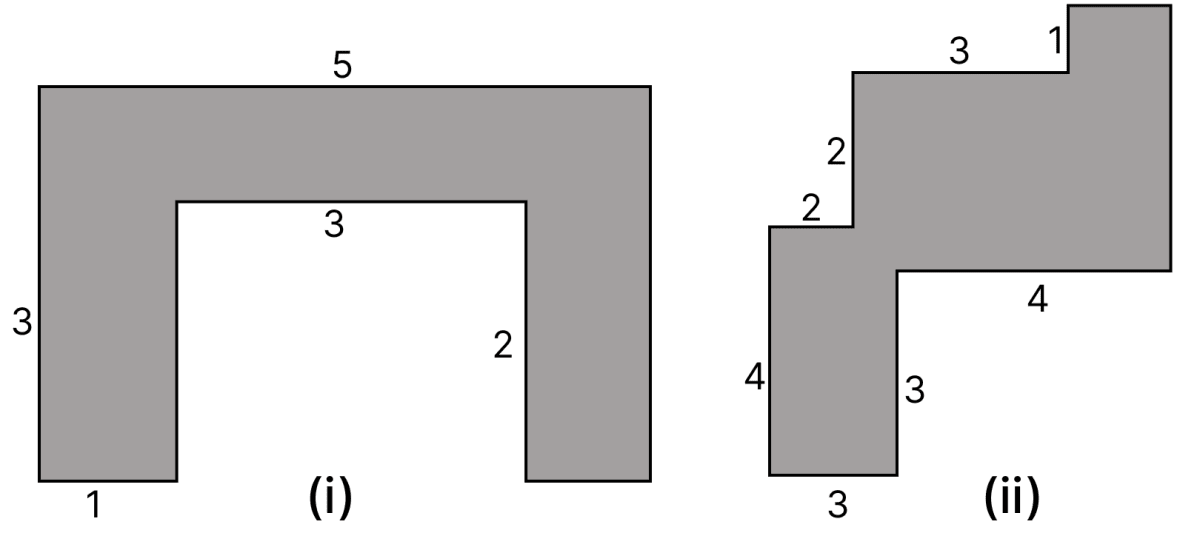
Mensuration
2 Likes
Answer
(i) Splitting the U-shape figure into three rectangles:
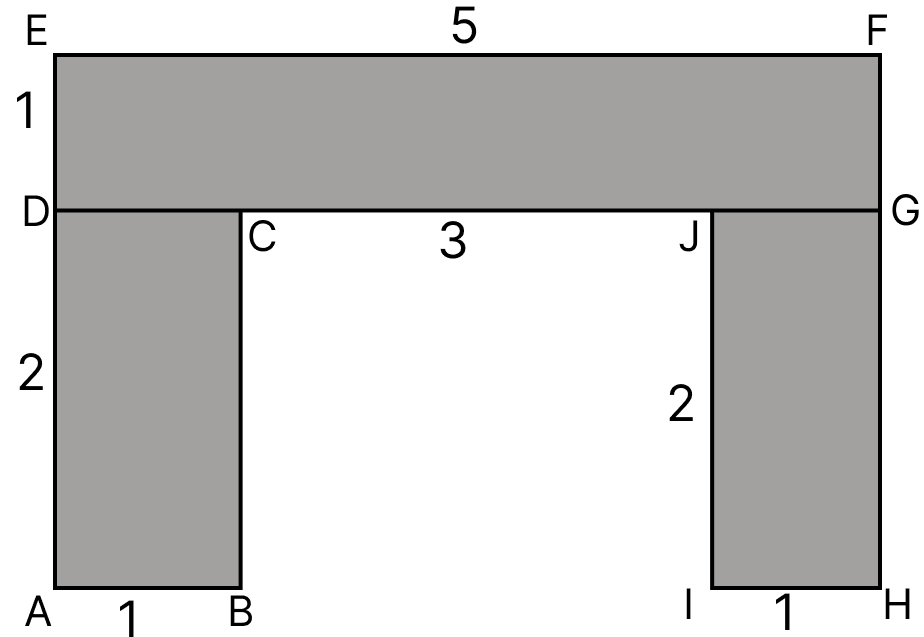
Rectangle DEFG: length = 5 cm, breadth = 1 cm
Area = 5 × 1 = 5 sq. cm
Rectangle JIHG: length = 2 cm, breadth = 1 cm
Area = 2 × 1 = 2 sq. cm
Rectangle ABCD: length = 2 cm, breadth = 1 cm
Area = 2 × 1 = 2 sq. cm
Total area of figure (i) = 5 + 2 + 2
= 9 sq. cm
Hence, the area of figure (i) is 9 sq. cm.
(ii) Splitting the figure:
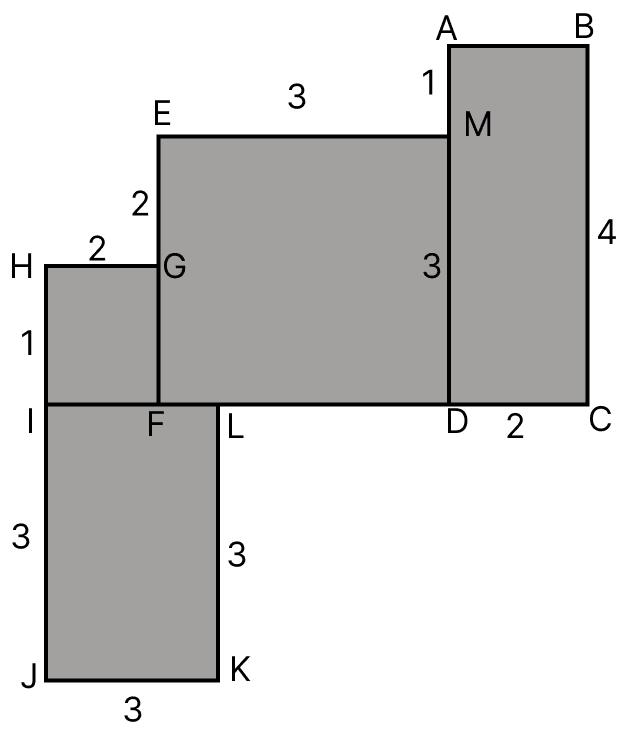
As, LC = 4 and EM = 3 = FD = LF + LD
IF + FL = JK = 3
HG = IF = 2
2 + FL = 3
Therefore, FL = 1
Now, LC = 4, FL + LD = 3
LD = 2
LD + DC = 4
2 + DC = 4
DC = 2
Rectangle ABCD: length = 2 cm, breadth = 4 cm
Area = 2 × 4 = 8 sq. cm
Rectangle HIGF: length = 2 cm, breadth = 1 cm
Area = 2 × 1 = 2 sq. cm
Square MEFD: length = 3 cm, breadth = 3 cm
Area = 3 × 3 = 9 sq. cm
Rectangle IJKL: length = 3 cm, breadth = 3 cm
Area = 3 × 3 = 9 sq. cm
Total area of figure (ii) = 8 + 2 + 9 + 9
= 28 sq. cm
Hence, the area of figure (ii) is 28 sq. cm.
Answered By
1 Like
Related Questions
If the cost of fencing a square plot at the rate of ₹ 30 per metre is ₹ 2400, then find the length of each side of the field.
If the cost of fencing a rectangular park at the rate of ₹ 30 per metre is ₹ 2400 and the length of the park is 24 m, find the breadth of the park.
How many envelopes of size 25 cm × 15 cm can be made from a rectangular sheet of size 4 m × 1.2 m?
The perimeter of a rectangle is 36 cm. What will be length and breadth (in natural numbers) of that rectangle whose area is
(i) maximum?
(ii) minimum?