Mathematics
State which of the following statements are true and which are false:
(i) A triangle can have two right angles.
(ii) A triangle cannot have more than one obtuse angle.
(iii) A triangle has at least two acute angles.
(iv) If all the three sides of a triangle are equal, it is called a scalene triangle.
(v) A triangle has four sides.
(vi) An isosceles triangle is an equilateral triangle also.
(vii) An equilateral triangle is an isosceles triangle also.
(viii) A scalene triangle has all its angles equal.
Triangles
3 Likes
Answer
(i) False
Reason — The sum of angles of a triangle is 180°. If a triangle had two right angles, their sum alone would be 180°, leaving 0° for the third angle, which is not possible.
(ii) True
Reason — If a triangle had two obtuse angles (each greater than 90°), their sum alone would exceed 180°, which violates the angle sum property.
(iii) True
Reason — Since the sum of angles of a triangle is 180°, a triangle can have at most one angle that is right or obtuse. So at least two angles must be acute.
(iv) False
Reason — If all three sides of a triangle are equal, it is called an equilateral triangle, not a scalene triangle.
(v) False
Reason — A triangle has three sides, not four.
(vi) False
Reason — An isosceles triangle has only two sides equal, so it is not necessarily an equilateral triangle (which has all three sides equal).
(vii) True
Reason — An equilateral triangle has all three sides equal, which means it has at least two equal sides. So it is also an isosceles triangle.
(viii) False
Reason — A scalene triangle has all sides of different lengths, so all its angles are also different (not equal).
Answered By
2 Likes
Related Questions
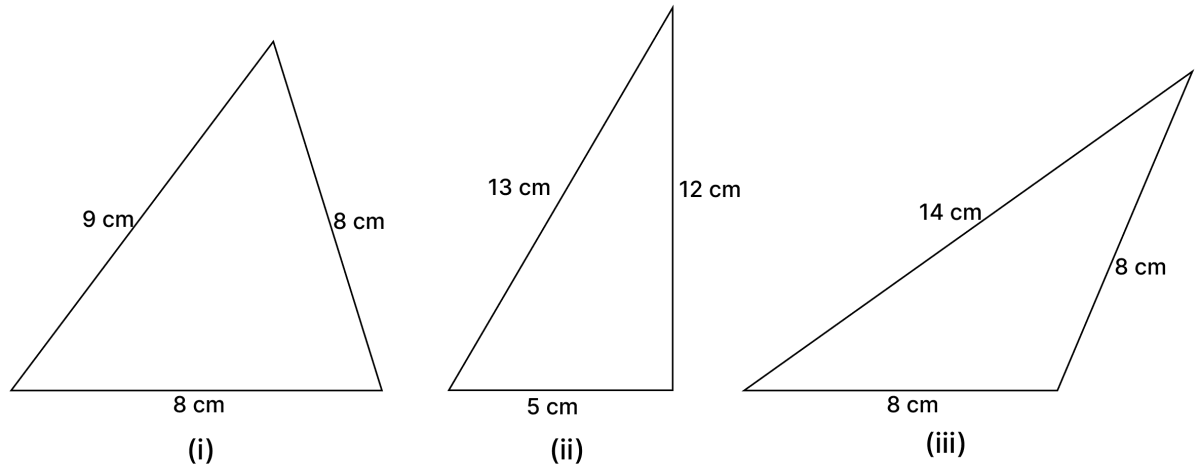
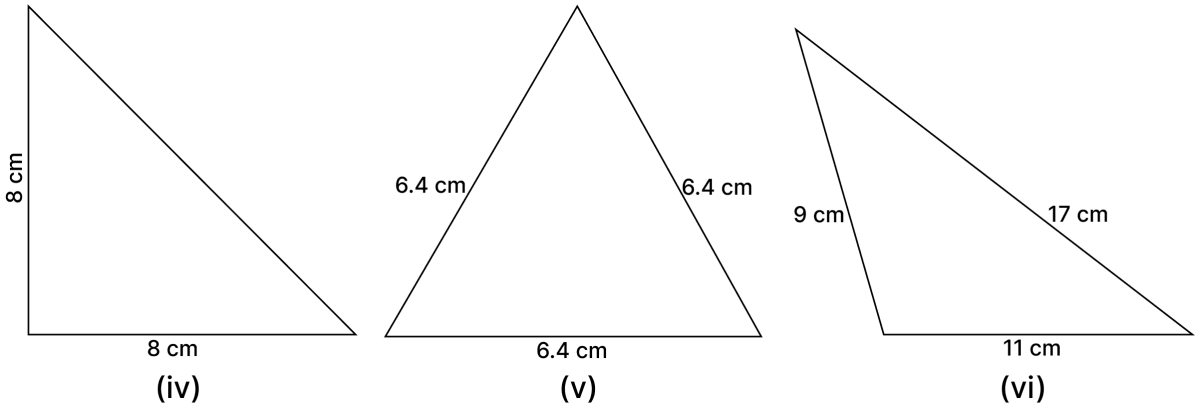
Name each of the following triangles in two different ways (you may judge the nature of the angle by observation):
Match the following:
Measures of triangles Types of triangles (i) 3 sides of equal length (a) Scalene (ii) 2 sides of equal length (b) Isosceles right-angled (iii) all sides of different length (c) Obtuse-angled (iv) 3 acute angles (d) Right-angled (v) 1 right angle (e) Equilateral (vi) 1 obtuse angle (f) Acute-angled (vii) 1 right angle with two sides of equal length (g) Isosceles State whether the following statements are true (T) or false (F):
(i) Each angle of a rectangle is a right angle.
(ii) The opposite sides of a rectangle are equal in length.
(iii) The diagonals of a square are perpendicular to one another.
(iv) All sides of a rhombus are equal in length.
(v) All sides of a parallelogram are equal in length.
(vi) The opposite sides of a trapezium are parallel.
(vii) The diagonals of a parallelogram are equal.
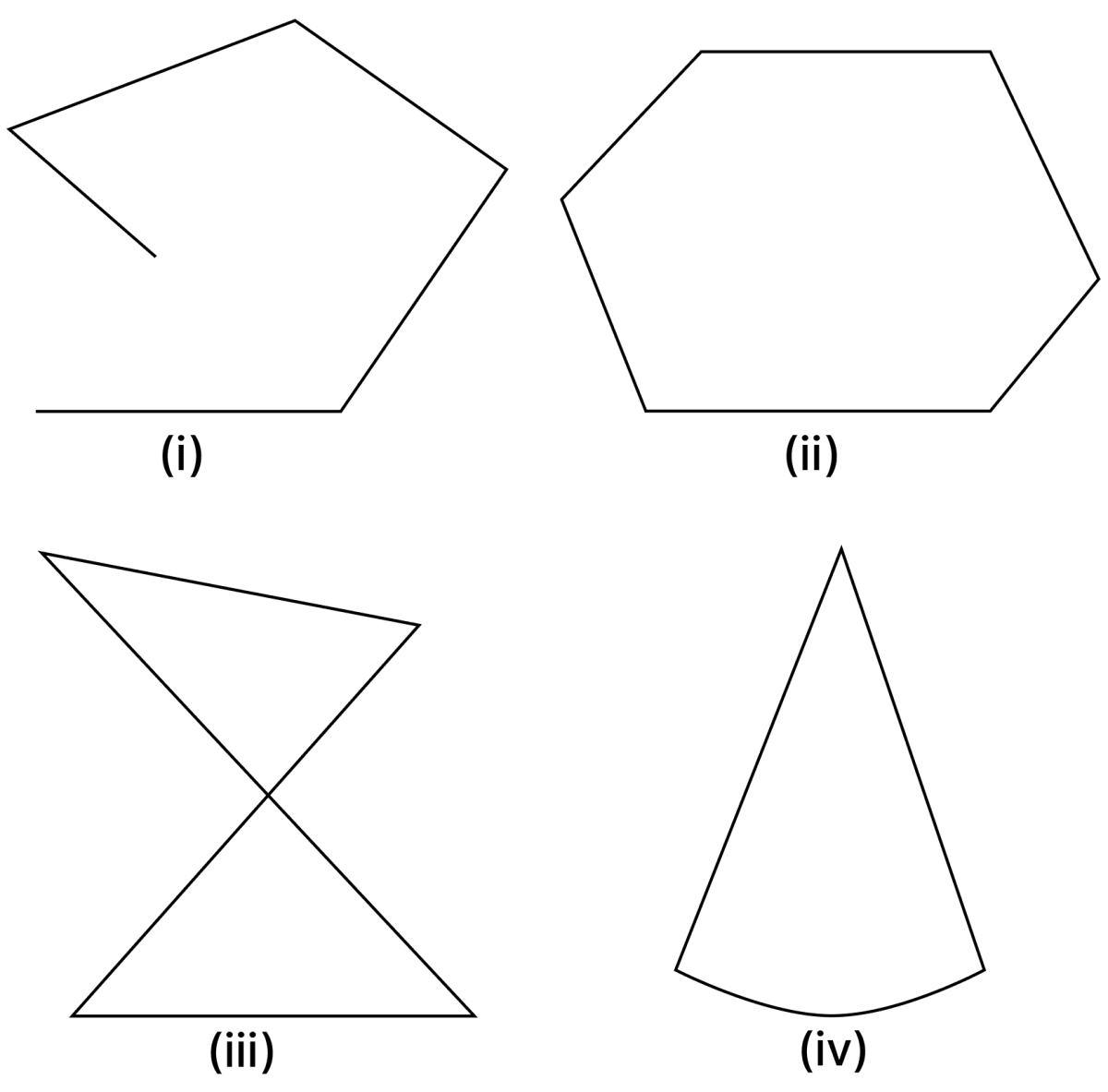
Examine whether the following figures are polygons. Give reasons.