Physics
State how are the two resistors joined with a battery in each of the following cases when —
(a) same current flows in each resistor,
(b) potential difference is same across each resistor,
(c) equivalent resistance is less than either of the two resistances,
(d) equivalent resistance is more than either of the two resistances.
Answer
(a) When same current flows in each resistor, then the two resistors are joined in series
(b) When potential difference is same across each resistor, then the two resistors are joined in parallel
(c) When equivalent resistance is less than either of the two resistances, then the two resistors are joined in parallel
(d) When equivalent resistance is more than either of the two resistances, then the two resistors are joined in series
Related Questions
Assertion (A): The terminal voltage of a cell is always less than its e.m.f.
Reason (R): More the current drawn from the cell, the less is the terminal voltage.
- Both A and R are true and R is the correct explanation of A.
- Both A and R are true and R is not the correct explanation of A.
- assertion is false but reason is true.
- assertion is true but reason is false.
Write the expressions for the equivalent resistance R of three resistors R1, R2 and R3 joined in (a) parallel, (b) series.
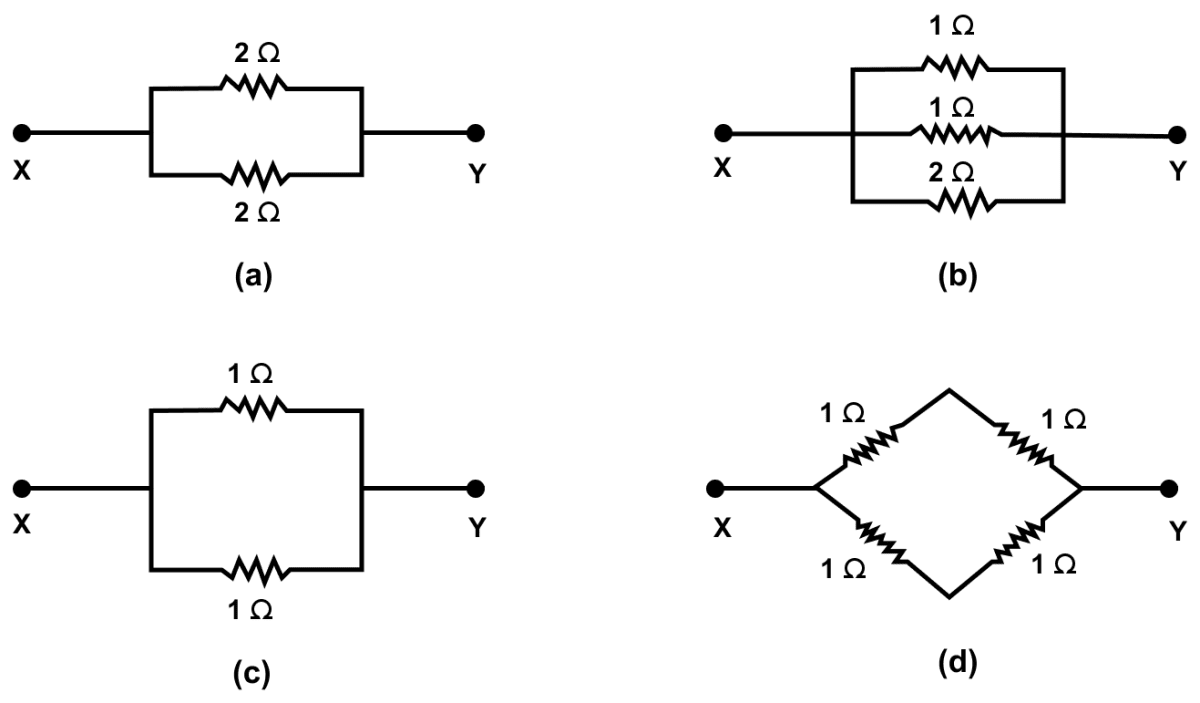
Which of the following combinations have the same equivalent resistance between X and Y?
State two differences between the e.m.f. and terminal voltage of a cell.