
Mathematics
Statement 1: The diagonals of a quadrilateral are perpendicular to each other; P, Q, R and S are the midpoints of sides AB, BC, CD and DA respectively. Then PQRS will be a rectangle.
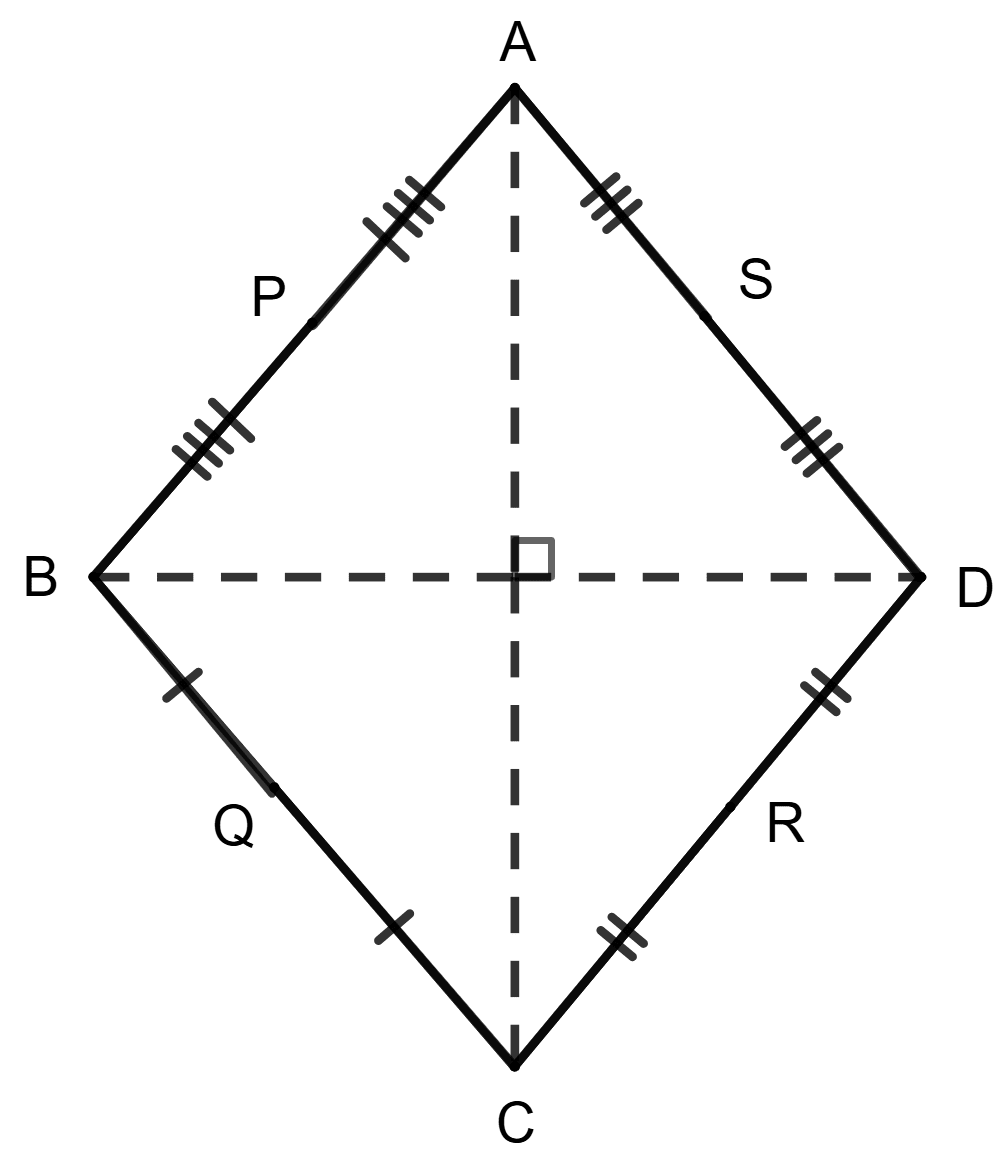
Statement 2: Quadrilateral PQRS will be a square as each of its angles will be 90°.
Both the statements are true.
Both the statements are false.
Statement 1 is true, and statement 2 is false.
Statement 1 is false, and statement 2 is true.
Mid-point Theorem
2 Likes
Answer
From figure,
PA = PB ⇒ P is mid-point of AB
SA = SD ⇒ S is mid-point of AD
BQ = CQ ⇒ Q is mid-point of BC
CR = RD ⇒ R is mid-point of CD
So, statement 1 is true.
By mid-point theorem,
The line segment joining the mid-points of any two sides of a triangle is parallel to the third side and is equal to half of it.
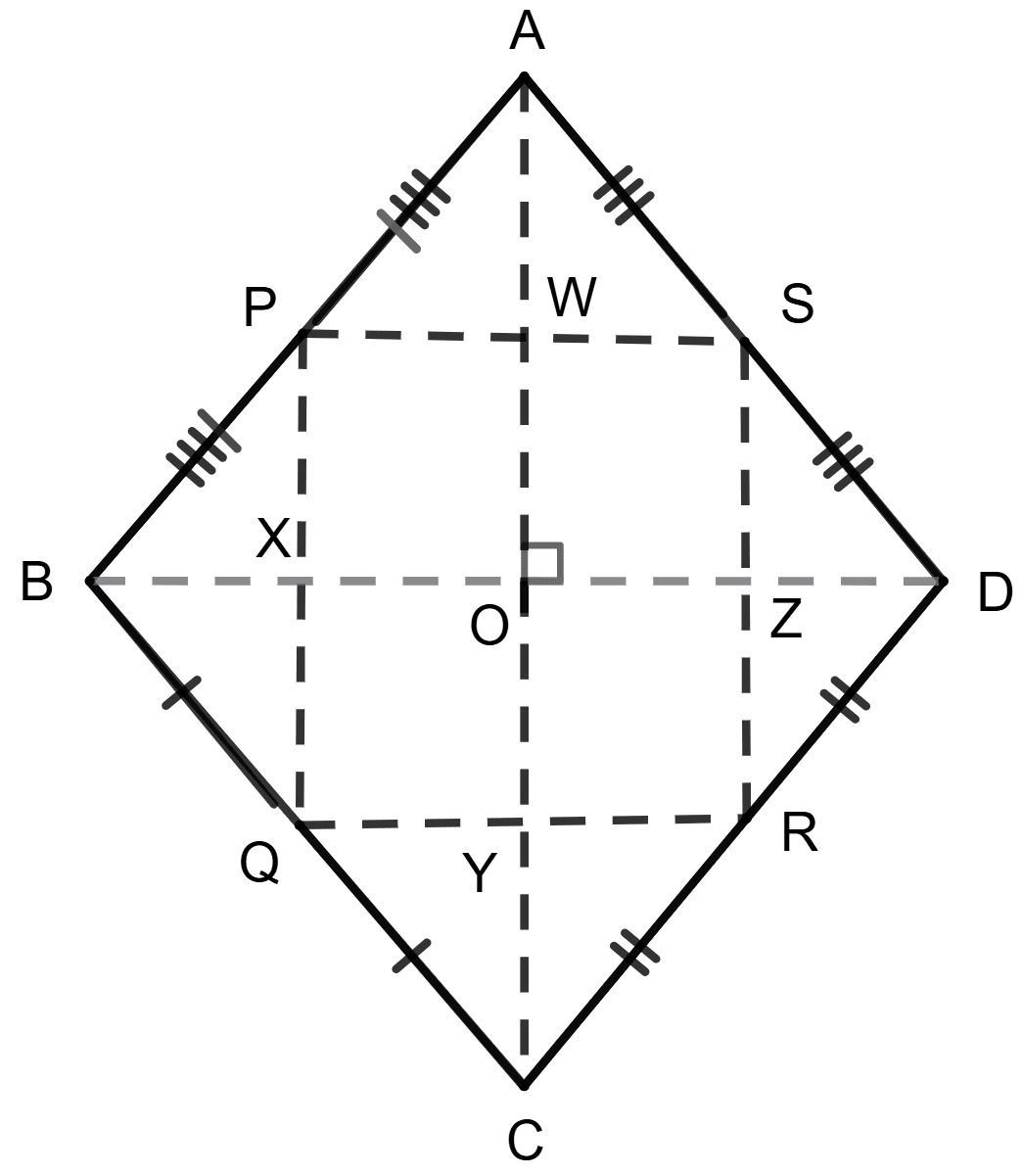
In △ ABC,
P and Q are mid-points of AB and BC respectively.
⇒ PQ = AC and PQ || AC. [By mid-point theorem] …………….(1)
In △ ADC,
S and R are mid-points of AD and CD respectively.
⇒ SR = AC and SR || AC. [By mid-point theorem] ……………..(2)
From (1) and (2), we get :
PQ = SR and PQ || SR.
In △ BCD,
R and Q are mid-points of CD and BC respectively.
⇒ QR = BD and QR || BD. [By mid-point theorem] ……………..(3)
In △ ABD,
S and P are mid-points of AD and AB respectively.
⇒ PS = BD and PS || BD. [By mid-point theorem] ……………..(4)
From (3) and (4), we get :
QR = PS and QR || PS.
Since, diagonals of quadrilateral intersect at right angle.
∴ ∠AOD = ∠COD = ∠AOB = ∠BOC = 90°.
From figure,
PQ || AC
∴ ∠PXO = ∠AOD = 90° (Corresponding angles are equal)
∴ ∠QXO = ∠COD = 90° (Corresponding angles are equal)
SR || AC
∴ ∠SZO = ∠AOB = 90° (Corresponding angles are equal)
∴ ∠RZO = ∠BOC = 90° (Corresponding angles are equal)
PS || BD
∴ ∠S = ∠RZO = 90° (Corresponding angles are equal)
∴ ∠P = ∠QXO = 90° (Corresponding angles are equal)
QR || BD
∴ ∠R = ∠SZO = 90° (Corresponding angles are equal)
∴ ∠Q = ∠PXO = 90° (Corresponding angles are equal)
Since, in quadrilateral PQRS,
Each interior angle is equal to 90° and opposite sides are parallel and equal, and we can prove that PQRS is a rectangle but cannot prove that all sides are equal thus we cannot prove that it is a square.
∴ Statement 1 is true, and statement 2 is false.
Hence, option 3 is the correct option.
Answered By
3 Likes
Related Questions
In the given figure, AB || CD || EF and E is the mid-point of side AD, then :
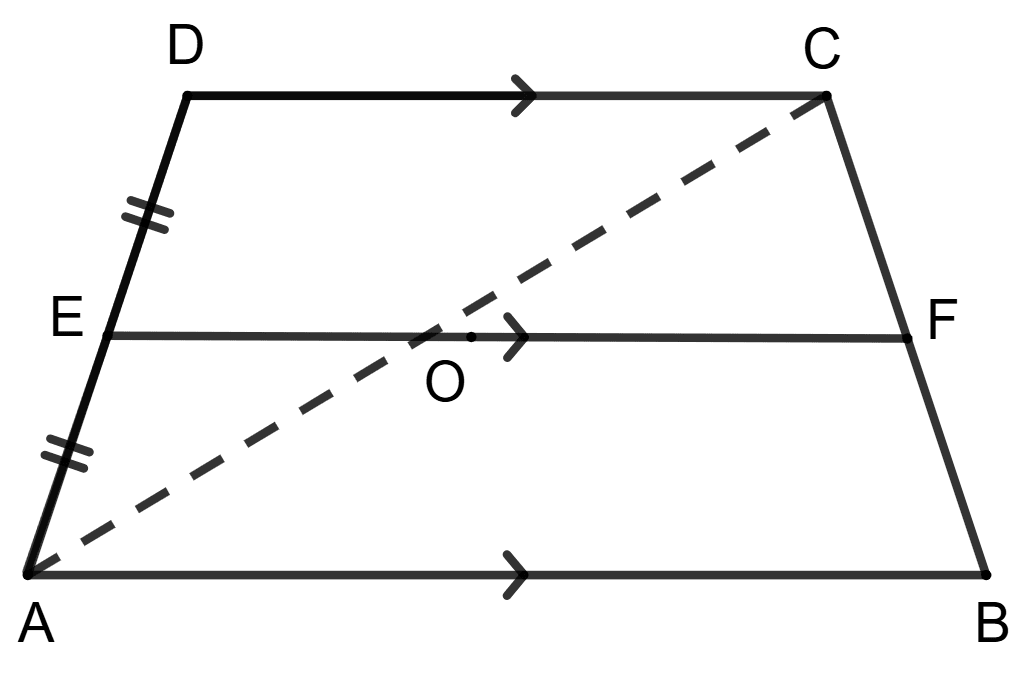
OE : OF = 1 : 3
OE = OF
OF = 2 x OE
CF = FB
In rhombus PQRS; A, B and C are mid-points of sides PQ, QR and RS respectively. If ∠P = 60°, the angle PQR is equal to:
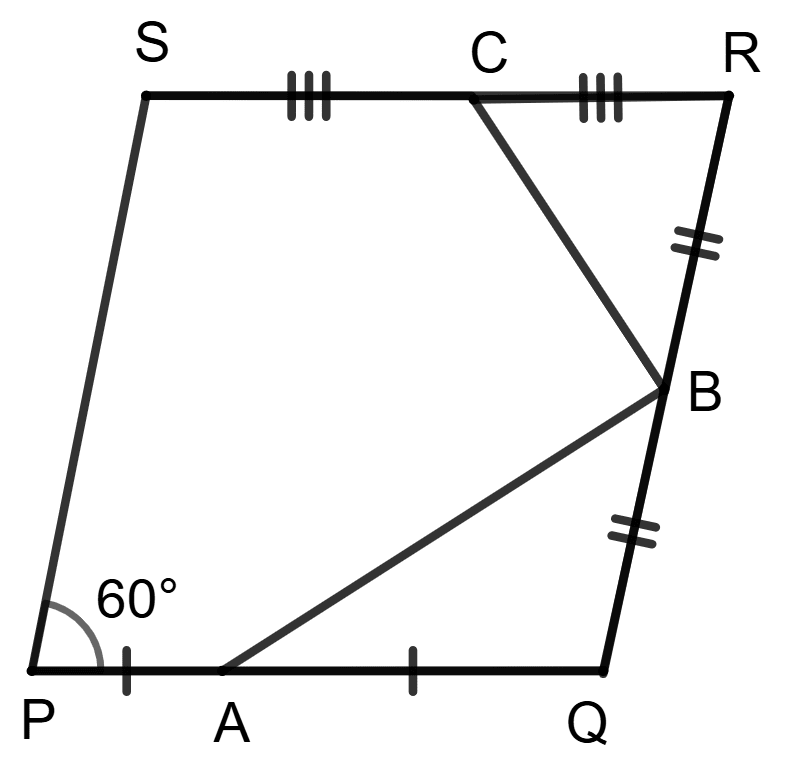
60°
90°
120°
none of these
Statement 1: AD is median of triangle ABC and DE is parallel to BA. Then DE will bisect AC.
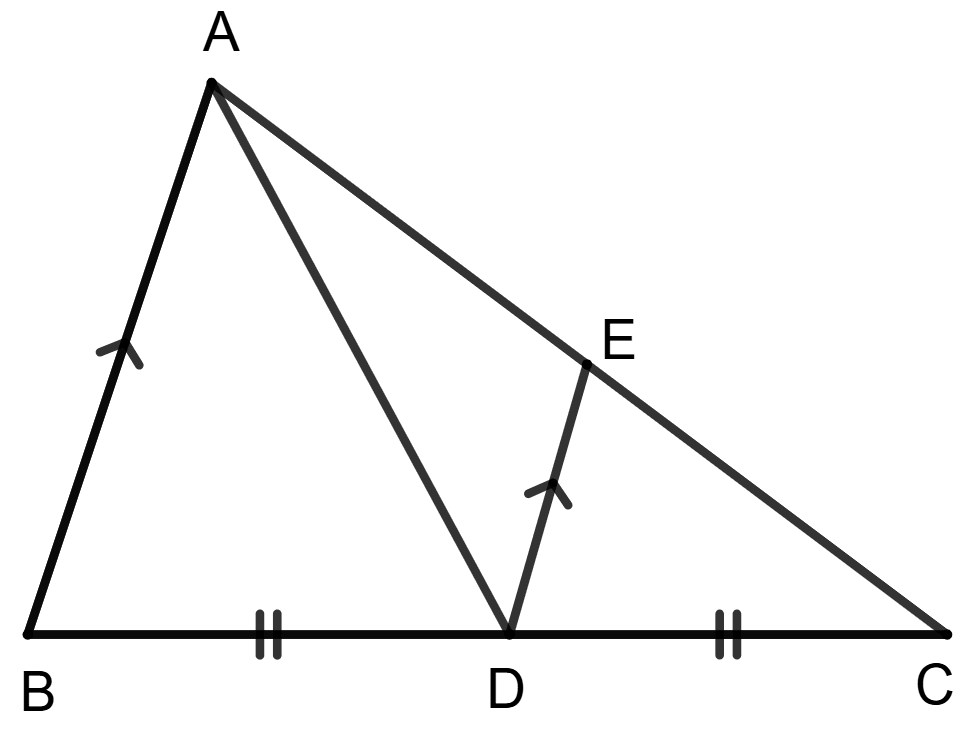
Statement 2: DE is median of triangle ADC.
Both the statements are true.
Both the statements are false.
Statement 1 is true, and statement 2 is false.
Statement 1 is false, and statement 2 is true.
Assertion (A): The figure formed by joining the mid-points of the sides of a quadrilateral ABCD is a square.
Reason (R): Diagonals of quadrilateral ABCD are not equal and are not perpendicular to each other.
A is true, but R is false.
A is false, but R is true.
Both A and R are true, and R is the correct reason for A.
Both A and R are true, and R is the incorrect reason for A.