
Science
A student needs to make a 0.12 Ω resistor. She has some copper wire of 0.80 mm diameter. Resistivity of copper is 1.8 × 10⁻⁸ Ωm
(a) Determine the cross-sectional area of the wire.
(b) Calculate the length of wire required for the 0.12 Ω resistor
Current Electricity
4 Likes
Answer
Given,
- Resistance () = 0.12 Ω
- Diameter of the wire () = 0.80 mm = 0.80 x 10⁻³ m
- Resistivity of copper () = 1.8 × 10⁻⁸ Ωm
(a) Area of cross-sectional () is given by,
Thus, the cross-sectional area is approximately 5.02 x 10⁻⁷ m2.
(b) Let length of the conductor be ''.
Now, resistance (R) of the wire is given by,
On putting values,
The student needs a length of approximately 3.34 m of given copper wire to make a 0.12 Ω resistor.
Answered By
2 Likes
Related Questions
The below image shows a corrective measure for a particular defect of vision.

(a) Identify the defect of vision and state what kind of lens is used to correct this deficiency.
(b) Draw and label a ray diagram that shows the defect of vision in the above case before correction.
(a) What is dispersion of light?
(b) Explain the condition under which dispersion happens?
(c) Give one reason that causes presbyopia.
Magnetic field lines are shown in the given diagram. A student makes a statement that the magnetic field at X is stronger than at Y.

(a) Explain with reason if the student’s claim is correct.
(b) Also redraw the diagram and mark the direction of magnetic field lines.
The below image is that of a Digital Single Lense Reflector (DSLR) Camera which are used to take high resolution photographs by professional photographers. The second image of the below two is a schematic diagram of how an image is formed on the sensor of the camera. Based on your understanding of the lenses, answer the following questions.
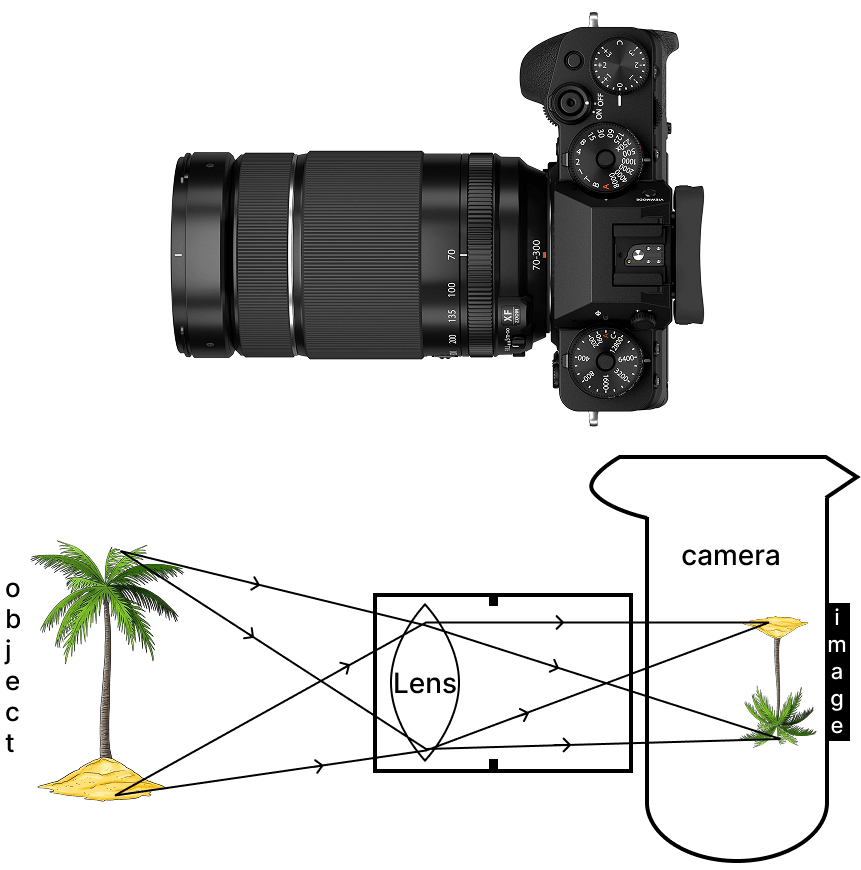
(a) What type of lens is used in the DSLR camera shown in the image?
(b) What type of image is formed on the sensor?
Attempt either subpart C or D.
(c) A photographer is using a DSLR camera with a lens of focal length f = 50 mm to take a close-up photograph of a small object. The lens projects an image onto the camera sensor that is located 60 mm behind the lens. Calculate the object distance (i.e., the distance between the object and the lens).
OR
(d) A photographer is using a DSLR camera to take a picture of a flower. The flower is positioned 150 mm away from the camera lens. The actual height of the flower is 80 mm, and the image height formed on the camera’s sensor is measured to be 20 mm. Calculate the focal length of the camera lens.