
Physics
Study the diagram and answer the questions that follow.
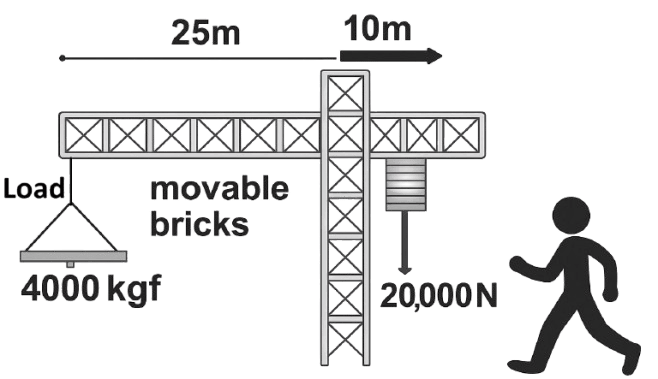
(a) In the diagram, is the worker attempting to raise or lower the load?
(b) Justify your answer to (a) with the necessary calculation.
Force
32 Likes
Answer
(a) Worker is attempting to lower the load.
(b) For rotational equilibrium about the fulcrum,
Clockwise Moment = Anticlockwise Moment
Assuming 1 kgf ≈ 9.8 N, we convert W1 = 4000 kgf ≈ 4000 x 9.8 = 39,200 N
- Moment due to Load (anticlockwise) :
M1 = W1 d1 = 39,200 x 25 = 980,000 Nm - Moment due to Worker’s Force (clockwise) :
M2 = F2 x d2 = 20,000 x 10 = 200,000 Nm
The clockwise moment (200,000 Nm) is much less than the anticlockwise moment (980,000 Nm). Their applied force is insufficient to raise the load, so that worker will lower the load.
Answered By
19 Likes
Related Questions
Seismic waves have different frequencies. During earthquakes, why are short-length buildings more prone to damage caused by high-frequency seismic waves?
Will the centre of gravity of a hollow sphere filled half with mercury and half with oil be identical to that of an empty hollow sphere? Give reasons for your answer.
The graph shows load against effort for a lever with load and effort on the same side of the fulcrum.
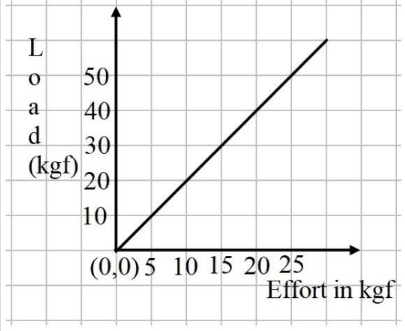
(a) Which feature of the load and effort graph must be calculated to determine mechanical advantage?
(b) Which class does this lever belong to?
(a) Convert to SI unit: 1 J/g °F
(b) Why does 1 g of water at 0°C have 336 J more heat energy than 1 g of ice at 0°C?