
Physics
Study the diagram and answer the questions that follow:
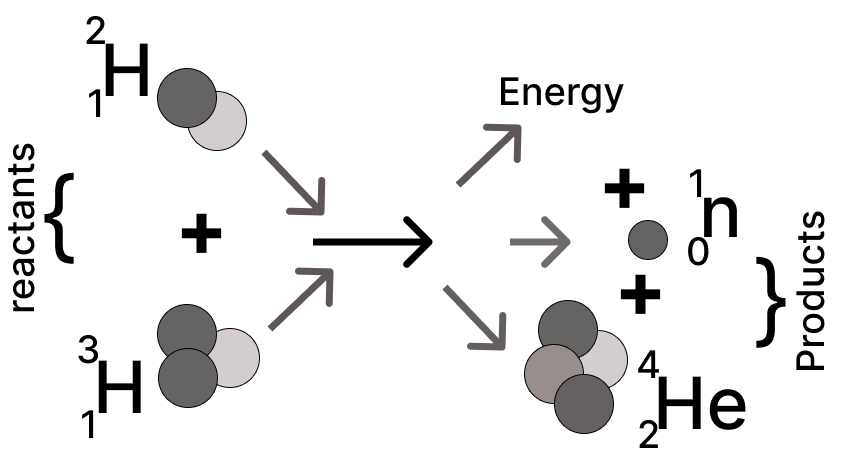
(a) Name the nuclear process displayed in the diagram.
(b) Is it possible to conduct this process at room temperature?
(c) Mass of reactants …………… mass of the products.
[Fill in the blank using <, > or =]
Radioactivity
6 Likes
Answer
(a) Nuclear fusion.
(b) No, it is not possible to conduct nuclear fusion at room temperature because when two nuclei approach, each other, due to their positive charge, the electrostatic force of repulsion between them becomes so strong that they do not fuse. Hence to make the fusion possible, a high temperature (≈ 107 K) and high pressure is required.
(c) Mass of reactants > mass of the products.
Reason : The sum of masses of the product nuclei is less than the sum of mass of the parent nucleus because this loss in mass is converted into energy according to Einstein's mass-energy relation.
Answered By
5 Likes
Related Questions
The diagram below displays four solid plastic balls attached to wires, all mounted on a wooden base. When a person shakes the wooden base back and forth at a steady pace, the balls begin to vibrate as well. It is noted that while all the balls vibrate, only one of them vibrates vigorously.
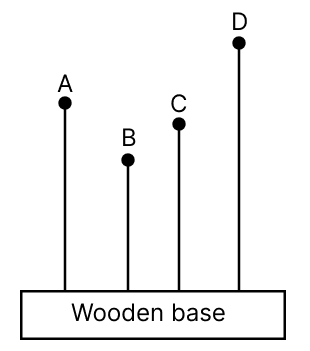
(a) Explain why only one ball vibrates vigorously.
(b) If fA, fB, fC, and fD are the natural frequencies of vibration of the wires, then arrange them in the increasing order of their frequencies and justify.
The diagram given below shows a bulb connected by dual control switches. Observe the diagrams and answer the questions that follow.
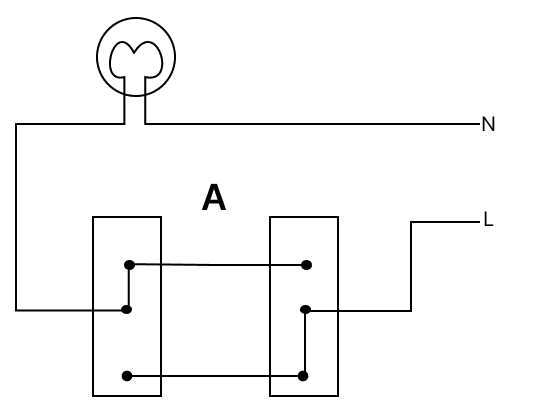
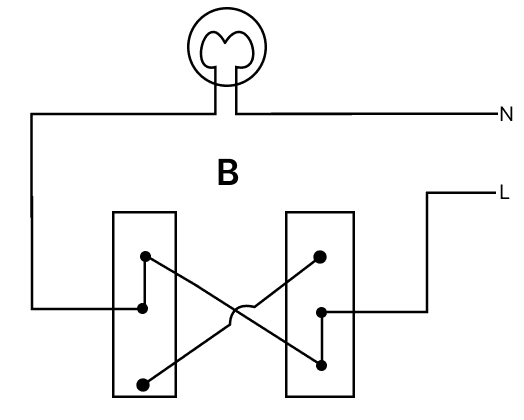
(a) Which switch can successfully turn the bulbs ON or OFF? (Circuit A, Circuit B, or both)
(b) At present, in which circuit is the bulb glowing?
(c) If the L and N wires are swapped in the circuit (your answer to (b)), will the circuit still function?
A cell of e.m.f 1.5 V and internal resistance 1 Ω is connected to two resistors of resistances 6 Ω and 3 Ω in parallel and a resistor of resistance 2 Ω in series as shown in the diagram.
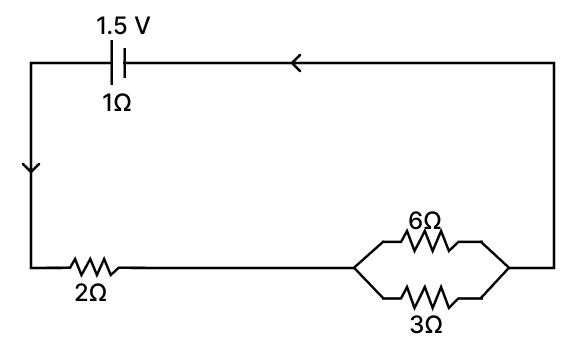
Calculate the current through:
(a) 2 Ω resistor
(b) 6 Ω resistor
A spirit lamp supplying heat at a rate of 50 W is used to melt 0.025 kg of ice at 0 °C taken in a container. If all the ice in the container is melted in 168 s, then what is the specific latent heat of fusion of ice?
(The heat capacity of the container is negligible.)