
Mathematics
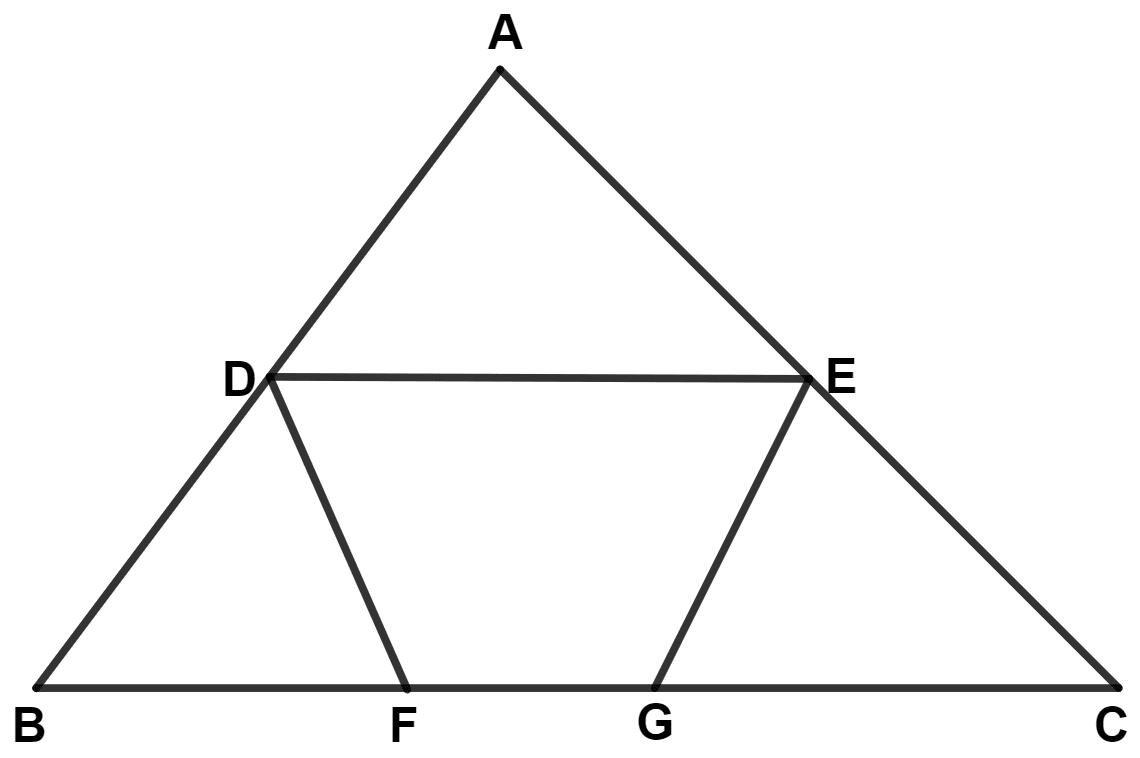
The given figure shows an equilateral triangle ABC with each side 15 cm. Also DE // BC, DF // AC and EG //AB. If DE + DF + EG = 20 cm, find FG.
Triangles
11 Likes
Answer
Given,
ABC is an equilateral triangle.
∴ AB = BC = AC = 15 cm and ∠A = ∠B = ∠C = 60°.
In △ ADE,
⇒ ∠ADE = ∠ABC = 60° (Corresponding angles are equal)
⇒ ∠AED = ∠ACB = 60° (Corresponding angles are equal)
By angle sum property of triangle,
⇒ ∠AED + ∠ADE + ∠DAE = 180°
⇒ 60° + 60° + ∠DAE = 180°
⇒ ∠DAE + 120° = 180°
⇒ ∠DAE = 180° - 120° = 60°.
∴ △ ADE is an equilateral triangle with each side equal to x cm.
∴ AD = DE = EA = x cm.
In △ BDF,
⇒ ∠BFD = ∠BCA = 60° (Corresponding angles are equal)
⇒ ∠DBF = ∠B = 60°
By angle sum property of triangle,
⇒ ∠BFD + ∠DBF + ∠BDF = 180°
⇒ 60° + 60° + ∠BDF = 180°
⇒ ∠BDF + 120° = 180°
⇒ ∠BDF = 180° - 120° = 60°.
∴ △ BDF is an equilateral triangle with each side equal to y cm.
∴ DB = BF = FD = y cm.
In △ EGC,
⇒ ∠EGC = ∠ABC = 60° (Corresponding angles are equal)
⇒ ∠ECG = ∠C = 60°
By angle sum property of triangle,
⇒ ∠EGC + ∠ECG + ∠GEC = 180°
⇒ 60° + 60° + ∠GEC = 180°
⇒ ∠GEC + 120° = 180°
⇒ ∠GEC = 180° - 120° = 60°.
∴ △ EGC is an equilateral triangle with each side equal to z cm.
∴ EG = GC = CE = z cm.
Given,
⇒ AB = 15
⇒ AD + BD = 15
⇒ x + y = 15 ……….(1)
⇒ AC = 15
⇒ AE + EC = 15
⇒ x + z = 15 ……….(2)
Given,
⇒ DE + DF + EG = 20
⇒ x + y + z = 20
⇒ 15 + z = 20 [From equation (1)]
⇒ z = 20 - 15 = 5 cm.
Substituting value of z in equation (2), we get :
⇒ x + 5 = 15
⇒ x = 15 - 5 = 10 cm.
Substituting value of x in equation (1), we get :
⇒ 10 + y = 15
⇒ y = 15 - 10 = 5 cm.
From figure,
⇒ BC = 15 cm
⇒ BF + FG + GC = 15
⇒ y + FG + z = 15
⇒ 5 + FG + 5 = 15
⇒ FG + 10 = 15
⇒ FG = 15 - 10 = 5 cm.
Hence, FG = 5 cm.
Answered By
3 Likes
Related Questions
In △ABC, angle ∠ACB = 90°. D is a point on side AB so that DA = DC.
(i) Prove that △BDC is an isosceles triangle.
(ii) If ∠BDC = 60°, show that ∠A = 30°.
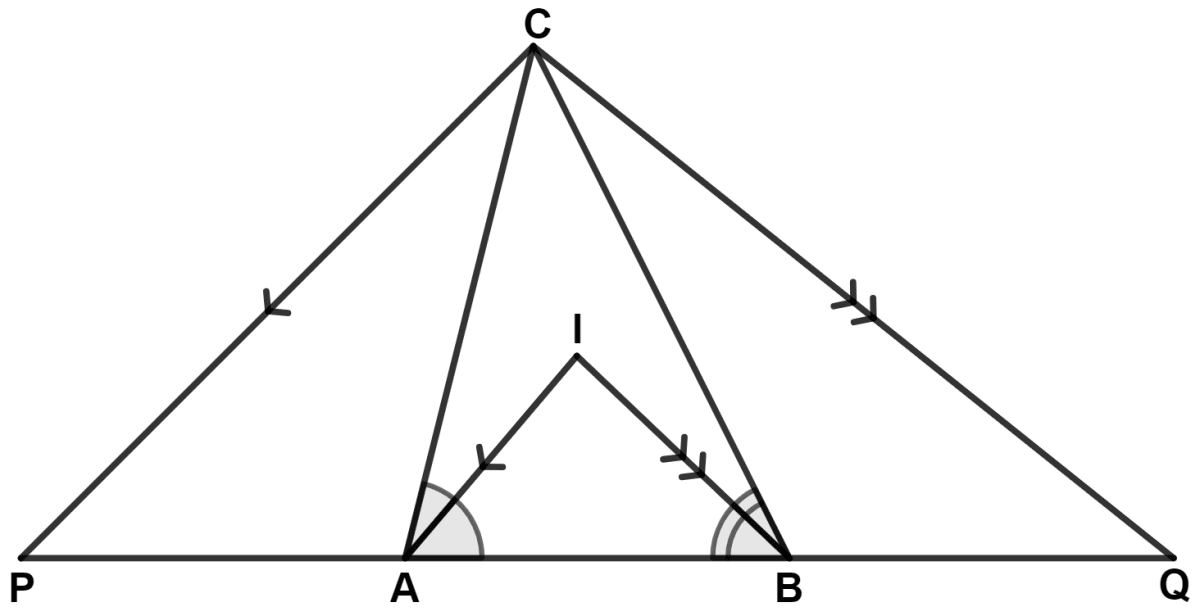
In the following figure; IA and IB are bisectors of angles CAB and CBA respectively. CP is parallel to IA and CQ is parallel to IB.
Prove that :
PQ = The perimeter of Δ ABC.
In triangle ABC, bisector of angle BAC meets opposite side BC at point D. If BD = CD, prove that △ ABC is isosceles.
In Δ ABC, D is a point on BC such that AB = AD = BD = DC. Show that :
∠ADC : ∠C = 4 : 1.