
Mathematics
The perimeter of a rhombus is 40 cm. If one diagonal is 16 cm, find :
(i) its other diagonal
(ii) its area
Area Trapezium Polygon
10 Likes
Answer
(i) Given:
The perimeter of a rhombus = 40 cm.
One diagonal = 16 cm.
As we know, the perimeter of the rhombus = 4 x side
⇒ 4 x side = 40 cm
⇒ Side = cm
⇒ Side = 10 cm
AB = 10 cm
AC = 16 cm
Then, OA = OC = = 8 cm
Let OB be a cm.
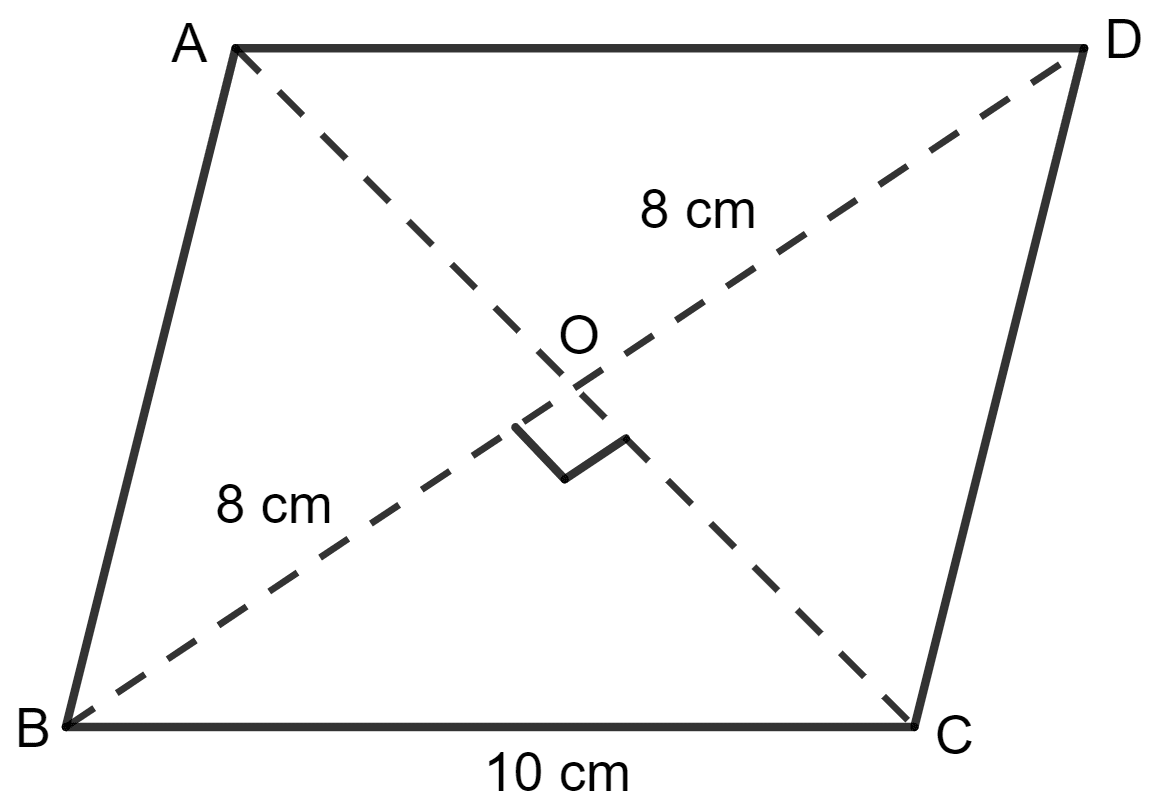
Since the diagonal of a rhombus bisect at 90°.
Applying pythagoras theorem in triangle AOB, we get:
AB2 = OA2 + OB2
⇒ (10)2 = (8)2 + a2
⇒ 100 = 64 + a2
⇒ a2 = 100 - 64
⇒ a2 = 36
⇒ a =
⇒ a = 6
So, OB = 6 cm
BD = 2 x 6 cm
= 12 cm
Hence, the length of other diagonal is 12 cm.
(ii) As we know that area of rhombus = x product of its diagonal
= x 16 x 12 cm2
= x 192 cm2
= 96 cm2
Hence, the area of the rhombus is 96 cm2.
Answered By
3 Likes
Related Questions
The adjacent sides of a parallelogram are 21 cm and 28 cm. If its one diagonal is 35 cm, find the area of the parallelogram.
The diagonals of a rhombus are 18 cm and 24 cm. Find :
(i) its area
(ii) length of its sides
(iii) its perimeter
The length of the diagonals of a rhombus is in the ratio 4 : 3. If its area is 384 cm2, find its side.
A thin metal iron-sheet is a rhombus in shape, with each side 10 m. If one of its diagonals is 16 m, find the cost of painting its both sides at the rate of ₹ 6 per m2.
Also, find the distance between the opposite sides of this rhombus.