
History & Civics
The period when religious reformers challenged some of the practices of the Roman Catholic Church across Europe in the 15th and 16th centuries, was marked by the rise of Bhakti and Sufi movements in India. Compare and contrast the religious reform movements in India and Europe.
Reformation
29 Likes
Answer
The 16th-century Reformation movement in Europe, led by figures like John Wycliffe and Martin Luther, protested clerical corruption and aimed to reform the Church. Meanwhile, India saw the peak of the Bhakti and Sufi movements, with saints like Meerabai, Sant Jnaneshwar, and Hazrat Nizamuddin preaching divine unity, equality, and devotion.
While arising in entirely different regions, these European and Indian spiritual movements shared striking similarities alongside key differences:
Similarities:
- Both movements challenged the established religious authority of their respective societies. In Europe, the Protestant Reformation challenged the Roman Catholic Church, while in India, the Bhakti and Sufi movements challenged the Brahminical orthodoxy and Islamic orthodoxy, respectively.
- Both movements emphasized the importance of individual faith and personal experience. In Europe, the Protestant Reformation emphasized the idea of a personal relationship with God, while in India, the Bhakti and Sufi movements emphasized the importance of personal devotion and spiritual experience.
- Both movements used vernacular language as a means of spreading their ideas. In Europe, the Protestant Reformation translated the Bible into local languages, while in India, the Bhakti and Sufi movements composed devotional poetry and songs in the local languages.
Differences:
- The European Reformation was primarily a protest against the corruption and excesses of the Roman Catholic Church, while the Bhakti and Sufi movements in India were attempts to reform Hinduism and Islam from within. The Indian reform movements were more focused on spiritual renewal, while the European reform movements were more focused on institutional reform.
- The European Reformation led to the formation of new Christian denominations, such as Lutheranism, Calvinism, and Anglicanism, while the Bhakti and Sufi movements did not result in the formation of new religions or sects. Instead, they brought about changes within Hinduism and Islam.
- The European Reformation emphasized reason and individualism. The Bhakti and Sufi movements, on the other hand, were more rooted in traditional religious practices and emphasized devotion and mysticism.
Answered By
14 Likes
Related Questions
What was the role of the Council of Trent in Counter Reformation?
With reference to the Reformation Movement, answer the following:
(a) Mention any three Church practices that caused dissatisfaction among the people?
(b) How did New Learning become a factor that led to the Reformation?
(c) Who were the Protestants? By what other names was Protestantism known?
Study the picture given below and answer the following questions.
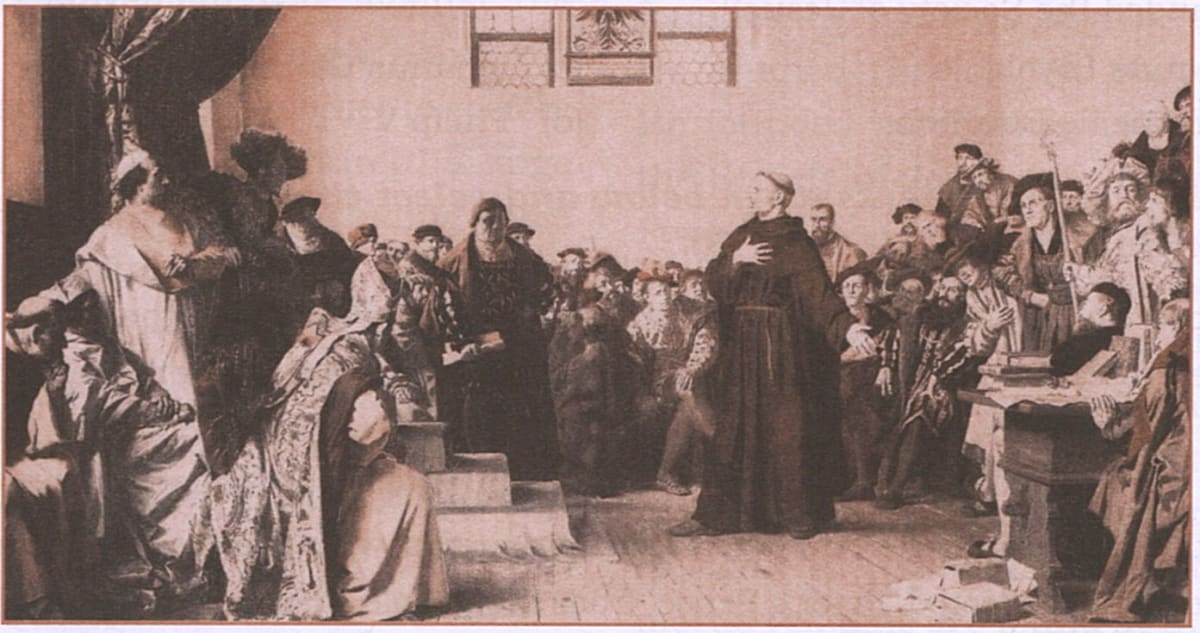
(a) Identify the incident in the picture. Where was it held?
(b) Name the person who was there to defend his case. What was the final outcome of the case?
(c) State the contribution of this person in reforming the church in Europe
Imagine you are Martin Luther, draft a speech that you would give to defend yourself at the Diet of Worms.