Biology
The response of plants to gravity is known as geotropism. How are plant parts sensitive to gravity? Describe with the help of a diagram.
Answer
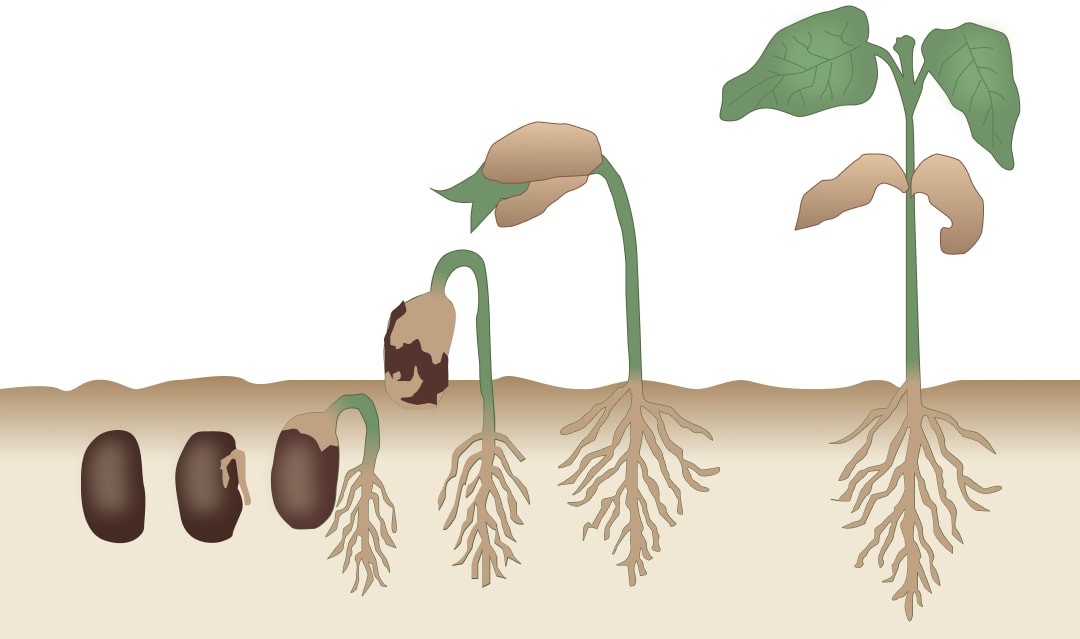
If we sow some seeds of beans or gram in moist soil in glass beaker, they will sprout in 3-4 days. Each seed will give rise to a tiny seedling. Water the seedlings regularly. After 8-9 days of growth, we will observe that the stem has increased in length growing away from the force of gravity whereas the roots have also increased in length but growing towards the force of gravity. The growth in stem shows negative (away) response to gravity, while the root shows positive (towards) response to gravity. The below diagrams shows this growth of seedlings:
Related Questions
Study the diagrams given below and answer the following questions.

(a) Name the structures shown as X and Y in the figures (A) and (B), respectively.
(b) Write the functions performed by the structures X and Y.
(c) Name the phenomenon depicted and define it.
(d) How do the structures X and Y differ from each other?
(e) Give examples of the plants which show the said phenomenon.
Given below are the figures showing some kinds of tropic movements in plants. Study the same and answer the following questions:
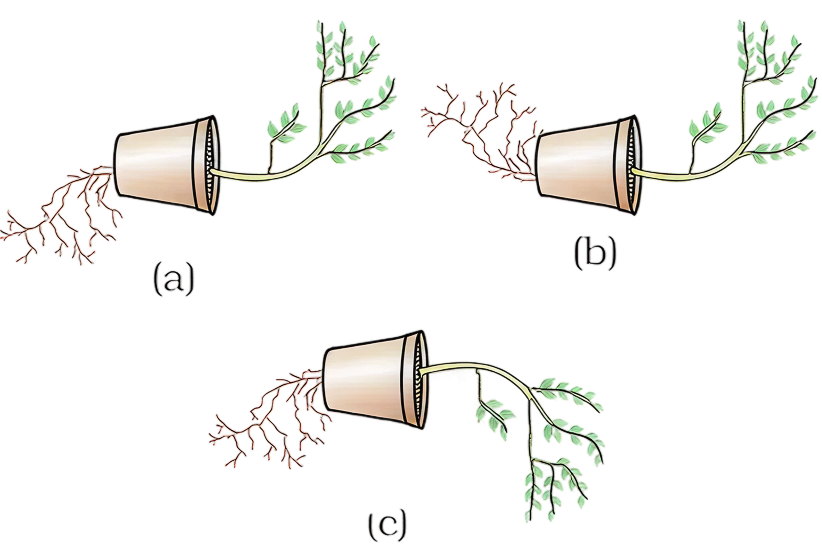
(a) Which one of these figures is correct? Give reason in support of your answer.
(b) Name the kind of movements shown by the root system and the shoot system. Define each.
(c) What are the two stimuli which affect root system and shoot system positively ? Name them.
(d) Which of the following stimuli affect the growth of root strongly?
- Gravity
- Water
(e) Draw a neat and labelled diagram of the longitudinal section of a pistil showing chemotropism in an angiospermic plant.
The figure given below depicts a kind of tropic movement in plants. Study the same and answer the following questions.

(a) What kind of a movement is shown in figure. Define it.
(b) How does this movement differ from geotropism?
(c) Name the stimulus responsible for thigmotropism. Give one example of a plant showing thigmotropism.
(d) Name one stimulus which gives a positive response for the roots but negative response for the shoot.
(e) Draw a neat and labelled diagram of the part of plant showing leaf tendril. Name the plant.
Rohan set up an experiment with germinating bean seeds. He fixed the seeds on a wire mesh with moist sawdust placed below them. At the start, the radicles grow downward and the plumules upward. After a few days though, he noticed that the radicles began bending towards the moist sawdust instead of simply going straight down.
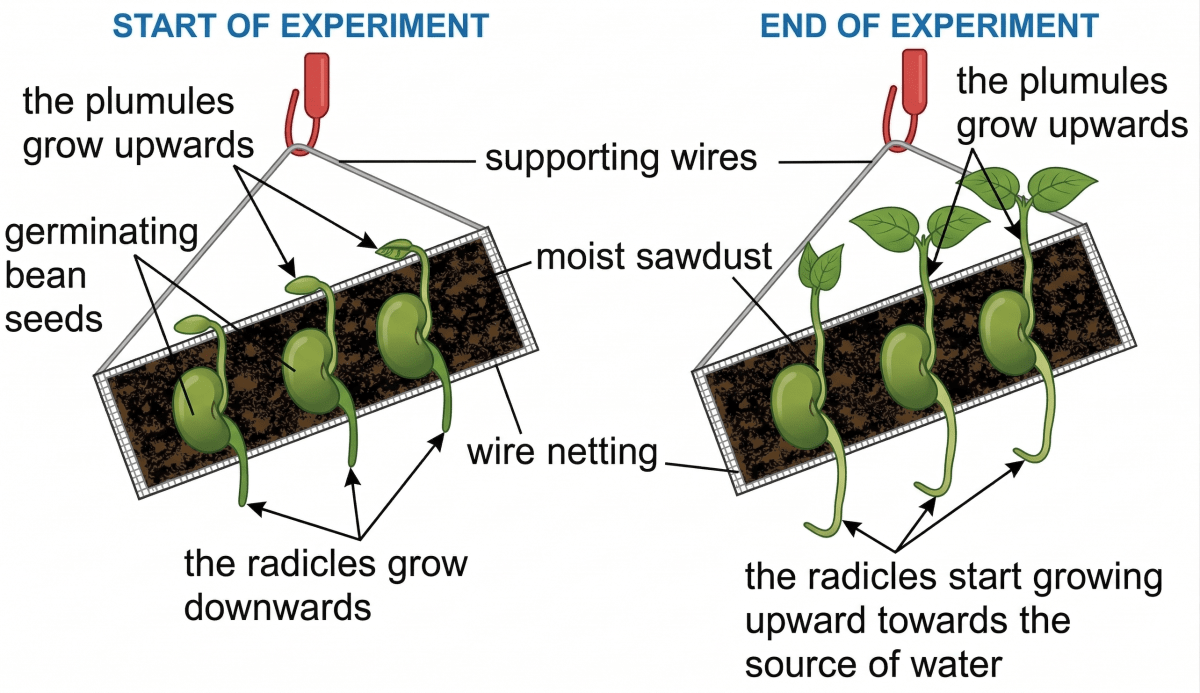
(a) Name two types of tropic movements shown by the radicles in this experiment.
(b) What stimuli are responsible for these movements?
(c) Which one of the stimuli mentioned by you above in (b) is more effective for the growth of the radicles in this experiment ?
(d) Why do the plumules continue to grow upwards even after the radicles bend ?