
Geography
Each time zone in the world differs from the next by 15 degrees in longitude and 1 hour in time.
Latitudes & Longitudes
6 Likes
Answer
The Earth rotates 360° in 24 hours, which means it turns 15° of longitude every hour (360° ÷ 24 = 15°). Therefore, for every 15° of longitude travelled east or west, there is a 1-hour difference in local time.
If you move eastward, the time increases by 1 hour for every 15°.
If you move westward, the time decreases by 1 hour for every 15°.
Answered By
3 Likes
Related Questions
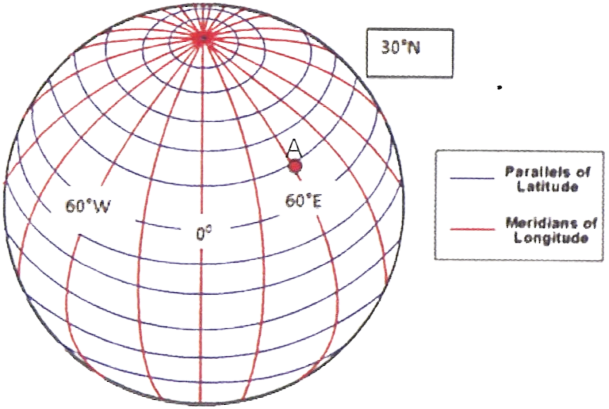
(i) What is the 0° meridian known as?
(ii) What is the location of point A in terms of latitude and longitude?
Greenwich Mean time is taken as reference for international time.
State the technical term for the following statements:
- A complete network of parallels of latitude and Meridians of Longitudes drawn on the map or globe.
- The longitude of zero degree passing through Greenwich near London.
- The temperature zone located between tropical and frigid zone.
- The latitude which is the southernmost limit of the apparent movement of the Sun.
If the time at 0° longitude is 7:00 a.m. what will be the time at
(i) 2° East
(ii) 25° East longitude.