
Mathematics
Two adjacent sides of a parallelogram are 28 cm and 26 cm. If one diagonal of it is 30 cm long; find the area of the parallelogram. Also, find the distance between its shorter sides.
Mensuration
33 Likes
Answer
By joining diagonal BD, the parallelogram is divided into two triangles. Let the sides of Δ ABD be:
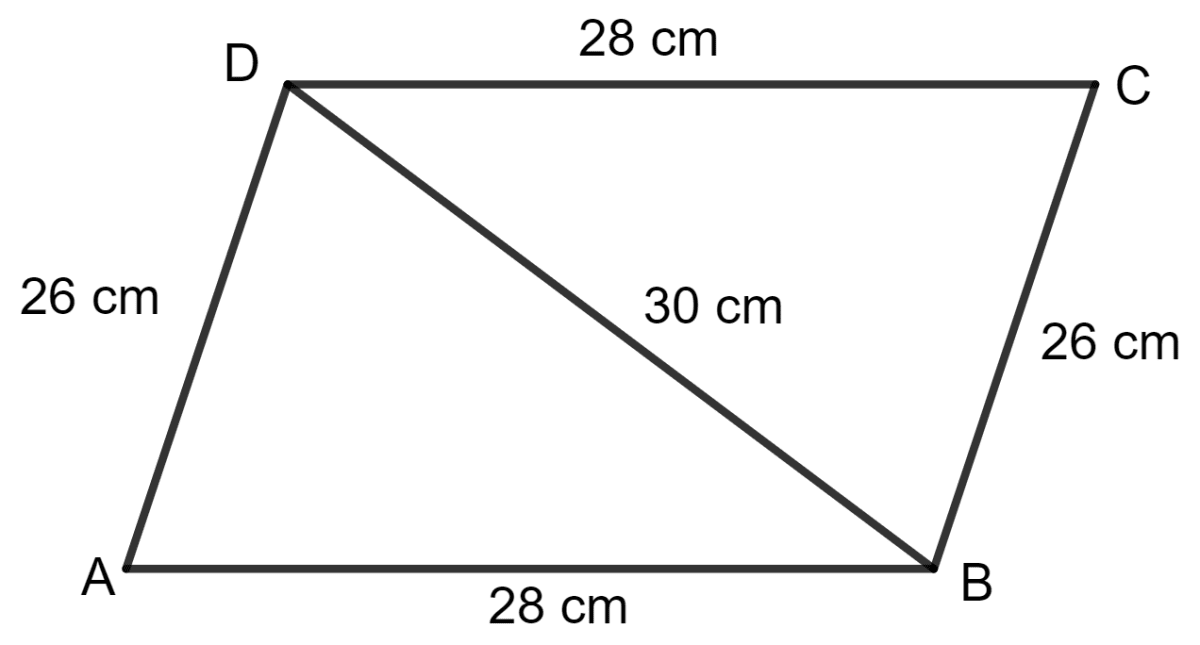
a = 28 cm, b = 26 cm and c = 30 cm.
The semi-perimeter s:
∵ Area of triangle =
= cm2
= cm2
= cm2
= 336 cm2
Area of parallelogram ABCD = 2 x area of Δ ABD
= 2 x 336 cm2
= 672 cm2
Let h be the distance between the shorter sides.
Area of the parallelogram = base x height
⇒ 26 x h = 672
⇒ h =
⇒ h = 25.84 cm
Hence, the area of the parallelogram is 672 cm2 and the distance between the shorter sides is 25.84 cm.
Answered By
17 Likes
Related Questions
A floor which measures 15 m x 8 m is to be laid with tiles measuring 50 cm x 25 cm. Find the number of tiles required.
Further, if a carpet is laid on the floor so that a space of 1 m exists between its edges and the edges of the floor, what fraction of the floor is left uncovered.
Two adjacent sides of parallelogram are 24 cm and 18 cm. If the distance between the longer sides is 12 cm; find the distance between the shorter sides.
The area of a rhombus is 216 sq. cm. If its one diagonal is 24 cm; find :
(i) length of its other diagonal,
(ii) length of its side,
(iii) perimeter of the rhombus.
The perimeter of a rhombus is 52 cm. If one diagonal is 24 cm; find :
(i) the length of its other diagonal,
(ii) its area.