
Mathematics
The two parallel sides of a trapezium are 58 m and 42 m long. The other two sides are equal, each being 17 m. Find its area.
Mensuration
1 Like
Answer
ABCD is a trapezium.
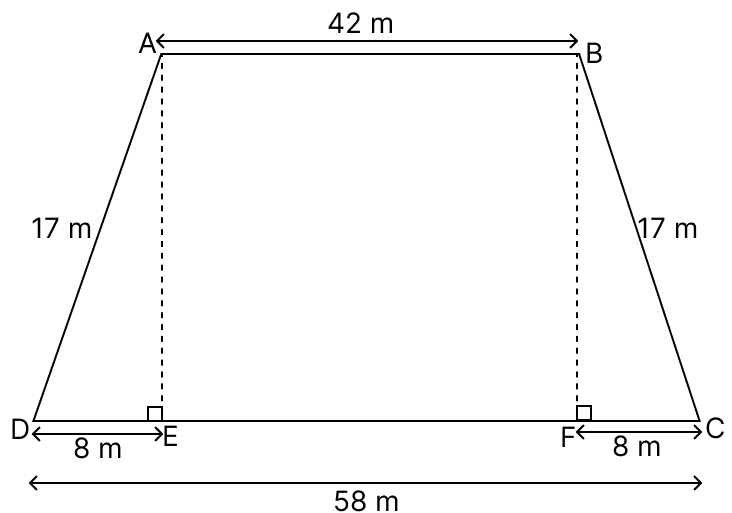
AB = 42 m
CD = 58 m
AD = BC = 17 m
From A and B drop perpendiculars AE and BF respectively to DC.
From figure,
EF = AB = 42 m
Since, AD = BC (given) and AE = BF (perpendicular between same parallels)
Thus,
DE = FC = x (let)
From figure,
⇒ DE + FC + EF = DC
⇒ x + x + 42 = 58
⇒ 2x = 58 - 42
⇒ 2x = 16
⇒ x = 8 meters.
In △ AED,
Using pythagoras theorem,
⇒ AD2 = AE2 + ED2
⇒ 172 = AE2 + 82
⇒ AE2 = 172 - 82
⇒ AE2 = 289 - 64
⇒ AE2 = 225
⇒ AE = = 15 m.
Height = AE = 15 m.
By formula,
Area of trapezium =
Hence, area = 750 m2.
Answered By
1 Like
Related Questions
The area of a parallelogram is 338 m2. If its altitude is twice the corresponding base, determine the base and the altitude.
Find the area of a rhombus one side of which measures 20 cm and the one of whose diagonals is 24 cm.
The perimeter of a rhombus is 52 cm. If one of its diagonals is 24 cm long, find:
(i) the length of the other diagonal,
(ii) the area of the rhombus.
The area of a rhombus is 216 cm2 and one of its diagonals measures 24 cm. Find:
(i) the length of the other diagonal,
(ii) the length of each of its sides,
(iii) its perimeter.