Mathematics
Two trains leave a railway station at same time. The first train travels due west and the second train due north. The first train travels 5 km/hr faster than the second train. If after 2 hours, they are 50 km apart, find the speed of each train.
Answer
Let speed of second train be x km/hr and first be (x + 5) km/hr.
According to figure,
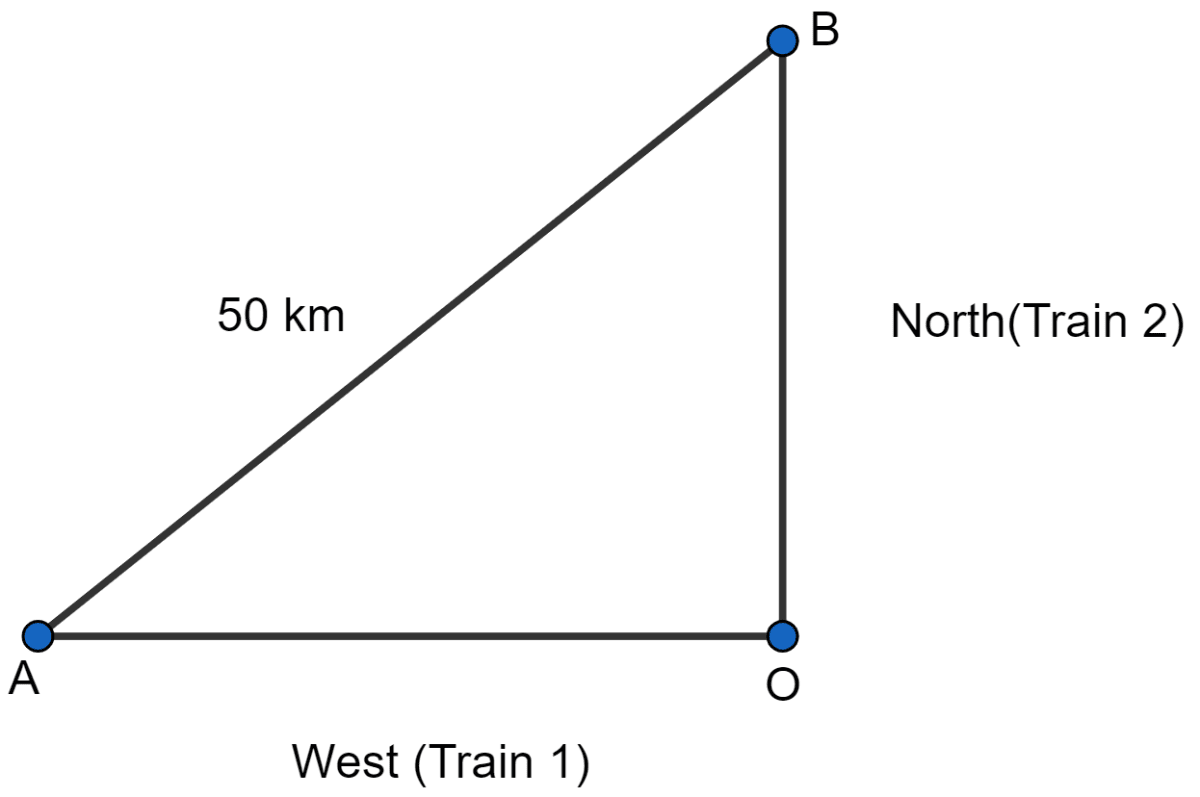
Let O be the position where trains leave
Distance travelled by first train OA = 2(x + 5) km
Distance travelled by second train OB = 2x km
By pythagoras theorem we get,
⇒ AB2 = OA2 + OB2
⇒ 502 = [2(x + 5)]2 + (2x)2
⇒ 502 = 4(x + 5)2 + 4x2
⇒ 2500 = 4(x2 + 25 + 10x) + 4x2
⇒ 2500 = 4x2 + 100 + 40x + 4x2
⇒ 8x2 + 40x - 2400 = 0
⇒ 8(x2 + 5x - 300) = 0
⇒ x2 + 5x - 300 = 0
⇒ x2 + 20x - 15x - 300 = 0
⇒ x(x + 20) - 15(x + 20) = 0
⇒ (x - 15)(x + 20) = 0
⇒ x - 15 = 0 or x + 20 = 0
⇒ x = 15 or x = -20.
Since, speed cannot be negative,
∴ x ≠ -20.
∴ x = 15 and x + 5 = 20
Hence, speed of first train = 20 km/hr and second train = 15 km/hr.
Related Questions
A rectangular plot has an area of 24 m2. If its perimeter is 20 m, find its length.
A rectangular garden 10 m by 16 m is surrounded by a concrete walk of uniform width. The area of concrete walk is 120 square metre.
Assuming the width of the walk to be x m, form an equation in x and solve it to find the value of x.
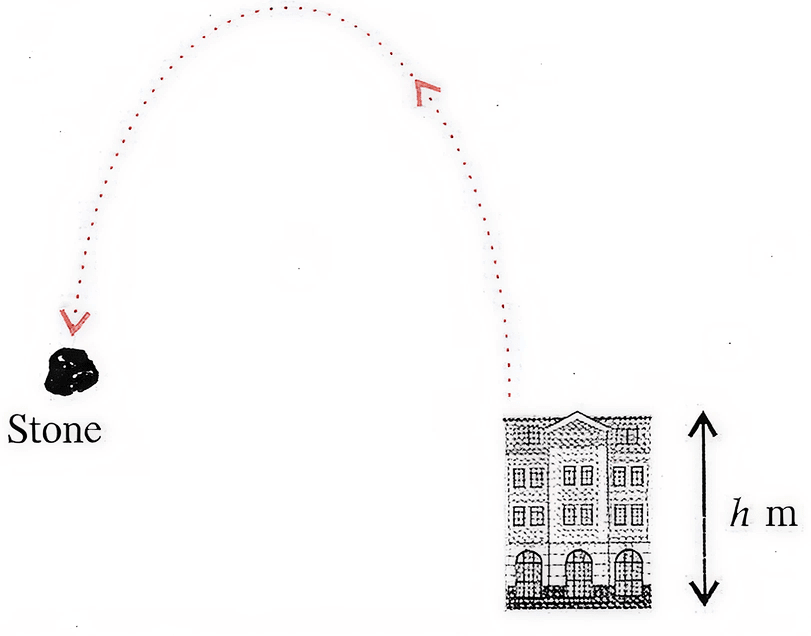
A stone is thrown into air from the top of a building of height h m. The height of the stone (in metres) above the ground after t seconds is given by h(t) = 5t2 + 30t + 2; where t is the time from when the stone is thrown.
(i) How high will the stone be from the ground after 2 seconds?
(ii) From what height, above the ground, the stone is thrown?
(iii) At what time will the stone be 37 m above the ground?
Case study:
Malik and Rakesh are best friends who are also neighbours living in Gurugram. Their families are also on excellent terms.During summer, they decide to go for a vacation together along with their families to Ahmedabad by their own vehicles.
Malik travels by a Jeep and Rakesh by a car.
Malik’s jeep travels at a speed of x km/h and Rakesh’s car travels 10 km/h slower than Malik’s jeep. Rakesh took 2 hours more than Malik to reach Ahmedabad. The distance between Gurugram and Ahmedabad (by road) is approximately 975 km.
(i) What will be the distance covered by Rakesh’s car in five hours?
(ii) Form a quadratic equation to describe the speed of Malik’s jeep.
(iii) What is the speed of Malik’s jeep?
(iv) How much time is taken by Rakesh to reach Ahmedabad?