
History & Civics
Both the United Nations Organisation and the Non-Aligned Movement aim to achieve international peace and security. In this context, answer the following:
(i) Mention any three functions of the Security Council.
(ii) Mention any three functions of the World Health Organisation.
(iii) Name any two founders of the Non-Aligned Movement. Mention any two of its objectives.
Major Agencies of UNO
7 Likes
Answer
(i) The functions of the Security Council related to maintaining world peace are as follows:
- To maintain international peace and security in accordance with the principles and purposes of the United Nations.
- To investigate any dispute or situation which might lead to international friction and to take military action against an aggressor.
- To recommend methods of adjusting such disputes or the terms of settlement.
(ii) Three functions of the World Health Organisation are:
- It helps countries to improve their health system by building up infrastructure especially manpower, institutions and services for the individual and community.
- It gives important drugs needed for medical care. The WHO launched a programme to immunise children against six major diseases-Measles, Diphtheria, Tetanus, Tuberculosis, Polio and Whooping Cough.
- It promotes research to cure and prevent diseases. For example, it arranged for the investigation of cancer and heart diseases in laboratories in many countries to identify disease-causing organisms, to improve vaccines and to train research workers.
(iii) Two founders of the Non-Aligned Movement are — Prime Minister Nehru of India, and President Nasser of Egypt.
Two objectives of Non-Aligned Movement are:
- To oppose colonialism, imperialism and racial discrimination.
- To advocate peaceful settlement of international disputes.
Answered By
2 Likes
Related Questions
The Revolt of 1857 was the beginning of the independence struggle against the colonial rule of the British. With reference to the consequences of the Revolt, answer the following:
(i) Mention any three changes made in the administration with the end of the Company's Rule.
(ii) State any three policies promised to Indians in Queen Victoria's Proclamation.
(iii) Mention any four changes made in the army after the Revolt.
The Indian National Movement is divided into three phases. With reference to the Second Phase of the Indian National Movement, answer the following questions:
(i) Who partitioned Bengal? Mention any two points to explain the perspective of the Nationalists regarding the actual motive behind the decision of Partition.
(ii) What was the objective of the Assertive Nationalists? Mention any two contributions of Bal Gangadhar Tilak.
(iii) In which year was the Muslim League formed? Mention any three objectives of the Muslim League.
Look at the picture given and answer the following questions:
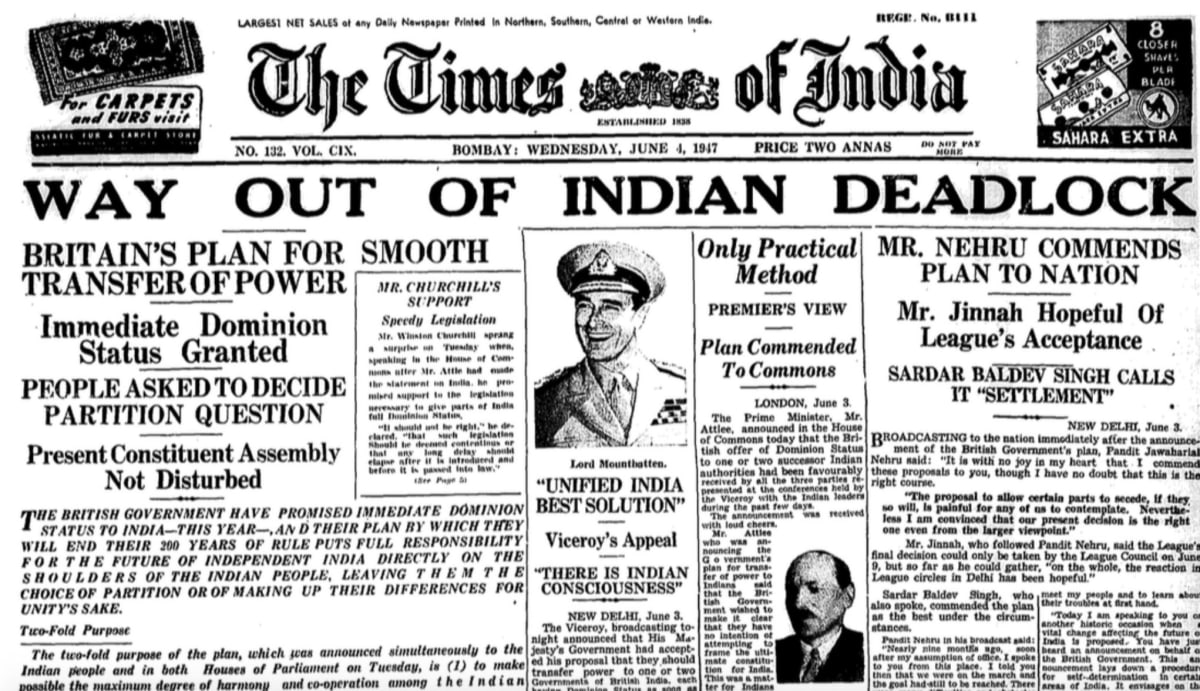
(i) Name the Viceroy who announced the plan for smooth transfer of power. Mention any two clauses of his plan with reference to the Princely States.
(ii) Mention any three reasons for the acceptance of his plan by the Congress.
(iii) Mention any four provisions of the Indian Independence Act of 1947.
The final act of the long-drawn-out negotiations took place at Versailles on Saturday afternoon, and to-day Germany and the Allies - always with the exception of America - are at peace. Peace is a blessed word, and both the word and the fact are welcome to-day. So far as Germany is concerned there is for the present an end of strife, and at least a formal return to the decent relations of civilised states.
Editorial: Peace in force (12 January 1920)
The Guardian
(a) Mention any three causes of the World War which ended with the signing of the treaty being discussed in the passage above.
(b) Name the organisation which was established in 1920 to maintain peace after this war. Mention any two of its objectives.
(c) Mention any four clauses of the Treaty which affected Germany.