
Mathematics
Use graph paper for this question (Take 2 cm = 1 unit along both x and y axis). ABCD is a quadrilateral whose vertices are A(2, 2), B(2, -2), C(0, -1) and D(0, 1).
(i) Reflect quadrilateral ABCD on the y-axis and name it as A'B'C'D'.
(ii) Write down the co-ordinates of A' and B'.
(iii) Name two points which are invariant under the above reflection.
(iv) Name the polygon A'B'C'D'.
Reflection
4 Likes
Answer
(i) Since, points C and D lie on y-axis, thus they are invariant on reflection in it.
Thus, C' = C = (0, -1) and D' = D = (0, 1).
Reflected quadrilateral A'B'CD is shown in the graph below:
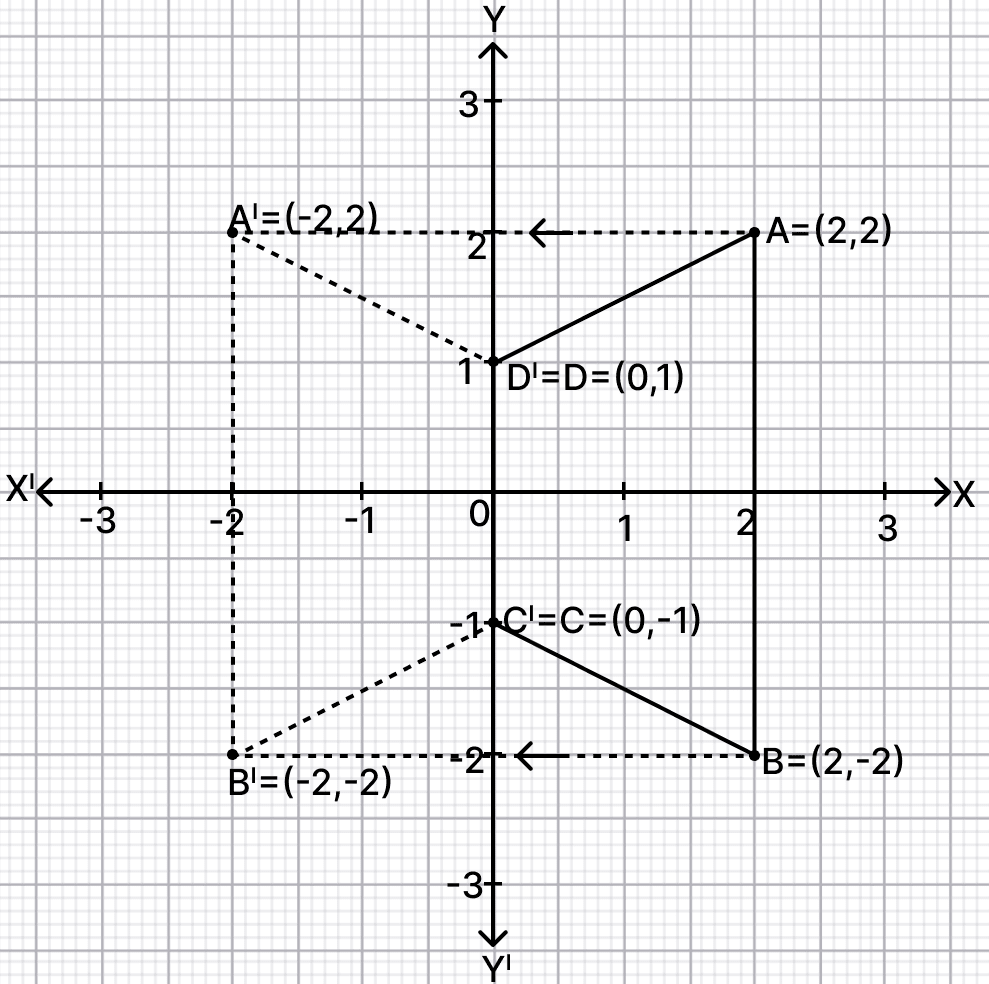
(ii) From graph we get,
The coordinates of A' and B' are (-2, 2) and (-2, -2) respectively.
(iii) From graph we get,
The two points which are invariant under the above reflection are C(0, -1) and D(0, 1).
(iv) From graph we get,
A'B' // D'C' and A'D' = B'C'
The polygon(A'B'C'D') formed is an isosceles trapezium.
Answered By
1 Like
Related Questions
Use a graph paper for this question taking 1 cm = 1 unit along both x and y axes.
(i) Plot the points A(0, 5), B(2, 5), C(5, 2), D(5, -2), E(2, -5) and F(0, -5).
(ii) Reflect the points B, C, D and E on y-axis and name them respectively as B', C', D' and E'.
(iii) Write the co-ordinate of B', C', D' and E'.
(iv) Name the figure formed by BCDEE'D'C'B'.
(v) Name a line of symmetry for the figure formed.
Use graph paper to answer the following questions. (Take 2 cm = 1 unit)
(i) Plot the points A(-4, 2) and B(2, 4).
(ii) A' is the image of A when reflected in the y-axis. Plot it on the graph paper and write the co-ordinates of A'.
(iii) B' is the image of B when reflected in the line AA'. Write the co-ordinates of B'.
(iv) Write the geometric name of the figure ABA'B'.
(v) Name a line of symmetry of the figure formed.
Find the image of the following points as directed.
(i) Point A(4, 5) reflected in the line x = 6.
(ii) Point B(-3, 2) reflected in the line x = -5.
(iii) Point C(3, 6) reflected in the line y = -2.
(iv) Point D(-2, -5) reflected in the line y = 5.
Use graph sheet for this question.
(a) Plot A(0, 3), B(2, 1) and C(4, -1).
(b) Reflect point B and C in y-axis and name their images as B' and C' respectively. Plot and write coordinates of the points B' and C'.
(c) Reflect point A in the line BB' and name its images as A'.
(d) Plot and write coordinates of point A'.
(e) Join the points ABA'B' and give the geometrical name of the closed figure so formed.