Mathematics
Using ruler and compasses only, construct a ΔABC in which AB = 6 cm, BC = 3.5 cm and CA = 4.6 cm.
(i) Draw the locus of a point P which moves so that it is always 3 cm from B.
(ii) Draw the locus of a point which moves so that it is equidistant from BC and CA.
(iii) Mark the point of intersection of the two loci obtained above. Measure PC.
Answer
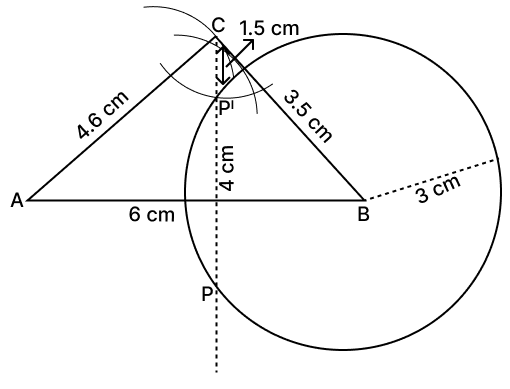
Steps of construction :
Draw a line segment AB = 6 cm.
With B as the center and a radius of 3.5 cm, draw an arc.
With A as the center and a radius of 4.6 cm, draw a second arc intersecting the first arc at C.
Join ABC, ABC is required triangle.
With B as the center and a radius of 3 cm, draw a circle.
Draw the angle bisector of C.
Mark the point where bisector meets circle as P and P'. Measure CP and CP'.
On measuring PC = 4 cm and CP' = 1.5 cm.
Related Questions
Using ruler and compasses only, construct a rhombus ABCD whose diagonals AC and BD are 8 cm and 6 cm long respectively. Find by construction a point P equidistant from AB and AD and also equidistant from C and D. Measure PC.
Using ruler and compasses only, construct a ΔABC in which AB = 4 cm, BC = 5 cm and ∠ABC = 120°.
(i) Locate the point P such that ∠BAP = 90° and BP = CP.
(ii) Measure the length of BP.
Using ruler and compasses only, construct an isosceles ΔABC in which BC = 5 cm, AB = AC and ∠BAC = 90°. Locate the point P such that :
(i) P is equidistant from BC and AC.
(ii) P is equidistant from B and C.
Using ruler and compasses only, construct a quadrilateral ABCD in which AB = 6 cm, BC = 5 cm, ∠B = 60°, AD = 5 cm and D is equidistant from AB and BC.