KnowledgeBoat Logo
|

Mathematics

If cos A=12\text{cos A} = \dfrac{1}{\sqrt2} and sin B=32\text{sin B} = \dfrac{\sqrt3}{2}, the value of tan Btan A1+tan A tan B\dfrac{\text{tan B} - \text{tan A}}{1 + \text{tan A tan B}} is :

  1. 232 - {\sqrt3}
  2. 2+32 + {\sqrt3}
  3. 32{\sqrt3} - 2
  4. 3+2{\sqrt3} + 2

Trigonometric Identities

28 Likes

Answer

Given:

cos A=12A = \dfrac{1}{\sqrt2}

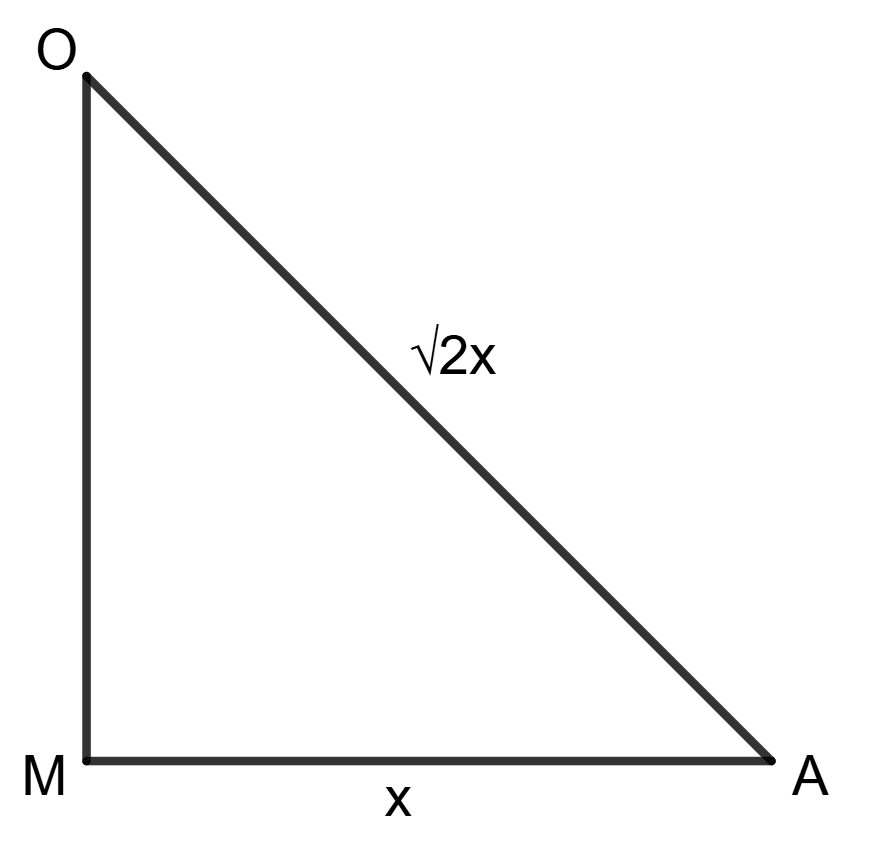
i.e., BaseHypotenuse=12\dfrac{\text{Base}}{\text{Hypotenuse}} = \dfrac{1}{\sqrt2}

∴ If length of AM = x unit, length of AO = x 2\sqrt{2} unit.

If cos A = 1/2 and sin B = 3/2, the value of tan B - tan A1 + tan A tan B is : Trigonometrical Ratios, Concise Mathematics Solutions ICSE Class 9.

In Δ AMO,

⇒ AO2 = AM2 + MO2 (∵ AC is hypotenuse)

⇒ (2\sqrt{2}x)2 = (x)2 + MO2

⇒ 2x2 = x2 + MO2

⇒ MO2 = 2x2 - x2

⇒ MO2 = x2

⇒ MO = x2\sqrt{\text{x}^2}

⇒ MO = x

tan A=PerpendicularBaseA = \dfrac{Perpendicular}{Base}

=OMMA=xx=1= \dfrac{OM}{MA} = \dfrac{x}{x} = 1

And,

sin B=32B = \dfrac{\sqrt3}{2}

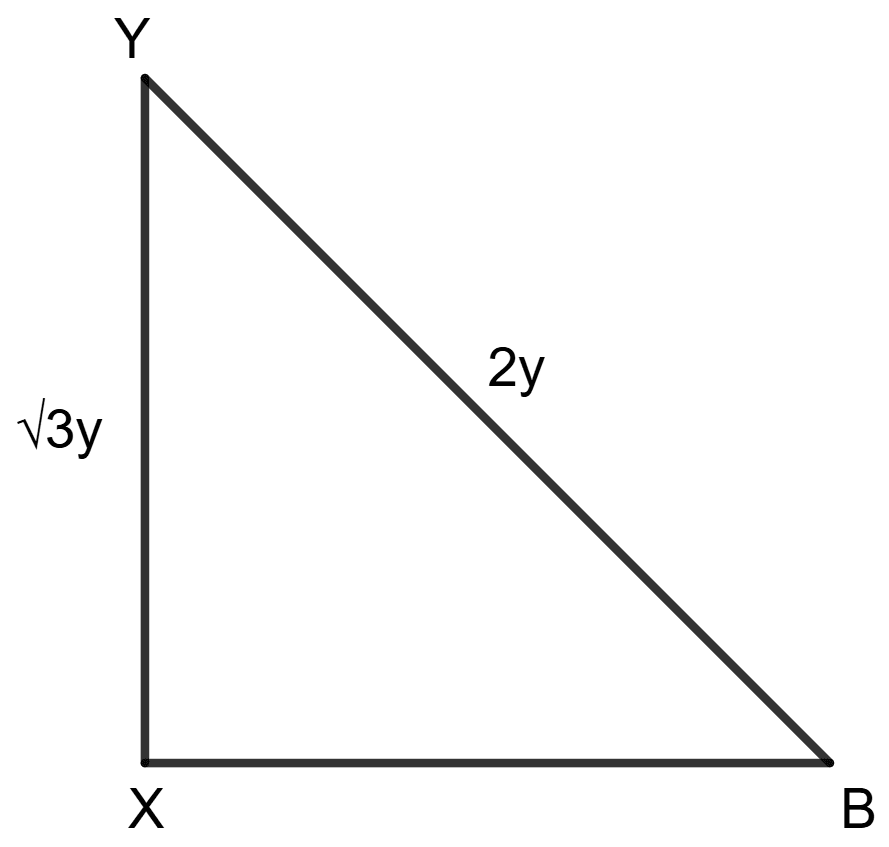
i.e. PerpendicularHypotenuse=32\dfrac{\text{Perpendicular}}{\text{Hypotenuse}} = \dfrac{\sqrt3}{2}

∴ If length of XY = 3\sqrt{3} y unit, length of YB = 2y unit.

If cos A = 1/2 and sin B = 3/2, the value of tan B - tan A1 + tan A tan B is : Trigonometrical Ratios, Concise Mathematics Solutions ICSE Class 9.

In Δ BXY,

⇒ YB2 = YX2 + BX2 (∵ AC is hypotenuse)

⇒ (2y)2 = (3\sqrt{3}y)2 + BX2

⇒ 4y2 = 3y2 + BX2

⇒ BX2 = 4y2 - 3y2

⇒ BX2 = y2

⇒ BX = y2\sqrt{\text{y}^2}

⇒ BX = y

tan B=PerpendicularBaseB = \dfrac{Perpendicular}{Base}

=XYBX=3yy=31= \dfrac{XY}{BX} = \dfrac{\sqrt{3}y}{y} = \dfrac{\sqrt{3}}{1}

Now,

tan Btan A1+tan A tan B=3111+31×1=311+3=(31)×(13)(1+3)×(13)=(331+3)1232=23413=2(32)2=2(32)2=3+2=23\dfrac{\text{tan B} - \text{tan A}}{1 + \text{tan A } \text{tan B}}\\[1em] = \dfrac{\dfrac{\sqrt{3}}{1} - 1}{1 + \dfrac{\sqrt{3}}{1} \times 1}\\[1em] = \dfrac{\sqrt{3} - 1}{1 + \sqrt{3}}\\[1em] = \dfrac{(\sqrt{3} - 1) \times (1 - \sqrt{3})}{(1 + \sqrt{3}) \times (1 - \sqrt{3})}\\[1em] = \dfrac{(\sqrt{3} - 3 - 1 + \sqrt{3})}{1^2 - \sqrt{3}^2}\\[1em] = \dfrac{2 \sqrt{3} - 4}{1 - 3}\\[1em] = \dfrac{2 (\sqrt{3} - 2)}{-2}\\[1em] = \dfrac{\cancel{2} (\sqrt{3} - 2)}{-\cancel{2}}\\[1em] = -\sqrt{3} + 2\\[1em] = 2 - \sqrt{3}

Hence, option 1 is the correct option.

Answered By

12 Likes


Related Questions