KnowledgeBoat Logo
|

Mathematics

Given : sin θ=pq\text{sin θ} = \dfrac{p}{q}, find cos θ + sin θ in terms of p and q.

Trigonometric Identities

25 Likes

Answer

Given:

sin θ = pq\dfrac{p}{q}

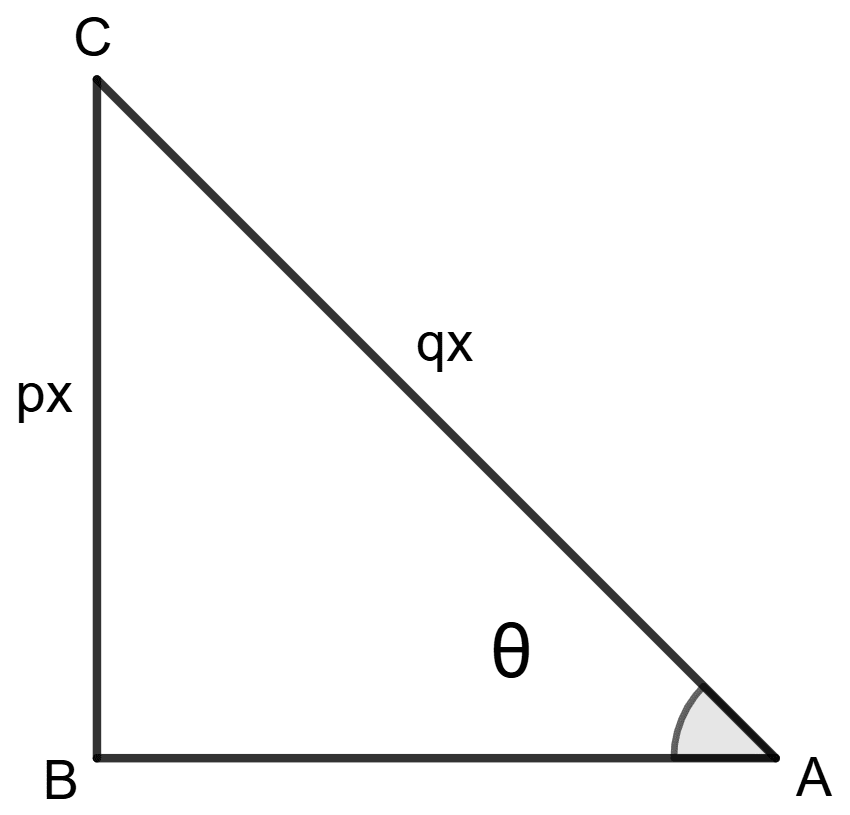
i.e. PerpendicularHypotenuse=pq\dfrac{\text{Perpendicular}}{\text{Hypotenuse}} = \dfrac{p}{q}

∴ If length of BC = px unit, length of AC = qx unit.

Given : sin θ = p/q, find cos θ + sin θ in terms of p and q. Trigonometrical Ratios, Concise Mathematics Solutions ICSE Class 9.

In Δ ABC,

⇒ AC2 = BC2 + AB2 (∵ AC is hypotenuse)

⇒ (qx)2 = (px)2 + AB2

⇒ AB2 = q2x2 - p2x2

⇒ AB = q2x2p2x2\sqrt{q^2\text{x}^2 - p^2\text{x}^2}

⇒ AB = (q2p2\sqrt{q^2 - p^2}) x

cos θ = BaseHypotenuse\dfrac{Base}{Hypotenuse}

=ABAC=(q2p2)xqx=q2p2q= \dfrac{AB}{AC} = \dfrac{\sqrt{(q^2 - p^2)}x}{qx} = \dfrac{\sqrt{q^2 - p^2}}{q}

Now,

cos θ+sin θ=q2p2q+pq=q2p2+pq\text{cos θ} + \text{sin θ} = \dfrac{\sqrt{q^2 - p^2}}{q} + \dfrac{p}{q}\\[1em] = \dfrac{\sqrt{q^2 - p^2} + p}{q}

Hence, cos θ + sin θ = q2p2+pq\dfrac{\sqrt{q^2 - p^2} + p}{q}.

Answered By

19 Likes


Related Questions