Physics
When a body starts from rest, the equation of motion takes the form: 1. v = u 2. v = at 3. v = at<sup>2</sup> 4. S = ut + at<sup>2</sup>
Related Questions
A ball moves on a smooth floor in a straight line with a uniform velocity 10 m s-1 for 6 s. At t = 6 s, the ball hits a wall and comes back along the same line to the starting point with same speed. Draw the velocity-time graph and use it to find the total distance travelled by the ball and its displacement.
Figure shows the velocity-time graph of a particle moving in a straight line.
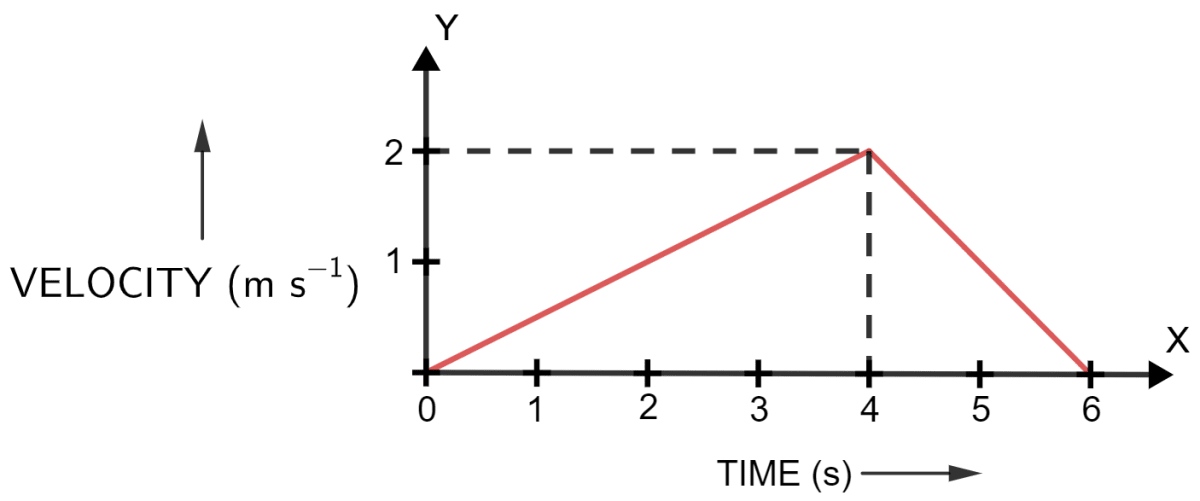
(i) State the nature of motion of particle.
(ii) Find the displacement of particle at t = 6 s.
(iii) Does the particle change its direction of motion?
(iv) Compare the distance travelled by the particle from 0 to 4 s and from 4 s to 6 s.
(v) Find the acceleration from 0 to 4 s and retardation from 4 s to 6 s.
If a body is moving with a uniform retardation, then its acceleration will be:
- Positive
- Negative
- Zero
- Cannot say
A car acquires a velocity of 54 ms-1 in 20 s starting from rest, then its acceleration is:
- 5.4 ms-2
- 2.7 ms-2
- 7.2 ms-2
- 2.0 ms-2