Chemistry
Which of the following about oxides is correct?
- A basic oxide is an oxide of a non-metal
- Acidic oxides contain ionic bonds
- Amphoteric oxides contain a metal
- Basic oxides are always gases
Answer
Amphoteric oxides contain a metal
Reason — Let's analyze each option:
A basic oxide is an oxide of a non-metal: This is incorrect. Basic oxides are typically oxides of metals. For example, calcium oxide (CaO) and magnesium oxide (MgO) are basic oxides, and both contain metals.
Acidic oxides contain ionic bonds: This is incorrect. Acidic oxides are usually covalent compounds. They are generally formed by non-metals, such as sulphur dioxide (SO₂) and carbon dioxide (CO₂), and tend to form acids when dissolved in water.
Amphoteric oxides contain a metal: This is correct. Amphoteric oxides, such as aluminum oxide (Al₂O₃) and zinc oxide (ZnO), contain metals and can react both as acids and bases.
Basic oxides are always gases: This is incorrect. Basic oxides are typically solid at room temperature. For example, calcium oxide (CaO) and magnesium oxide (MgO) are solid basic oxides.
Related Questions
The ratio between the volumes occupied by 4.4 grams of carbon dioxide and 2 grams of hydrogen gas is:
- 2.2 : 1
- 1 : 2.2
- 1 : 10
- 10 : 1
Aqueous lead (II) nitrate can be distinguished from aqueous zinc nitrate by adding any of the following solution in excess, except:
- aqueous potassium chloride
- aqueous sodium sulphate
- dilute sulphuric acid
- sodium hydroxide solution
A student takes Cu, Al, Fe and Zn strips, separately in four test tubes labeled as I, II, III and IV respectively. He adds 10 ml of freshly prepared ferrous sulphate solution to each test tube and observes the colour of the metal residue in each case.
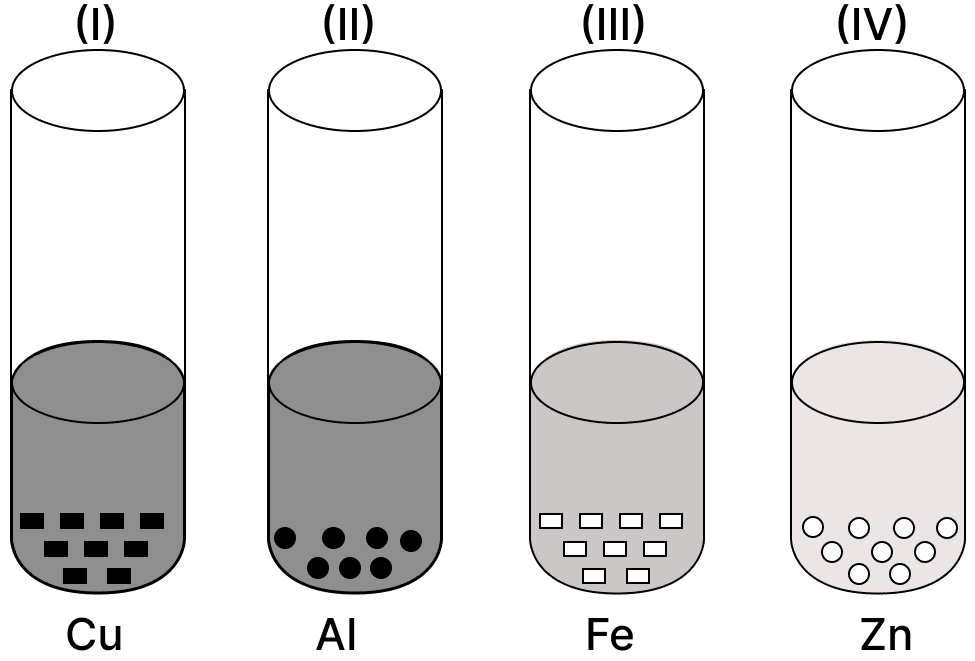
He would observe a black residue in the test tubes:
- (I) and (II)
- (I) and (III)
- (II) and (III)
- (II) and (IV)
Electroplating steel objects with silver involves a three-step process.
Step 1 — A coating of copper is applied to the object.
Step 2 — A coating of nickel is applied to the object.
Step 3 — The coating of silver is applied to the object.
(a) A diagram of the apparatus used for step 1 is shown.

The chemical process taking place on the surface of the object is
Cu2+(aq) + 2e- ⟶ Cu (s)
What is the observation seen on the surface of the object?Explain why the concentration of copper ions in the electrolyte remains constant throughout step 1.
(b) Give two changes which would be needed in order to coat nickel onto the object in step 2.
(c) Write down the reaction taking place at the positive electrode during step 3.