Mathematics
Which of the following pairs of triangles are congruent ? In each case, state the condition of congruency :
(a) In △ ABC and △ DEF, AB = DE, BC = EF and ∠B = ∠E.
(b) In △ ABC and △ DEF, ∠B = ∠E = 90°; AC = DF and BC = EF.
(c) In △ ABC and △ QRP, AB = QR, ∠B = ∠R and ∠C = ∠P.
(d) In △ ABC and △ PQR, AB = PQ, AC = PR and BC = QR.
(e) In △ ABC and △ PQR, BC = QR, ∠A = 90°, ∠C = ∠R = 40° and ∠Q = 50°.
Triangles
26 Likes
Answer
(a) Given,
In △ ABC and △ DEF,
⇒ AB = DE
⇒ BC = EF
⇒ ∠B = ∠E
∴ △ ABC ≅ △ DEF (By S.A.S. axiom)
Hence, △ ABC and △ DEF are congruent by S.A.S. axiom.
(b) Given,
In △ ABC and △ DEF,
⇒ AC = DF
⇒ BC = EF
⇒ ∠B = ∠E (Both equal to 90°)
∴ △ ABC ≅ △ DEF (By R.H.S. axiom)
Hence, △ ABC and △ DEF are congruent by R.H.S. axiom.
(c) Given,
In △ ABC and △ QRP,
⇒ AB = QR
⇒ ∠B = ∠R
⇒ ∠C = ∠P
∴ △ ABC ≅ △ QRP (By A.A.S. or A.S.A. axiom)
Hence, △ ABC and △ DEF are congruent by A.A.S. or A.S.A. axiom.
(d) Given,
In △ ABC and △ PQR,
⇒ AB = PQ
⇒ AC = PR
⇒ BC = QR
∴ △ ABC ≅ △ PQR (By S.S.S. axiom)
Hence, △ ABC and △ PQR are congruent by S.S.S. axiom.
(e) In △ ABC,
⇒ ∠A + ∠B + ∠C = 180°
⇒ 90° + ∠B + 40° = 180°
⇒ ∠B + 130° = 180°
⇒ ∠B = 180° - 130° = 50°.
In △ ABC and △ PQR,
⇒ BC = QR (Given)
⇒ ∠B = ∠Q (Both equal to 50°)
⇒ ∠C = ∠R (Both equal to 40°)
∴ △ ABC ≅ △ PQR (By A.S.A. axiom)
Hence, △ ABC and △ PQR are congruent by A.S.A. axiom.
Answered By
17 Likes
Related Questions
Assertion (A): If PQ = PR, ΔPQS ≅ ΔPRT
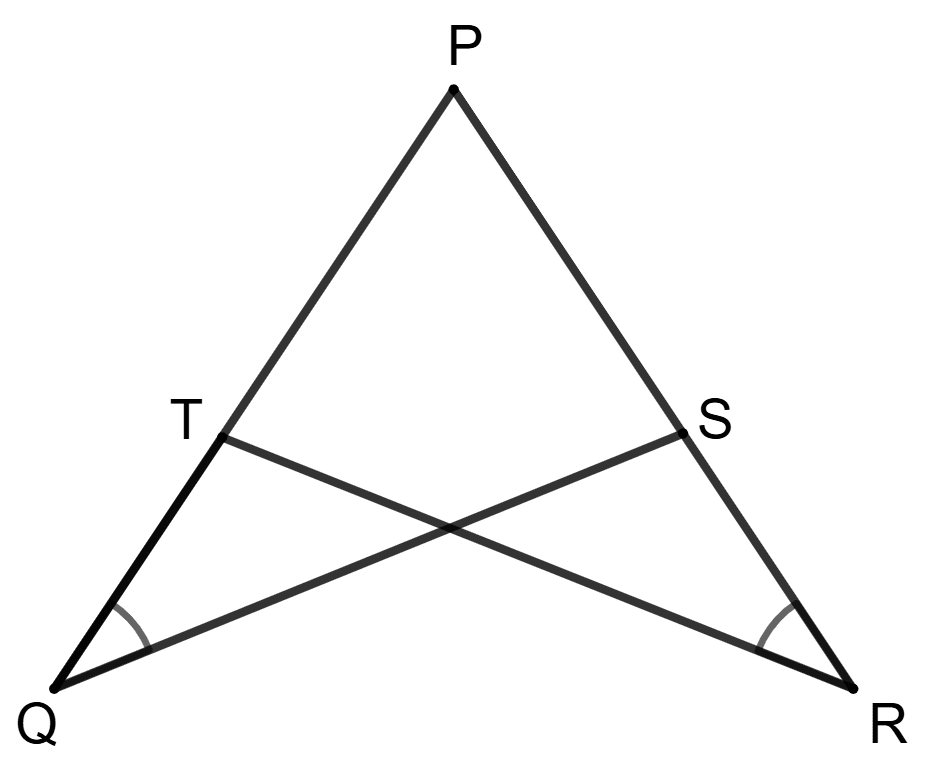
Reason (R): PQ = PR, ∠P = ∠P and ∠Q = ∠R
A is true, but R is false.
A is false, but R is true.
Both A and R are true and R is the correct reason for A.
Both A and R are true and R is the incorrect reason for A.
Assertion (A): ΔABD ≅ ΔACE
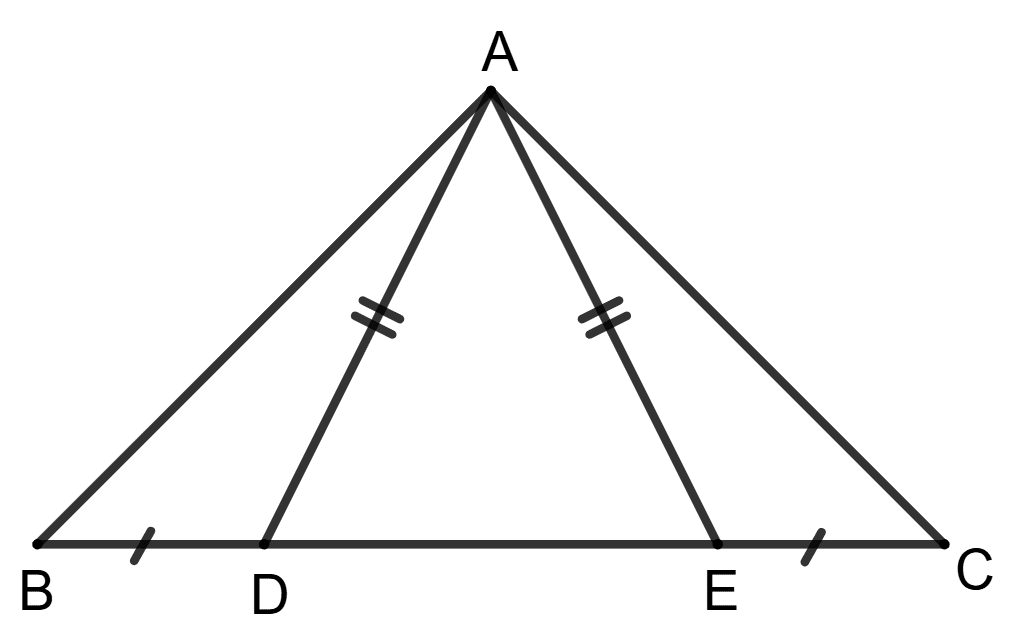
Reason (R): ∠ADE + ∠ADB = ∠AEC + ∠AED
But AD = AE
⇒ ∠ADE = ∠AED
∴ ∠ADB = ∠AEC
⇒ ∠ABD ≅ ∠AEC
A is true, but R is false.
A is false, but R is true.
Both A and R are true and R is the correct reason for A.
Both A and R are true and R is the incorrect reason for A.
In quadrilateral ABCD, AB = AD and CB = CD. Prove that AC is perpendicular bisector of BD.
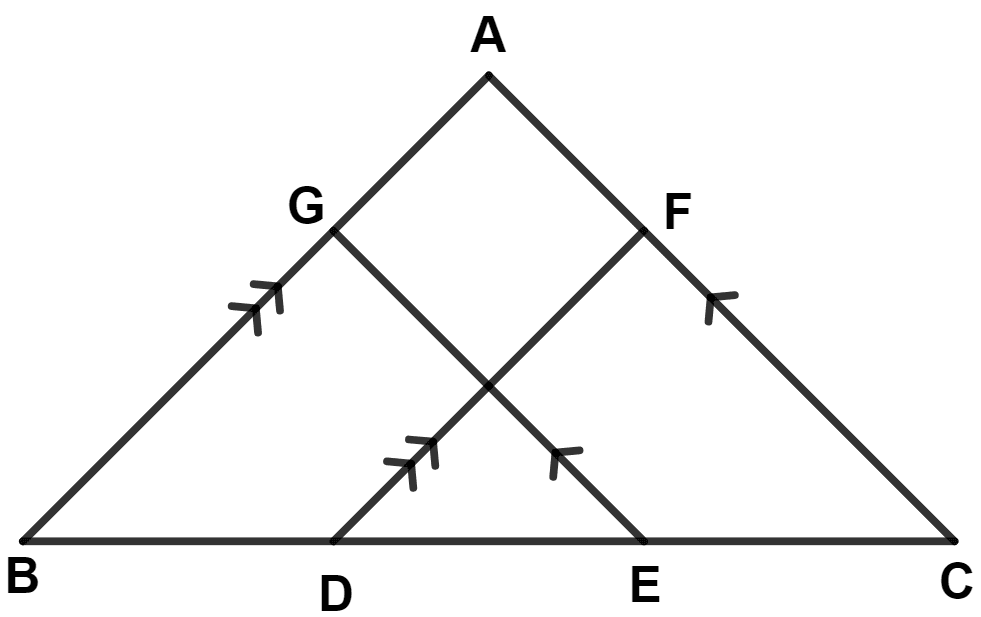
In the given figure : AB // FD, AC // GE and BD = CE; prove that :
(i) BG = DF
(ii) CF = EG.