
History & Civics
With reference to the Reformation Movement, answer the following:
(a) Mention any three Church practices that caused dissatisfaction among the people?
(b) How did New Learning become a factor that led to the Reformation?
(c) Who were the Protestants? By what other names was Protestantism known?
Reformation
254 Likes
Answer
(a) Three Church practice — that caused dissatisfaction among the people were:
- Economic Factors — In the middle ages, the Church had vast properties, which gave ample income to the Church. Besides, one-tenth of the income of a person was given to the Church. This was called the tithe. In addition to this, the clergy collected another sum called the 'Peter's Pence' from the people. The Church also started selling 'Letter of Indulgence'. These were pardon certificates remitting punishments of the sinners who bought them, both in this life and after their death.
- Corruption in the Church — With passage of time, moral decay crept into some areas in the functioning of the Church. Some of the clergymen lacked proper education and lived a life of luxury neglecting their religious duties. They could pronounce a marriage lawful or unlawful. There were fees for every transaction in life, from birth to death.
- Rulers' Resentment — Pope's interference in the political affairs was naturally opposed by the kings. They strongly supported the Reformation Movement in order to weaken the Church.
(b) The spread of new learning and spirit of enquiry was developed by Renaissance scholars. The invention of printing press and the printing of the Bible in vernacular languages brought a new outlook among laymen. The Renaissance encouraged spirit of enquiry, developed critical attitude space and broadened the mental outlook of man. People then began to question everything including the authority of the Pope. They criticised the Church practices, rituals and the lifestyles of some of the clergymen. The changed attitude of people finally led to outbreak of Reformation movement.
(c) The Reformation permanently split the Christian Church into two main groups: Roman Catholics, who remained loyal to the Pope in Rome, and Protestants, who broke away.
Although the Protestant movement erupted across multiple countries—including Germany, England, France, Switzerland, Scotland, and Czechoslovakia—the reformers were not entirely unified. They developed diverse religious beliefs and rituals, leading to distinct branches of Protestantism, such as:
- Calvinism, originating in Switzerland
- Presbyterianism, in Scotland
- Puritanism, in England
Answered By
163 Likes
Related Questions
What was Counter Reformation?
What was the role of the Council of Trent in Counter Reformation?
Study the picture given below and answer the following questions.
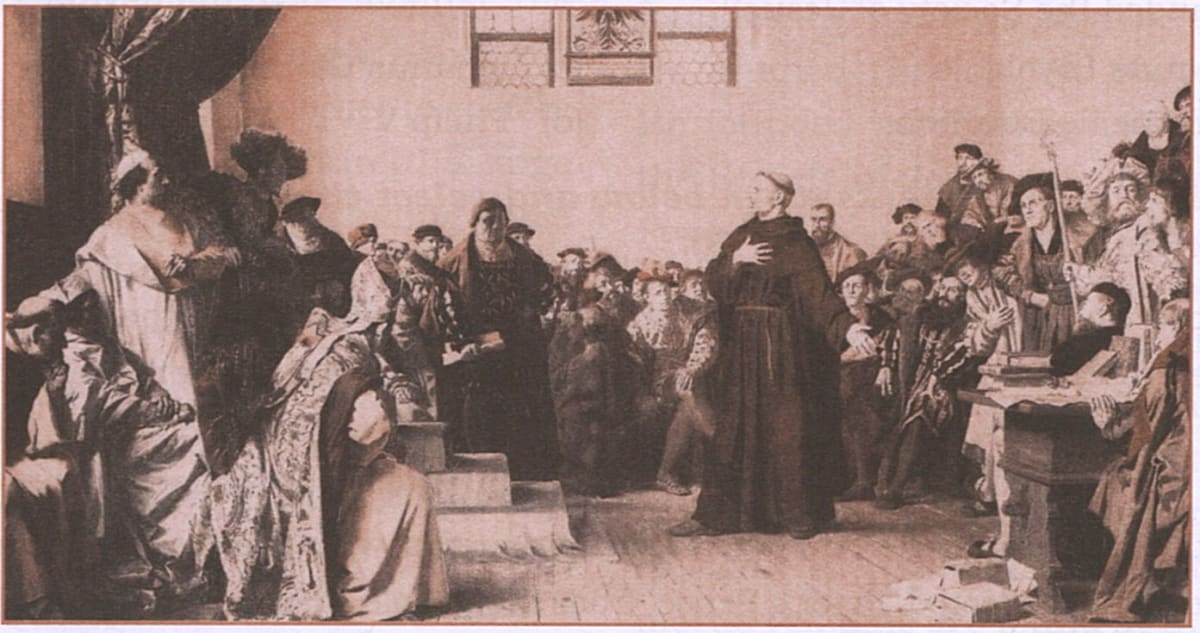
(a) Identify the incident in the picture. Where was it held?
(b) Name the person who was there to defend his case. What was the final outcome of the case?
(c) State the contribution of this person in reforming the church in Europe
Imagine you are Martin Luther, draft a speech that you would give to defend yourself at the Diet of Worms.