KnowledgeBoat Logo
|
OPEN IN APP

Chapter 17

Circles

Class - 10 Concise Mathematics Selina


Exercise 17(A)

Question 1(a)

In the given figure, O is center of the circle and ∠B = 55°. The angle A is equal to :

  1. 55°

  2. 35°

  3. 45°

  4. 50°

In the given figure, O is center of the circle and ∠B = 55°. The angle A is equal to : Circles, Concise Mathematics Solutions ICSE Class 10.

Answer

From figure,

In △ OCB,

OB = OC (Radius of common circle)

We know that,

Angles opposite to equal sides of a triangle are equal.

∴ ∠C = ∠B = 55°

By angle sum property of triangle,

⇒ ∠C + ∠B + ∠O = 180°

⇒ 55° + 55° + ∠O = 180°

⇒ ∠O + 110° = 180°

⇒ ∠O = 180° - 110° = 70°.

We know that,

The angle which an arc subtends at the center is double that which it subtends at any point on the remaining part of the circumference.

⇒ ∠O = 2∠A

⇒ ∠A = O2=70°2\dfrac{∠O}{2} = \dfrac{70°}{2} = 35°.

Hence, Option 2 is the correct option.

Question 1(b)

In the given figure, O is center of the circle and angle OBA = 50°. The angle P is :

  1. 50°

  2. 80°

  3. 40°

  4. 60°

In the given figure, O is center of the circle and angle OBA = 50°. The angle P is : Circles, Concise Mathematics Solutions ICSE Class 10.

Answer

From figure,

In △ OAB,

OA = OB (Radius of common circle)

We know that,

Angles opposite to equal sides of a triangle are equal.

∴ ∠A = ∠B = 50°

By angle sum property of triangle,

⇒ ∠A + ∠B + ∠O = 180°

⇒ 50° + 50° + ∠O = 180°

⇒ ∠O + 100° = 180°

⇒ ∠O = 180° - 100° = 80°.

We know that,

The angle which an arc subtends at the center is double that which it subtends at any point on the remaining part of the circumference.

⇒ ∠O = 2∠P

⇒ ∠P = O2=80°2\dfrac{∠O}{2} = \dfrac{80°}{2} = 40°.

Hence, Option 3 is the correct option.

Question 1(c)

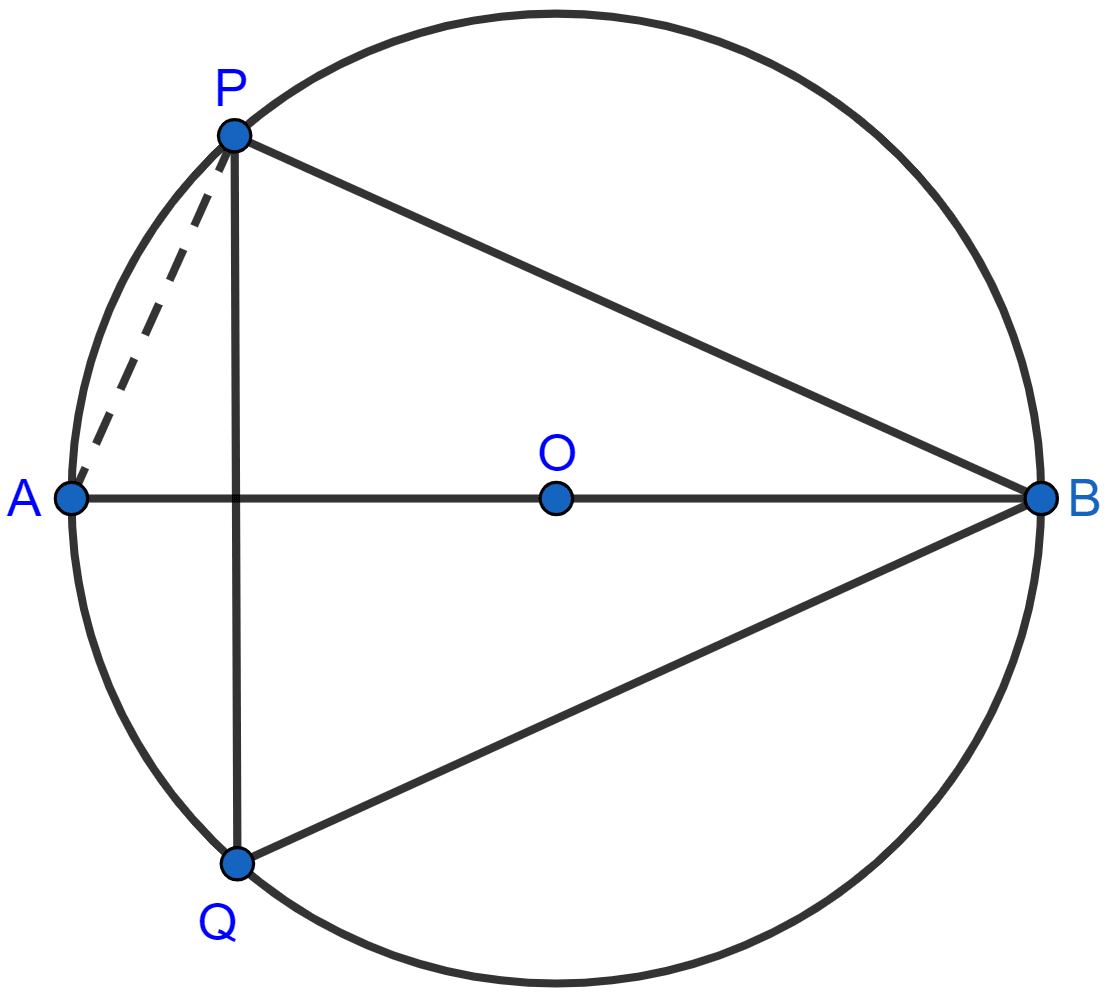
In the given figure, chord AB = chord PB and angle C = 50°. The angle PAB is equal to :

  1. 65°

  2. 50°

  3. 75°

  4. 60°

In the given figure, O is center of the circle and angle OBA = 50°. The angle P is : Circles, Concise Mathematics Solutions ICSE Class 10.

Answer

We know that,

Angle in same segment are equal.

∴ ∠APB = ∠ACB = 50°

In △ PAB,

PB = AB (Given)

We know that,

Angles opposite to equal sides of a triangle are equal.

∴ ∠PAB = ∠APB = 50°.

Hence, Option 2 is the correct option.

Question 1(d)

O' and O" are centers of two circles which intersect each other at points A and B. Then :

  1. BC = BD

  2. BC is larger than BD.

  3. BC is smaller than BD.

  4. C, B and D are collinear.

O' and O'' are centers of two circles which intersect each other at points A and B. Then : Circles, Concise Mathematics Solutions ICSE Class 10.

Answer

We know that,

Angle in semicircle is a right angle.

From figure,

AC and AD are diameter.

∴ ∠ABC = ∠ABD = 90°.

From figure,

⇒ ∠ABC + ∠ABD = 90° + 90° = 180°.

∴ CBD is a straight line, or points C, B and D are collinear.

Hence, Option 4 is the correct option.

Question 1(e)

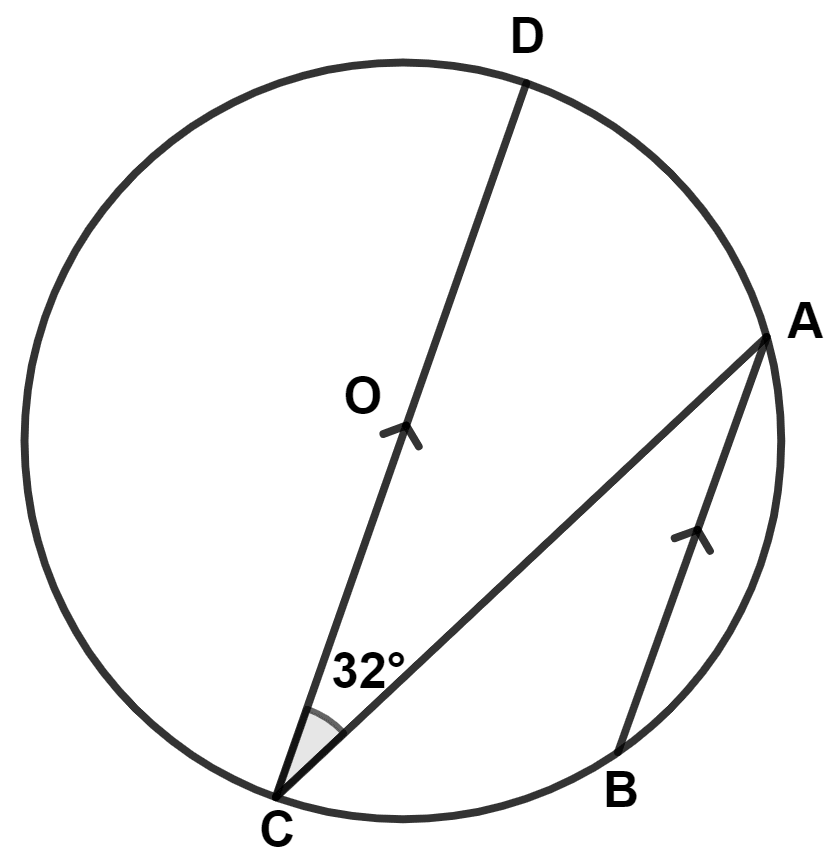
In the given figure, O is center of the circle, AB || DC and ∠ACD = 32°, ∠DAB is equal to :

  1. 122°

  2. 148°

  3. 90°

  4. none of the above

In the given figure, O is center of the circle, AB || DC and ∠ACD = 32°, ∠DAB is equal to : Circles, Concise Mathematics Solutions ICSE Class 10.

Answer

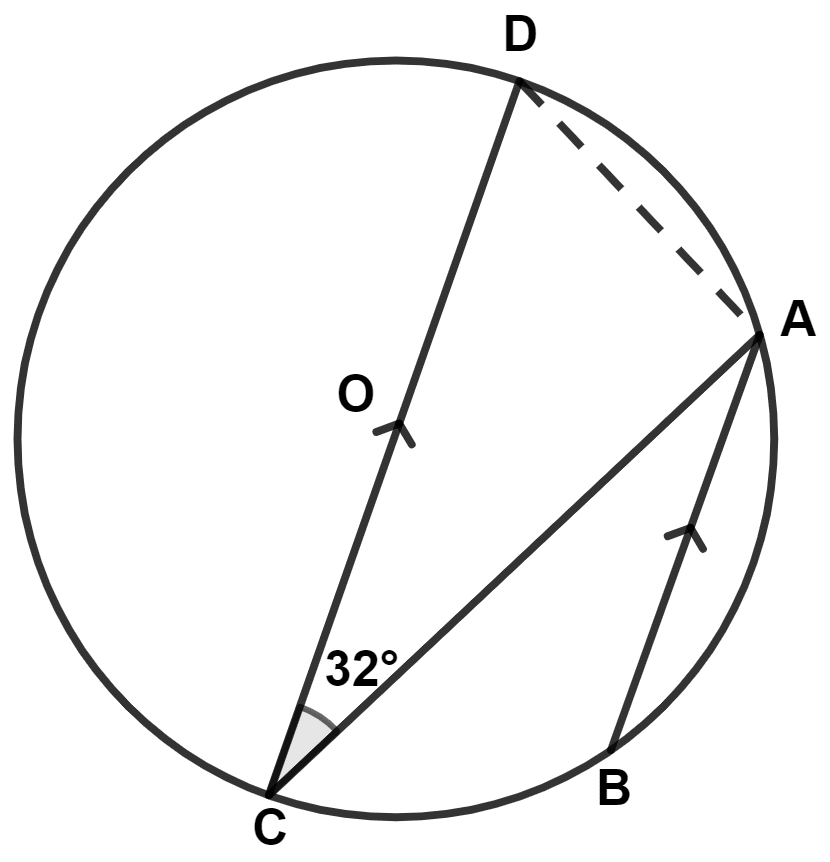
Join DA.

From figure,

In the given figure, O is center of the circle, AB || DC and ∠ACD = 32°, ∠DAB is equal to : Circles, Concise Mathematics Solutions ICSE Class 10.

In △DAC,

∠DAC = 90° (Angle in semicircle is a right angle)

As, alternate angles are equal.

∴ ∠CAB = ∠ACD = 32°

From figure,

∠DAB = ∠DAC + ∠CAB = 90° + 32° = 122°.

Hence, Option 1 is the correct option.

Question 2

In the given figure, ∠BAD = 65°, ∠ABD = 70°, ∠BDC = 45°

(i) Prove that AC is a diameter of the circle.

(ii) Find ∠ACB

In the given figure, ∠BAD = 65°, ∠ABD = 70°, ∠BDC = 45°. Prove that AC is a diameter of the circle. Find ∠ACB. Circles, Concise Mathematics Solutions ICSE Class 10.

Answer

(i) In ∆ABD,

⇒ ∠DAB + ∠ABD + ∠ADB = 180° [Angle sum property of a triangle]

⇒ 65° + 70° + ∠ADB = 180°

⇒ 135° + ∠ADB = 180°

⇒ ∠ADB = 180° - 135° = 45°

From figure,

⇒ ∠ADC = ∠ADB + ∠BDC = 45° + 45° = 90°.

As the angle in a semicircle is a right angle,

∴ Arc ADC is semi-circle and AC is the diameter.

Hence, proved that AC is the diameter.

(ii) We know that,

Angles in the same segment of a circle are equal.

∴ ∠ACB = ∠ADB = 45°.

Hence, ∠ACB = 45°.

Question 3(i)

In the following figure, O is the center of the circle. Find the value of a.

In the following figure, O is the center of the circle. Find the value of a. Circles, Concise Mathematics Solutions ICSE Class 10.

Answer

We know that,

Angle in semi-circle is a right angle.

∴ ∠BAD = 90°

From figure,

⇒ ∠BAD + ∠ADB + ∠DBA = 180°

⇒ 90° + ∠ADB + 35° = 180°

⇒ ∠ADB + 125° = 180°

⇒ ∠ADB = 180° - 125° = 55°.

We know that,

Angles subtended by the same chord on the circle are equal.

∴ a = ∠ADB = 55°.

Hence, a = 55°.

Question 3(ii)

In the following figure, O is the center of the circle. Find the value of b.

In the following figure, O is the center of the circle. Find the value of b. Circles, Concise Mathematics Solutions ICSE Class 10.

Answer

Mark the point of intersection of AC and BD as E:

In the following figure, O is the center of the circle. Find the value of b. Circles, Concise Mathematics Solutions ICSE Class 10.

Since, AC is a straight line.

∴ ∠AEB + ∠BEC = 180°

⇒ 120° + ∠BEC = 180°

⇒ ∠BEC = 180° - 120° = 60°.

In △BEC,

⇒ ∠BEC + ∠ECB + ∠CBE = 180°

⇒ 60° + ∠ECB + 25° = 180°

⇒ ∠ECB + 85° = 180°

⇒ ∠ECB = 180° - 85° = 95°.

We know that,

Angles subtended by the same chord on the circle are equal.

∴ b = ∠ACB

From figure,

∠ACB = ∠ECB = 95°.

Hence, b = 95°.

Question 3(iii)

In the following figure, O is the center of the circle. Find the value of c.

In the following figure, O is the center of the circle. Find the value of c. Circles, Concise Mathematics Solutions ICSE Class 10.

Answer

We know that,

Angle which an arc subtends at the center is double that which it subtends at any point on the remaining part of the circumference.

∠AOB = 2∠ACB = 2 x 50° = 100°.

Also, OA = OB = radius of circle.

∴ ∠OBA = ∠OAB = c [As angles opposite to equal sides are equal]

In △OAB,

⇒ ∠OAB + ∠AOB + ∠OBA = 180°

⇒ 2∠OAB + 100° = 180° [∵ ∠OBA = ∠OAB and ∠AOB = 100°]

⇒ 2c + 100° = 180°

⇒ 2c = 180° - 100°

⇒ 2c = 80°

⇒ c = 802\dfrac{80}{2} = 40°.

Hence, c = 40°.

Question 3(iv)

In the following figure, O is the center of the circle. Find the value of d.

In the following figure, O is the center of the circle. Find the value of d. Circles, Concise Mathematics Solutions ICSE Class 10.

Answer

We know that,

Angle in semi-circle is a right angle.

∴ ∠APB = 90°

In △APB,

⇒ ∠APB + ∠PBA + ∠PAB = 180°

⇒ 90° + 45° + ∠PAB = 180°

⇒ ∠PAB = 180° - 135° = 45°.

We know that,

Angles subtended by the same chord on the circle are equal.

∴ d = ∠PAB = 45°.

Hence, d = 45°.

Question 4

Calculate:

(i) ∠CDB,

(ii) ∠ABC,

(iii) ∠ACB.
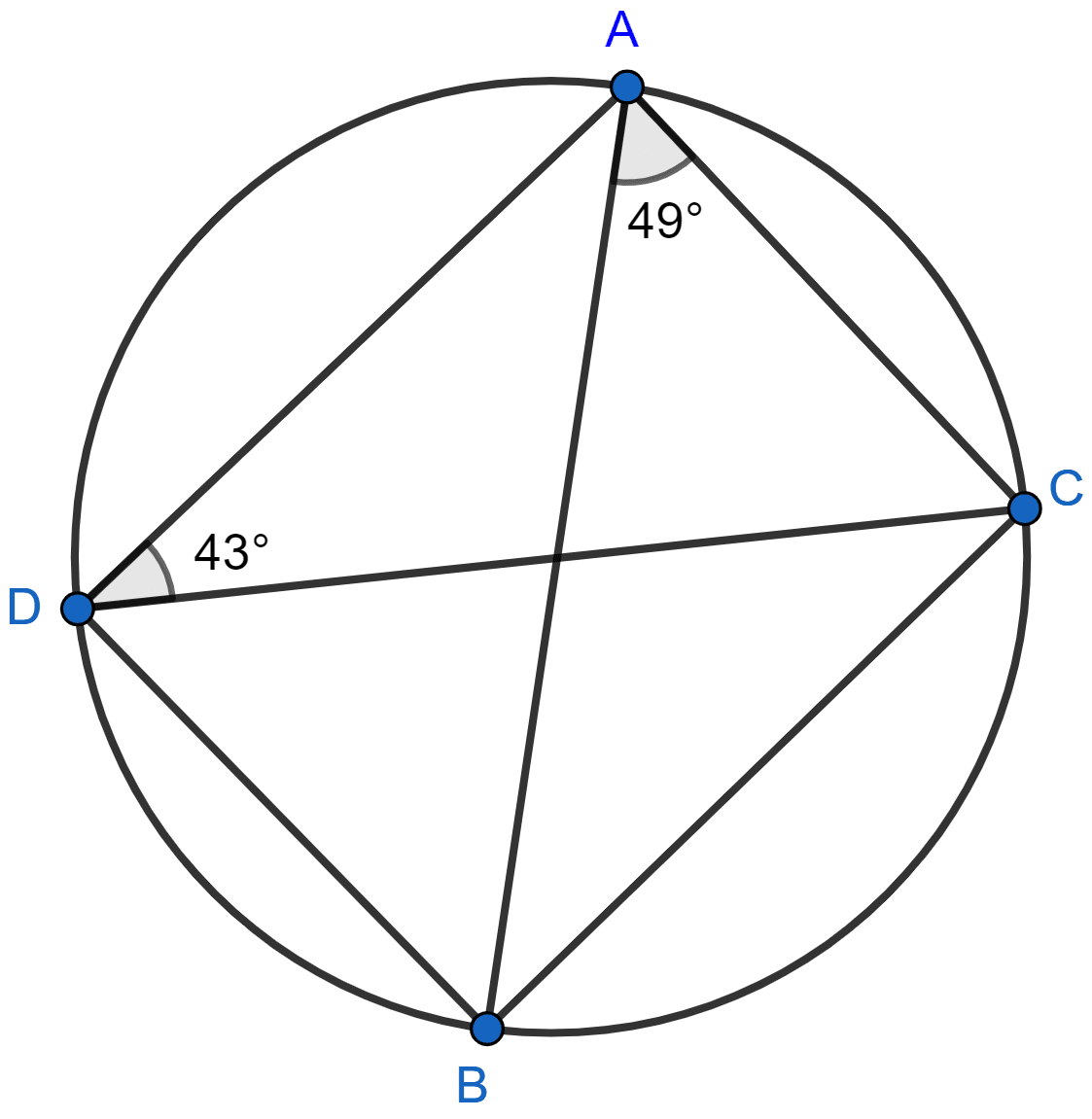
Calculate ∠CDB, ∠ABC, ∠ACB. Circles, Concise Mathematics Solutions ICSE Class 10.

Answer

(i) We know that,

Angles subtended by the same chord on the circle are equal.

∴ ∠CDB = ∠BAC = 49°.

Hence, ∠CDB = 49°.

(ii) We know that,

Angles subtended by the same chord on the circle are equal.

∠ABC = ∠ADC = 43°.

Hence, ∠ABC = 43°.

(iii) In △ABC,

⇒ ∠ABC + ∠ACB + ∠BAC = 180°

⇒ 43° + ∠ACB + 49° = 180°

⇒ ∠ACB + 92° = 180°

⇒ ∠ACB = 180° - 92° = 88°.

Hence, ∠ACB = 88°.

Question 5

Given: ∠CAB = 75° and ∠CBA = 50°. Find the value of ∠DAB + ∠ABD.

Given: ∠CAB = 75° and ∠CBA = 50°. Find the value of ∠DAB + ∠ABD. Circles, Concise Mathematics Solutions ICSE Class 10.

Answer

In ∆ABC, by angle sum property we have

⇒ ∠ACB + ∠CBA + ∠CAB = 180°

⇒ ∠ACB + 50° + 75° = 180°

⇒ ∠ACB + 125° = 180°

⇒ ∠ACB = 180° - 125° = 55°.

We know that,

Angles subtended by the same chord on the circle are equal.

⇒ ∠ADB = ∠ACB = 55°.

Now, taking ∆ABD

⇒ ∠DAB + ∠ABD + ∠ADB = 180° [Angle sum property]

⇒ ∠DAB + ∠ABD + 55° = 180°

⇒ ∠DAB + ∠ABD = 180° - 55°

⇒ ∠DAB + ∠ABD = 125°

Hence, ∠DAB + ∠ABD = 125°.

Question 6

In the figure given alongside, AOB is a diameter of the circle and ∠AOC = 110°, find ∠BDC.

In the figure, AOB is a diameter of the circle and ∠AOC = 110°, find ∠BDC. Circles, Concise Mathematics Solutions ICSE Class 10.

Answer

Join AD.

In the figure, AOB is a diameter of the circle and ∠AOC = 110°, find ∠BDC. Circles, Concise Mathematics Solutions ICSE Class 10.

We know that,

Angle at the center is double the angle at the circumference subtended by the same chord.

∠ADC = 12\dfrac{1}{2}∠AOC = 12\dfrac{1}{2} x 110° = 55°.

Also, we know that

Angle in the semi-circle is a right angle.

∠ADB = 90°

From figure,

∠BDC = ∠BDA - ∠ADC = 90° - 55° = 35°.

Hence, ∠BDC = 35°.

Question 7

In the following figure, O is the centre of the circle, ∠AOB = 60° and ∠BDC = 100°. Find ∠OBC.

In the following figure, O is the centre of the circle, ∠AOB = 60° and ∠BDC = 100°. Find ∠OBC. Circles, Concise Mathematics Solutions ICSE Class 10.

Answer

We know that,

Angle at the centre is double the angle at the circumference subtended by the same chord.

∠ACB = 12\dfrac{1}{2}∠AOB = 12×60°\dfrac{1}{2} \times 60° = 30°.

In △BDC,

⇒ ∠BDC + ∠DCB + ∠CBD = 180° [Angle sum property]

⇒ 100° + 30° + ∠CBD = 180° [From figure, ∠DCB = ∠ACB]

⇒ ∠CBD + 130° = 180°

⇒ ∠CBD = 180° - 130° = 50°.

From figure,

⇒ ∠OBC = ∠CBD = 50°.

Hence, ∠OBC = 50°.

Question 8

In cyclic quadrilateral ABCD, ∠DAC = 27°; ∠DBA = 50° and ∠ADB = 33°. Calculate :

(i) ∠DBC,

(ii) ∠DCB,

(iii) ∠CAB.

In cyclic quadrilateral ABCD, ∠DAC = 27°; ∠DBA = 50° and ∠ADB = 33°. Calculate ∠DBC, ∠DCB, ∠CAB. Circles, Concise Mathematics Solutions ICSE Class 10.

Answer

(i) We know that,

Angles in same segment are equal.

∠DBC = ∠DAC = 27°.

Hence, ∠DBC = 27°.

(ii) We know that,

Angles in same segment are equal.

∠ACB = ∠ADB = 33°.

and,

∠ACD = ∠ABD = 50°.

From figure,

⇒ ∠DCB = ∠ACD + ∠ACB = 50° + 33° = 83°.

Hence, ∠DCB = 83°.

(iii) In quad. ABCD,

⇒ ∠DAB + ∠DCB = 180° [As sum of opposite angles in a cyclic quadrilateral = 180°]

⇒ ∠DAC + ∠CAB + ∠DCB = 180°

⇒ 27° + 83° + ∠CAB = 180°

⇒ ∠CAB + 110° = 180°

⇒ ∠CAB = 180° - 110° = 70°.

Hence, ∠CAB = 70°.

Question 9

In the figure given alongside, AB and CD are straight lines through the centre O of a circle. If ∠AOC = 80° and ∠CDE = 40°, find the number of degrees in :

(i) ∠DCE,

(ii) ∠ABC.
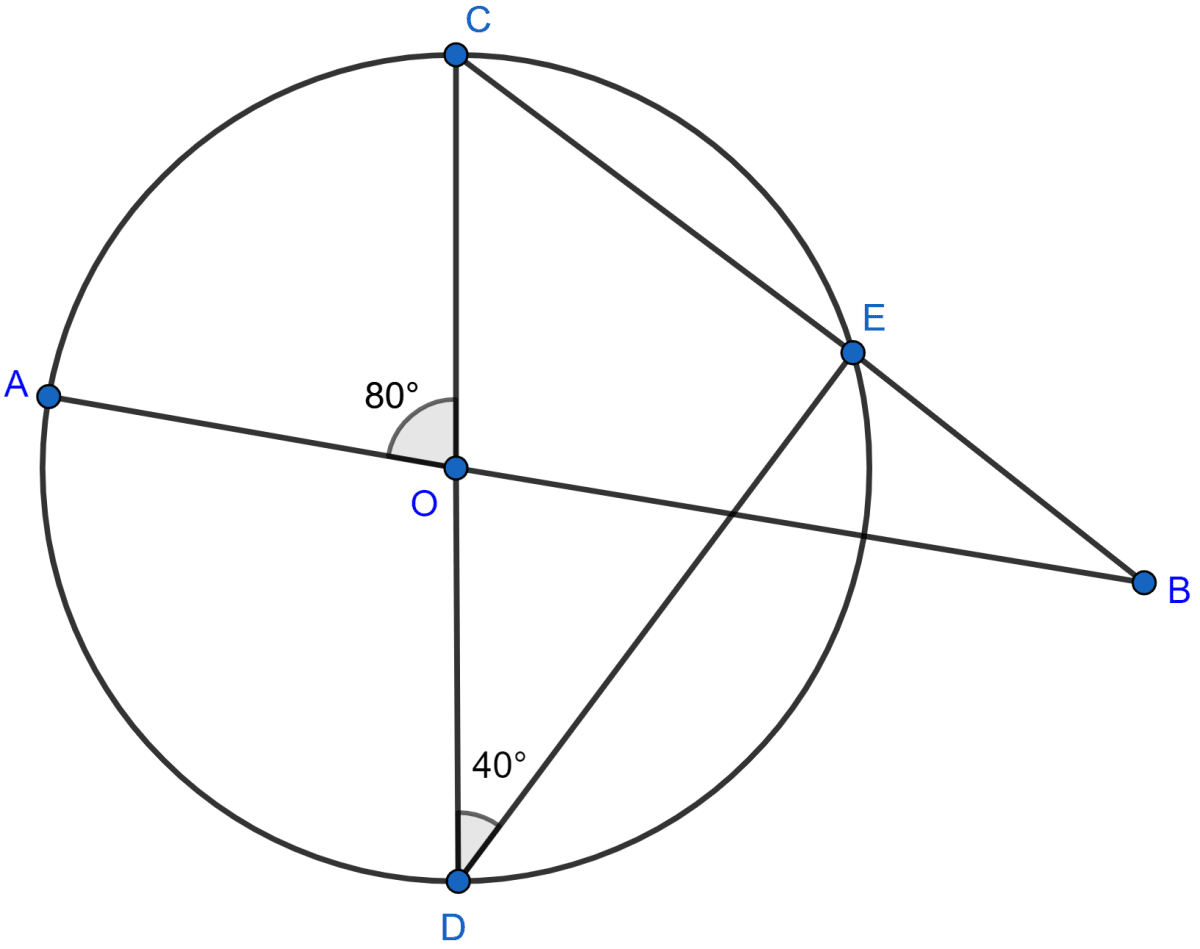
In the figure given alongside, AB and CD are straight lines through the centre O of a circle. If ∠AOC = 80° and ∠CDE = 40°, find the number of degrees in ∠DCE, ∠ABC. Circles, Concise Mathematics Solutions ICSE Class 10.

Answer

(i) From figure,

∠CED = 90° [As angle in semi-circle = 90°]

In △CED,

⇒ ∠CED + ∠CDE + ∠DCE = 180° [By angle sum property of triangle]

⇒ 90° + 40° + ∠DCE = 180°

⇒ ∠DCE + 130° = 180°

⇒ ∠DCE = 180° - 130° = 50°.

Hence, ∠DCE = 50°.

(ii) We know that,

An exterior angle is equal to sum of two opposite interior angles.

In ∆BOC,

⇒ ∠AOC = ∠OCB + ∠OBC

⇒ ∠OBC = ∠AOC - ∠OCB

⇒ ∠OBC = ∠AOC - ∠DCE

⇒ ∠OBC = 80° - 50° = 30°.

From figure,

∠ABC = ∠OBC = 30°.

Hence, ∠ABC = 30°.

Question 10

In the figure given alongside, AB || CD and O is the center of the circle. If ∠ADC = 25°; find the angle AEB. Give reasons in support of your answer.

In the figure, AB || CD and O is the center of the circle. If ∠ADC = 25°; find the angle AEB. Give reasons in support of your answer. Circles, Concise Mathematics Solutions ICSE Class 10.

Answer

Join AC, BD and CB.

In the figure, AB || CD and O is the center of the circle. If ∠ADC = 25°; find the angle AEB. Give reasons in support of your answer. Circles, Concise Mathematics Solutions ICSE Class 10.

As angle is a semicircle is a right angle.

∴ ∠CAD = 90° and ∠CBD = 90°

Given, AB || CD

So, ∠BAD = ∠ADC = 25° [Alternate angles are equal]

From figure,

∠BAC = ∠BAD + ∠CAD = 25° + 90° = 115°.

Sum of opposite angles in a cyclic quadrilateral = 180°.

In quadrilateral ACDB,

⇒ ∠CDB + ∠BAC = 180°

⇒ ∠CDA + ∠ADB + ∠BAC = 180°

⇒ 25° + ∠ADB + 115° = 180°

⇒ ∠ADB = 180° - 115° - 25° = 40°.

As angles in same segment are equal.

∴ ∠AEB = ∠ADB = 40°.

Hence, ∠AEB = 40°.

Question 11

AB is a diameter of the circle APBR as shown in the figure. APQ and RBQ are straight lines. Find :

(i) ∠PRB,

(ii) ∠PBR,

(iii) ∠BPR.
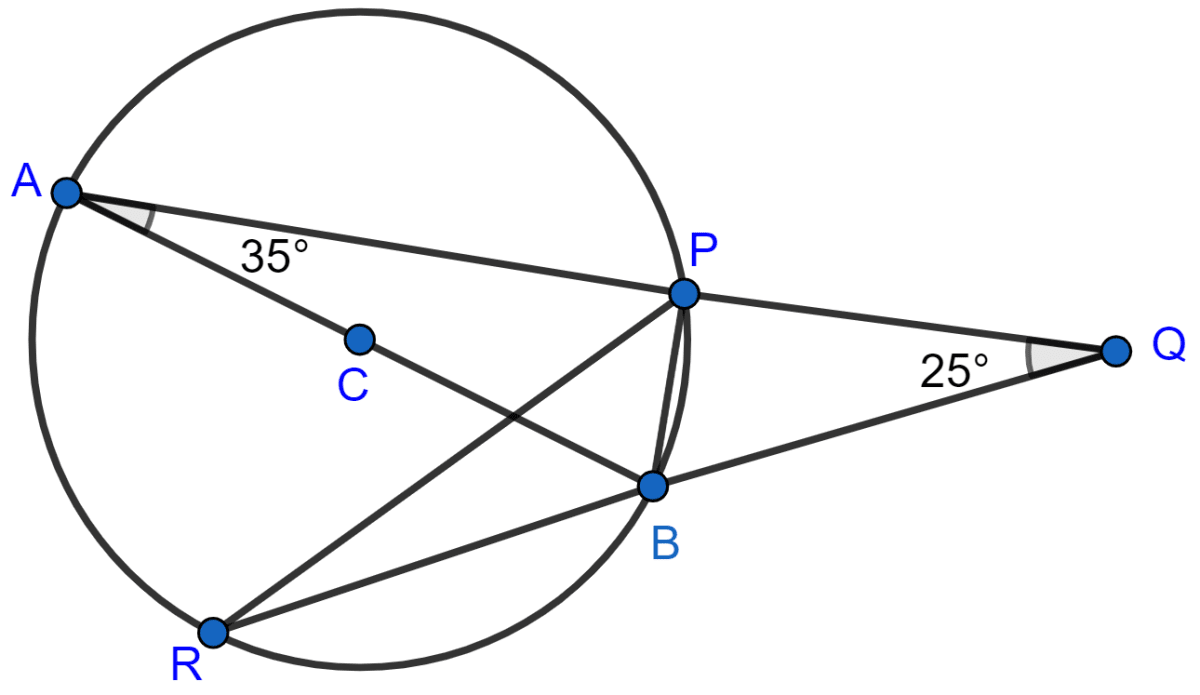
AB is a diameter of the circle APBR as shown in the figure. APQ and RBQ are straight lines. Find ∠PRB, ∠PBR, ∠BPR. Circles, Concise Mathematics Solutions ICSE Class 10.

Answer

(i) We know that,

Angles in same segment are equal.

∠PRB = ∠PAB = 35°.

Hence, ∠PRB = 35°.

(ii) From figure,

∠BPA = 90° [Angle in semi-circle is a right angle.]

⇒ ∠BPA + ∠BPQ = 180° [Linear pairs]

⇒ 90° + ∠BPQ = 180°

⇒ ∠BPQ = 180° - 90° = 90°.

Exterior angle of a triangle is equal to the sum of two opposite interior angles.

⇒ ∠PBR = ∠BPQ + ∠BQP = 90° + 25° = 115°.

Hence, ∠PBR = 115°.

(iii) In △ABP,

⇒ ∠BPA + ∠PAB + ∠ABP = 180°

⇒ 90° + 35° + ∠ABP = 180°

⇒ 125° + ∠ABP = 180°

⇒ ∠ABP = 180° - 125° = 55°.

From figure,

∠ABR = ∠PBR - ∠ABP = 115° - 55° = 60°.

∠APR = ∠ABR = 60°. [Angles in same segment are equal]

In △BPR,

⇒ ∠BPR + ∠PRB + ∠PBR = 180°

⇒ ∠BPR + 35° + 115° = 180°

⇒ 150° + ∠BPR = 180°

⇒ ∠BPR = 180° - 150° = 30°.

Hence, ∠BPR = 30°.

Question 12

In the given figure, A is the center of the circle, ABCD is a parallelogram and CDE is a straight line. Prove that : ∠BCD = 2∠ABE.
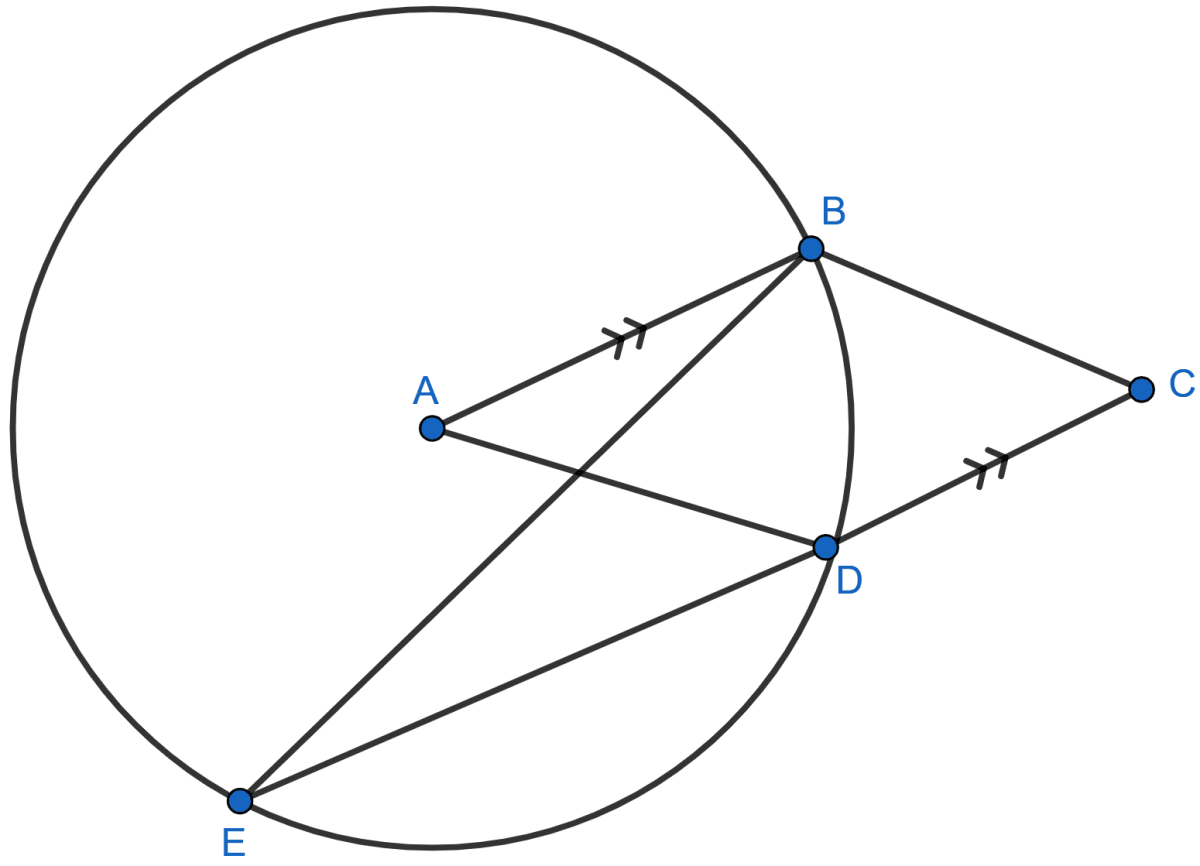
In the given figure, A is the center of the circle, ABCD is a parallelogram and CDE is a straight line. Prove that : ∠BCD = 2∠ABE. Circles, Concise Mathematics Solutions ICSE Class 10.

Answer

∠BAD = 2∠BED [Angle at the center is double the angle at the circumference subtended by the same chord.]

Since, CDE is a straight line and CD || AB.

∴ AB || ED.

⇒ ∠BED = ∠ABE [Alternate angles are equal]

Multiplying above equation by 2 we get,

⇒ 2∠BED = 2∠ABE

⇒ ∠BAD = 2∠ABE ...............(1)

ABCD is a parallelogram.

⇒ ∠BAD = ∠BCD [Opposite angles of a paralellogram are equal] ..........(2)

From (1) and (2) we get,

⇒ ∠BCD = 2∠ABE.

Hence, proved that ∠BCD = 2∠ABE.

Question 13

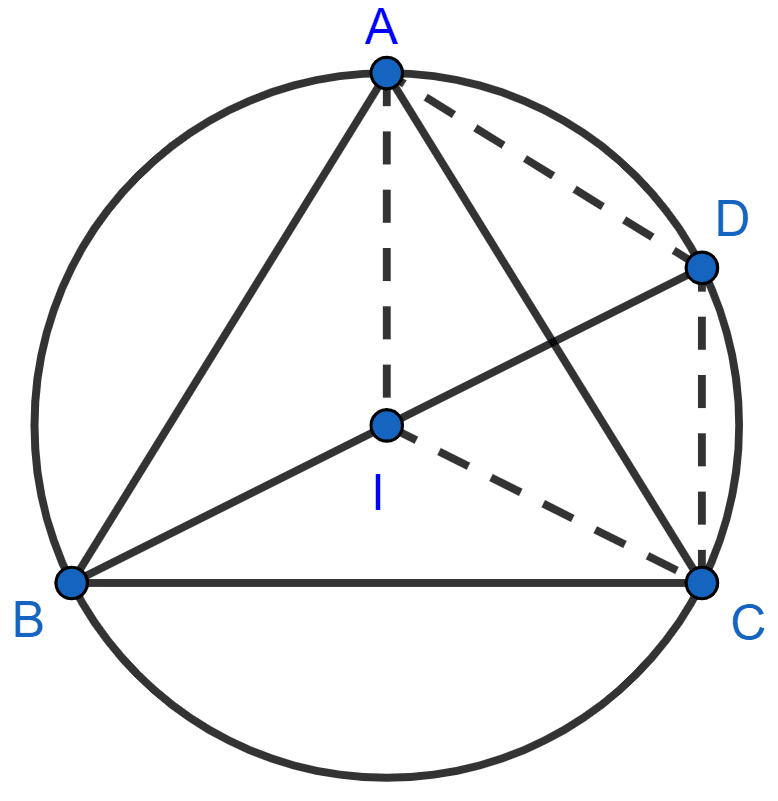
In the given figure, I is the incenter of △ABC, BI when produced meets the circumcircle of △ABC at D. Given, ∠BAC = 55° and ∠ACB = 65°; calculate :

(i) ∠DCA,

(ii) ∠DAC,

(iii) ∠DCI,

(iv) ∠AIC.
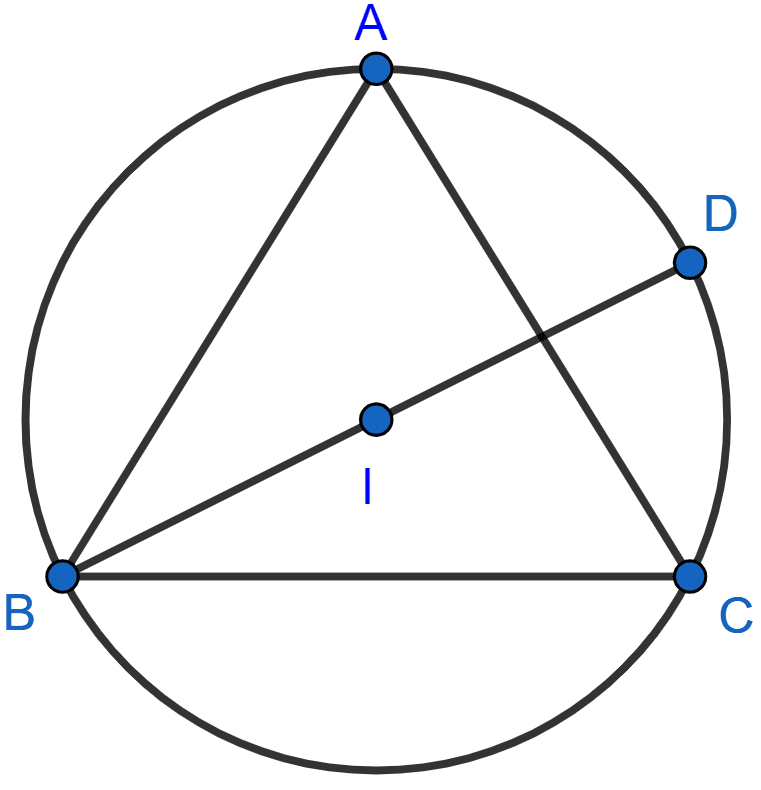
In the figure, I is the incenter of △ABC, BI when produced meets the circumcircle of △ABC at D. Given, ∠BAC = 55° and ∠ACB = 65°; calculate : ∠DCA, ∠DAC, ∠DCI, ∠AIC. Circles, Concise Mathematics Solutions ICSE Class 10.

Answer

(i) Join IA, IC and CD.

In the figure, I is the incenter of △ABC, BI when produced meets the circumcircle of △ABC at D. Given, ∠BAC = 55° and ∠ACB = 65°; calculate : ∠DCA, ∠DAC, ∠DCI, ∠AIC. Circles, Concise Mathematics Solutions ICSE Class 10.

In △ABC,

⇒ ∠ABC + ∠BAC + ∠ACB = 180°

⇒ ∠ABC + 55° + 65° = 180°

⇒ ∠ABC + 120° = 180°

⇒ ∠ABC = 180° - 120° = 60°.

IB is the bisector of ∠ABC [As I is the incenter].

∠ABD = 12\dfrac{1}{2}∠ABC = 12\dfrac{1}{2} x 60° = 30°.

We know that,

Angle in same segment are equal.

∴ ∠DCA = ∠ABD = 30°.

Hence, ∠DCA = 30°.

(ii) ∠CBD = ∠ABD = 30° [As IB is bisector of ∠ABC]

We know that,

Angle in same segment are equal.

∴ ∠DAC = ∠CBD = 30°.

Hence, ∠DAC = 30°.

(iii) As CI is the angle bisector of ∠ACB.

∠ACI = 12\dfrac{1}{2}∠ACB = 12×65°\dfrac{1}{2} \times 65° = 32.5°

From figure,

∠DCI = ∠DCA + ∠ACI = 30° + 32.5° = 62.5°

Hence, ∠DCI = 62.5°.

(iv) As AI is the angle bisector of ∠BAC.

∠IAC = 12\dfrac{1}{2}∠BAC = 12×55°\dfrac{1}{2} \times 55° = 27.5°

In △AIC,

⇒ ∠IAC + ∠ACI + ∠AIC = 180°

⇒ 27.5° + 32.5° + ∠AIC = 180°

⇒ 60° + ∠AIC = 180°

⇒ ∠AIC = 180° - 60° = 120°.

Hence, ∠AIC = 120°.

Question 14

In the given figure, AB = AC = CD and ∠ADC = 38°. Calculate :

(i) Angle ABC

(ii) Angle BEC

In the given figure, AB = AC = CD and ∠ADC = 38°. Calculate : Angle ABC Angle BEC. Circles, Concise Mathematics Solutions ICSE Class 10.

Answer

Join BE.

In the given figure, AB = AC = CD and ∠ADC = 38°. Calculate : Angle ABC Angle BEC. Circles, Concise Mathematics Solutions ICSE Class 10.

(i) AC = CD

∠DAC = ∠ADC = 38° [Angles opposite to equal sides are equal]

In △ACD,

⇒ ∠DAC + ∠ADC + ∠ACD = 180°

⇒ 38° + 38° + ∠ACD = 180°

⇒ 76° + ∠ACD = 180°

⇒ ∠ACD = 180° - 76° = 104°

From figure,

⇒ ∠ACB + ∠ACD = 180° [BCD is a straight line]

⇒ ∠ACB + 104° = 180°

⇒ ∠ACB = 180° - 104° = 76°.

Given,

AB = AC

∴ ∠ABC = ∠ACB = 76°. [As angles opposite to equal sides are equal]

Hence, ∠ABC = 76°.

(ii) In △ABC,

⇒ ∠BAC + ∠ACB + ∠ABC = 180° [Angle sum property of triangle]

⇒ ∠BAC + 76° + 76° = 180°

⇒ ∠BAC + 152° = 180°

⇒ ∠BAC = 180° - 152° = 28°.

We know that,

Angles in same segment are equal.

⇒ ∠BEC = ∠BAC = 28°.

Hence, ∠BEC = 28°.

Question 15

In the given figure, AC is the diameter of circle, centre O. Chord BD is perpendicular to AC. Write down the angles p, q and r in terms of x.

In the figure, AC is the diameter of circle, centre O. Chord BD is perpendicular to AC. Write down the angles p, q and r in terms of x. Circles, Concise Mathematics Solutions ICSE Class 10.

Answer

We know that,

Angle at the centre is double the angle at the circumference subtended by the same chord.

⇒ ∠AOB = 2∠ACB

⇒ x = 2q

⇒ q = x2\dfrac{x}{2}.

In the figure, AC is the diameter of circle, centre O. Chord BD is perpendicular to AC. Write down the angles p, q and r in terms of x. Circles, Concise Mathematics Solutions ICSE Class 10.

Angles in the same segment are equal.

∴ ∠ADB = ∠ACB = q = x2\dfrac{x}{2}

From figure,

∠ADC = 90° [Angle in semi-circle is a right angle.]

∠BDC = ∠ADC - ∠ADB = 90° - x2\dfrac{x}{2}.

∴ r = 90° - x2\dfrac{x}{2}.

In △EBC,

⇒ ∠EBC + ∠CEB + ∠ECB = 180° [Angle sum property of triangle]

⇒ ∠EBC + 90° + q = 180°

⇒ ∠EBC = 90° - q

From figure,

∠DBC = ∠EBC = 90° - q = 90° - x2\dfrac{x}{2}.

Angles in the same segment are equal.

∴ ∠DAC = ∠DBC

⇒ p = 90° - x2\dfrac{x}{2}.

Hence, p = 90° - x2\dfrac{x}{2}, q = x2\dfrac{x}{2} and r = 90° - x2\dfrac{x}{2}.

Question 16

In the given figure, AOB is a diameter and DC is parallel to AB. If ∠CAB = x°; find (in terms of x) the values of :

(i) ∠COB,

(ii) ∠DOC,

(iii) ∠DAC,

(iv) ∠ADC.
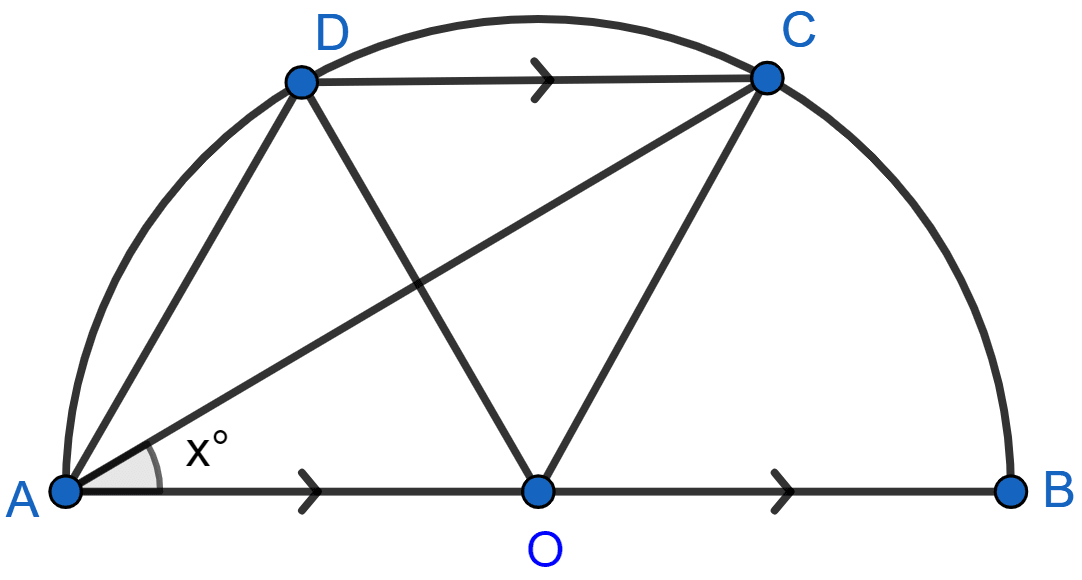
In the given figure, AOB is a diameter and DC is parallel to AB. If ∠CAB = x°; find (in terms of x) the values of : ∠COB, ∠DOC, ∠DAC, ∠ADC. Circles, Concise Mathematics Solutions ICSE Class 10.

Answer

(i) We know that,

Angle at the centre is double the angle at the circumference subtended by the same chord.

⇒ ∠COB = 2∠CAB = 2x

Hence, ∠COB = 2x.

(ii) As DC || OB

⇒ ∠OCD = ∠COB = 2x [Alternate angles]

In △OCD,

OC = OD [Radius of same circle]

∠ODC = ∠OCD = 2x [Angles opposite to equal sides are equal]

⇒ ∠ODC + ∠OCD + ∠DOC = 180°

⇒ 2x + 2x + ∠DOC = 180°

⇒ ∠DOC = 180° - 4x.

Hence, ∠DOC = 180° - 4x.

(iii) We know that,

Angle at the centre is double the angle at the circumference subtended by the same chord.

⇒ ∠DOC = 2∠DAC

⇒ ∠DAC = 12\dfrac{1}{2}∠DOC = 12\dfrac{1}{2} x (180° - 4x) = 90° - 2x.

Hence, ∠DAC = 90° - 2x.

(iv) DC || AO

∴ ∠ACD = ∠OAC = x (Alternate angles are equal)

In △ADC,

⇒ ∠ADC + ∠DAC + ∠ACD = 180° [Angle sum property of triangle]

⇒ ∠ADC + 90° - 2x° + x = 180°

⇒ ∠ADC + 90° - x = 180°

⇒ ∠ADC = 180° - 90° + x

⇒ ∠ADC = 90° + x

Hence, ∠ADC = 90° + x.

Question 17

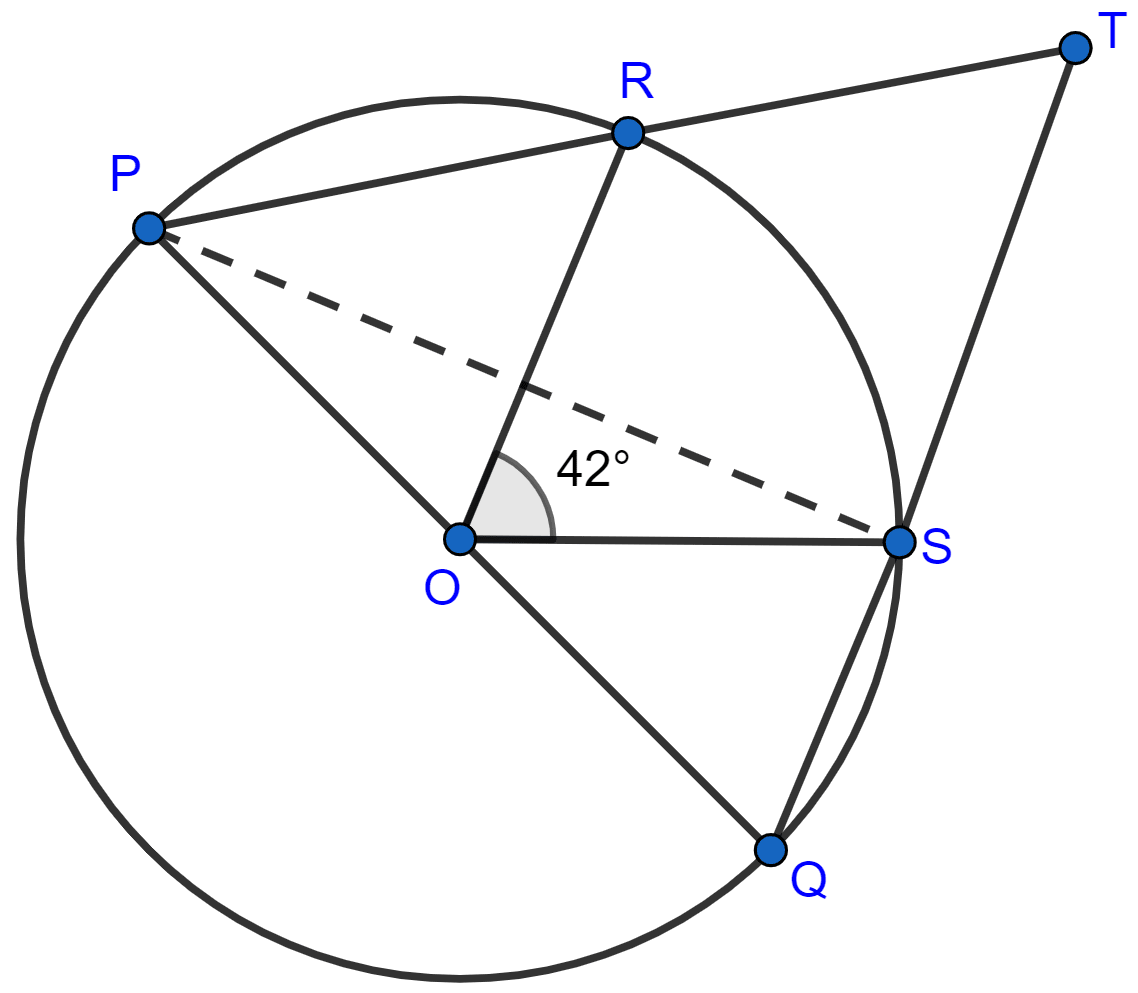
In the given figure, PQ is the diameter of the circle whose center is O. Given, ∠ROS = 42°, calculate ∠RTS.
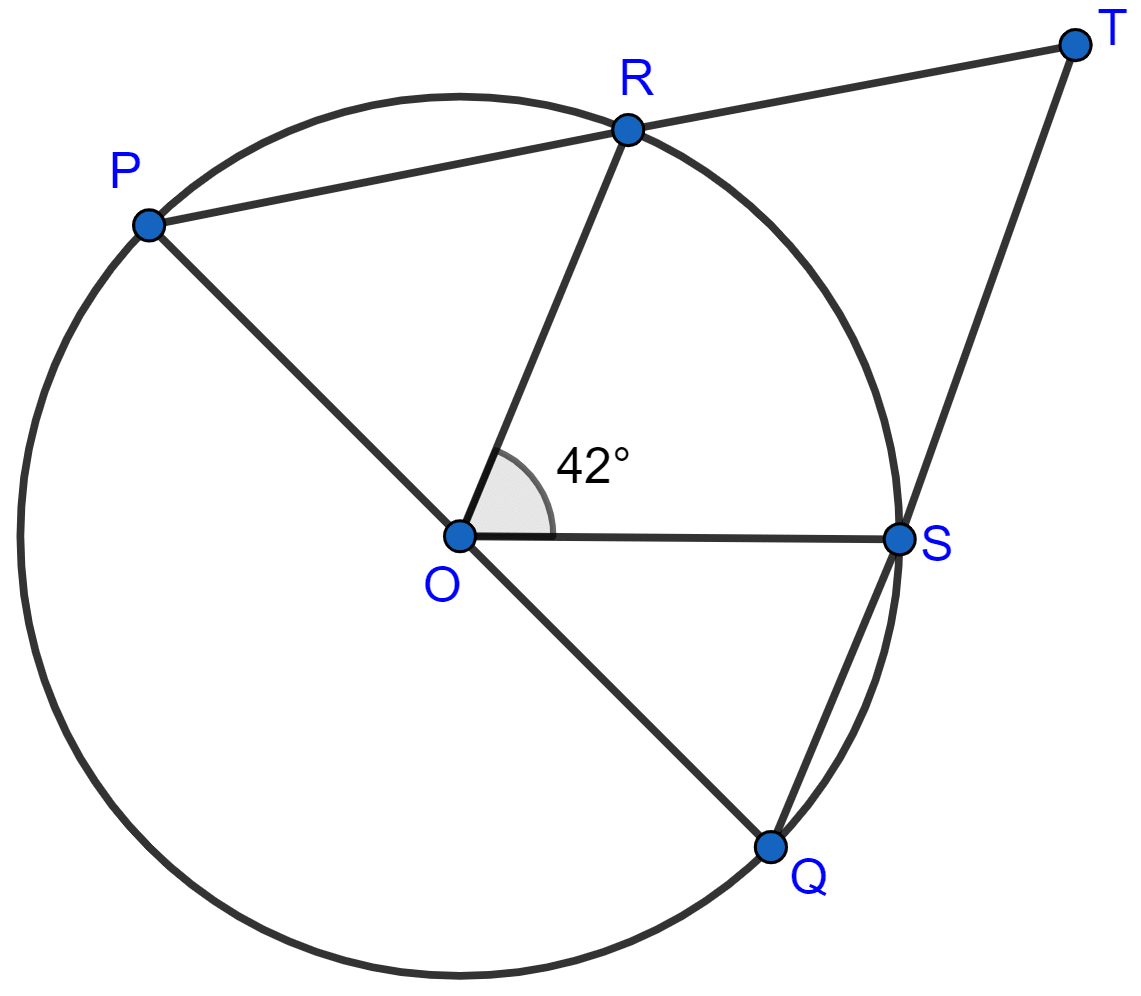
In the given figure, PQ is the diameter of the circle whose center is O. Given, ∠ROS = 42°, calculate ∠RTS. Circles, Concise Mathematics Solutions ICSE Class 10.

Answer

Join PS.

In the given figure, PQ is the diameter of the circle whose center is O. Given, ∠ROS = 42°, calculate ∠RTS. Circles, Concise Mathematics Solutions ICSE Class 10.

∠PSQ = 90° [Angle in semi-circle is a right angle.]

We know that,

Angle at the centre is double the angle at the circumference subtended by the same chord.

⇒ ∠ROS = 2∠SPR

⇒ ∠SPR = 12\dfrac{1}{2}∠ROS = 422\dfrac{42}{2} = 21°

From figure,

⇒ ∠SPT = ∠SPR = 21°.

From figure,

⇒ ∠PSQ = 90° [Angle in a semi-circle is a right angle.]

Since, QST is a straight line.

⇒ ∠PSQ + ∠PST = 180°

⇒ 90° + ∠PST = 180°

⇒ ∠PST = 90°.

In △PST,

⇒ ∠PTS + ∠PST + ∠SPT = 180° [Angle sum property of triangle]

⇒ ∠PTS + 90° + 21° = 180°

⇒ ∠PTS + 111° = 180°

⇒ ∠PTS = 180° - 111° = 69°.

From figure,

∠RTS = ∠PTS = 69°.

Hence, ∠RTS = 69°.

Question 18

The given figure shows a circle with center O and ∠ABP = 42°. Calculate the measure of :

(i) ∠PQB

(ii) ∠QPB + ∠PBQ
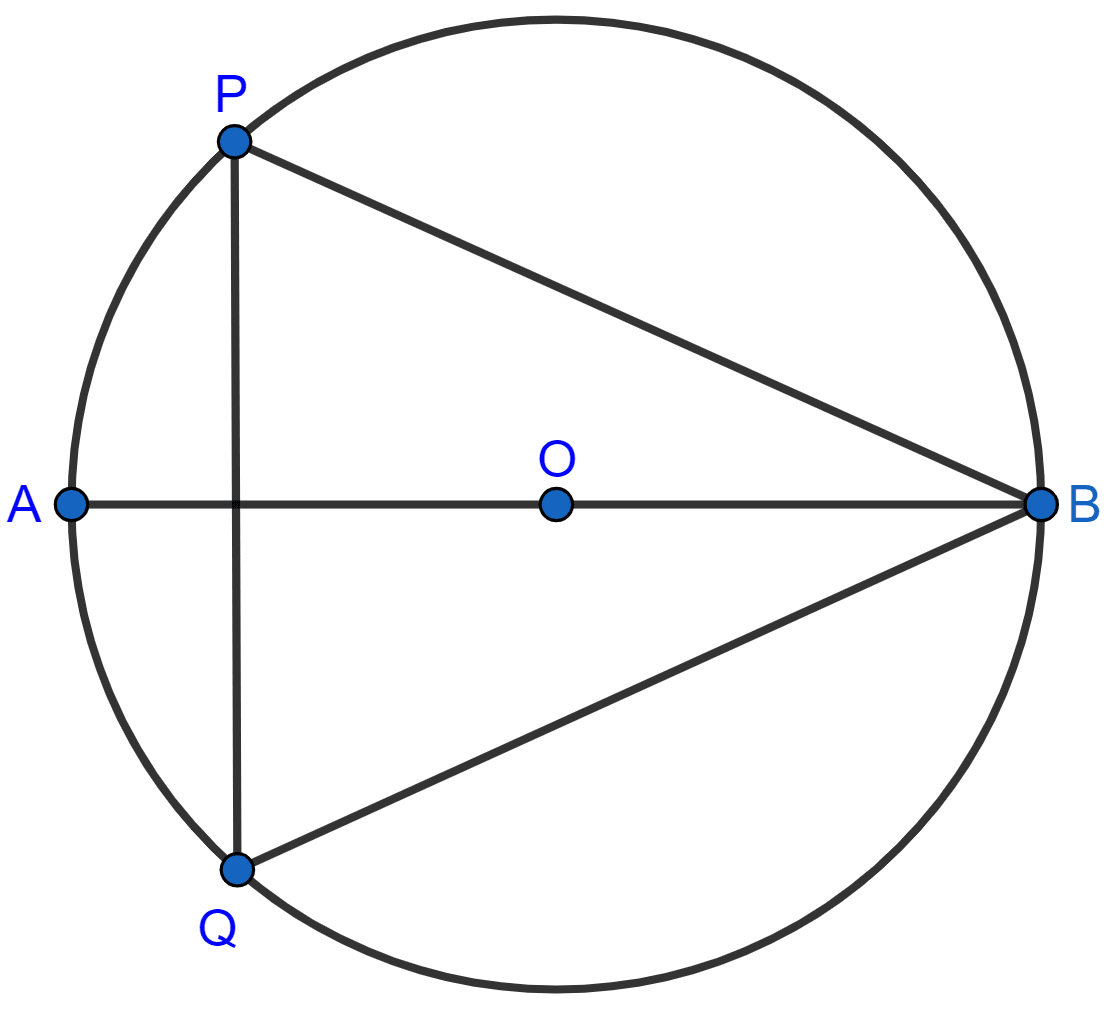
The given figure shows a circle with center O and ∠ABP = 42°. Calculate the measure of : ∠PQB ∠QPB + ∠PBQ. Hence, show that AC is a diameter. Circles, Concise Mathematics Solutions ICSE Class 10.

Answer

Join AP.

The given figure shows a circle with center O and ∠ABP = 42°. Calculate the measure of : ∠PQB ∠QPB + ∠PBQ. Hence, show that AC is a diameter. Circles, Concise Mathematics Solutions ICSE Class 10.

(i) We know that,

Angle in a semi-circle is a right angle.

∠APB = 90°.

In △APB,

⇒ ∠APB + ∠ABP + ∠BAP = 180° [Angle sum property of triangle]

⇒ 90° + 42° + ∠BAP = 180°

⇒ ∠BAP + 132° = 180°

⇒ ∠BAP = 180° - 132° = 48°.

From figure,

∠PQB = ∠BAP = 48° [Angles in same segment are equal]

Hence, ∠PQB = 48°.

(ii) In △BQP,

⇒ ∠QPB + ∠PBQ + ∠PQB = 180° [Angle sum property of triangle]

⇒ ∠QPB + ∠PBQ + 48° = 180°

⇒ ∠QPB + ∠PBQ = 180° - 48°

⇒ ∠QPB + ∠PBQ = 132°.

Hence, ∠QPB + ∠PBQ = 132°.

Question 19

In the given figure, M is the centre of the circle. Chords AB and CD are perpendicular to each other. If ∠MAD = x and ∠BAC = y :

(i) express ∠AMD in terms of x.

(ii) express ∠ABD in terms of y.

(iii) prove that : x = y.

In the given figure, M is the centre of the circle. Chords AB and CD are perpendicular to each other. If ∠MAD = x and ∠BAC = y : express ∠AMD in terms of x, express ∠ABD in terms of y, prove that : x = y. Circles, Concise Mathematics Solutions ICSE Class 10.

Answer

Mark the point of intersection of AB and CD as L.

In the given figure, M is the centre of the circle. Chords AB and CD are perpendicular to each other. If ∠MAD = x and ∠BAC = y : express ∠AMD in terms of x, express ∠ABD in terms of y, prove that : x = y. Circles, Concise Mathematics Solutions ICSE Class 10.

(i) In △AMD,

MA = MD [Radius of circle]

∴ ∠MAD = ∠MDA = x.

In △AMD,

⇒ ∠MAD + ∠MDA + ∠AMD = 180° [Angle sum property of triangle]

⇒ x + x + ∠AMD = 180°

⇒ ∠AMD = 180° - 2x.

Hence, ∠AMD = 180° - 2x.

(ii) Let the perpendicular chords AB and CD intersect each other at L.

From figure,

∠ALC = 90°.

In △ALC,

⇒ ∠LAC + ∠LCA + ∠ALC = 180° [Angle sum property of triangle]

⇒ y + ∠DCA + 90° = 180°

⇒ ∠DCA = 180° - 90° - y

⇒ ∠DCA = 90° - y

From figure,

∠ABD = ∠DCA [Angles in same segment are equal]

∴ ∠ABD = 90° - y.

Hence, ∠ABD = 90° - y.

(iii) We know that,

Angle which an arc subtends at the center is double that which it subtends at any point on the remaining part of the circumference.

∴ ∠AMD = 2∠ABD

∠ABD = 12\dfrac{1}{2} ∠AMD = 12×(180°2x)\dfrac{1}{2} \times (180° - 2x) = 90° - x.

We have,

∠ABD = 90° - y and ∠ABD = 90° - x

⇒ 90° - y = 90° - x

⇒ x = y.

Hence, proved that x = y.

Exercise 17(B)

Question 1(a)

ABCD is a trapezium with AD parallel to BC. Side BC is produced to point E and angle DCE = 95°. Angle B is equal to :

  1. 85°

  2. 105°

  3. 95°

  4. 175°

ABCD is a trapezium with AD parallel to BC. Side BC is produced to point E and angle DCE = 95°. Angle B is equal to : Circles, Concise Mathematics Solutions ICSE Class 10.

Answer

Given,

AD || BC

Since,

Side BC is produced to point E.

We can say that,

AD || BE

From figure,

∠ADC = ∠DCE = 95° (Alternate angles are equal)

We know that,

The opposite angles of a cyclic quadrilateral are supplementary.

∴ ∠ADC + ∠CBA = 180°

⇒ ∠CBA = 180° - ∠ADC = 180° - 95° = 85°.

Hence, Option 1 is the correct option.

Question 1(b)

In the given figure, ABC is an equilateral triangle. Angle ADC is :

  1. 60°

  2. 100°

  3. 80°

  4. 120°

In the given figure, ABC is an equilateral triangle. Angle ADC is : Circles, Concise Mathematics Solutions ICSE Class 10.

Answer

Since, ABC is an equilateral triangle.

∴ ∠ABC = 60°.

We know that,

The opposite angles of a cyclic quadrilateral are supplementary.

∴ ∠ABC + ∠ADC = 180°

⇒ 60° + ∠ADC = 180°

⇒ ∠ADC = 180° - 60° = 120°.

Hence, Option 4 is the correct option.

Question 1(c)

In the given figure, O is the center of the circle. ∠OAB and ∠OCB are 30° and 40° respectively. ∠AOC is equal to :

  1. 70°

  2. 80°

  3. 150°

  4. 140°

In the given figure, O is the center of the circle. ∠OAB and ∠OCB are 30° and 40° respectively. ∠AOC is equal to : Circles, Concise Mathematics Solutions ICSE Class 10.

Answer

Join AC.

In the given figure, O is the center of the circle. ∠OAB and ∠OCB are 30° and 40° respectively. ∠AOC is equal to : Circles, Concise Mathematics Solutions ICSE Class 10.

In △AOC,

Since,

OA = OC (Radius of same circle)

∴ ∠OAC = ∠OCA = x (let)

By angle sum property of triangle,

⇒ ∠OAC + ∠OCA + ∠AOC = 180°

⇒ x + x + ∠AOC = 180°

⇒ ∠AOC = 180° - 2x

In △AOC,

By angle sum property of triangle,

⇒ ∠BAC + ∠ACB + ∠CBA = 180°

⇒ (30° + x) + (40° + x) + ∠CBA = 180°

⇒ ∠CBA + 70° + 2x = 180°

⇒ ∠CBA = 180° - 70° - 2x

⇒ ∠CBA = 110° - 2x

We know that,

The angle which an arc subtends at the center is double that which it subtends at any point on the remaining part of the circumference.

∴ ∠AOC = 2∠CBA

⇒ 180° - 2x = 2(110° - 2x)

⇒ 180° - 2x = 220° - 4x

⇒ 4x - 2x = 220° - 180°

⇒ 2x = 40°

⇒ x = 40°2\dfrac{40°}{2} = 20°.

⇒ ∠AOC = 180° - 2x

⇒ ∠AOC = 180° - 2(20°) = 180° - 40° = 140°.

Hence, Option 4 is the correct option.

Question 1(d)

In the given figure APB and CQD are two straight lines, then :

  1. AB || CD

  2. AC || PQ

  3. PQ || BD

  4. AC || BD

In the given figure APB and CQD are two straight lines, then : Circles, Concise Mathematics Solutions ICSE Class 10.

Answer

Let ∠BPQ = x and ∠DQP = y

We know that,

The exterior angle of a cyclic quadrilateral is equal to the opposite interior angle.

From figure,

In cyclic quadrilateral APQC,

∠A = ∠DQP = y and ∠C = ∠BPQ = x

From figure,

APB is a straight line.

∴ ∠APQ + ∠BPQ = 180°

⇒ ∠APQ + x = 180°

⇒ ∠APQ = 180° - x

CQD is a straight line.

∴ ∠CQP + ∠DQP = 180°

⇒ ∠CQP + y = 180°

⇒ ∠CQP = 180° - y

In cyclic quadrilateral PQDB,

∠B = ∠CQP = 180° - y and ∠D = ∠APQ = 180° - x

⇒ ∠A + ∠B = y + (180° - y) = 180°

⇒ ∠C + ∠D = x + (180° - x) = 180°

We know that,

Sum of adjacent angles in a trapezium is 180°.

∴ ABDC is a trapezium.

∴ AC || BD.

Hence, Option 4 is the correct option.

Question 1(e)

In the figure, given below, ∠ABC is equal to :

  1. 105°

  2. 75°

  3. 90°

  4. 45°

In the figure, given below, ∠ABC is equal to : Circles, Concise Mathematics Solutions ICSE Class 10.

Answer

We know that,

Sum of co-interior angles in a trapezium is equal to 180°.

⇒ ∠A + ∠D = 180°

⇒ 105° + ∠D = 180°

⇒ ∠D = 180° - 105° = 75°

We know that,

The opposite angles of a cyclic quadrilateral is 180°.

In cyclic quadrilateral ABCD,

⇒ ∠D + ∠B = 180°

⇒ 75° + ∠B = 180°

⇒ ∠B = 180° - 75° = 105°.

Hence, Option 1 is the correct option.

Question 2

In the given figure, O is the centre of the circle. If ∠AOB = 140° and ∠OAC = 50°; find :

(i) ∠ACB,

(ii) ∠OBC,

(iii) ∠OAB,

(iv) ∠CBA.

In the given figure, O is the centre of the circle. If ∠AOB = 140° and ∠OAC = 50°; find ∠ACB, ∠OBC, ∠OAB, ∠CBA. Circles, Concise Mathematics Solutions ICSE Class 10.

Answer

Given, ∠AOB = 140° and ∠OAC = 50°

(i) We know that,

Angle at the center is double the angle at the circumference subtended by the same chord.

∠ACB = 12\dfrac{1}{2}Reflex ∠AOB

= 12\dfrac{1}{2} (360° - 140°)

= 12×220°\dfrac{1}{2} \times 220° = 110°.

Hence, ∠ACB = 110°.

(ii) We know that,

The sum of angles in a quadrilateral is 360°

In quadrilateral OBCA,

∠OBC + ∠ACB + ∠OAC + ∠AOB = 360°

⇒ ∠OBC + 110° + 50° + 140° = 360°

⇒ ∠OBC + 300° = 360°

⇒ ∠OBC = 360° - 300° = 60°.

Hence, ∠OBC = 60°.

(iii) Join AB.

In the given figure, O is the centre of the circle. If ∠AOB = 140° and ∠OAC = 50°; find ∠ACB, ∠OBC, ∠OAB, ∠CBA. Circles, Concise Mathematics Solutions ICSE Class 10.

In ∆AOB, we have

OA = OB (radius of circle)

So, ∠OBA = ∠OAB (As angles opposite to equal sides are equal)

By angle sum property of a triangle we get,

⇒ ∠OBA + ∠OAB + ∠AOB = 180°

⇒ 2∠OAB + 140° = 180°

⇒ 2∠OAB = 40°

⇒ ∠OAB = 402\dfrac{40}{2} = 20°

Hence, ∠OAB = 20°.

(iv) We already found, ∠OBC = 60°.

⇒ ∠OBC = ∠CBA + ∠OBA

⇒ 60° = ∠CBA + 20°

⇒ ∠CBA = 60° - 20° = 40°

Hence, ∠CBA = 40°.

Question 3

In the figure, given below, ABCD is a cyclic quadrilateral in which ∠BAD = 75°; ∠ABD = 58° and ∠ADC = 77°. Find :

(i) ∠BDC,

(ii) ∠BCD,

(iii) ∠BCA.

In the figure, ABCD is a cyclic quadrilateral in which ∠BAD = 75°; ∠ABD = 58° and ∠ADC = 77°. Find ∠BDC, ∠BCD, ∠BCA. Circles, Concise Mathematics Solutions ICSE Class 10.

Answer

(i) We know,

Sum of angles in a triangle = 180°.

In △ABD,

⇒ ∠ADB + ∠ABD + ∠DAB = 180°

⇒ ∠ADB + 58° + 75° = 180°

⇒ ∠ADB + 133° = 180°

⇒ ∠ADB = 180° - 133° = 47°

From figure,

∠BDC = ∠ADC - ∠ADB = 77° - 47° = 30°.

Hence, ∠BDC = 30°.

(ii) We know that,

Sum of opposite angles of a cyclic quadrilateral is 180°.

⇒ ∠BAD + ∠BCD = 180°

⇒ ∠BCD = 180° - 75° = 105°.

Hence, ∠BCD = 105°.

(iii) Join AC.

In the figure, ABCD is a cyclic quadrilateral in which ∠BAD = 75°; ∠ABD = 58° and ∠ADC = 77°. Find ∠BDC, ∠BCD, ∠BCA. Circles, Concise Mathematics Solutions ICSE Class 10.

We know that,

Angles subtended by the same chord on the circle are equal.

∠BCA = ∠ADB = 47°

Hence, ∠BCA = 47°.

Question 4

In the following figure, O is the centre of the circle and ΔABC is equilateral.

Find:

(i) ∠ADB, (ii) ∠AEB.

In the figure, O is the centre of the circle and ΔABC is equilateral. Find ∠ADB, ∠AEB. Circles, Concise Mathematics Solutions ICSE Class 10.

Answer

(i) We know that each angle in an equilateral triangle = 60°.

∴ ∠ACB = 60°

As angles in same segment are equal.

∴ ∠ADB = ∠ACB = 60°.

Hence, ∠ADB = 60°.

(ii) Join OA and OB.

In the figure, O is the centre of the circle and ΔABC is equilateral. Find ∠ADB, ∠AEB. Circles, Concise Mathematics Solutions ICSE Class 10.

We know that,

Angle at the center is double the angle at the circumference subtended by the same chord.

∴ ∠AOB = 2∠ACB = 2 x 60° = 120°.

∴ ∠AEB = 12\dfrac{1}{2} Reflex ∠AOB

= 12\dfrac{1}{2}(360° - 120°) = 12×240°\dfrac{1}{2} \times 240°

= 120°.

Hence, ∠AEB = 120°.

Question 5

ABCD is a cyclic quadrilateral in a circle with centre O. If ∠ADC = 130°, find ∠BAC.

ABCD is a cyclic quadrilateral in a circle with centre O. If ∠ADC = 130°, find ∠BAC. Circles, Concise Mathematics Solutions ICSE Class 10.

Answer

We know that,

Angle in a semi-circle is 90°.

∠ACB = 90°.

We know that,

Sum of opposite angles of a cyclic quadrilateral = 180°.

⇒ ∠ABC = 180° - ∠ADC = 180° - 130° = 50°.

In △ACB,

⇒ ∠ACB + ∠CBA + ∠BAC = 180° [Angle sum property]

⇒ 90° + 50° + ∠BAC = 180°

⇒ ∠BAC + 140° = 180°

⇒ ∠BAC = 180° - 140° = 40°.

Hence, ∠BAC = 40°.

Question 6(a)

In the following figure,

(i) if ∠BAD = 96°, find ∠BCD and ∠BFE.

(ii) Prove that AD is parallel to FE.

In the figure, if ∠BAD = 96°, find ∠BCD and ∠BFE. Prove that AD is parallel to FE. Circles, Concise Mathematics Solutions ICSE Class 10.

Answer

(i) ABCD is a cyclic quadrilateral.

So, ∠BAD + ∠BCD = 180° [As sum of opposite angles in a cyclic quadrilateral = 180°]

⇒ ∠BCD = 180° - ∠BAD

= 180° - 96°

= 84°.

As DCE is a straight line.

∴ ∠BCE = 180° - ∠BCD

= 180° - 84° = 96°.

BCEF is a cyclic quadrilateral,

So, ∠BCE + ∠BFE = 180°

⇒ ∠BFE = 180° - ∠BCE

= 180° - 96°

= 84°.

Hence, ∠BCD = 84° and ∠BFE = 84°.

(ii) Now, ∠BAD + ∠BFE = 96° + 84° = 180°.

But these two are interior angles on the same side of a pair of lines AD and FE.

Hence, proved that AD || FE.

Question 6(b)

ABCD is a parallelogram. A circle through vertices A and B meets side BC at point P and side AD at point Q. Show that quadrilateral PCDQ is cyclic.

Answer

The figure of the parallelogram ABCD with a circle through its vertices A and B meeting side BC at point P and side AD at point Q is shown below:

In the figure, if ∠BAD = 96°, find ∠BCD and ∠BFE. Prove that AD is parallel to FE. Circles, Concise Mathematics Solutions ICSE Class 10.

We know that,

An exterior angle of a cyclic quadrilateral is equal to its opposite interior angle.

∴ ∠1 = ∠A ....... (i)

Also,

∠A = ∠C ...........(ii) [Opposite angles of a parallelogram are equal.]

From (i) and (ii) we get,

∠1 = ∠C .........(iii)

Also,

⇒ ∠C + ∠D = 180° [Sum of co-interior angles of a parallelogram = 180°]

⇒ ∠1 + ∠D = 180°

Hence, proved that PCDQ is cyclic.

Question 7

Prove that:

(i) the parallelogram, inscribed in a circle, is a rectangle.

(ii) the rhombus, inscribed in a circle, is a square.

Answer

(i) Let's assume that ABCD is a parallelogram which is inscribed in a circle.

Prove that the parallelogram, inscribed in a circle, is a rectangle. Circles, Concise Mathematics Solutions ICSE Class 10.

⇒ ∠A = ∠C and ∠B = ∠D [Opposite angles of a parallelogram are equal]

⇒ ∠A + ∠C = 180° and ∠B + ∠D = 180° [Pair of opposite angles in a cyclic quadrilateral are supplementary]

⇒ 2∠A = 180° and 2∠B = 180°

⇒ ∠A = 90° and ∠B = 90°

⇒ ∠A = ∠C = 90° and ∠B = ∠D = 90°.

Also,

AB = CD and AD = BC [Opposite sides of parallelogram are equal]

Hence, proved that ABCD is a rectangle.

(ii) Let's assume that ABCD is a rhombus which is inscribed in a circle.

Prove that the rhombus, inscribed in a circle, is a square. Circles, Concise Mathematics Solutions ICSE Class 10.

So, we have

∠BAD = ∠BCD [Opposite angles of a rhombus are equal]

From figure,

∠BAD + ∠BCD = 180° [Pair of opposite angles in a cyclic quadrilateral are supplementary]

⇒ 2∠BAD = 180°

Thus, ∠BAD = ∠BCD = 90°.

Also,

∠ABC = ∠ADC [Opposite angles of a rhombus are equal]

From figure,

∠ABC + ∠ADC = 180° [Pair of opposite angles in a cyclic quadrilateral are supplementary]

⇒ 2∠ABC = 180°

Thus, ∠ABC = ∠ADC = 90°.

Since, each side of rhombus are equal.

Thus,

Each angle of quadrilateral = 90° and all sides are equal.

Hence, proved that ABCD is a square.

Question 8

In the given figure, AB = AC. Prove that DECB is an isosceles trapezium.

In the given figure, AB = AC. Prove that DECB is an isosceles trapezium. Circles, Concise Mathematics Solutions ICSE Class 10.

Answer

Given, AB = AC

So, ∠B = ∠C ........(1) [As Angles opposite to equal sides are equal]

From figure,

DECB is a cyclic quadrilateral.

∴ ∠B + ∠DEC = 180° [Sum of opposite angles in cyclic quadrilateral = 180°]

⇒ ∠C + ∠DEC = 180° (Using 1)

But this is the sum of interior angles on one side of a transversal.

∴ DE || BC.

∴ ∠ADE = ∠B and ∠AED = ∠C [Corresponding angles]

Thus, ∠ADE = ∠AED

∴ AD = AE

⇒ AB - AD = AC - AE [As AB = AC]

⇒ BD = CE

Hence, we have DE || BC and BD = CE.

Hence, proved that DECB is an isosceles trapezium.

Question 9

The figure given below, shows a circle with centre O.

Given : ∠AOC = a and ∠ABC = b.

(i) Find the relationship between a and b.

(ii) Find the measure of angle OAB, if OABC is a parallelogram.

The figure shows a circle with centre O. Given : ∠AOC = a and ∠ABC = b. Find the relationship between a and b. Find the measure of angle OAB, if OABC is a parallelogram. Circles, Concise Mathematics Solutions ICSE Class 10.

Answer

(i) We know that,

Angle at the centre is double the angle at the circumference subtended by the same chord

∴ ∠ABC = 12\dfrac{1}{2} Reflex ∠COA

⇒ b = 12\dfrac{1}{2} (360° - a)

⇒ 2b = 360° - a

⇒ a + 2b = 360° .....(1)

Hence, relationship between a and b is given by the equation : a + 2b = 360°.

(ii) From equation 1, we get :

⇒ a + 2b = 360°

⇒ a = 360° - 2b

As OABC is a parallelogram, the opposite angles are equal.

So, a = b

⇒ 360° - 2b = b

⇒ 3b = 360°

⇒ b = 360°3\dfrac{360°}{3} = 120°

Let ∠OAB = x and ∠OCB = x.

⇒ ∠OAB + ∠OCB + ∠AOC + ∠ABC = 360°

⇒ x + x + a + b = 360°

⇒ 2x + 120° + 120° = 360°

⇒ 2x + 240° = 360°

⇒ 2x = 120°

⇒ x = 120°2\dfrac{120°}{2} = 60°.

Hence, ∠OAB = 60°.

Question 10

In the figure given, RS is a diameter of the circle. NM is parallel to RS and ∠MRS = 29°.

Calculate :

(i) ∠RNM,

(ii) ∠NRM.

In the figure given, RS is a diameter of the circle. NM is parallel to RS and ∠MRS = 29°. Calculate ∠RNM, ∠NRM. Circles, Concise Mathematics Solutions ICSE Class 10.

Answer

(i) Join RN and MS.

In the figure given, RS is a diameter of the circle. NM is parallel to RS and ∠MRS = 29°. Calculate ∠RNM, ∠NRM. Circles, Concise Mathematics Solutions ICSE Class 10.

∠RMS = 90° [Angle in a semi-circle is a right angle]

In ∆RMS

⇒ ∠RMS + ∠RSM + ∠MRS = 180° [Angle sum property of triangle]

⇒ 90° + ∠RSM + 29° = 180°

⇒ ∠RSM + 119° = 180°

⇒ ∠RSM = 180° - 119° = 61°.

Sum of opposite angles in a cyclic quadrilateral = 180°.

⇒ ∠RNM + ∠RSM = 180°

⇒ ∠RNM + 61° = 180°

⇒ ∠RNM = 180° - 61° = 119°.

Hence, ∠RNM = 119°.

(ii) Now as RS || NM,

∠NMR = ∠MRS = 29° [Alternate angles are equal]

From figure,

∠NMS = ∠NMR + ∠RMS = 29° + 90° = 119°.

Sum of opposite angles in a cyclic quadrilateral = 180°.

In quadrilateral NMSR,

⇒ ∠NRS + ∠NMS = 180°

⇒ ∠NRM + ∠MRS + ∠NMS = 180°

⇒ ∠NRM + 29° + 119° = 180°

⇒ ∠NRM = 180° - 119° - 29°

⇒ ∠NRM = 32°.

Hence, ∠NRM = 32°.

Question 11

In the given figure, SP is the bisector of ∠RPT and PQRS is a cyclic quadrilateral. Prove that :

SQ = SR.

In the given figure, SP is the bisector of ∠RPT and PQRS is a cyclic quadrilateral. Prove that SQ = SR. Circles, Concise Mathematics Solutions ICSE Class 10.

Answer

PQRS is a cyclic quadrilateral.

Sum of opposite angles in a cyclic quadrilateral = 180°.

∴ ∠QRS + ∠QPS = 180° ...........(1)

Also,

∠QPS + ∠SPT = 180° [As QPT is a straight line] ........(2)

Subtracting equation (2) from (1) we get,

⇒ ∠QRS + ∠QPS - (∠QPS + ∠SPT) = 180° - 180°

⇒ ∠QRS - ∠SPT = 0

⇒ ∠QRS = ∠SPT ..........(3)

∠RQS = ∠RPS [Angles in same segment are equal] ........(4)

∠RPS = ∠SPT [As PS bisects ∠RPT] .......(5)

From (3), (4) and (5) we get :

⇒ ∠QRS = ∠RQS.

∴ SQ = SR [As sides opposite to equal angles are also equal]

Hence, proved that SQ = SR.

Question 12

In the figure, O is the center of the circle, ∠AOE = 150°, ∠DAO = 51°. Calculate the sizes of the angles CEB and OCE.

In the figure, O is the center of the circle, ∠AOE = 150°, ∠DAO = 51°. Calculate the sizes of the angles CEB and OCE. Circles, Concise Mathematics Solutions ICSE Class 10.

Answer

We know that,

Angle at the center is double the angle at the circumference subtended by the same chord.

⇒ Reflex ∠AOE = 2∠ADE

⇒ ∠ADE = 12\dfrac{1}{2} Reflex ∠AOE

⇒ ∠ADE = 12\dfrac{1}{2} (360° - 150°)

⇒ ∠ADE = 12×210°\dfrac{1}{2} \times 210° = 105°.

From figure,

⇒ ∠DAB + ∠BED = 180° [Sum of opposite angles in a cyclic quadrilateral = 180°.]

⇒ ∠BED = 180° - ∠DAB = 180° - 51° = 129°.

Also,

⇒ ∠CEB + ∠BED = 180° [As CED is a straight line]

⇒ ∠CEB = 180° - ∠BED = 180° - 129° = 51°.

In △ADC,

⇒ ∠ADC + ∠ACD + ∠DAC = 180°

⇒ ∠ADE + ∠ACD + ∠DAO = 180° [From figure, ∠ADC = ∠ADE and ∠DAC = ∠DAO]

⇒ 105° + ∠ACD + 51° = 180°

⇒ ∠ACD = 180° - 105° - 51° = 24°.

From figure,

∠OCE = ∠ACD = 24°.

Hence, ∠CEB = 51° and ∠OCE = 24°.

Question 13

In the figure, given below, P and Q are the centers of two circles intersecting at B and C. ACD is a straight line. Calculate the numerical value of x.

In the figure, given below, P and Q are the centers of two circles intersecting at B and C. ACD is a straight line. Calculate the numerical value of x. Circles, Concise Mathematics Solutions ICSE Class 10.

Answer

We know that,

Angle at the center is double the angle at the circumference subtended by the same chord.

⇒ ∠APB = 2∠ACB

⇒ ∠ACB = 12\dfrac{1}{2} ∠APB

⇒ ∠ACB = 12×\dfrac{1}{2} \times 150° = 75°.

From figure,

⇒ ∠ACB + ∠BCD = 180° [As ACD is a straight line]

⇒ 75° + ∠BCD = 180°

⇒ ∠BCD = 180° - 75° = 105°.

Also,

⇒ Reflex ∠BQD = 2∠BCD [Angle at the center is double the angle at the circumference subtended by the same chord.]

⇒ (360° - x) = 2 x 10⁵°

⇒ x = 360° - 210° = 150°.

Hence, x = 150°.

Question 14

The figure shows two circles which intersect at A and B. The center of the smaller circle is O and lies on the circumference of the larger circle. Given ∠APB = a°.

Calculate, in terms of a°, the value of :

(i) obtuse ∠AOB,

(ii) ∠ACB,

(iii) ∠ADB.

Give reasons for your answers clearly.

The figure shows two circles which intersect at A and B. The center of the smaller circle is O and lies on the circumference of the larger circle. Given ∠APB = a°. Calculate, in terms of a°, the value of obtuse ∠AOB, ∠ACB, ∠ADB. Give reasons for your answers clearly. Circles, Concise Mathematics Solutions ICSE Class 10.

Answer

(i) We know that,

Angle at the center is double the angle at the circumference subtended by the same chord.

obtuse ∠AOB = 2∠APB = 2a°.

Hence, obtuse ∠AOB = 2a°.

(ii) OACB is a cyclic quadrilateral.

⇒ ∠AOB + ∠ACB = 180° [Sum of opposite angles in a cyclic quadrilateral = 180°.]

⇒ ∠ACB + 2a° = 180°

⇒ ∠ACB = 180° - 2a°.

Hence, ∠ACB = 180° - 2a°.

(iii) Join AD and BD.

The figure shows two circles which intersect at A and B. The center of the smaller circle is O and lies on the circumference of the larger circle. Given ∠APB = a°. Calculate, in terms of a°, the value of obtuse ∠AOB, ∠ACB, ∠ADB. Give reasons for your answers clearly. Circles, Concise Mathematics Solutions ICSE Class 10.

As, angles in same segment are equal.

∴ ∠ADB = ∠ACB = 180° - 2a°.

Hence, ∠ADB = 180° - 2a°.

Question 15

In the given figure, O is the centre of the circle and ∠ABC = 55°. Calculate the values of x and y.

In the given figure, O is the centre of the circle and ∠ABC = 55°. Calculate the values of x and y. Circles, Concise Mathematics Solutions ICSE Class 10.

Answer

We know that,

Angle at the center is double the angle at the circumference subtended by the same chord.

∠AOC = 2∠ABC = 2 × 55° = 110°.

∴ x = 110°.

ABCD is a cyclic quadrilateral.

∴ ∠ADC + ∠ABC = 180°

⇒ y + 55° = 180°

⇒ y = 180° - 55° = 125°.

Hence, x = 110° and y = 125°.

Question 16

In the given figure, ∠BAD = 65°, ∠ABD = 70°, ∠BDC = 45°

(i) Prove that AC is a diameter of the circle.

(ii) Find ∠ACB

In the given figure, ∠BAD = 65°, ∠ABD = 70°, ∠BDC = 45°. Prove that AC is a diameter of the circle. Find ∠ACB. Circles, Concise Mathematics Solutions ICSE Class 10.

Answer

(i) In ∆ABD,

⇒ ∠DAB + ∠ABD + ∠ADB = 180° [Angle sum property of a triangle]

⇒ 65° + 70° + ∠ADB = 180°

⇒ 135° + ∠ADB = 180°

⇒ ∠ADB = 180° - 135° = 45°

From figure,

⇒ ∠ADC = ∠ADB + ∠BDC = 45° + 45° = 90°.

As the angle in a semicircle is a right angle,

∴ Arc ADC is semi-circle and AC is the diameter.

Hence, proved that AC is the diameter.

(ii) We know that,

Angles in the same segment of a circle are equal.

∴ ∠ACB = ∠ADB = 45°.

Hence, ∠ACB = 45°.

Question 17

In the given figure, AB is a diameter of the circle. Chord ED is parallel to AB and ∠EAB = 63°. Calculate :

(i) ∠EBA,

(ii) ∠BCD.

In the given figure, AB is a diameter of the circle. Chord ED is parallel to AB and ∠EAB = 63°. Calculate ∠EBA, ∠BCD. Circles, Concise Mathematics Solutions ICSE Class 10.

Answer

(i) We know that,

Angle in semi-circle is a right angle.

∴ ∠AEB = 90°.

In △AEB,

⇒ ∠AEB + ∠EBA + ∠EAB = 180°

⇒ 90° + ∠EBA + 63° = 180°

⇒ 153° + ∠EBA = 180°

⇒ ∠EBA = 180° - 153° = 27°.

Hence, ∠EBA = 27°.

(ii) As, AB || ED

∴ ∠DEB = ∠EBA = 27° [Alternate angles]

BCDE is a cyclic quadrilateral.

∴ ∠DEB + ∠BCD = 180° [Sum of opposite angles in a cyclic quadrilateral = 180°.]

⇒ 27° + ∠BCD = 180°

⇒ ∠BCD = 180° - 27° = 153°.

Hence, ∠BCD = 153°.

Question 18

In the given figure, AB is a diameter of the circle with center O. DO is parallel to CB and ∠DCB = 120°. Calculate :

(i) ∠DAB,

(ii) ∠DBA,

(iii) ∠DBC,

(iv) ∠ADC.

Also, show that the △AOD is an equilateral triangle.

In the given figure, AB is a diameter of the circle with center O. DO is parallel to CB and ∠DCB = 120°. Calculate :∠DAB, ∠DBA, ∠DBC, ∠ADC. Also, show that the △AOD is an equilateral triangle. Circles, Concise Mathematics Solutions ICSE Class 10.

Answer

(i) ABCD is a cyclic quadrilateral.

∴ ∠DCB + ∠DAB = 180° [Sum of opposite angles in a cyclic quadrilateral = 180°.]

⇒ ∠DAB = 180° - ∠DCB

⇒ ∠DAB = 180° - 120° = 60°.

Hence, ∠DAB = 60°.

(ii) We know that,

Angle in a semi-circle is a right angle.

∠ADB = 90°.

In △DAB,

⇒ ∠ADB + ∠DAB + ∠DBA = 180°

⇒ 90° + 60° + ∠DBA = 180°

⇒ 150° + ∠DBA = 180°

⇒ ∠DBA = 180° - 150° = 30°.

Hence, ∠DBA = 30°.

(iii) OD = OB (Radius of circle)

∴ ∠ODB = ∠OBD [Angles opposite to equal sides are equal]

From figure,

∠OBD = ∠DBA = 30°.

∴ ∠ODB = 30°.

As, DO || BC

∴ ∠DBC = ∠ODB = 30° [Alternate angles are equal.]

Hence, ∠DBC = 30°.

(iv) From figure,

∠ABC = ∠ABD + ∠DBC = 30° + 30° = 60°.

In cyclic quadrilateral ABCD,

∴ ∠ADC + ∠ABC = 180° [Sum of opposite angles in a cyclic quadrilateral = 180°.]

⇒ ∠ADC = 180° - ∠ABC

⇒ ∠ADC = 180° - 60° = 120°.

Hence, ∠ADC = 120°.

In △AOD,

OA = OD [Radius of same circle]

∠AOD = ∠DAO [Angles opposite to equal sides are equal]

From figure,

⇒ ∠DAO = ∠DAB = 60°.

∴ ∠AOD = ∠DAO = ∠ADO = 60°

Hence, proved that △AOD is an equilateral triangle.

Question 19

Calculate the angles x, y and z if :

x3=y4=z5\dfrac{x}{3} = \dfrac{y}{4} = \dfrac{z}{5}

Calculate the angles x, y and z if x/3 = y/4 = z/5. Circles, Concise Mathematics Solutions ICSE Class 10.

Answer

Let x3=y4=z5\dfrac{x}{3} = \dfrac{y}{4} = \dfrac{z}{5} = k.

∴ x = 3k, y = 4k and z = 5k.

From figure,

∠BCP = ∠DCQ [Vertically opposite angles are equal.]

Exterior angle of a triangle is equal to the sum of two opposite interior angles.

∠ABC = ∠BCP + ∠BPC = x + y = 3k + 4k = 7k

∠ADC = ∠DCQ + ∠DQC = x + z = 3k + 5k = 8k.

ABCD is a cyclic quadrilateral.

We know that,

⇒ ∠ABC + ∠ADC = 180° [Sum of opposite angles in a cyclic quadrilateral = 180°]

⇒ 8k + 7k = 180°

⇒ 15k = 180°

⇒ k = 18015\dfrac{180}{15} = 12°.

x = 3k = 3 x 12° = 36°

y = 4k = 4 x 12° = 48°

z = 5k = 5 x 12° = 60°.

Hence, x = 36°, y = 48° and z = 60°.

Question 20

In the given figure, AC is the diameter of the circle with center O. CD and BE are parallel. Angle ∠AOB = 80° and ∠ACE = 10°. Calculate :

(i) Angle BEC,

(ii) Angle BCD,

(iii) Angle CED.

In the given figure, AC is the diameter of the circle with center O. CD and BE are parallel. Angle ∠AOB = 80° and ∠ACE = 10°. Calculate :  Angle BEC, Angle BCD, Angle CED. Circles, Concise Mathematics Solutions ICSE Class 10.

Answer

(i) From figure,

⇒ ∠BOC + ∠BOA = 180° [As AOC is a straight line.]

⇒ ∠BOC + 80° = 180°

⇒ ∠BOC = 180° - 80° = 100°.

We know that,

Angle at the centre is double the angle at the circumference subtended by the same chord.

⇒ ∠BOC = 2∠BEC

⇒ ∠BEC = 12\dfrac{1}{2}∠BOC = 100°2\dfrac{100°}{2} = 50°.

Hence, ∠BEC = 50°.

(ii) Given,

DC || EB

∴ ∠DCE = ∠BEC = 50° [Alternate angles are equal]

We know that,

Angle at the centre is double the angle at the circumference subtended by the same chord.

⇒ ∠AOB = 2∠ACB

⇒ ∠ACB = 12\dfrac{1}{2}∠AOB = 80°2\dfrac{80°}{2} = 40°.

From figure,

∠BCD = ∠ACB + ∠ACE + ∠DCE = 40° + 10° + 50° = 100°.

Hence, ∠BCD = 100°.

(iii) As sum of opposite angles of cyclic quadrilateral = 180°.

⇒ ∠BED + ∠BCD = 180°

⇒ ∠BED = 180° - ∠BCD = 180° - 100° = 80°.

From figure,

⇒ ∠BED = ∠BEC + ∠CED

⇒ 80° = 50° + ∠CED

⇒ ∠CED = 80° - 50° = 30°.

Hence, ∠CED = 30°.

Question 21

In the given figure, AE is the diameter of the circle. Write down the numerical value of ∠ABC + ∠CDE. Give reasons for your answer.

In the given figure, AE is the diameter of the circle. Write down the numerical value of ∠ABC + ∠CDE. Give reasons for your answer. Circles, Concise Mathematics Solutions ICSE Class 10.

Answer

Join OA, OB, OC, OD.

In the given figure, AE is the diameter of the circle. Write down the numerical value of ∠ABC + ∠CDE. Give reasons for your answer. Circles, Concise Mathematics Solutions ICSE Class 10.

In △OAB,

OA = OB [Radius of same circle]

∠1 = ∠2.

In △OBC,

OB = OC [Radius of same circle]

∠3 = ∠4.

In △OCD,

OC = OD [Radius of same circle]

∠5 = ∠6.

In △ODE,

OD = OE [Radius of same circle]

∠7 = ∠8.

In △OAB,

⇒ ∠1 + ∠2 + ∠a = 180° [By angle sum property of triangle] ..........(1)

In △OBC,

⇒ ∠3 + ∠4 + ∠b = 180° [By angle sum property of triangle] ..........(2)

In △OCD,

⇒ ∠5 + ∠6 + ∠c = 180° [By angle sum property of triangle] ..........(3)

In △ODE,

⇒ ∠7 + ∠8 + ∠d = 180° [By angle sum property of triangle] .........(4)

Adding (1), (2), (3) and (4) we get,

⇒ ∠1 + ∠2 + ∠a + ∠3 + ∠4 + ∠b + ∠5 + ∠6 + ∠c + ∠7 + ∠8 + ∠d + = 180° + 180° + 180° + 180°

⇒ ∠2 + ∠2 + ∠a + ∠3 + ∠3 + ∠b + ∠6 + ∠6 + ∠c + ∠7 + ∠7 + ∠d + = 720°

⇒ 2∠2 + 2∠3 + 2∠6 + 2∠7 + ∠a + ∠b + ∠c + ∠d = 720°

⇒ 2[∠2 + ∠3] + 2[∠6 + ∠7] + 180° = 720° [As ∠a + ∠b + ∠c + ∠d = 180°]

⇒ 2∠ABC + 2∠CDE = 540°

⇒ ∠ABC + ∠CDE = 270°.

Hence, ∠ABC + ∠CDE = 270°.

Question 22

In the given figure, AOC is a diameter and AC is parallel to ED. If ∠CBE = 64°, calculate ∠DEC.

In the given figure, AOC is a diameter and AC is parallel to ED. If ∠CBE = 64°, calculate ∠DEC. Circles, Concise Mathematics Solutions ICSE Class 10.

Answer

Join AB.

In the given figure, AOC is a diameter and AC is parallel to ED. If ∠CBE = 64°, calculate ∠DEC. Circles, Concise Mathematics Solutions ICSE Class 10.

∠ABC = 90° [As angle in a semi-circle is a right angle.]

From figure,

∠ABE = ∠ABC - ∠CBE = 90° - 64° = 26°.

As angles in same segment are equal.

∠ACE = ∠ABE = 26°.

Given,

AC || ED

∴ ∠DEC = ∠ACE = 26° [Alternate angles are equal]

Hence, ∠DEC = 26°.

Question 23

Use the given figure to find :

(i) ∠BAD

(ii) ∠DQB.

Use the given figure to find ∠BAD ∠DQB. Circles, Concise Mathematics Solutions ICSE Class 10.

Answer

(i) In △ADP,

⇒ ∠PAD + ∠ADP + ∠DPA = 180° [Angle sum property of triangle]

⇒ ∠PAD + 85° + 40° = 180°

⇒ ∠PAD + 125° = 180°

⇒ ∠PAD = 180° - 125° = 55°.

From figure,

⇒ ∠BAD = ∠PAD = 55°.

Hence, ∠BAD = 55°.

(ii) We know that,

Sum of opposite angles in a cyclic quadrilateral = 180°.

⇒ ∠ABC + ∠ADC = 180°

⇒ ∠ABC + 85° = 180°

⇒ ∠ABC = 180° - 85° = 95°.

In △AQB,

⇒ ∠AQB + ∠QAB + ∠ABQ = 180° [Angle sum property of triangle]

⇒ ∠AQB + ∠BAD + ∠ABC = 180° [From figure, ∠QAB = ∠BAD and ∠ABQ = ∠ABC]

⇒ ∠AQB + 55° + 95° = 180°

⇒ ∠AQB + 150° = 180°

⇒ ∠AQB = 180° - 150° = 30°.

From figure,

⇒ ∠DQB = ∠AQB = 30°.

Hence, ∠DQB = 30°.

Question 24

In the given figure, PQ is a diameter. Chord SR is parallel to PQ. Given that ∠PQR = 58°, Calculate :

(i) ∠RPQ

(ii) ∠STP.

In the given figure, PQ is a diameter. Chord SR is parallel to PQ. Given that ∠PQR = 58°, Calculate ∠RPQ ∠STP. Circles, Concise Mathematics Solutions ICSE Class 10.

Answer

Join PR.

In the given figure, PQ is a diameter. Chord SR is parallel to PQ. Given that ∠PQR = 58°, Calculate ∠RPQ ∠STP. Circles, Concise Mathematics Solutions ICSE Class 10.

(i) ∠PRQ = 90° [Angle in semi-circle is a right angle.]

In △PQR,

⇒ ∠RPQ + ∠PRQ + ∠PQR = 180° [Angle sum property of triangle]

⇒ ∠RPQ + 90° + 58° = 180°

⇒ ∠RPQ + 148° = 180°

⇒ ∠RPQ = 180° - 148° = 32°.

Hence, ∠RPQ = 32°.

(ii) As, SR || PQ,

∠PRS = ∠RPQ = 32° [Alternate angles are equal]

In cyclic quadrilateral PRST,

⇒ ∠STP + ∠PRS = 180° [As sum of opposite angles in a cyclic quadrilateral = 180°]

⇒ ∠STP = 180° - ∠PRS = 180° - 32° = 148°.

Hence, ∠STP = 148°.

Question 25

AB is the diameter of the circle with center O. OD is parallel to BC and ∠AOD = 60°. Calculate the numerical values of :

(i) ∠ABD,

(ii) ∠DBC,

(iii) ∠ADC.

AB is the diameter of the circle with center O. OD is parallel to BC and ∠AOD = 60°. Calculate the numerical values of : ∠ABD, ∠DBC, ∠ADC. Circles, Concise Mathematics Solutions ICSE Class 10.

Answer

Join BD.

AB is the diameter of the circle with center O. OD is parallel to BC and ∠AOD = 60°. Calculate the numerical values of : ∠ABD, ∠DBC, ∠ADC. Circles, Concise Mathematics Solutions ICSE Class 10.

(i) From figure,

⇒ ∠BDA = 90° [Angle in semi-circle is a right angle.]

In △OAD,

OA = OD [Radius of same circle]

∠OAD = ∠ODA = x (let) [As angles opposite to equal side are equal]

In △OAD,

⇒ ∠OAD + ∠ODA + ∠AOD = 180° [Angle sum property of triangle]

⇒ x + x + 60° = 180°

⇒ 2x = 180° - 60°

⇒ 2x = 120°

⇒ x = 120°2\dfrac{120°}{2} = 60°.

From figure,

∠ODB = ∠BDA - ∠ADO = 90° - 60° = 30°.

Given, OD || BC

∠DBC = ∠ODB = 30° [Alternate angles are equal]

Hence, ∠DBC = 30°.

(ii) We know that,

Angle in a semi-circle is a right angle.

∴ ∠BDA = 90°.

Since,

∠OAD = ∠ODA = ∠AOD = 60°.

From figure,

⇒ ∠BDA = ∠ODA + ∠ODB

⇒ 90° = 60° + ∠ODB

⇒ ∠ODB = 90° - 60° = 30°.

Given,

OD || BC

∴ ∠DBC = ∠ODB = 30° [Alternate angles are equal].

Hence, ∠DBC = 30°.

(iii) From figure,

∠ABC = ∠ABD + ∠DBC = 30° + 30° = 60°.

Since, sum of opposite nagles in a cyclic quadrilateral = 180°.

∴ ∠ABC + ∠ADC = 180°

⇒ 60° + ∠ADC = 180°

⇒ ∠ADC = 120°.

Hence, ∠ADC = 120°.

Question 26

In the given figure, the center O of the small circle lies on the circumference of the bigger circle. If ∠APB = 75° and ∠BCD = 40°, find :

(i) ∠AOB,

(ii) ∠ACB,

(iii) ∠ABD,

(iv) ∠ADB.

In the given figure, the center O of the small circle lies on the circumference of the bigger circle. If ∠APB = 75° and ∠BCD = 40°, find ∠AOB, ∠ACB, ∠ABD, ∠ADB. Circles, Concise Mathematics Solutions ICSE Class 10.

Answer

Join AB and AD.

In the given figure, the center O of the small circle lies on the circumference of the bigger circle. If ∠APB = 75° and ∠BCD = 40°, find ∠AOB, ∠ACB, ∠ABD, ∠ADB. Circles, Concise Mathematics Solutions ICSE Class 10.

(i) We know that,

Angle which an arc subtends at the center is double that which it subtends at any point on the remaining part of the circumference.

∴ ∠AOB = 2∠APB = 2 × 75° = 150°.

Hence, ∠AOB = 150°.

(ii) We know that,

Sum of opposite angles in a cyclic quadrilateral = 180°.

∴ ∠ACB + ∠AOB = 180°

⇒ ∠ACB + 150° = 180°

⇒ ∠ACB = 180° - 150° = 30°.

Hence, ∠ACB = 30°.

(iii) From figure,

∠ACD = ∠ACB + ∠BCD = 30° + 40° = 70°.

We know that,

Sum of opposite angles in a cyclic quadrilateral = 180°.

In cyclic quadrilateral ABDC,

∴ ∠ABD + ∠ACD = 180°

⇒ ∠ABD + 70° = 180°

⇒ ∠ABD = 180° - 70° = 110°.

Hence, ∠ABD = 110°.

(iv) We know that,

Sum of opposite angles in a cyclic quadrilateral = 180°.

In cyclic quadrilateral AOBD,

∴ ∠ADB + ∠AOB = 180°

⇒ ∠ADB + 150° = 180°

⇒ ∠ADB = 180° - 150° = 30°.

Hence, ∠ADB = 30°.

Question 27

In the given figure, ∠BAD = 65°, ∠ABD = 70° and ∠BDC = 45°. Find :

(i) ∠BCD

(ii) ∠ACB

Hence, show that AC is a diameter.

In the given figure, ∠BAD = 65°, ∠ABD = 70° and ∠BDC = 45°. Find ∠BCD  ∠ACB. Hence, show that AC is a diameter. Circles, Concise Mathematics Solutions ICSE Class 10.

Answer

(i) We know that,

Sum of opposite angles in a cyclic quadrilateral = 180°.

In cyclic quadrilateral ABCD,

∴ ∠BCD + ∠BAD = 180°

⇒ ∠BCD + 65° = 180°

⇒ ∠BCD = 180° - 65° = 115°.

Hence, ∠BCD = 115°.

(ii) In △ABD,

⇒ ∠ADB + ∠BAD + ∠DBA = 180° [Angle sum property of triangle]

⇒ ∠ADB + 65° + 70° = 180°

⇒ ∠ADB + 135° = 180°

⇒ ∠ADB = 180° - 135° = 45°.

We know that,

Angles in same segment are equal.

∴ ∠ACB = ∠ADB = 45°.

Hence, ∠ADB = 45°.

From figure,

∠ADC = ∠ADB + ∠BDC = 45° + 45° = 90°.

Since, angle in a semi-circle is a right angle.

Hence, proved that AC is a diameter.

Question 28

In a cyclic quadrilateral ABCD, ∠A : ∠C = 3 : 1 and ∠B : ∠D = 1 : 5; find each angle of the quadrilateral.

Answer

Let ∠A = 3x and ∠C = x.

In cyclic quadrilateral ABCD,

⇒ ∠A + ∠C = 180° [Sum of opposite angles in a cyclic quadrilateral = 180°]

⇒ 3x + x = 180°

⇒ 4x = 180°

⇒ x = 180°4\dfrac{180°}{4} = 45°.

∠A = 3x = 3 x 45 = 135°

∠C = x = 45°.

Let ∠B = y and ∠D = 5y.

In cyclic quadrilateral ABCD,

⇒ ∠B + ∠D = 180° [Sum of opposite angles in a cyclic quadrilateral = 180°]

⇒ y + 5y = 180°

⇒ 6y = 180°

⇒ y = 180°6\dfrac{180°}{6} = 30°.

∠B = y = 30°

∠D = 5y = 5 x 30° = 150°.

Hence, ∠A = 135°, ∠B = 30°, ∠C = 45° and ∠D = 150°.

Exercise 17(C)

Question 1(a)

In the given figure, O is the center of the circle and chord AB : chord CD = 3 : 5. If angle AOB = 60°, angle COD is equal to :

  1. 60°

  2. 120°

  3. 90°

  4. 100°

In the given figure, O is the center of the circle and chord AB : chord CD = 3 : 5. If angle AOB = 60°, angle COD is equal to : Circles, Concise Mathematics Solutions ICSE Class 10.

Answer

Given,

Chord AB : Chord CD = 3 : 5

∴ ∠AOB : ∠COD = 3 : 5

⇒ 60° : ∠COD = 3 : 5

60°COD=35\dfrac{60°}{∠COD} = \dfrac{3}{5}

⇒ ∠COD = 60°×53=300°3\dfrac{60° \times 5}{3} = \dfrac{300°}{3} = 100°.

Hence, Option 4 is the correct option.

Question 1(b)

In the given figure, O is the center of the circle and angle OAB = 55°, then angle ACB is equal to :

  1. 55°

  2. 35°

  3. 70°

  4. 30°

In the given figure, O is the center of the circle and angle OAB = 55°, then angle ACB is equal to : Circles, Concise Mathematics Solutions ICSE Class 10.

Answer

From figure,

In △OAB,

OA = OB (Radius of same circle)

We know that,

Angles opposite to equal sides are equal.

∴ ∠OBA = ∠OAB = 55°

By angle sum property of triangle,

⇒ ∠OBA + ∠OAB + ∠AOB = 180°

⇒ 55° + 55° + ∠AOB = 180°

⇒ ∠AOB + 110° = 180°

⇒ ∠AOB = 180° - 110° = 70°.

We know that,

The angle which an arc of a circle subtends at the center is double that which it subtends at any point on the remaining part of the circumference.

∴ ∠AOB = 2∠ACB

∠ACB = AOB2=70°2\dfrac{∠AOB}{2} = \dfrac{70°}{2} = 35°.

Hence, Option 2 is the correct option.

Question 1(c)

In the given figure, O is the center of a circle. AB is the side of a square and BC is side of a regular hexagon. Also arc AD = arc CD. Angle DOC is equal to :

  1. 150°

  2. 105°

  3. 130°

  4. 210°

In the given figure, O is the center of a circle. AB is the side of a square and BC is side of a regular hexagon. Also arc AD = arc CD. Angle DOC is equal to : Circles, Concise Mathematics Solutions ICSE Class 10.

Answer

Join OD.

In the given figure, O is the center of a circle. AB is the side of a square and BC is side of a regular hexagon. Also arc AD = arc CD. Angle DOC is equal to : Circles, Concise Mathematics Solutions ICSE Class 10.

Since, AB is the side of square.

∴ ∠AOB = 360°4\dfrac{360°}{4} = 90°.

Since, BC is the side of regular hexagon.

∴ ∠BOC = 360°6\dfrac{360°}{6} = 60°.

We know that,

Equal arcs subtends equal angles at the center.

Since, arc AD = arc CD

∴ ∠AOD = ∠COD = x (let)

From figure,

⇒ ∠AOD + ∠COD + ∠AOB + ∠BOC = 360°

⇒ x + x + 90° + 60° = 360°

⇒ 2x + 150° = 360°

⇒ 2x = 360° - 150°

⇒ 2x = 210°

⇒ x = 210°2\dfrac{210°}{2} = 105°.

Hence, Option 2 is the correct option.

Question 1(d)

In the given figure, O is the center of the circle, AB is side of a regular pentagon, then angle ACB is equal to :

  1. 36°

  2. 72°

  3. 50°

  4. 40°

In the given figure, O is the center of the circle, AB is side of a regular pentagon, then angle ACB is equal to : Circles, Concise Mathematics Solutions ICSE Class 10.

Answer

Join OA and OB.

In the given figure, O is the center of the circle, AB is side of a regular pentagon, then angle ACB is equal to : Circles, Concise Mathematics Solutions ICSE Class 10.

Given,

AB is side of a regular pentagon.

∴ ∠AOB = 360°5\dfrac{360°}{5} = 72°.

We know that,

The angle which an arc of a circle subtends at the center is double that which it subtends at any point on the remaining part of the circumference.

∴ ∠AOB = 2∠ACB

∠ACB = AOB2=72°2\dfrac{∠AOB}{2} = \dfrac{72°}{2} = 36°.

Hence, Option 1 is the correct option.

Question 1(e)

In the given figure, O is the center of the circle, chords AB, CD and EF are equal whereas chords BC, DE and FA are separately equal. The angle AOC is equal to :

  1. 80°

  2. 100°

  3. 90°

  4. 120°

In the given figure, O is the center of the circle, chords AB, CD and EF are equal whereas chords BC, DE and FA are separately equal. The angle AOC is equal to : Circles, Concise Mathematics Solutions ICSE Class 10.

Answer

Given,

Chords AB, CD and EF are equal.

∴ ∠AOB = ∠COD = ∠EOF = x (let)

Chords BC, DE and FA are equal.

∴ ∠BOC = ∠DOE = ∠AOF = y (let)

From figure,

⇒ ∠AOB + ∠COD + ∠EOF + ∠BOC + ∠DOE + ∠AOF = 360°

⇒ x + x + x + y + y + y = 360°

⇒ 3x + 3y = 360°

⇒ 3(x + y) = 360°

⇒ x + y = 360°3\dfrac{360°}{3}

⇒ x + y = 120°

From figure,

∠AOC = ∠AOB + ∠BOC = x + y = 120°.

Hence, Option 4 is the correct option.

Question 2

In a cyclic-trapezium, the non-parallel sides are equal and the diagonals are also equal. Prove it.

Answer

Let ABCD be the cyclic trapezium in which AB || DC, AC and BD are the diagonals.

In a cyclic-trapezium, the non-parallel sides are equal and the diagonals are also equal. Prove it. Circles, Concise Mathematics Solutions ICSE Class 10.

It's seen that chord AD subtends ∠ABD and chord BC subtends ∠BDC at the circumference of the circle.

But, ∠ABD = ∠BDC [Alternate angles, as AB || DC with BD as the transversal]

∴ Chord AD must be equal to chord BC [As equal chord subtends equal angles at circumference]

From figure,

⇒ ∠B + ∠D = 180° [As, sum of opposite angles in a cyclic quadrilateral = 180°]

Also,

⇒ ∠B + ∠C = 180° [Sum of co-interior angles = 180° (As, AB || CD)]

∴ ∠B + ∠C = ∠B + ∠D

⇒ ∠C = ∠D

Now, in ∆ADC and ∆BCD

⇒ DC = DC [Common]

⇒ ∠C = ∠D [Proved above]

⇒ AD = BC [Proved above]

Hence, by SAS criterion of congruence

∆ADC ≅ ∆BCD

∴ AC = BD [By C.P.C.T.]

Hence, proved above AC = BD and AD = BC.

Question 3

In the following figure, AD is the diameter of the circle with centre O. Chords AB, BC and CD are equal. If ∠DEF = 110°, calculate :

(i) ∠AEF, (ii) ∠FAB.

In the figure, AD is the diameter of the circle with centre O. Chords AB, BC and CD are equal. If ∠DEF = 110°, calculate ∠AEF, ∠FAB. Circles, Concise Mathematics Solutions ICSE Class 10.

Answer

Join AE, OB and OC.

In the figure, AD is the diameter of the circle with centre O. Chords AB, BC and CD are equal. If ∠DEF = 110°, calculate ∠AEF, ∠FAB. Circles, Concise Mathematics Solutions ICSE Class 10.

(i) As AOD is the diameter

∠AED = 90° [Angle in a semi-circle is a right angle]

But, given ∠DEF = 110°

So,

∠AEF = ∠DEF - ∠AED = 110° - 90° = 20°.

Hence, ∠AEF = 20°.

(ii) Also given, Chord AB = Chord BC = Chord CD

So,

∠AOB = ∠BOC = ∠COD [Equal chords subtends equal angles at the centre]

From figure,

⇒ ∠AOB + ∠BOC + ∠COD = 180° [AOD is a straight line]

⇒ ∠AOB = ∠BOC = ∠COD = 180°3\dfrac{180°}{3} = 60°

Now, in ∆OAB we have

OA = OB [Radii of same circle]

So, ∠OAB = ∠OBA [Angles opposite to equal sides are equal]

In ∆OAB,

⇒ ∠OAB + ∠OBA + ∠AOB = 180° [By angle sum property of triangle]

⇒ ∠OAB + ∠OBA + 60° = 180°

⇒ ∠OAB + ∠OBA = 180° - 60° = 120°.

Since, ∠OAB = ∠OBA

∴ ∠OAB = ∠OBA = 120°2\dfrac{120°}{2} = 60°.

Now, in cyclic quadrilateral ADEF

⇒ ∠DEF + ∠DAF = 180° [As sum of opposite angles in cyclic quadrilateral = 180°]

⇒ ∠DAF = 180° - ∠DEF

⇒ ∠DAF = 180° - 110° = 70°.

From figure,

∠FAB = ∠DAF + ∠OAB = 70° + 60° = 130°.

Hence, ∠FAB = 130°.

Question 4

If two sides of a cyclic-quadrilateral are parallel; prove that :

(i) its other two sides are equal.

(ii) its diagonals are equal.

Answer

Let ABCD is a cyclic quadrilateral in which AB || DC. AC and BD are its diagonals.

If two sides of a cyclic-quadrilateral are parallel; prove that : its other two sides are equal. its diagonals are equal. Circles, Concise Mathematics Solutions ICSE Class 10.

As AB || DC (given)

∠DCA = ∠CAB [Alternate angles are equal]

Chord AD subtends ∠DCA and chord BC subtends ∠CAB at the circumference of the circle.

and

∠DCA = ∠CAB

We know that,

If the angles subtended by 2 chords on the circumference of the circle are equal, then the lengths of the chords are also equal.

∴ chord AD = chord BC or AD = BC.

Hence, proved that AD = BC.

(ii) From figure,

⇒ ∠A + ∠C = 180° [As, sum of opposite angles in a cyclic quadrilateral = 180°]

Also,

⇒ ∠B + ∠C = 180° [Sum of co-interior angles = 180° (As, AB || CD)]

∴ ∠B + ∠C = ∠A + ∠C

⇒ ∠B = ∠A

In ∆ABC and ∆ADB

⇒ AB = AB [Common]

⇒ ∠B = ∠A [Proved above]

⇒ BC = AD [Proved above]

Hence, by SAS criterion of congruence

∆ACB ≅ ∆ADB

∴ AC = BD [By C.P.C.T.]

Hence, proved that AC = BC.

Question 5

The given figure show a circle with centre O. Also, PQ = QR = RS and ∠PTS = 75°.

Calculate:

(i) ∠POS,

(ii) ∠QOR,

(iii) ∠PQR.

The given figure show a circle with centre O. Also, PQ = QR = RS and ∠PTS = 75°. Calculate: ∠POS, ∠QOR, ∠PQR. Circles, Concise Mathematics Solutions ICSE Class 10.

Answer

Join OP, OQ, OR and OS.

The given figure show a circle with centre O. Also, PQ = QR = RS and ∠PTS = 75°. Calculate: ∠POS, ∠QOR, ∠PQR. Circles, Concise Mathematics Solutions ICSE Class 10.

Given, PQ = QR = RS

∴ ∠POQ = ∠QOR = ∠ROS = x (let) [Equal chords subtends equal angles at the centre]

Arc PQRS subtends ∠POS at the centre and ∠PTS at the circumference of the circle.

Thus,

∠POS = 2 x ∠PTS = 2 x 75° = 150° [As angle subtended at the centre by the arc is double that it subtends at any point on the circumference of the circle.]

⇒ ∠POQ + ∠QOR + ∠ROS = 150°

⇒ x + x + x = 150°

⇒ 3x = 150°

⇒ x = 150°3\dfrac{150°}{3} = 50°.

In ∆OPQ we have,

⇒ OP = OQ [Radii of the same circle]

⇒ ∠OPQ = ∠OQP = y (let) [Angles opposite to equal sides are equal]

In ∆OPQ,

⇒ ∠OPQ + ∠OQP + ∠POQ = 180°

⇒ ∠OPQ + ∠OQP + 50° = 180°

⇒ ∠OPQ + ∠OQP = 180° - 50°

⇒ ∠OPQ + ∠OQP = 130°

⇒ 2y = 130°

⇒ y = 130°2\dfrac{130°}{2} = 65°

⇒ ∠OPQ = ∠OQP = y = 65°.

In ∆OQR we have,

⇒ OQ = OR [Radii of the same circle]

⇒ ∠OQR = ∠ORQ = z (let) [Angles opposite to equal sides are equal]

In ∆OQR

⇒ ∠OQR + ∠ORQ + ∠QOR = 180°

⇒ z + z + 50° = 180°

⇒ 2z = 180° - 50°

⇒ 2z = 130°

⇒ z = 130°2\dfrac{130°}{2} = 65°

⇒ ∠OQR = ∠ORQ = z = 65°.

(i) Hence, ∠POS = 150°.

(ii) Hence, ∠QOR = 50°.

(iii) From figure,

∠PQR = ∠PQO + ∠OQR = 65° + 65° = 130°.

Hence, ∠PQR = 130°.

Question 6

In the given figure, AB is a side of a regular six-sided polygon and AC is a side of a regular eight-sided polygon inscribed in the circle with centre O. Calculate the sizes of :

(i) ∠AOB,

(ii) ∠ACB,

(iii) ∠ABC.

In the figure, AB is a side of a regular six-sided polygon and AC is a side of a regular eight-sided polygon inscribed in the circle with centre O. Calculate the sizes of ∠AOB, ∠ACB, ∠ABC. Circles, Concise Mathematics Solutions ICSE Class 10.

Answer

Join OC.

In the figure, AB is a side of a regular six-sided polygon and AC is a side of a regular eight-sided polygon inscribed in the circle with centre O. Calculate the sizes of ∠AOB, ∠ACB, ∠ABC. Circles, Concise Mathematics Solutions ICSE Class 10.

(i) We know that,

Each side of a regular hexagon, inscribed in a circle subtends an angle of 60° at the centre.

⇒ ∠AOB = 60°.

Hence, ∠AOB = 60°.

(ii) We know that,

Angle at the centre is twice the angle at remaining circumference.

∴ ∠AOB = 2∠ACB

⇒ ∠ACB = 12\dfrac{1}{2}∠AOB = 12×60°\dfrac{1}{2} \times 60° = 30°.

Hence, ∠ACB = 30°.

(iii) Since AC is the side of a regular octagon,

∠AOC = 360°8\dfrac{360°}{8} = 45°.

Again, arc AC subtends ∠AOC at the centre and ∠ABC at the remaining part of the circle.

∴ ∠AOC = 2∠ABC

∴ ∠ABC = 12\dfrac{1}{2} x ∠AOC = 12\dfrac{1}{2} x 45° = 22.5°

Hence, ∠ABC = 22.5°.

Question 7

In a regular pentagon ABCDE, inscribed in a circle; find the ratio between angle EDA and angle ADC.

Answer

Regular pentagon ABCDE inscribed in a circle is shown in the figure below:

In a regular pentagon ABCDE, inscribed in a circle; find the ratio between angle EDA and angle ADC. Circles, Concise Mathematics Solutions ICSE Class 10.

We know that,

Angle at the centre is twice the angle at remaining circumference.

∴ ∠AOE = 2∠ADE

⇒ ∠ADE = 12\dfrac{1}{2}∠AOE

As ∠AOE is subtended by AE which is a side of a regular pentagon inscribed in a circle,

∴ ∠AOE = 360°5\dfrac{360°}{5} = 72°

⇒ ∠ADE = 12\dfrac{1}{2}∠AOE = 12×72°\dfrac{1}{2} \times 72° = 36°.

We know that,

Each side of interior angle of a regular pentagon = 108°.

From figure,

⇒ ∠ADC = ∠EDC - ∠ADE = 108° - 36° = 72°.

∴ ∠ADE : ∠ADC = 36° : 72° = 1 : 2.

Hence, the ratio between angle EDA and angle ADC = 1 : 2.

Question 8

In the given figure, AB = BC = CD and ∠ABC = 132°. Calculate :

(i) ∠AEB,

(ii) ∠AED,

(iii) ∠COD.

In the given figure, AB = BC = CD and ∠ABC = 132°. Calculate : ∠AEB, ∠AED, ∠COD. Circles, Concise Mathematics Solutions ICSE Class 10.

Answer

(i) Join EB and EC.

In the given figure, AB = BC = CD and ∠ABC = 132°. Calculate : ∠AEB, ∠AED, ∠COD. Circles, Concise Mathematics Solutions ICSE Class 10.

In cyclic quadrilateral ABCE,

⇒ ∠ABC + ∠AEC = 180° [Sum of opposite angles in cyclic quadrilateral = 180°]

⇒ 132° + ∠AEC = 180°

⇒ ∠AEC = 180° - 132° = 48°.

Since, AB = BC.

We know that,

Angle which an arc subtends at the center is double that which it subtends at any point on the remaining part of the circumference.

∴ ∠AEB = 12\dfrac{1}{2}∠AEC

= 12×48°\dfrac{1}{2} \times 48° = 24°.

Hence, ∠AEB = 24°.

(ii) We know that,

Equal chords subtend equal angles at the circumference of the circle.

∠AEB = ∠BEC = ∠CED = 24°

∠AED = ∠AEB + ∠BEC + ∠CED = 24° + 24° + 24° = 72°.

Hence, ∠AED = 72°.

(iii) We know that,

Angle which an arc subtends at the center is double that which it subtends at any point on the remaining part of the circumference.

∴ ∠COD = 2∠CED = 2 × 24° = 48°.

Hence, ∠COD = 48°.

Question 9

In the figure, O is the centre of the circle and the length of arc AB is twice the length of arc BC. If angle AOB = 108°, find :

(i) ∠CAB,

(ii) ∠ADB.

In the figure, O is the centre of the circle and the length of arc AB is twice the length of arc BC. If angle AOB = 108°, find :∠CAB, ∠ADB. Circles, Concise Mathematics Solutions ICSE Class 10.

Answer

Join AD and BD.

In the figure, O is the centre of the circle and the length of arc AB is twice the length of arc BC. If angle AOB = 108°, find :∠CAB, ∠ADB. Circles, Concise Mathematics Solutions ICSE Class 10.

(i) Given,

⇒ arc AB = 2 arc BC

⇒ ∠AOB = 2∠BOC

⇒ ∠BOC = 12\dfrac{1}{2}∠AOB = 12×108°\dfrac{1}{2} \times 108° = 54°.

We know that,

Angle which an arc subtends at the center is double that which it subtends at any point on the remaining part of the circumference.

∴ ∠BOC = 2∠CAB

⇒ ∠CAB = 12\dfrac{1}{2}∠BOC = 12×54°\dfrac{1}{2} \times 54° = 27°.

Hence, ∠CAB = 27°.

(ii) Arc AB subtends ∠AOB at the centre and ∠ACB at the remaining part of the circle.

∴ ∠AOB = 2∠ACB

∠ACB = 12\dfrac{1}{2}∠AOB = 12×108°\dfrac{1}{2} \times 108° = 54°.

In cyclic quadrilateral ADBC,

⇒ ∠ADB + ∠ACB = 180° [As sum of opposite angles in cyclic quadrilateral = 180°]

⇒ ∠ADB + 54° = 180°

⇒ ∠ADB = 180° - 54° = 126°.

Hence, ∠ADB = 126°.

Question 10

The figure shows a circle with centre O. AB is the side of regular pentagon and AC is the side of regular hexagon.

Find the angles of triangle ABC.

The figure shows a circle with centre O. AB is the side of regular pentagon and AC is the side of regular hexagon. Find the angles of triangle ABC. Circles, Concise Mathematics Solutions ICSE Class 10.

Answer

Join OA, OB and OC.

The figure shows a circle with centre O. AB is the side of regular pentagon and AC is the side of regular hexagon. Find the angles of triangle ABC. Circles, Concise Mathematics Solutions ICSE Class 10.

Since, AB is the side of regular pentagon,

∠AOB = 360°5\dfrac{360°}{5} = 72°.

Since, AC is the side of regular hexagon,

∠AOC = 360°6\dfrac{360°}{6} = 60°.

From figure,

⇒ ∠AOB + ∠AOC + reflex∠BOC = 360°

⇒ 72° + 60° + reflex∠BOC = 360°

⇒ reflex∠BOC + 132° = 360°

⇒ reflex∠BOC = 360° - 132° = 228°.

We know that,

Angle which an arc subtends at the center is double that which it subtends at any point on the remaining part of the circumference.

Arc BC subtends ∠BOC at the centre and ∠BAC at the remaining part of the circle.

∴ ∠BOC = 2∠BAC

⇒ ∠BAC = 12BOC=12×228°\dfrac{1}{2}∠BOC = \dfrac{1}{2} \times 228° = 114°.

Arc AC subtends ∠AOC at the centre and ∠ABC at the remaining part of the circle.

∴ ∠AOC = 2∠ABC

⇒ ∠ABC = 12×AOC=12×60°\dfrac{1}{2} \times ∠AOC = \dfrac{1}{2} \times 60° = 30°.

Arc AB subtends ∠AOB at the centre and ∠ACB at the remaining part of the circle.

∴ ∠AOB = 2∠ACB

⇒ ∠ACB = 12×AOB=12×72°\dfrac{1}{2} \times ∠AOB = \dfrac{1}{2} \times 72° = 36°.

Hence, angles of triangle are ∠ABC = 30°, ∠ACB = 36° and ∠BAC = 114°.

Question 11

In the given figure, BD is a side of regular hexagon, DC is a side of a regular pentagon and AD is a diameter. Calculate :

(i) ∠ADC,

(ii) ∠BDA,

(iii) ∠ABC,

(iv) ∠AEC.

In the figure, BD is a side of regular hexagon, DC is a side of a regular pentagon and AD is a diameter. Calculate : ∠ADC,   ∠BDA, ∠ABC,  ∠AEC. Circles, Concise Mathematics Solutions ICSE Class 10.

Answer

Let O be the center of the circle.

Join BC, BO, CO and EO.

In the figure, BD is a side of regular hexagon, DC is a side of a regular pentagon and AD is a diameter. Calculate : ∠ADC,   ∠BDA, ∠ABC,  ∠AEC. Circles, Concise Mathematics Solutions ICSE Class 10.

Since, BD is the side of a regular hexagon,

∴ ∠BOD = 360°6\dfrac{360°}{6} = 60°.

Since, DC is the side of a regular pentagon,

∴ ∠COD = 360°5\dfrac{360°}{5} = 72°.

In △BOD,

OB = OD [Radii of same circle]

∴ ∠OBD = ∠ODB = x (let) [Angles opposite to equal sides are equal]

⇒ ∠OBD + ∠ODB + ∠BOD = 180°

⇒ x + x + 60° = 180°

⇒ 2x = 180° - 60°

⇒ 2x = 120°

⇒ x = 120°2\dfrac{120°}{2} = 60°.

(i) In △OCD,

⇒ OD = OC [Radii of same circle]

⇒ ∠ODC = ∠OCD = y (let) [Angles opposite to equal sides are equal]

⇒ ∠OCD + ∠ODC + ∠COD = 180°

⇒ y + y + 72° = 180°

⇒ 2y = 180° - 72°

⇒ 2y = 108°

⇒ y = 108°2\dfrac{108°}{2} = 54°.

From figure,

∠ADC = ∠ODC = y = 54°.

Hence, ∠ADC = 54°.

(ii) From figure,

∠BDA = ∠BDO = 60°.

Hence, ∠BDA = 60°.

(iii) We know that,

Angle at the centre is twice the angle at remaining circumference.

Arc AC subtends ∠AOC at the centre and ∠ABC at the remaining part of the circle.

∴ ∠AOC = 2∠ABC

⇒ ∠ABC = 12\dfrac{1}{2}∠AOC

⇒ ∠ABC = 12\dfrac{1}{2}[∠AOD - ∠COD]

⇒ ∠ABC = 12\dfrac{1}{2}[180° - 72°]

⇒ ∠ABC = 12×108°\dfrac{1}{2} \times 108°

⇒ ∠ABC = 54°.

Hence, ∠ABC = 54°.

(iv) In cyclic quadrilateral AECD,

⇒ ∠AEC + ∠ADC = 180°

⇒ ∠AEC + 54° = 180°

⇒ ∠AEC = 180° - 54°

⇒ ∠AEC = 126°.

Hence, ∠AEC = 126°.

Test Yourself

Question 1(a)

In the given figure x°, y°, z° and p° are exterior angles of cyclic quadrilateral ABCD, then x° + y° + z° + p° is :

  1. 180°

  2. 270°

  3. 360°

  4. 720°

In the given figure x°, y°, z° and p° are exterior angles of cyclic quadrilateral ABCD, then x° + y° + z° + p° is : Circles, Concise Mathematics Solutions ICSE Class 10.

Answer

We know that,

The exterior angle of a cyclic quadrilateral is equal to the interior opposite angle.

In cyclic quadrilateral ABCD,

∠C = x°, ∠B = p°, ∠D = y° and ∠A = z°.

∴ x° + y° + z° + p° = ∠C + ∠D + ∠A + ∠B

We know that,

Sum of angles in a cyclic quadrilateral is 360°.

∴ ∠A + ∠B + ∠C + ∠D = 360°.

Hence, Option 3 is the correct option.

Question 1(b)

In the given figure, O is center of the circle and OABC is a rhombus, then :

  1. x° + y° = 180°

  2. x° = y° = 90°

  3. x° + 2y° = 360°

  4. x° = y° = 45°

In the given figure, O is center of the circle and OABC is a rhombus, then : Circles, Concise Mathematics Solutions ICSE Class 10.

Answer

Join OB.

In the given figure, O is center of the circle and OABC is a rhombus, then : Circles, Concise Mathematics Solutions ICSE Class 10.

From figure,

OB = OA (Radius of same circle) ........(1)

We know that,

Sides of rhombus are equal.

∴ OA = AB .............(2)

From (1) and (2), we get :

⇒ OA = OB = AB

∴ OAB is an equilateral triangle.

Since, diagonals of rhombus bisect the interior angles.

In △OAB,

∠AOB = x2\dfrac{x}{2}

∠OBA = y2\dfrac{y}{2}

Since, each angle of equilateral triangle is 60°.

∴ ∠AOB = 60°

x2=60°\dfrac{x}{2} = 60°

⇒ x = 120°.

∴ ∠OBA = 60°

y2=60°\dfrac{y}{2} = 60°

⇒ y = 120°.

Substituting value of x and y in L.H.S. of equation x° + 2y° = 360°, we get :

⇒ 120° + 2(120°)

⇒ 120° + 240°

⇒ 360°.

Since, L.H.S. = R.H.S.

Hence, Option 3 is the correct option.

Question 1(c)

Arcs AB and BC are of lengths in the ratio 11 : 4 and O is center of the circle. If angle BOC = 32°, the angle AOB is :

  1. 64°

  2. 88°

  3. 128°

  4. 132°

Arcs AB and BC are of lengths in the ratio 11 : 4 and O is center of the circle. If angle BOC = 32°, the angle AOB is : Circles, Concise Mathematics Solutions ICSE Class 10.

Answer

Given,

Arcs AB and BC are of lengths in the ratio 11 : 4.

∴ ∠AOB : ∠BOC = 11 : 4

⇒ ∠AOB : 32° = 11 : 4

AOB32°=114\Rightarrow \dfrac{∠AOB}{32°} = \dfrac{11}{4}

⇒ ∠AOB = 114×32°\dfrac{11}{4} \times 32° = 88°.

Hence, Option 2 is the correct option.

Question 1(d)

In the given figure, AB is the side of regular pentagon and BC is the side of regular hexagon. Angle BAC is :

  1. 132°

  2. 66°

  3. 90°

  4. 120°

In the given figure, AB is the side of regular pentagon and BC is the side of regular hexagon. Angle BAC is : Circles, Concise Mathematics Solutions ICSE Class 10.

Answer

Since,

AB is the side of regular pentagon.

∴ ∠AOB = 360°5\dfrac{360°}{5} = 72°.

BC is the side of regular hexagon.

∴ ∠BOC = 360°6\dfrac{360°}{6} = 60°.

From figure,

∠AOC = ∠AOB + ∠BOC = 72° + 60° = 132°.

We know that,

The angle which an arc of a circle subtends at the center is double that which it subtends at any point on the remaining part of the circumference.

⇒ ∠AOC = 2∠APC

⇒ ∠APC = AOC2=132°2\dfrac{∠AOC}{2} = \dfrac{132°}{2} = 66°.

Hence, Option 2 is the correct option.

Question 1(e)

In the given figure, O is center of the circle. Chord BC = chord CD and angle A = 80°. Angle BOC is :

  1. 120°

  2. 80°

  3. 100°

  4. 160°

In the given figure, O is center of the circle. Chord BC = chord CD and angle A = 80°. Angle BOC is : Circles, Concise Mathematics Solutions ICSE Class 10.

Answer

Given,

Chord BC = chord CD

∴ ∠BOC = ∠COD = x (let)

From figure,

∠BOD = ∠BOC + ∠COD = x + x = 2x

We know that,

The angle which an arc subtends at the center is double that which it subtends at any point on the remaining part of the circumference.

⇒ ∠BOD = 2∠BAD

⇒ 2x = 2 × 80°

⇒ x = 80°.

Hence, Option 2 is the correct option.

Question 1(f)

In the given circle, ∠BAD = 95°, ∠ABD = 40° and ∠BDC = 45°.

Assertion (A) : To show that AC is a diameter, the angle ADC or angle ABC need to be proved to be 90°.

Reason (R) : In △ADB,

∠ADB = 180° - 95° - 40° = 45°

∴ Angle ADC = 45° + 45° = 90°

(i) A is true, R is false

(ii) A is true, R is true

(iii) A is false, R is false

(iv) A is false, R is true

In the given circle, ∠BAD = 95°, ∠ABD = 40° and ∠BDC = 45°. Circles, Concise Mathematics Solutions ICSE Class 10.

Answer

We know that,

Angle in semicircle is a right angle.

If AC is the diameter, then ∠ADC = ∠ABC = 90°.

∴ Assertion (A) is true.

From figure,

In △ADB,

By angle sum property of triangle,

∴ ∠ADB + ∠DBA + ∠BAD = 180°

⇒ ∠ADB + 40° + 95° = 180°

⇒ ∠ADB + 135° = 180°

⇒ ∠ADB = 180° - 135° = 45°.

From figure,

⇒ ∠ADC = ∠ADB + ∠BDC = 45° + 45° = 90°.

∴ Reason (R) is true.

Hence, Option 2 is the correct option.

Question 1(g)

ABCD is a cyclic quadrilateral, BD and AC are its diameters. Also, ∠DBC = 50°.

ABCD is a cyclic quadrilateral, BD and AC are its diameters. Also, ∠DBC = 50°. Concise Mathematics Solutions ICSE Class 10.

Assertion (A) : ∠BAC = 40°.

Reason (R) : ∠BAC = ∠BDC = 180° - (50° + 90°) = 40°.

  1. A is true, R is false.

  2. A is false, R is true.

  3. Both A and R are true and R is correct reason for A.

  4. Both A and R are true and R is incorrect reason for A.

Answer

Since BD and AC are diameters, that means:

∠ABC and ∠BCD are right angles (Angles in a semicircle is a right angle)

In △ DBC, using angle sum property,

⇒ ∠DBC + ∠BCD + ∠BDC = 180°

⇒ 50° + 90° + ∠BDC = 180°

⇒ 140° + ∠BDC = 180°

⇒ ∠BDC = 180° - 140°

⇒ ∠BDC = 40°

We know that, angles in the same segment of a circle are equal.

⇒ ∠BAC = ∠BDC

⇒ ∠BAC = 40°

So, assertion and reason are true and reason clearly explains assertion.

Hence, option 3 is the correct option.

Question 1(h)

Points A, C, B and D are concyclic, AB is diameter and ∠ABC = 60°.

Points A, C, B and D are concyclic, AB is diameter and ∠ABC = 60°. Concise Mathematics Solutions ICSE Class 10.

Assertion (A) : ∠BAC = 60°.

Reason (R) : AB is diameter so ∠ACB = 90° and ∠ABC + ∠BAC = 90°.

  1. A is true, R is false.

  2. A is false, R is true.

  3. Both A and R are true and R is correct reason for A.

  4. Both A and R are true and R is incorrect reason for A.

Answer

Join AC.

Points A, C, B and D are concyclic, AB is diameter and ∠ABC = 60°. Concise Mathematics Solutions ICSE Class 10.

Since AB is diameter, that means :

∠ACB = 90° (Angles in a semicircle is a right angle)

In △ ABC, using angle sum property,

⇒ ∠ABC + ∠ACB + ∠BAC = 180° ....................(1)

⇒ 60° + 90° + ∠BAC = 180°

⇒ 150° + ∠BAC = 180°

⇒ ∠BAC = 180° - 150°

⇒ ∠BAC = 30°

So, assertion (A) is false.

From equation (1),

⇒ ∠ABC + 90° + ∠BAC = 180°

⇒ ∠ABC + ∠BAC = 180° - 90°

⇒ ∠ABC + ∠BAC = 90°

So, reason (R) is true.

Hence, option 2 is the correct option.

Question 1(i)

AB is diameter of the circle and ∠ACD = 38°.

AB is diameter of the circle and ∠ACD = 38°. Concise Mathematics Solutions ICSE Class 10.

Assertion (A) : x = 38°.

Reason (R) : ∠ACB = 90°, x = ∠DCB = 90° - 38° = 52°.

AB is diameter of the circle and ∠ACD = 38°. Concise Mathematics Solutions ICSE Class 10.
  1. A is true, R is false.

  2. A is false, R is true.

  3. Both A and R are true and R is correct reason for A.

  4. Both A and R are true and R is incorrect reason for A.

Answer

AB is diameter of the circle and ∠ACD = 38°. Concise Mathematics Solutions ICSE Class 10.

Join DB and CB.

It is given AB is diameter of the circle and angles in a semicircle is a right angle.

⇒ ∠ACB = 90°

⇒ ∠ACD + ∠DCB = 90°

⇒ 38° + ∠DCB = 90°

⇒ ∠DCB = 90° - 38°

⇒ ∠DCB = 52°

We know that, angles subtended by the same chord in the same segment of a circle are equal.

⇒ ∠BAD (x) = ∠BCD = 52°

So, assertion (A) is false but reason (R) is true.

Hence, option 2 is the correct option.

Question 1(j)

Chords AC and BD intersect each other at point P.

Chords AC and BD intersect each other at point P. Concise Mathematics Solutions ICSE Class 10.

Assertion (A) : PA x PC = PB x PD.

Reason (R) : Δ APD ∼ Δ BPC

Chords AC and BD intersect each other at point P. Concise Mathematics Solutions ICSE Class 10.

PAPB=PDPC\Rightarrow \dfrac{PA}{PB} = \dfrac{PD}{PC}

  1. A is true, R is false.

  2. A is false, R is true.

  3. Both A and R are true and R is correct reason for A.

  4. Both A and R are true and R is incorrect reason for A.

Answer

In Δ APD and Δ BPC,

⇒ ∠APD = ∠BPC (Vertically opposite angles are equal)

⇒ ∠ADP = ∠BCP (Angles in same segment are equal)

∴ Δ APD ∼ Δ BPC (By A.A. similarity)

Corresponding sides of similar triangles are proportional.

APPB=PDPC\Rightarrow \dfrac{AP}{PB} = \dfrac{PD}{PC} ........(1)

So, reason (R) is true.

Solving (1),

⇒ AP x PC = PD x PB

So, assertion (A) is true and R is the correct reason for A.

Hence, option 3 is the correct option.

Question 1(k)

A circle with center at point O and ∠AOC = 160°.

A circle with center at point O and ∠AOC = 160°. Concise Mathematics Solutions ICSE Class 10.

Statement (1) : Angle x = 100° and angle y = 80°.

Statement (2) : The angle, which an arc of a circle subtends at the center of the circle is double the angle which it subtends at any point on the remaining part of the circumference.

  1. Both statements are true.

  2. Both statements are false.

  3. Statement 1 is true, and statement 2 is false.

  4. Statement 1 is false, and statement 2 is true.

Answer

We know that, the angle, subtended by an arc of a circle is double the angle subtended by it at any point on the remaining part of the circle.

So, statement 2 is true.

⇒ ∠AOC = 2x

⇒ 160° = 2x

⇒ x = 160°2\dfrac{160°}{2} = 80°

We know that, sum of either pair of opposite angles of a cyclic quadrilateral is 180°.

⇒ x + y = 180°

⇒ 80° + y = 180°

⇒ y = 180° - 80° = 100°

So, statement 1 is false.

Hence, option 4 is the correct option.

Question 1(l)

AC is diameter, AE is parallel to BC and ∠BAC = 50°.

AC is diameter, AE is parallel to BC and ∠BAC = 50°. Concise Mathematics Solutions ICSE Class 10.

Statement (1) : ∠EDC + 50° = 180°.

Statement (2) : ∠EDC + ∠EAC = 180°.

  1. Both statements are true.

  2. Both statements are false.

  3. Statement 1 is true, and statement 2 is false.

  4. Statement 1 is false, and statement 2 is true.

Answer

It is given that AC is diameter and angles in a semicircle is a right angle.

⇒ ∠ABC = 90°

Since, AE is parallel to BC and AB is transversal.

⇒ ∠ABC + ∠BAE = 180° [The sum of co-interior angles formed when a transversal intersects two parallel lines is always 180°]

⇒ 90° + ∠BAE = 180°

⇒ ∠BAE = 180° - 90°

⇒ ∠BAE = 90°

⇒ ∠BAC + ∠EAC = 90°

⇒ 50° + ∠EAC = 90°

⇒ ∠EAC = 90° - 50°

⇒ ∠EAC = 40°

AEDC form a cyclic quadrilateral and sum of either pair of opposite angles of a cyclic quadrilateral is 180°.

⇒ ∠EDC + ∠EAC = 180°

⇒ ∠EDC + 40° = 180°

So, statement 1 is false but statement 2 is true.

Hence, option 4 is the correct option.

Question 1(m)

O is the center of the circle, OB = BC and ∠BOC = 20°.

O is the center of the circle, OB = BC and ∠BOC = 20°. Concise Mathematics Solutions ICSE Class 10.

Statement (1) : x = 2 x 20° = 40°

Statement (2) : ∠BOC = 20°.

x = ∠OAB + 20° = ∠OBA + 20° = 40° + 20° = 60°

  1. Both statements are true.

  2. Both statements are false.

  3. Statement 1 is true, and statement 2 is false.

  4. Statement 1 is false, and statement 2 is true.

Answer

Given,

⇒ OB = OC

⇒ ∠BOC = ∠BCO = 20° (Angles opposite to equal sides of a triangle are always equal)

In △ OBC, using angle sum property,

⇒ ∠OBC + ∠BCO + ∠BOC = 180°

⇒ ∠OBC + 20° + 20° = 180°

⇒ ∠OBC + 40° = 180°

⇒ ∠OBC = 180° - 40°

⇒ ∠OBC = 140°

∠OBC and ∠OBA forms linear pairs of angle.

⇒ ∠OBC + ∠OBA = 180°

⇒ 140° + ∠OBA = 180°

⇒ ∠OBA = 180° - 140°

⇒ ∠OBA = 40°

Since OB = OA (Radii of same circle)

⇒ ∠OBA = ∠OAB = 40° (Angles opposite to equal sides of a triangle are always equal)

Using exterior angle property, the exterior angle of a triangle is equal to the sum of the two opposite interior angles.

In triangle OAC,

⇒ ∠EOA = ∠OAC + ∠OCA

⇒ x = ∠OAB + 20°

⇒ x = ∠OBA + 20° = 40° + 20° = 60°

So, statement 1 is false and statement 2 is true.

Hence, option 4 is the correct option.

Question 1(n)

O is the center of the circle and ∠AOC = 120°.

O is the center of the circle and ∠AOC = 120°. Concise Mathematics Solutions ICSE Class 10.

Statement (1) : ∠ABC = 120°

Statement (2) : ∠ABC + ∠ADC = 180° ⇒ ∠ABC + 60° = 180°.

O is the center of the circle and ∠AOC = 120°. Concise Mathematics Solutions ICSE Class 10.
  1. Both statements are true.

  2. Both statements are false.

  3. Statement 1 is true, and statement 2 is false.

  4. Statement 1 is false, and statement 2 is true.

Answer

Since, the angle, which an arc of a circle subtends at the center of the circle is double the angle which it subtends at any point on the remaining part of the circumference.

⇒ ∠AOC = 2 x ∠ADC

⇒ 120° = 2 x ∠ADC

⇒ ∠ADC = 120°2\dfrac{120°}{2} = 60°

ABCD form a cyclic quadrilateral and sum of opposite angles of cyclic quadrilateral is 180°.

⇒ ∠ADC + ∠ABC = 180°

⇒ 60° + ∠ABC = 180°

⇒ ∠ABC = 180° - 60°

⇒ ∠ABC = 120°

So, both statement are true.

Hence, option 1 is the correct option.

Question 2

In the given circle with diameter AB, find the value of x.

In the given circle with diameter AB, find the value of x. Circles, Concise Mathematics Solutions ICSE Class 10.

Answer

As angles in same segment are equal.

∴ ∠ABD = ∠ACD = 30°.

From figure,

∠ADB = 90° [As angle in semi-circle is a right angle.]

In △ADB,

⇒ ∠ABD + ∠ADB + ∠BAD = 180° [By angle sum property of triangle]

⇒ 30° + 90° + x = 180°

⇒ 120° + x = 180°

⇒ x = 180° - 120° = 60°.

Hence, the value of x = 60°.

Question 3

In the given figure, ABC is a triangle in which ∠BAC = 30°. Show that BC is equal to the radius of the circumcircle of the triangle ABC, whose centre is O.

In the given figure, ABC is a triangle in which ∠BAC = 30°. Show that BC is equal to the radius of the circumcircle of the triangle ABC, whose centre is O. Circles, Concise Mathematics Solutions ICSE Class 10.

Answer

Join OB and OC.

In the given figure, ABC is a triangle in which ∠BAC = 30°. Show that BC is equal to the radius of the circumcircle of the triangle ABC, whose centre is O. Circles, Concise Mathematics Solutions ICSE Class 10.

We know that,

Angle at the centre is twice the angle at remaining circumference.

∴ ∠BOC = 2∠BAC = 2 × 30° = 60°

In △OBC,

⇒ OB = OC [Radii of same circle]

⇒ ∠OBC = ∠OCB = x (let) [As angles opposite to equal sides are equal]

⇒ ∠BOC + ∠OBC + ∠OCB = 180°

⇒ 60° + x + x = 180°

⇒ 2x + 60° = 180°

⇒ 2x = 180° - 60°

⇒ 2x = 120°

⇒ x = 120°2\dfrac{120°}{2} = 60°.

∴ ∠OBC = ∠OCB = ∠BOC = 60°.

Hence, △OBC is an equilateral triangle.

∴ OB = OC = BC.

Hence, proved that BC is equal to the radius of the circumcircle of the triangle ABC.

Question 4

Prove that the circle drawn on any one of the equal sides of an isosceles triangle as diameter bisects the base.

Answer

In △ABC, AB = AC and a circle with AB as diameter is drawn which intersects the side BC at D.

In the given figure, ABC is a triangle in which ∠BAC = 30°. Show that BC is equal to the radius of the circumcircle of the triangle ABC, whose centre is O. Circles, Concise Mathematics Solutions ICSE Class 10.

From figure,

∠ADB = 90° [Angle in semi-circle is a right angle.]

Also,

⇒ ∠ADB + ∠ADC = 180° [Linear pair]

⇒ ∠ADC = 180° - ∠ADB

⇒ ∠ADC = 180° - 90° = 90°.

In △ABD and △ACD,

⇒ AB = AC [Given]

⇒ ∠ADB = ∠ADC = 90°

⇒ AD = AD [Common]

∴ △ABD ≅ △ACD by RHS axiom of congruency

∴ BD = CD [By C.P.C.T.]

∴ D is mid-point of BC.

Hence, proved that the circle drawn on any one of the equal sides of an isosceles triangle as diameter bisects the base.

Question 5

In the given figure, chord ED is parallel to diameter AC of the circle. Given ∠CBE = 65°, calculate ∠DEC.

In the given figure, chord ED is parallel to diameter AC of the circle. Given ∠CBE = 65°, calculate ∠DEC. Circles, Concise Mathematics Solutions ICSE Class 10.

Answer

Join OE and AB.

In the given figure, chord ED is parallel to diameter AC of the circle. Given ∠CBE = 65°, calculate ∠DEC. Circles, Concise Mathematics Solutions ICSE Class 10.

Arc EC subtends ∠EOC at the centre and ∠EBC at the remaining part of the circle.

We know that,

Angle at the centre is twice the angle at remaining circumference.

∴ ∠EOC = 2∠EBC = 2 x 65° = 130°.

Now, in ∆OEC

OE = OC [Radii of the same circle]

So, ∠OEC = ∠OCE [Angle opposite to equal sides are equal.]

In ∆OCE by angle sum property,

⇒ ∠OEC + ∠OCE + ∠EOC = 180°

⇒ 2∠OCE + 130° = 180°

⇒ 2∠OCE = 180° - 130°

⇒ 2∠OCE = 50°

⇒ ∠OCE = 50°2\dfrac{50°}{2} = 25°.

Given, AC || ED

∴ ∠DEC = ∠OCE [Alternate angles are equal]

⇒ ∠DEC = 25°.

Hence, ∠DEC = 25°.

Question 6

In the figure, ∠DBC = 58°. BD is a diameter of the circle. Calculate :

(i) ∠BDC

(ii) ∠BEC

(iii) ∠BAC

In the figure, ∠DBC = 58°. BD is a diameter of the circle. Calculate : ∠BDC ∠BEC ∠BAC. Circles, Concise Mathematics Solutions ICSE Class 10.

Answer

(i) Given that BD is a diameter of the circle.

We know that,

Angle in a semicircle is a right angle.

So, ∠BCD = 90°

Also given that,

∠DBC = 58°

In ∆BDC,

⇒ ∠DBC + ∠BCD + ∠BDC = 180° [Angle sum property of triangle]

⇒ 58° + 90° + ∠BDC = 180°

⇒ 148° + ∠BDC = 180°

⇒ ∠BDC = 180° - 148° = 32°.

Hence, ∠BDC = 32°.

(ii) We know that, the opposite angles of a cyclic quadrilateral are supplementary.

So, in cyclic quadrilateral BECD

⇒ ∠BEC + ∠BDC = 180°

⇒ ∠BEC + 32° = 180°

⇒ ∠BEC = 180° - 32° = 148°

Hence, ∠BEC = 148°.

(iii) In cyclic quadrilateral ABEC,

⇒ ∠BAC + ∠BEC = 180° [Sum of opposite angles of a cyclic quadrilateral = 180°]

⇒ ∠BAC + 148° = 180°

⇒ ∠BAC = 180° - 148°= 32°.

Hence, ∠BAC = 32°.

Question 7

D and E are points on equal sides AB and AC of an isosceles triangle ABC such that AD = AE. Prove that the points B, C, E and D are concyclic.

Answer

Join DE.

D and E are points on equal sides AB and AC of an isosceles triangle ABC such that AD = AE. Prove that the points B, C, E and D are concyclic. Circles, Concise Mathematics Solutions ICSE Class 10.

In ∆ABC,

AB = AC = x (let) [Given]

So, ∠B = ∠C [Angles opposite to equal sides are equal]

Similarly,

In ∆ADE,

AD = AE = y (let) [Given]

So, ∠ADE = ∠AED [Angles opposite to equal sides are equal]

Now, in ∆ABC we have

ADAB=AEAC=yx\dfrac{AD}{AB} = \dfrac{AE}{AC} = \dfrac{y}{x}.

Hence, DE || BC [By converse of BPT]

So,

⇒ ∠ADE = ∠B [Corresponding angles are equal]

⇒ (180° - ∠EDB) = ∠B

⇒ ∠B + ∠EDB = 180°

∠B = ∠C [Proved above]

So,

⇒ ∠C + ∠EDB = 180°

Thus, opposite angles are supplementary.

Similarly,

⇒ ∠B + ∠CED = 180°

Since, sum of opposite angles of cyclic quadrilateral = 180°.

Hence, proved that B, C, E and D are concyclic.

Question 8

In the given figure, ABCD is a cyclic quadrilateral. AF is drawn parallel to CB and DA is produced to point E. If ∠ADC = 92°, ∠FAE = 20°; determine ∠BCD. Given reason in support of your answer.

In the given figure, ABCD is a cyclic quadrilateral. AF is drawn parallel to CB and DA is produced to point E. If ∠ADC = 92°, ∠FAE = 20°; determine ∠BCD. Given reason in support of your answer. Circles, Concise Mathematics Solutions ICSE Class 10.

Answer

Given,

In cyclic quad. ABCD

AF || CB and DA is produced to E such that ∠ADC = 92° and ∠FAE = 20°.

From figure,

⇒ ∠B + ∠D = 180° [As sum of opposite angles in a cyclic quadrilateral = 180°]

⇒ ∠B + 92° = 180°

⇒ ∠B = 180° - 92° = 88°

As AF || CB,

∠FAB = ∠B = 88° [Alternate angles are equal]

But, ∠FAE = 20° [Given]

From figure,

∠BAE = ∠BAF + ∠FAE = 88° + 20° = 108°.

∠BAD = 180° - ∠BAE = 180° - 108° = 72°.

∠BCD + ∠BAD = 180° [As sum of opposite angles in a cyclic quadrilateral = 180°]

⇒ ∠BCD + 72° = 180°

⇒ ∠BCD = 180° - 72° = 108°.

Hence, ∠BCD = 108°.

Question 9

If I is the incentre of triangle ABC and AI when produced meets the circumcircle of triangle ABC in point D. If ∠BAC = 66° and ∠ABC = 80°. Calculate :

(i) ∠DBC,

(ii) ∠IBC,

(iii) ∠BIC.

If I is the incentre of triangle ABC and AI when produced meets the circumcircle of triangle ABC in point D. If ∠BAC = 66° and ∠ABC = 80°. Calculate : (i) ∠DBC, (ii) ∠IBC, (iii) ∠BIC. Circles, Concise Mathematics Solutions ICSE Class 10.

Answer

Join DB and DC, IB and IC.

If I is the incentre of triangle ABC and AI when produced meets the circumcircle of triangle ABC in point D. If ∠BAC = 66° and ∠ABC = 80°. Calculate : (i) ∠DBC, (ii) ∠IBC, (iii) ∠BIC. Circles, Concise Mathematics Solutions ICSE Class 10.

(i) From figure,

∠DAC = 12\dfrac{1}{2}∠BAC [As I is the incenter]

∠DAC = 12\dfrac{1}{2} x 66° = 33°.

As angle in same segment are equal.

∴ ∠DBC = ∠DAC = 33°.

Hence, ∠DBC = 33°.

(ii) Since, I is the incentre of ∆ABC, IB bisects ∠ABC.

∴ ∠IBC = 12\dfrac{1}{2}∠ABC

= 12×80°\dfrac{1}{2} \times 80° = 40°.

Hence, ∠IBC = 40°.

(iii) In ∆ABC,

⇒ ∠ACB + ∠ABC + ∠BAC = 180° [By angle sum property]

⇒ ∠ACB = 180° - ∠ABC - ∠BAC

⇒ ∠ACB = 180° - 80° - 66°

⇒ ∠ACB = 180° - 146°

⇒ ∠ACB = 34°.

As I is incenter so, IC bisects ∠C

∴ ∠ICB = 12\dfrac{1}{2}∠ACB = 12×34°\dfrac{1}{2} \times 34° = 17°.

In ∆IBC

⇒ ∠IBC + ∠ICB + ∠BIC = 180° [By angle sum property of triangle]

⇒ 40° + 17° + ∠BIC = 180°

⇒ 57° + ∠BIC = 180°

⇒ ∠BIC = 180° - 57° = 123°.

Hence, ∠BIC = 123°.

Question 10

In the given Figure, AB = AD = DC = PB and ∠DBC = x°. Determine, in terms of x :

(i) ∠ABD, (ii) ∠APB.

Hence or otherwise, prove that AP is parallel to DB.

In the given figure, AB = AD = DC = PB and ∠DBC = x°. Determine, in terms of x : (i) ∠ABD, (ii) ∠APB. Hence or otherwise, prove that AP is parallel to DB. Circles, Concise Mathematics Solutions ICSE Class 10.

Answer

(i) Join AC and BD.

In the given figure, AB = AD = DC = PB and ∠DBC = x°. Determine, in terms of x : (i) ∠ABD, (ii) ∠APB. Hence or otherwise, prove that AP is parallel to DB. Circles, Concise Mathematics Solutions ICSE Class 10.

∠DAC = ∠DBC = x° [Angles in the same segment are equal]

∠DCA = ∠DAC = x° [As angles opposite to equal sides are equal]

Also, we have

∠ABD = ∠DCA = x° [Angles in the same segment are equal]

Hence, ∠ABD = x°.

(ii) In ∆ABP

⇒ Ext. ∠ABC = ∠BAP + ∠APB

But, ∠BAP = ∠APB [As angles opposite to equal sides are equal]

⇒ 2x° = ∠APB + ∠APB = 2∠APB

⇒ 2∠APB = 2x°

⇒ ∠APB = x°

Hence, ∠APB = x°.

Thus, ∠APB = ∠DBC = x° [These are corresponding angles]

Hence, proved that AP || DB.

Question 11

In the given figure; ABC, AEQ and CEP are straight lines. Show that ∠APE and ∠CQE are supplementary.

In the given figure; ABC, AEQ and CEP are straight lines. Show that ∠APE and ∠CQE are supplementary. Circles, Concise Mathematics Solutions ICSE Class 10.

Answer

Join EB.

In the given figure; ABC, AEQ and CEP are straight lines. Show that ∠APE and ∠CQE are supplementary. Circles, Concise Mathematics Solutions ICSE Class 10.

We know that,

In cyclic quadrilateral sum of opposite angles = 180°.

In cyclic quad. ABEP

⇒ ∠APE + ∠ABE = 180° .....(1) [Opposite angles of a cyclic quad. are supplementary]

Similarly, in cyclic quad. BCQE

⇒ ∠CQE + ∠CBE = 180° .....(2)

Adding (1) and (2), we have

⇒ ∠APE + ∠ABE + ∠CQE + ∠CBE = 180° + 180°

⇒ ∠APE + ∠ABE + ∠CQE + ∠CBE = 360° .....(3)

From figure,

∠ABE + ∠CBE = 180° [Linear pair]

Putting this value of ∠ABE + ∠CBE in Eq 3 we get,

∠APE + ∠CQE + 180° = 360°

⇒ ∠APE + ∠CQE = 360° - 180°

⇒ ∠APE + ∠CQE = 180°

Hence, proved that ∠APE and ∠CQE are supplementary.

Question 12

In the given figure, AB is the diameter of the circle with centre O.

If ∠ADC = 32°, find angle BOC.

In the given figure, AB is the diameter of the circle with centre O. If ∠ADC = 32°, find angle BOC. Circles, Concise Mathematics Solutions ICSE Class 10.

Answer

We know that,

Angle at the centre is twice the angle at remaining circumference.

Arc AC subtends ∠AOC at the centre and ∠ADC at the remaining part of the circle.

⇒ ∠AOC = 2∠ADC

⇒ ∠AOC = 2 x 32° = 64°

From figure,

∠AOC and ∠BOC are linear pair,

∴ ∠AOC + ∠BOC = 180°

⇒ 64° + ∠BOC = 180°

⇒ ∠BOC = 180° - 64° = 116°.

Hence, ∠BOC = 116°.

Question 13

In a cyclic quadrilateral PQRS, angle PQR = 135°. Sides SP and RQ produced meet at point A whereas sides PQ and SR produced meet at point B.

If ∠A : ∠B = 2 : 1, find angles A and B.

Answer

Let ∠A = 2x and ∠B = x.

In a cyclic quadrilateral PQRS, angle PQR = 135°. Sides SP and RQ produced meet at point A whereas sides PQ and SR produced meet at point B. If ∠A : ∠B = 2 : 1, find angles A and B. Circles, Concise Mathematics Solutions ICSE Class 10.

In cyclic quadrilateral PQRS,

⇒ ∠PSR + ∠PQR = 180° [As sum of opposite angles in a cyclic quadrilateral = 180°]

⇒ ∠PSR + 135° = 180°

⇒ ∠PSR = 180° - 135° = 45°.

From figure,

⇒ ∠PQR + ∠PQA = 180° [Linear pairs]

⇒ ∠PQA + 135° = 180°

⇒ ∠PQA = 180° - 135° = 45°.

In △PBS,

⇒ ∠BSP + ∠BPS + ∠PBS = 180°

⇒ ∠PSR + ∠BPS + ∠B = 180°

⇒ ∠BPS + 45° + x = 180°

⇒ ∠BPS = 180° - 45° - x

⇒ ∠BPS = 135° - x ............(1)

We know that,

An exterior angle is equal to the sum of two opposite interior angles.

In △PQA,

⇒ ∠BPS = ∠PQA + ∠A

⇒ ∠BPS = 45° + 2x ...........(2)

From 1 and 2 we get,

⇒ 135° - x = 45° + 2x

⇒ 2x + x = 135° - 45°

⇒ 3x = 90°

⇒ x = 90°3\dfrac{90°}{3} = 30°.

∠A = 2x = 2 x 30° = 60°

∠B = x = 30°.

Hence, ∠A = 60° and ∠B = 30°.

Question 14

In the following figure, ABCD is a cyclic quadrilateral in which AD is parallel to BC. If the bisector of angle A meets BC at point E and the given circle at point F, prove that :

(i) EF = FC

(ii) BF = DF

In the following figure, ABCD is a cyclic quadrilateral in which AD is parallel to BC. If the bisector of angle A meets BC at point E and the given circle at point F, prove that (i) EF = FC (ii) BF = DF. Circles, Concise Mathematics Solutions ICSE Class 10.

Answer

AF is the angle bisector of ∠A,

∴ ∠BAF = ∠DAF

Also,

∠DAE = ∠BAE .......(1)

and

∠DAE = ∠AEB ........(2) [Alternate angles are equal]

From (1) and (2) we get,

∠BAE = ∠AEB

(i) In △ABE,

⇒ ∠BAE + ∠AEB + ∠ABE = 180°

⇒ ∠AEB + ∠AEB + ∠ABE = 180°

⇒ 2∠AEB + ∠ABE = 180°

⇒ ∠ABE = 180° - 2∠AEB

Since, ABCD is a cyclic quadrilateral and sum of opposite angles in a cyclic quadrilateral = 180°.

∴ ∠ABC + ∠ADC = 180°

⇒ ∠ABE + ∠ADC = 180°

⇒ 180° - 2∠AEB + ∠ADC = 180°

⇒ ∠ADC = 180° - 180° + 2∠AEB

⇒ ∠ADC = 2∠AEB .........(3)

Since, ADCF is also a cyclic quadrilateral,

∴ ∠AFC + ∠ADC = 180°

⇒ ∠AFC = 180° - ∠ADC

⇒ ∠AFC = 180° - 2∠AEB [From (3)]

In △ECF,

⇒ ∠EFC + ∠ECF + ∠FEC = 180°

⇒ ∠AFC + ∠ECF + ∠FEC = 180° [From figure, ∠EFC = ∠AFC]

⇒ ∠AFC + ∠ECF + ∠AEB = 180° [∠FEC = ∠AEB (Vertically opposite angles are equal)]

⇒ ∠ECF = 180° - (∠AFC + ∠AEB)

⇒ ∠ECF = 180° - (180° - 2∠AEB + ∠AEB)

⇒ ∠ECF = ∠AEB

⇒ ∠ECF = ∠FEC

∴ EF = FC [As sides opposite to equal angles are equal.]

Hence, proved that EF = FC.

(ii) AF is the angle bisector of ∠A,

∴ ∠BAF = ∠DAF

∴ arc BF = arc DF [As equal arcs subtends equal angles]

∴ BF = DF [Equal arcs have equal chords]

Hence, proved that BF = DF.

Question 15

ABCD is a cyclic quadrilateral. Sides AB and DC produced meet at point E; whereas sides BC and AD produced meet at point F. If ∠DCF : ∠F : ∠E = 3 : 5 : 4, find the angles of the cyclic quadrilateral ABCD.

Answer

Let ∠DCF = 3x, ∠F = 5x and ∠E = 4x.

ABCD is a cyclic quadrilateral. Sides AB and DC produced meet at point E; whereas sides BC and AD produced meet at point F. If ∠DCF : ∠F : ∠E = 3 : 5 : 4, find the angles of the cyclic quadrilateral ABCD. Circles, Concise Mathematics Solutions ICSE Class 10.

From figure,

⇒ ∠A + ∠DCB = 180° [As sum of opposite angles in a cyclic quadrilateral = 180°]

⇒ ∠A = 180° - ∠DCB

⇒ ∠A = 180° - (180° - ∠DCF) [As ∠DCF and DCB form a linear pair]

⇒ ∠A = ∠DCF = 3x.

In △CDF,

∠CDA = ∠F + ∠DCF [As exterior angle in a triangle is equal to sum of two opposite interior angles.]

= 5x + 3x = 8x

In △BCE,

⇒ ∠ABC = ∠BCE + ∠E [As exterior angle in a triangle is equal to sum of two opposite interior angles.]

⇒ ∠ABC = ∠DCF + ∠E [∠BCE = ∠DCF, Vertically opposite angles are equal]

⇒ ∠ABC = 3x + 4x = 7x.

In cyclic quadrilateral ABCD,

⇒ ∠ABC + ∠CDA = 180°

⇒ 7x + 8x = 180°

⇒ 15x = 180°

⇒ x = 180°15\dfrac{180°}{15} = 12°.

∠A = 3x = 3 x 12° = 36°,

∠B = 7x = 7 x 12° = 84°,

∠C = 180° - ∠A = 180° - 36° = 144°,

∠D = 8x = 8 x 12° = 96°.

Hence, ∠A = 36°, ∠B = 84°, ∠C = 144°, ∠D = 96°.

Question 16

In the given figure, AB is the diameter of a circle with center O. If chord AC = chord AD, prove that :

(i) arc BC = arc DB

(ii) AB is the bisector of ∠CAD.

Further, if the length of arc AC is twice the length of arc BC, find :

(a) ∠BAC

(b) ∠ABC

In the given figure, AB is the diameter of a circle with center O. If chord AC = chord AD, prove that :  (i) arc BC = arc DB (ii) AB is the bisector of ∠CAD. Further, if the length of arc AC is twice the length of arc BC, find (a) ∠BAC (b) ∠ABC. Circles, Concise Mathematics Solutions ICSE Class 10.

Answer

Join BC and BD.

In the given figure, AB is the diameter of a circle with center O. If chord AC = chord AD, prove that :  (i) arc BC = arc DB (ii) AB is the bisector of ∠CAD. Further, if the length of arc AC is twice the length of arc BC, find (a) ∠BAC (b) ∠ABC. Circles, Concise Mathematics Solutions ICSE Class 10.

In △ABC and △ABD,

⇒ AC = AD [Given]

⇒ AB = AB [Common]

⇒ ∠ACB = ∠ADB [Both = 90°, Angle in semi-circle is a right angle.]

∴ △ ABC ≅ △ ABD [By RHS axiom of congruency]

(i) Since,

△ABC ≅ △ABD

∴ BC = BD [By C.P.C.T.]

∴ Arc BC = Arc BD [Equal chords have equal arcs].

Hence, proved that arc BC = arc BD.

(ii) Since,

△ABC ≅ △ABD

∴ ∠BAC = ∠BAD [By C.P.C.T.]

∴ AB is the bisector of ∠CAD.

Hence, proved that AB is the bisector of ∠CAD.

(a) Given,

arc AC = 2 arc BC

∴ ∠ABC = 2∠BAC

But,

⇒ ∠ABC + ∠BAC = 90° [ΔABC is right angled at C]

⇒ 2∠BAC + ∠BAC = 90°

⇒ 3∠BAC = 90°

⇒ ∠BAC = 90°3\dfrac{90°}{3} = 30°.

Hence, ∠BAC = 30°.

(b) ∠ABC = 2∠BAC = 2 x 30° = 60°.

Hence, ∠ABC = 60°.

Question 17

In cyclic quadrilateral ABCD; AD = BC, ∠BAC = 30° and ∠CBD = 70°; find :

(i) ∠BCD

(ii) ∠BCA

(iii) ∠ABC

(iv) ∠ADC

Answer

(i) From figure,

In cyclic quadrilateral ABCD; AD = BC, ∠BAC = 30° and ∠CBD = 70°; find : (i) ∠BCD (ii) ∠BCA (iii) ∠ABC (iv) ∠ADC. Circles, Concise Mathematics Solutions ICSE Class 10.

∠DAC = ∠CBD = 70° [Angles in same segment are equal]

∠BAD = ∠BAC + ∠DAC = 30° + 70° = 100°.

Since, sum of opposite angles of cyclic quadrilateral = 180°.

⇒ ∠BAD + ∠BCD = 180°

⇒ 100° + ∠BCD = 180°

⇒ ∠BCD = 180° - 100° = 80°.

Hence, ∠BCD = 80°.

(ii) Since, AD = BC

∠ACD = ∠BDC ............(1) [Equal chords subtends equal angles]

As,

Angles in same segment are equal.

∠ACB = ∠ADB ...........(2)

Adding (1) and (2) we get,

⇒ ∠ACD + ∠ACB = ∠BDC + ∠ADB

⇒ ∠BCD = ∠ADC = 80°.

In △BCD,

⇒ ∠CBD + ∠BCD + ∠BDC = 180°

⇒ 70° + 80° + ∠BDC = 180°

⇒ 150° + ∠BDC = 180°

⇒ ∠BDC = 180° - 150° = 30°.

∠ACD = ∠BDC = 30° [As equal chords subtends equal angles.]

From figure,

⇒ ∠BCA = ∠BCD - ∠ACD = 80° - 30° = 50°.

Hence, ∠BCA = 50°.

(iii) As sum of opposite angles in a cyclic quadrilateral = 180°.

⇒ ∠ADC + ∠ABC = 180°

⇒ 80° + ∠ABC = 180°

⇒ ∠ABC = 180° - 80° = 100°.

Hence, ∠ABC = 100°.

(iv) From part (ii) we get,

Hence, ∠ADC = 80°.

Question 18

In the given figure, ∠ACE = 43° and ∠CAF = 62°; find the values of a, b and c.

In the given figure, ∠ACE = 43° and ∠CAF = 62°; find the values of a, b and c. Circles, Concise Mathematics Solutions ICSE Class 10.

Answer

In △AEC,

⇒ ∠ACE + ∠CAE + ∠AEC = 180°

⇒ 43° + 62° + ∠AEC = 180°

⇒ ∠AEC = 180° - 105° = 75°.

From figure,

⇒ ∠ABD + ∠AED = 180° [As sum of opposite angles in a cyclic quadrilateral = 180°]

⇒ a + ∠AEC = 180° [From figure, ∠AED = ∠AEC]

⇒ a + 75° = 180°

⇒ a = 180° - 75° = 105°.

∠BDC = c [Vertically opposite angles are equal]

∠DBC = 180° - a [Linear pairs]
= 180° - 105°
= 75°.

In △DBC,

⇒ ∠DBC + ∠BCD + ∠BDC = 180° [Angle sum property of triangle]

⇒ 75° + 43° + c = 180°

⇒ 118° + c = 180°

⇒ c = 180° - 118° = 62°.

In △BAF,

⇒ ∠ABF + ∠BAF + ∠AFB = 180° [Angle sum property of triangle]

⇒ a + 62° + b = 180°

⇒ 105° + 62° + b = 180°

⇒ b + 167° = 180°

⇒ b = 180° - 167° = 13°.

Hence, a = 105°, b = 13° and c = 62°.

Question 19

In the given figure, AB is parallel to DC, ∠BCE = 80° and ∠BAC = 25°.

Find :

(i) ∠CAD

(ii) ∠CBD

(iii) ∠ADC

In the given figure, AB is parallel to DC, ∠BCE = 80° and ∠BAC = 25°. Find (i) ∠CAD (ii) ∠CBD  (iii) ∠ADC. Circles, Concise Mathematics Solutions ICSE Class 10.

Answer

(i) We know that,

Exterior angle of a cyclic quadrilateral is equal to interior opposite angle.

∠BAD = Exterior ∠BCE = 80°.

From figure,

In the given figure, AB is parallel to DC, ∠BCE = 80° and ∠BAC = 25°. Find (i) ∠CAD (ii) ∠CBD  (iii) ∠ADC. Circles, Concise Mathematics Solutions ICSE Class 10.

∠CAD = ∠BAD - ∠BAC = 80° - 25° = 55°.

Hence, ∠CAD = 55°.

(ii) We know that,

Angles in same segment are equal.

∴ ∠CBD = ∠CAD = 55°.

Hence, ∠CBD = 55°.

(iii) We know that,

Angles in same segment are equal.

∴ ∠BDC = ∠BAC = 25°.

AB || DC and BD is transversal.

So, ∠ABD = ∠BDC = 25°. [Alternate angles are equal]

From figure,

∠ABC = ∠ABD + ∠CBD = 25° + 55° = 80°.

In cyclic quadrilateral ABCD,

⇒ ∠ABC + ∠ADC = 180° [Sum of opposite angles in a cyclic quadrilateral = 180°]

⇒ 80° + ∠ADC = 180°

⇒ ∠ADC = 180° - 80° = 100°.

Hence, ∠ADC = 100°.

Question 20

In the figure, given below, CP bisects angle ACB. Show that DP bisects angle ADB.

In the figure, given below, CP bisects angle ACB. Show that DP bisects angle ADB. Circles, Concise Mathematics Solutions ICSE Class 10.

Answer

Since, CP is the bisector of ∠ACB,

∴ ∠ACP = ∠BCP .........(1)

We know that,

Angles in same segment are equal.

∴ ∠ACP = ∠ADP ..........(2)

∠BCP = ∠BDP ...........(3)

From (1) and (2) we get,

∠BCP = ∠ADP ...........(4)

From (3) and (4) we get,

∠ADP = ∠BDP.

∴ DP is the bisector of ∠ADB.

Hence, proved that DP is the bisector of ∠ADB.

Question 21

In the figure, given below, AD = BC, ∠BAC = 30° and ∠CBD = 70°. Find :

(i) ∠BCD

(ii) ∠BCA

(iii) ∠ABC

(iv) ∠ADB

In the figure, given below, AD = BC, ∠BAC = 30° and ∠CBD = 70°. Find : (i) ∠BCD (ii) ∠BCA (iii) ∠ABC (iv) ∠ADB. Circles, Concise Mathematics Solutions ICSE Class 10.

Answer

We know that,

Angles in same segment are equal.

∴ ∠CAD = ∠CBD = 70°.

From figure,

∠BAD = ∠BAC + ∠CAD = 30° + 70° = 100°.

(i) As sum of opposite angles in cyclic quadrilateral = 180°.

In cyclic quadrilateral ABCD,

⇒ ∠BCD + ∠BAD = 180°

⇒ ∠BCD + 100° = 180°

⇒ ∠BCD = 180° - 100° = 80°.

Hence, ∠BCD = 80°.

(ii) Since, AD = BC.

∴ ABCD is an isosceles trapezium and AB || DC.

∠DCA = ∠BAC = 30° [Alternate angles]

From figure,

∠BCA = ∠BCD - ∠DCA = 80° - 30° = 50°.

Hence, ∠BCA = 50°.

(iii) As angles in same segment are equal.

∠ABD = ∠DCA = 30°

From figure,

∠ABC = ∠ABD + ∠CBD = 30° + 70° = 100°.

Hence, ∠ABC = 100°.

(iv) As angles in same segment are equal.

∠ADB = ∠BCA = 50°.

Hence, ∠ADB = 50°.

Question 22

In the given figure, AD is a diameter. O is the centre of the circle. AD is parallel to BC and ∠CBD = 32°. Find :

(i) ∠OBD

(ii) ∠AOB

(iii) ∠BED

In the given figure, AD is a diameter. O is the centre of the circle. AD is parallel to BC and ∠CBD = 32°. Find : (i) ∠OBD (ii) ∠AOB  (iii) ∠BED. Circles, Concise Mathematics Solutions ICSE Class 10.

Answer

(i) Given,

AD || BC

∴ OD || BC and BD is transversal.

∠ODB = ∠CBD = 32° [Alternate angles are equal]

In △OBD,

OB = OD [Radius of same circle]

∠OBD = ∠ODB = 32°.

Hence, ∠OBD = 32°.

(ii) Given,

AD || BC

∴ AO || BC and OB is transversal.

∠AOB = ∠OBC [Alternate angles are equal]

From figure,

∠OBC = ∠OBD + ∠DBC = 32° + 32° = 64°.

∴ ∠AOB = 64°.

Hence, ∠AOB = 64°.

(iii) In △OAB,

OA = OB [Radius of same circle]

∠OAB = ∠OBA = x (let)

⇒ ∠OAB + ∠OBA + ∠AOB = 180°

⇒ x + x + 64° = 180°

⇒ 2x = 180° - 64°

⇒ 2x = 116°

⇒ x = 116°2\dfrac{116°}{2} = 58°

i.e., ∠OAB = 58°.

From figure,

∠DAB = ∠OAB = 58°.

We know that,

Angle in same segment are equal.

∠BED = ∠DAB = 58°.

Hence, ∠BED = 58°.

Question 23

In the figure given, O is the centre of the circle. ∠DAE = 70°. Find giving suitable reasons, the measure of

(i) ∠BCD

(ii) ∠BOD

(iii) ∠OBD

In the figure given, O is the centre of the circle. ∠DAE = 70°. Find giving suitable reasons, the measure of  (i) ∠BCD (ii) ∠BOD (iii) ∠OBD. Circles, Concise Mathematics Solutions ICSE Class 10.

Answer

(i) Given,

∠DAE = 70°

⇒ ∠DAE + ∠BAD = 180° [Linear pairs]

⇒ 70° + ∠BAD = 180°

⇒ ∠BAD = 180° - 70° = 110°.

We know that,

Sum of opposite angles in a cyclic quadrilateral = 180°

⇒ ∠BCD + ∠BAD = 180°

⇒ ∠BCD + 110° = 180°

⇒ ∠BCD = 180° - 110° = 70°.

Hence, ∠BCD = 70°.

(ii) We know that,

Angle which an arc subtends at the centre is double that which it subtends at any point on the remaining part of the circumference.

⇒ ∠BOD = 2∠BCD = 2 × 70° = 140°.

Hence, ∠BOD = 140°.

(iii) In △OBD,

OB = OD [Radius of same circle]

∠OBD = ∠ODB = x.

⇒ ∠OBD + ∠ODB + ∠BOD = 180°

⇒ x + x + 140° = 180°

⇒ 2x = 180° - 140°

⇒ 2x = 40°

⇒ x = 40°2\dfrac{40°}{2} = 20°.

∴ ∠OBD = 20°.

Hence, ∠OBD = 20°.

PrevNext