
In the given figure x°, y°, z° and p° are exterior angles of cyclic quadrilateral ABCD, then x° + y° + z° + p° is :
180°
270°
360°
720°

Answer
We know that,
The exterior angle of a cyclic quadrilateral is equal to the interior opposite angle.
In cyclic quadrilateral ABCD,
∠C = x°, ∠B = p°, ∠D = y° and ∠A = z°.
∴ x° + y° + z° + p° = ∠C + ∠D + ∠A + ∠B
We know that,
Sum of angles in a cyclic quadrilateral is 360°.
∴ ∠A + ∠B + ∠C + ∠D = 360°.
Hence, Option 3 is the correct option.
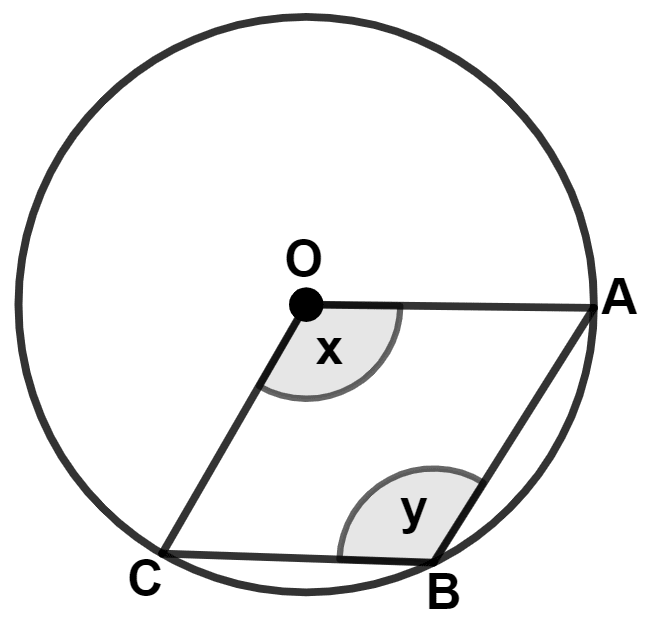
In the given figure, O is center of the circle and OABC is a rhombus, then :
x° + y° = 180°
x° = y° = 90°
x° + 2y° = 360°
x° = y° = 45°
Answer
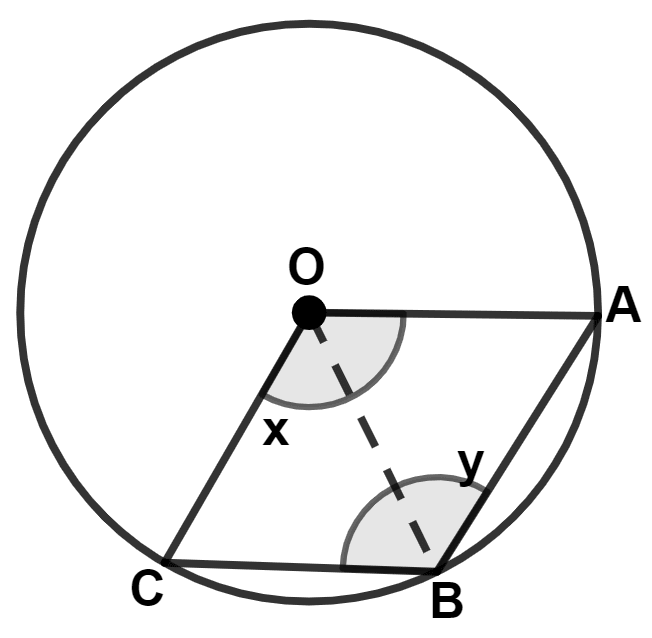
Join OB.
From figure,
OB = OA (Radius of same circle) ........(1)
We know that,
Sides of rhombus are equal.
∴ OA = AB .............(2)
From (1) and (2), we get :
⇒ OA = OB = AB
∴ OAB is an equilateral triangle.
Since, diagonals of rhombus bisect the interior angles.
In △OAB,
∠AOB =
∠OBA =
Since, each angle of equilateral triangle is 60°.
∴ ∠AOB = 60°
⇒
⇒ x = 120°.
∴ ∠OBA = 60°
⇒
⇒ y = 120°.
Substituting value of x and y in L.H.S. of equation x° + 2y° = 360°, we get :
⇒ 120° + 2(120°)
⇒ 120° + 240°
⇒ 360°.
Since, L.H.S. = R.H.S.
Hence, Option 3 is the correct option.
Arcs AB and BC are of lengths in the ratio 11 : 4 and O is center of the circle. If angle BOC = 32°, the angle AOB is :
64°
88°
128°
132°

Answer
Given,
Arcs AB and BC are of lengths in the ratio 11 : 4.
∴ ∠AOB : ∠BOC = 11 : 4
⇒ ∠AOB : 32° = 11 : 4
⇒ ∠AOB = = 88°.
Hence, Option 2 is the correct option.
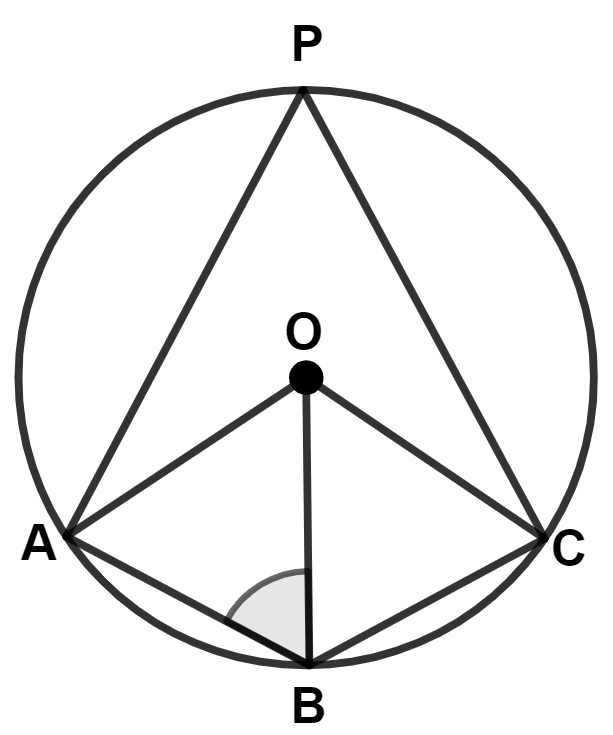
In the given figure, AB is the side of regular pentagon and BC is the side of regular hexagon. Angle BAC is :
132°
66°
90°
120°
Answer
Since,
AB is the side of regular pentagon.
∴ ∠AOB = = 72°.
BC is the side of regular hexagon.
∴ ∠BOC = = 60°.
From figure,
∠AOC = ∠AOB + ∠BOC = 72° + 60° = 132°.
We know that,
The angle which an arc of a circle subtends at the center is double that which it subtends at any point on the remaining part of the circumference.
⇒ ∠AOC = 2∠APC
⇒ ∠APC = = 66°.
Hence, Option 2 is the correct option.
In the given figure, O is center of the circle. Chord BC = chord CD and angle A = 80°. Angle BOC is :
120°
80°
100°
160°

Answer
Given,
Chord BC = chord CD
∴ ∠BOC = ∠COD = x (let)
From figure,
∠BOD = ∠BOC + ∠COD = x + x = 2x
We know that,
The angle which an arc subtends at the center is double that which it subtends at any point on the remaining part of the circumference.
⇒ ∠BOD = 2∠BAD
⇒ 2x = 2 × 80°
⇒ x = 80°.
Hence, Option 2 is the correct option.
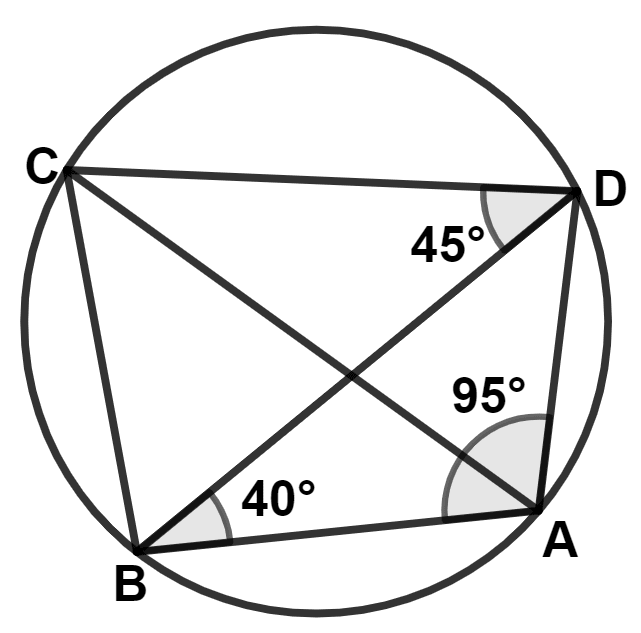
In the given circle, ∠BAD = 95°, ∠ABD = 40° and ∠BDC = 45°.
Assertion (A) : To show that AC is a diameter, the angle ADC or angle ABC need to be proved to be 90°.
Reason (R) : In △ADB,
∠ADB = 180° - 95° - 40° = 45°
∴ Angle ADC = 45° + 45° = 90°
A is true, R is false.
A is false, R is true.
Both A and R are true and R is correct reason for A.
Both A and R are true and R is incorrect reason for A.
Answer
We know that,
Angle in semicircle is a right angle.
If AC is the diameter, then ∠ADC = ∠ABC = 90°.
∴ Assertion (A) is true.
From figure,
In △ADB,
By angle sum property of triangle,
∴ ∠ADB + ∠DBA + ∠BAD = 180°
⇒ ∠ADB + 40° + 95° = 180°
⇒ ∠ADB + 135° = 180°
⇒ ∠ADB = 180° - 135° = 45°.
From figure,
⇒ ∠ADC = ∠ADB + ∠BDC = 45° + 45° = 90°.
∴ Reason (R) is true.
Hence, Option 3 is the correct option.
ABCD is a cyclic quadrilateral, BD and AC are its diameters. Also, ∠DBC = 50°.
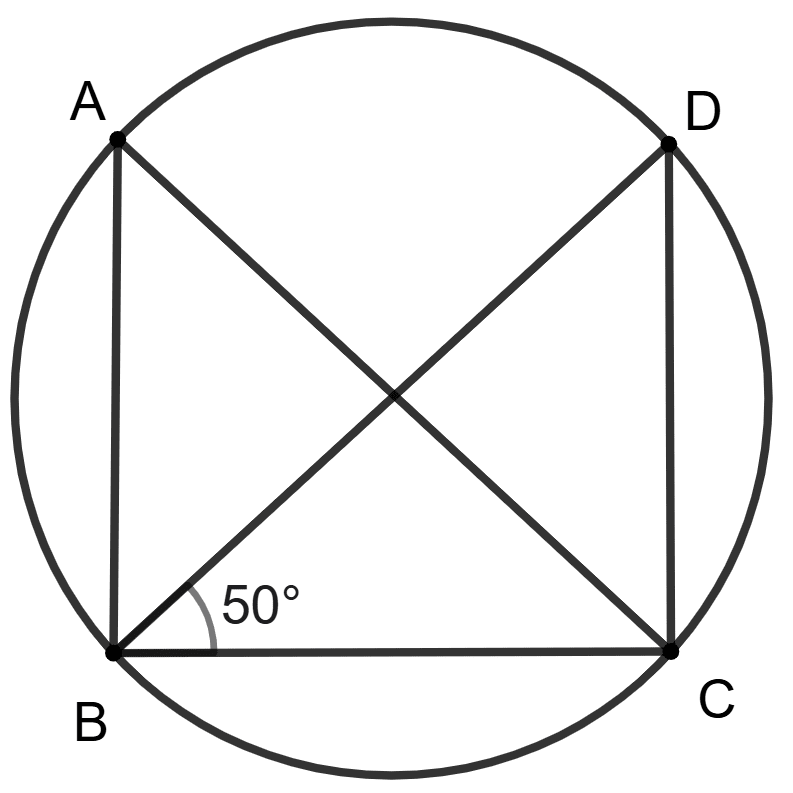
Assertion (A) : ∠BAC = 40°.
Reason (R) : ∠BAC = ∠BDC = 180° - (50° + 90°) = 40°.
A is true, R is false.
A is false, R is true.
Both A and R are true and R is correct reason for A.
Both A and R are true and R is incorrect reason for A.
Answer
Since BD and AC are diameters, that means:
∠ABC and ∠BCD are right angles (Angles in a semicircle is a right angle)
In △ DBC, using angle sum property,
⇒ ∠DBC + ∠BCD + ∠BDC = 180°
⇒ 50° + 90° + ∠BDC = 180°
⇒ 140° + ∠BDC = 180°
⇒ ∠BDC = 180° - 140°
⇒ ∠BDC = 40°
We know that, angles in the same segment of a circle are equal.
⇒ ∠BAC = ∠BDC
⇒ ∠BAC = 40°
So, assertion and reason are true and reason clearly explains assertion.
Hence, option 3 is the correct option.
Points A, C, B and D are concyclic, AB is diameter and ∠ABC = 60°.
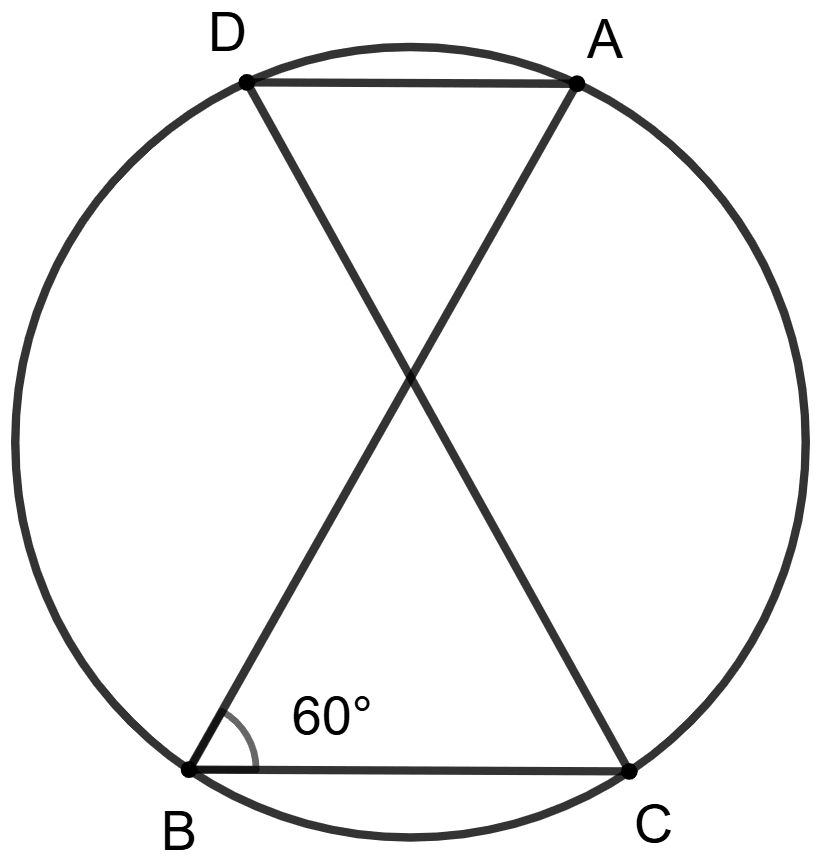
Assertion (A) : ∠BAC = 60°.
Reason (R) : AB is diameter so ∠ACB = 90° and ∠ABC + ∠BAC = 90°.
A is true, R is false.
A is false, R is true.
Both A and R are true and R is correct reason for A.
Both A and R are true and R is incorrect reason for A.
Answer
Join AC.
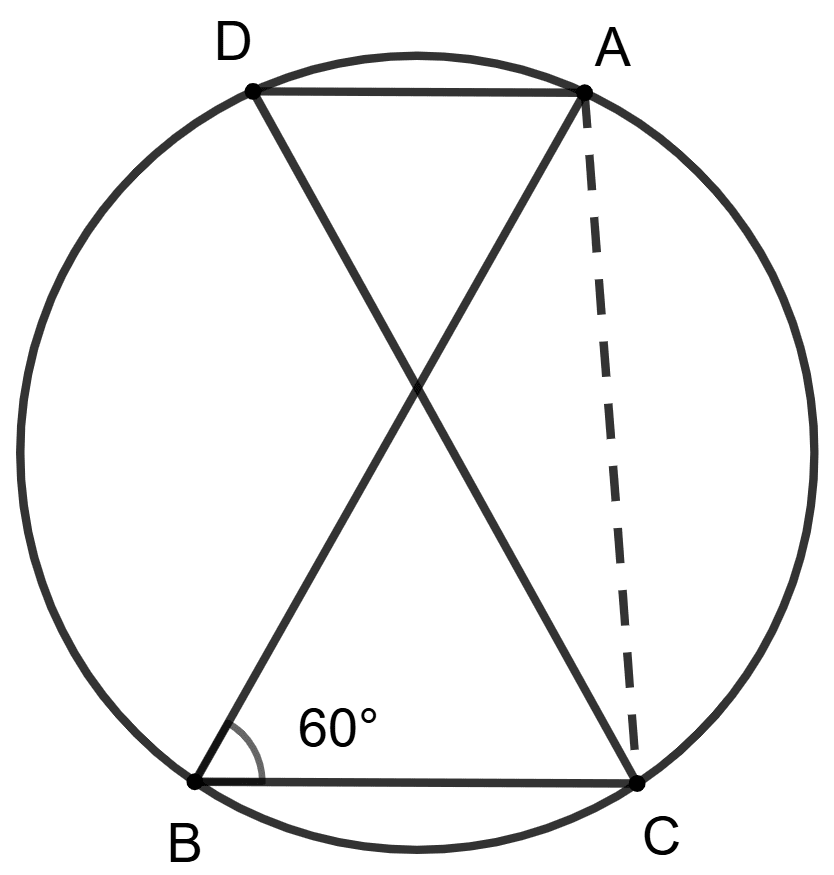
Since AB is diameter, that means :
∠ACB = 90° (Angles in a semicircle is a right angle)
In △ ABC, using angle sum property,
⇒ ∠ABC + ∠ACB + ∠BAC = 180° ....................(1)
⇒ 60° + 90° + ∠BAC = 180°
⇒ 150° + ∠BAC = 180°
⇒ ∠BAC = 180° - 150°
⇒ ∠BAC = 30°
So, assertion (A) is false.
From equation (1),
⇒ ∠ABC + 90° + ∠BAC = 180°
⇒ ∠ABC + ∠BAC = 180° - 90°
⇒ ∠ABC + ∠BAC = 90°
So, reason (R) is true.
Hence, option 2 is the correct option.
AB is diameter of the circle and ∠ACD = 38°.
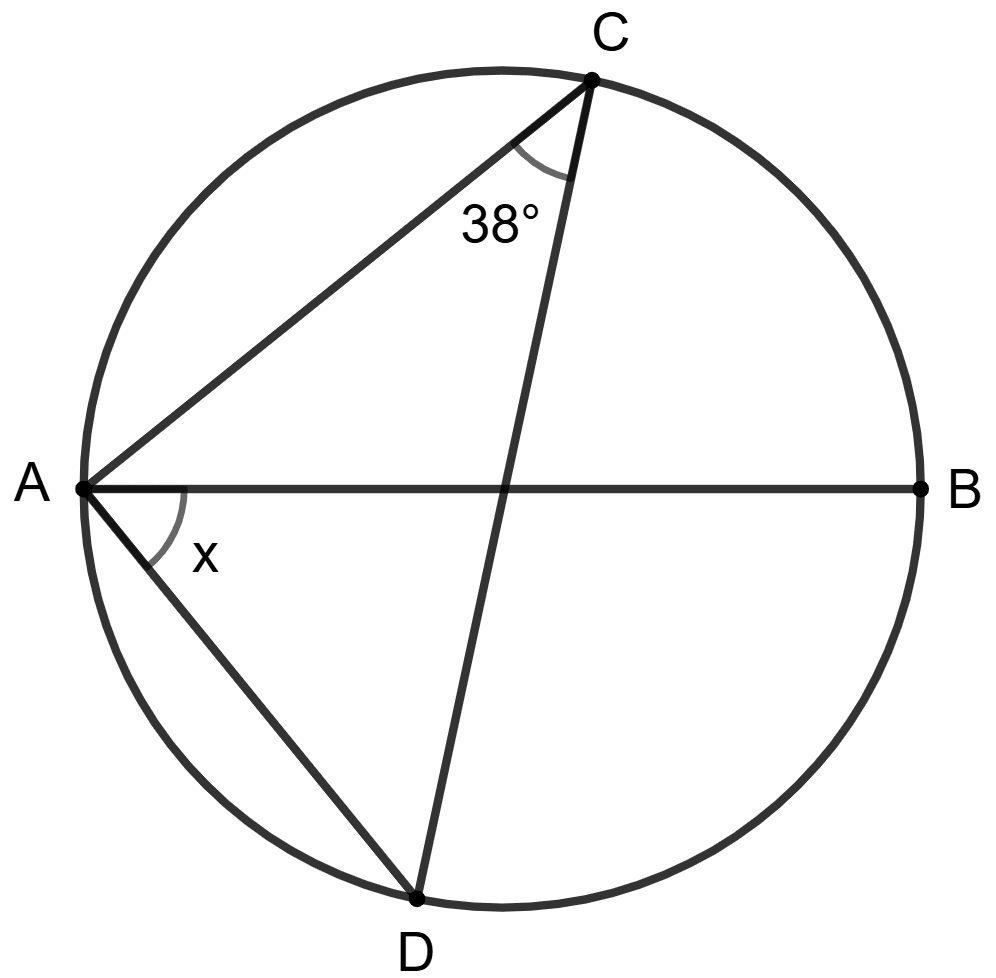
Assertion (A) : x = 38°.
Reason (R) : ∠ACB = 90°, x = ∠DCB = 90° - 38° = 52°.
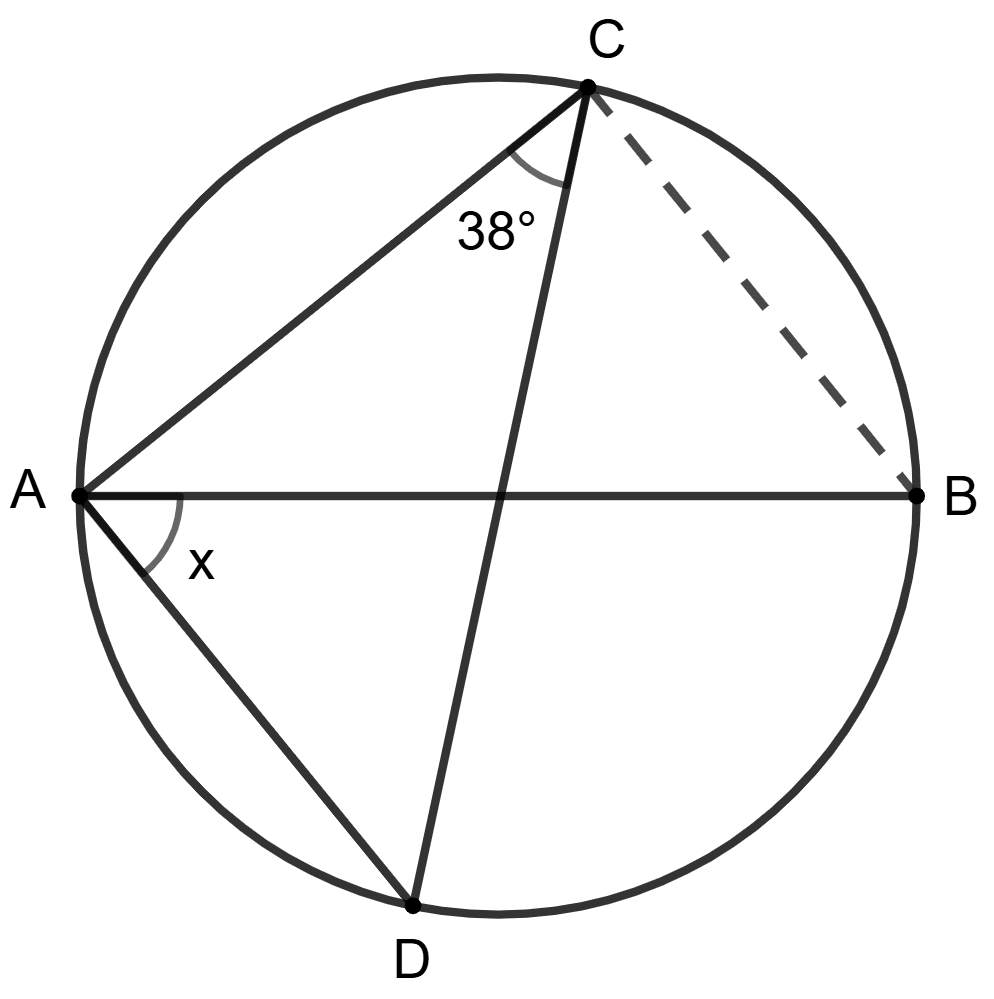
A is true, R is false.
A is false, R is true.
Both A and R are true and R is correct reason for A.
Both A and R are true and R is incorrect reason for A.
Answer
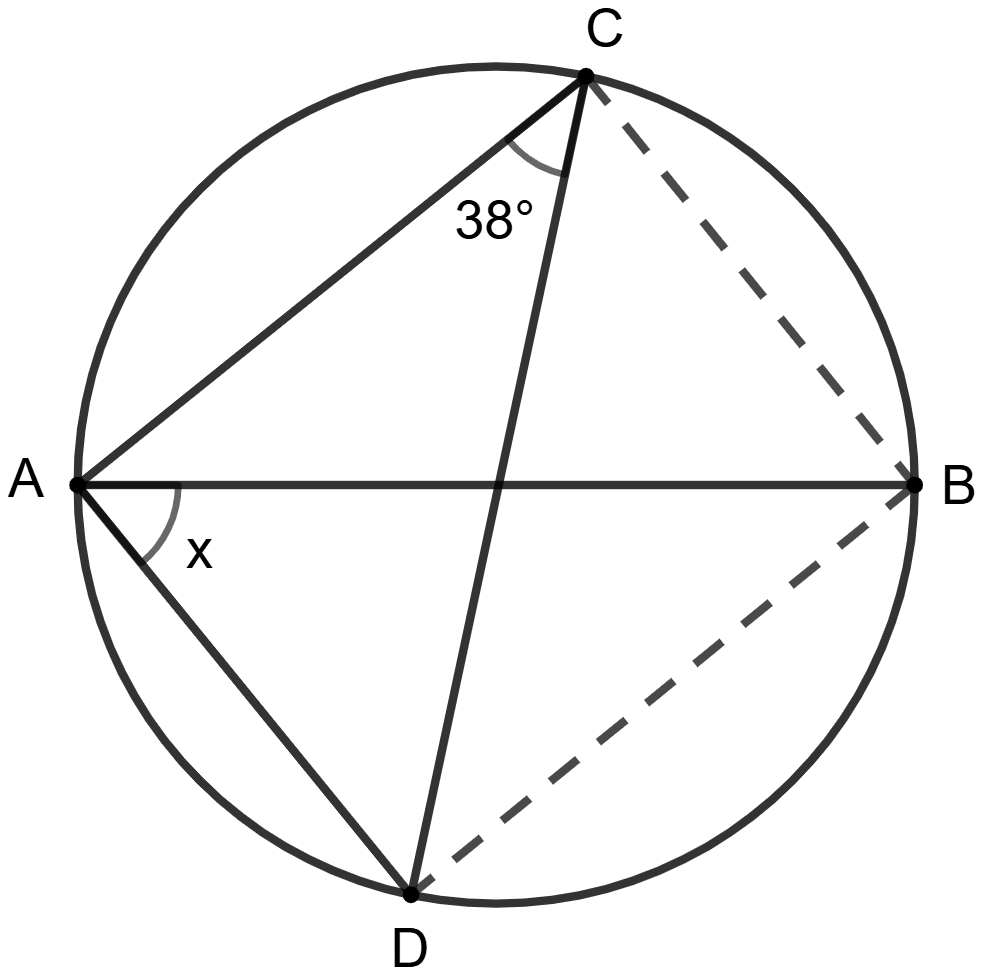
Join DB and CB.
It is given AB is diameter of the circle and angles in a semicircle is a right angle.
⇒ ∠ACB = 90°
⇒ ∠ACD + ∠DCB = 90°
⇒ 38° + ∠DCB = 90°
⇒ ∠DCB = 90° - 38°
⇒ ∠DCB = 52°
We know that, angles subtended by the same chord in the same segment of a circle are equal.
⇒ ∠BAD (x) = ∠BCD = 52°
So, assertion (A) is false but reason (R) is true.
Hence, option 2 is the correct option.
Chords AC and BD intersect each other at point P.
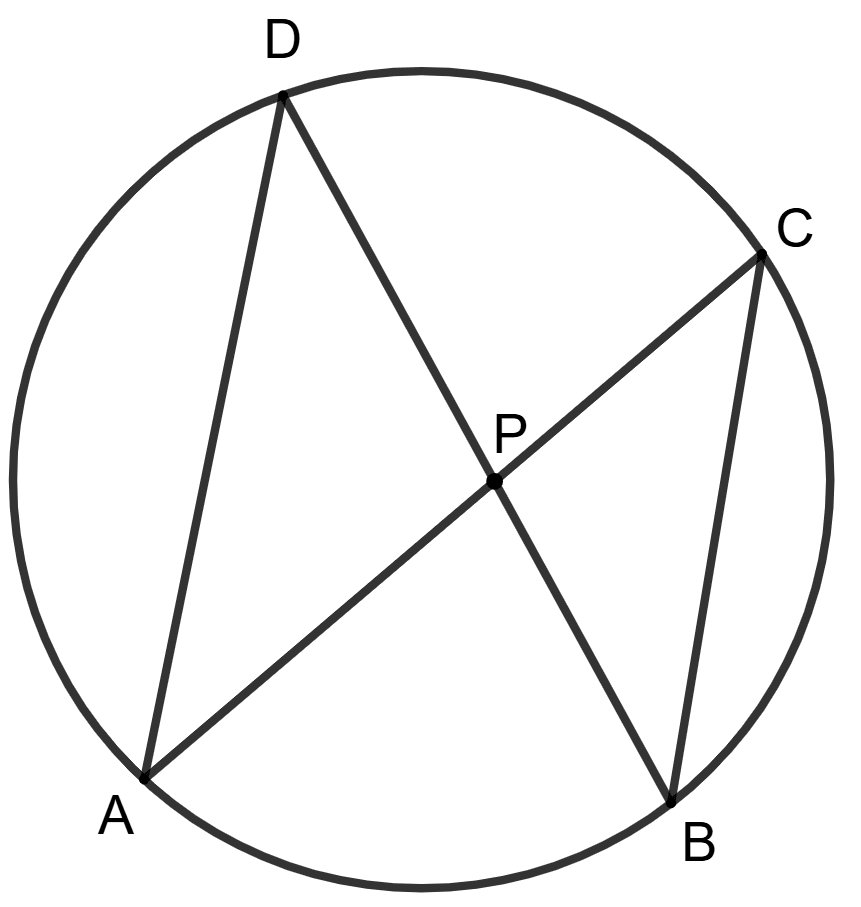
Assertion (A) : PA x PC = PB x PD.
Reason (R) : Δ APD ∼ Δ BPC
A is true, R is false.
A is false, R is true.
Both A and R are true and R is correct reason for A.
Both A and R are true and R is incorrect reason for A.
Answer
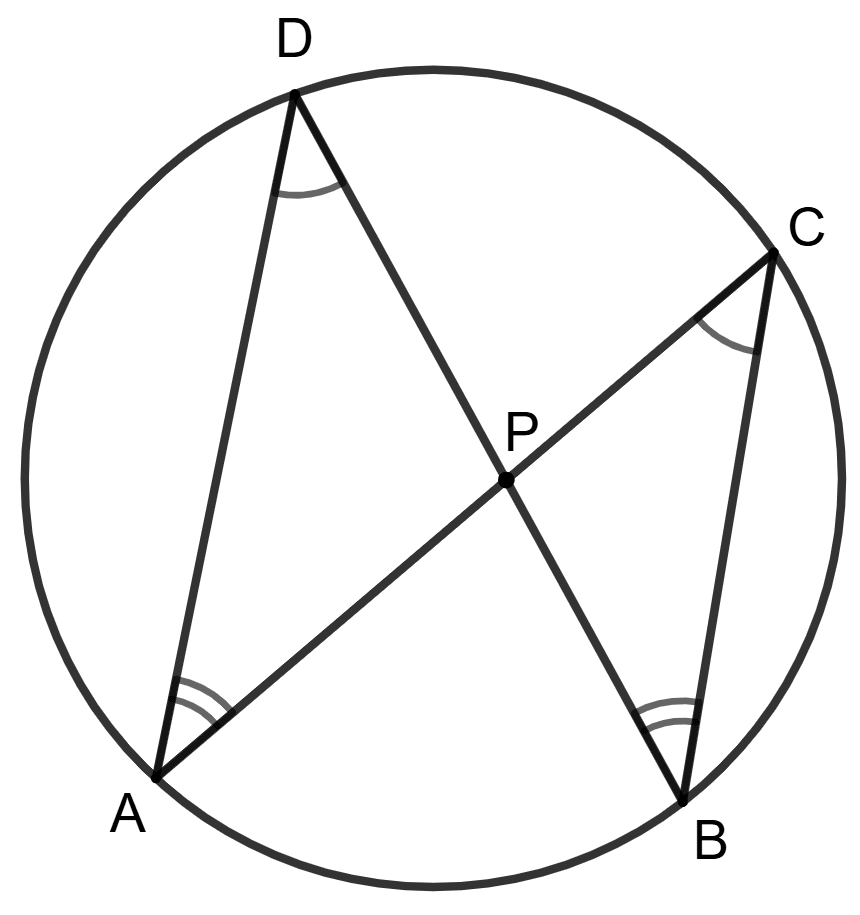
In Δ APD and Δ BPC,
⇒ ∠APD = ∠BPC (Vertically opposite angles are equal)
⇒ ∠ADP = ∠BCP (Angles in same segment are equal)
∴ Δ APD ∼ Δ BPC (By A.A. similarity)
Corresponding sides of similar triangles are proportional.
........(1)
So, reason (R) is true.
Solving (1),
⇒ AP x PC = PD x PB
So, assertion (A) is true and R is the correct reason for A.
Hence, option 3 is the correct option.
A circle with center at point O and ∠AOC = 160°.
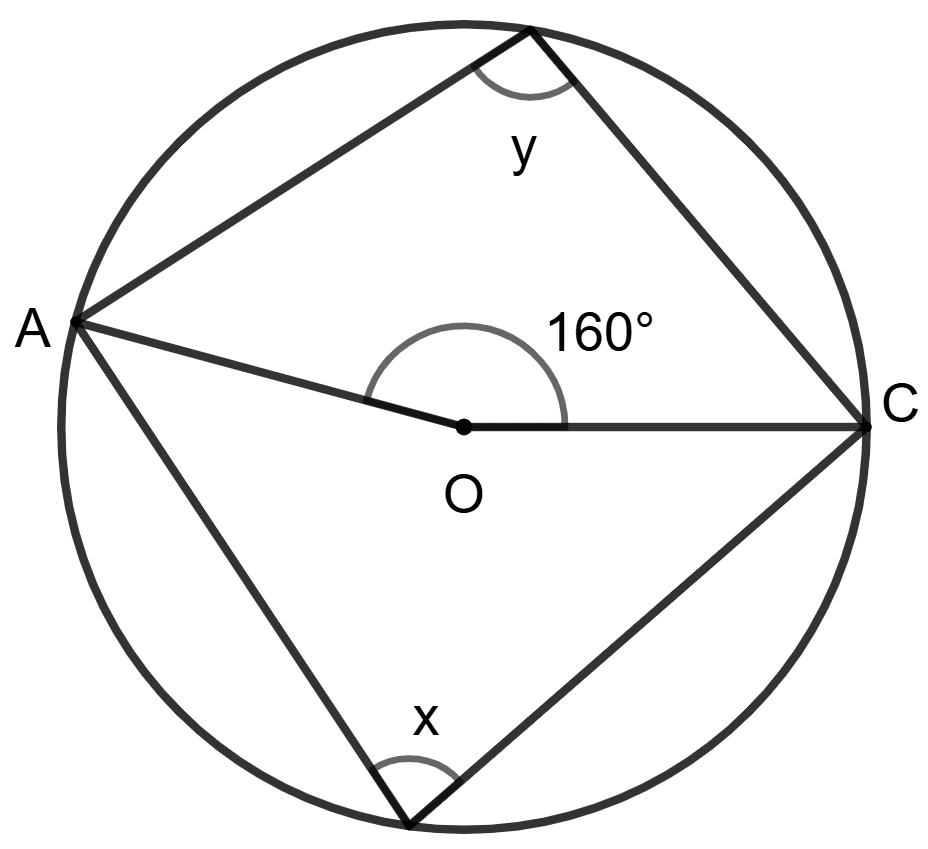
Statement (1) : Angle x = 100° and angle y = 80°.
Statement (2) : The angle, which an arc of a circle subtends at the center of the circle is double the angle which it subtends at any point on the remaining part of the circumference.
Both statements are true.
Both statements are false.
Statement 1 is true, and statement 2 is false.
Statement 1 is false, and statement 2 is true.
Answer
We know that, the angle, subtended by an arc of a circle is double the angle subtended by it at any point on the remaining part of the circle.
So, statement 2 is true.
⇒ ∠AOC = 2x
⇒ 160° = 2x
⇒ x = = 80°
We know that, sum of either pair of opposite angles of a cyclic quadrilateral is 180°.
⇒ x + y = 180°
⇒ 80° + y = 180°
⇒ y = 180° - 80° = 100°
So, statement 1 is false.
Hence, option 4 is the correct option.
AC is diameter, AE is parallel to BC and ∠BAC = 50°.
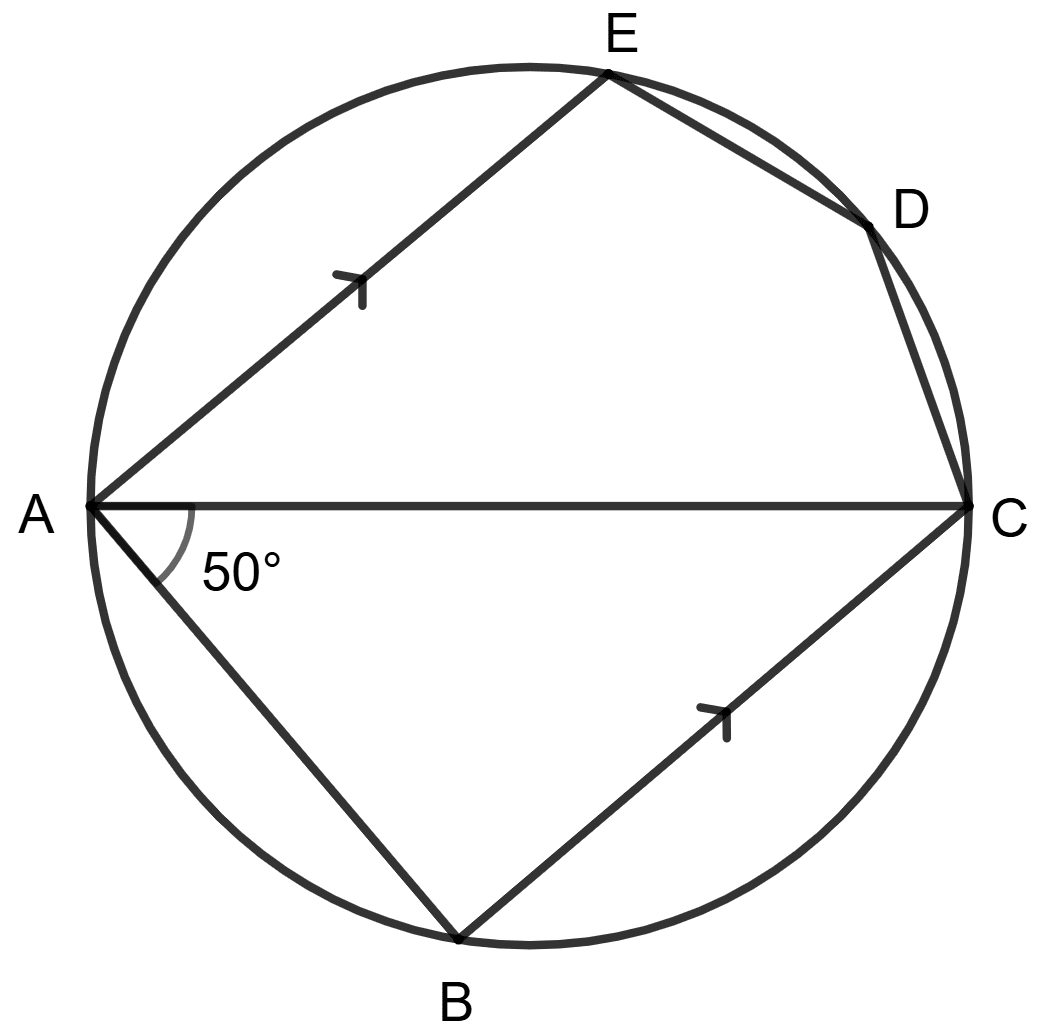
Statement (1) : ∠EDC + 50° = 180°.
Statement (2) : ∠EDC + ∠EAC = 180°.
Both statements are true.
Both statements are false.
Statement 1 is true, and statement 2 is false.
Statement 1 is false, and statement 2 is true.
Answer
It is given that AC is diameter and angles in a semicircle is a right angle.
⇒ ∠ABC = 90°
Since, AE is parallel to BC and AB is transversal.
⇒ ∠ABC + ∠BAE = 180° [The sum of co-interior angles formed when a transversal intersects two parallel lines is always 180°]
⇒ 90° + ∠BAE = 180°
⇒ ∠BAE = 180° - 90°
⇒ ∠BAE = 90°
⇒ ∠BAC + ∠EAC = 90°
⇒ 50° + ∠EAC = 90°
⇒ ∠EAC = 90° - 50°
⇒ ∠EAC = 40°
AEDC form a cyclic quadrilateral and sum of either pair of opposite angles of a cyclic quadrilateral is 180°.
⇒ ∠EDC + ∠EAC = 180°
⇒ ∠EDC + 40° = 180°
So, statement 1 is false but statement 2 is true.
Hence, option 4 is the correct option.
O is the center of the circle, OB = BC and ∠BOC = 20°.
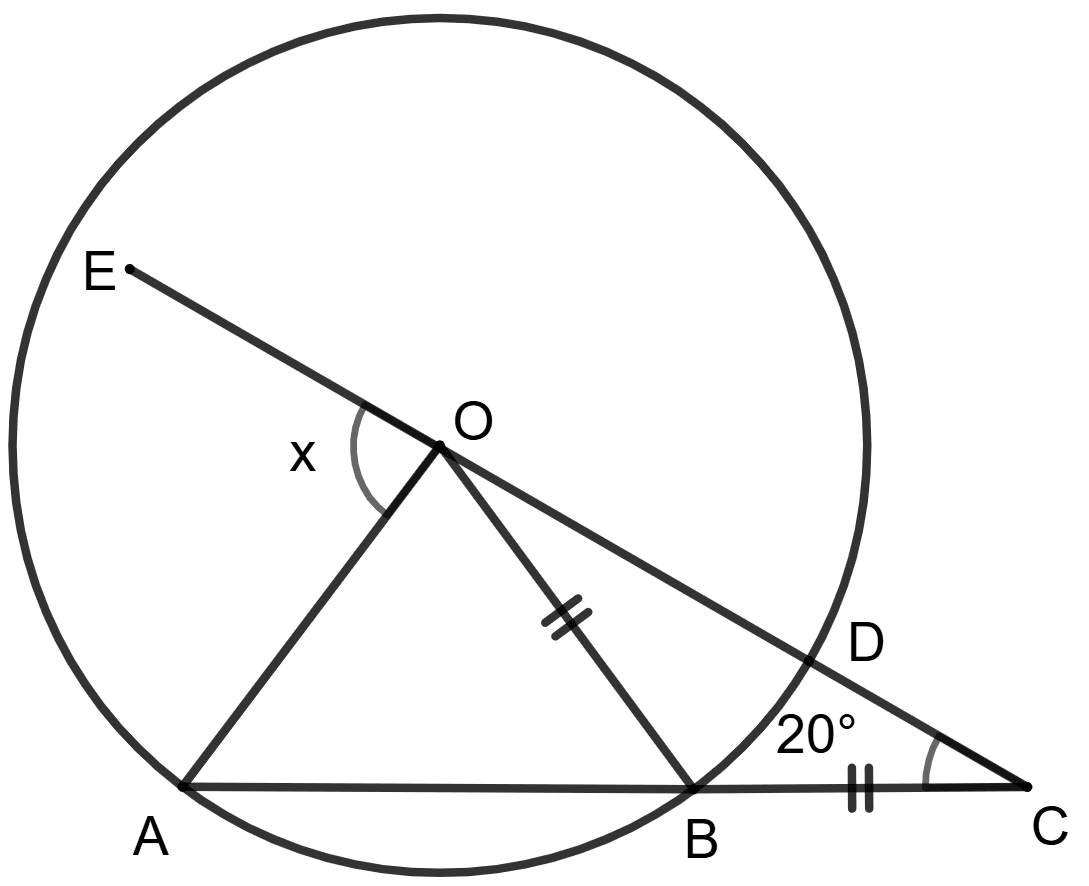
Statement (1) : x = 2 x 20° = 40°
Statement (2) : ∠BOC = 20°.
x = ∠OAB + 20° = ∠OBA + 20° = 40° + 20° = 60°
Both statements are true.
Both statements are false.
Statement 1 is true, and statement 2 is false.
Statement 1 is false, and statement 2 is true.
Answer
Given,
⇒ OB = OC
⇒ ∠BOC = ∠BCO = 20° (Angles opposite to equal sides of a triangle are always equal)
In △ OBC, using angle sum property,
⇒ ∠OBC + ∠BCO + ∠BOC = 180°
⇒ ∠OBC + 20° + 20° = 180°
⇒ ∠OBC + 40° = 180°
⇒ ∠OBC = 180° - 40°
⇒ ∠OBC = 140°
∠OBC and ∠OBA forms linear pairs of angle.
⇒ ∠OBC + ∠OBA = 180°
⇒ 140° + ∠OBA = 180°
⇒ ∠OBA = 180° - 140°
⇒ ∠OBA = 40°
Since OB = OA (Radii of same circle)
⇒ ∠OBA = ∠OAB = 40° (Angles opposite to equal sides of a triangle are always equal)
Using exterior angle property, the exterior angle of a triangle is equal to the sum of the two opposite interior angles.
In triangle OAC,
⇒ ∠EOA = ∠OAC + ∠OCA
⇒ x = ∠OAB + 20°
⇒ x = ∠OBA + 20° = 40° + 20° = 60°
So, statement 1 is false and statement 2 is true.
Hence, option 4 is the correct option.
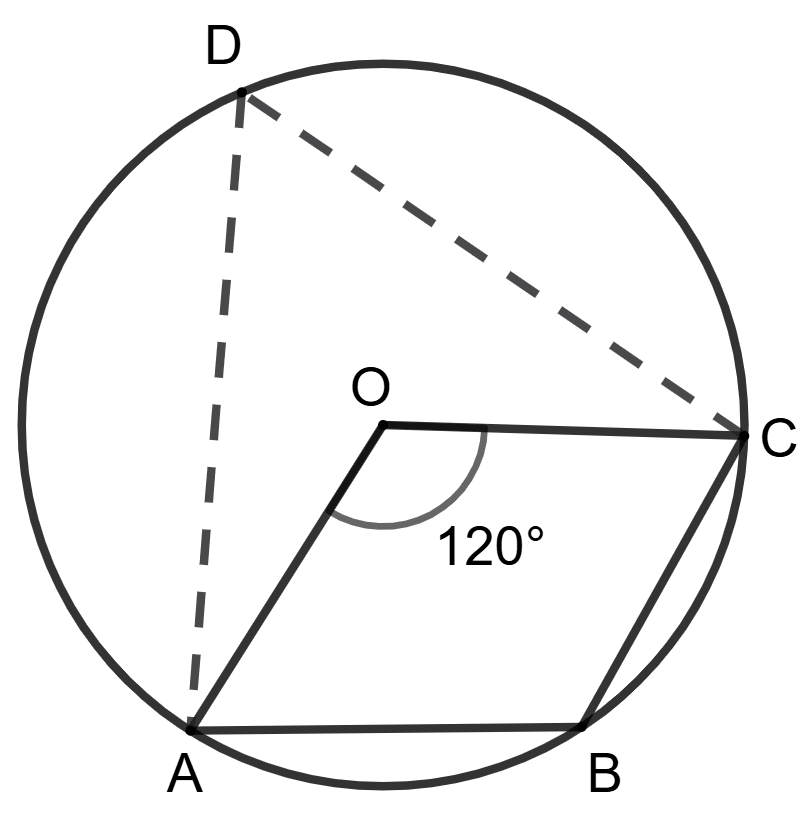
O is the center of the circle and ∠AOC = 120°.
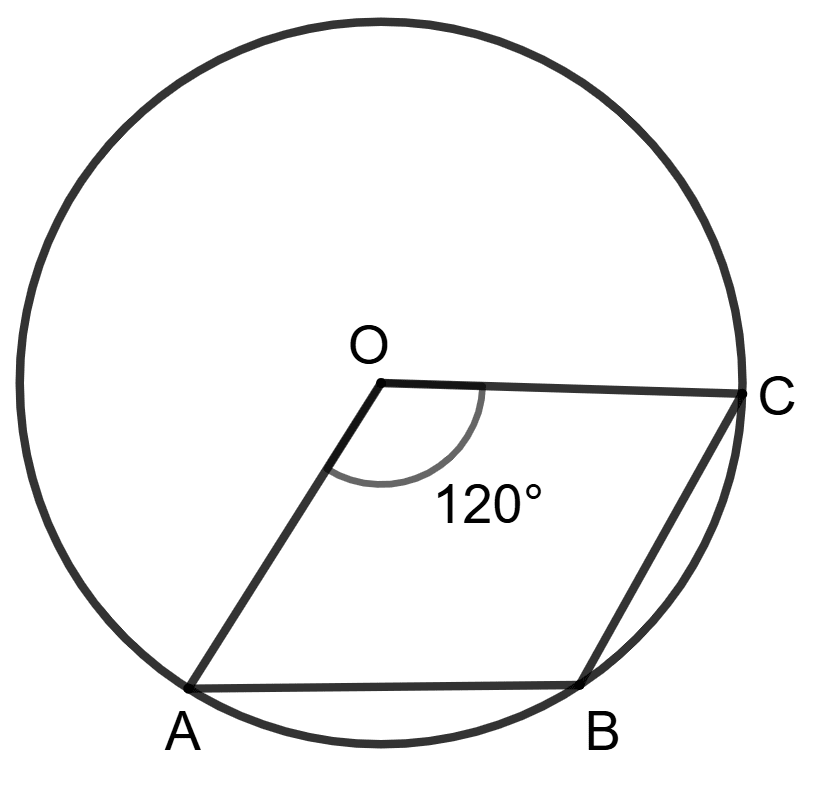
Statement (1) : ∠ABC = 120°
Statement (2) : ∠ABC + ∠ADC = 180° ⇒ ∠ABC + 60° = 180°.
Both statements are true.
Both statements are false.
Statement 1 is true, and statement 2 is false.
Statement 1 is false, and statement 2 is true.
Answer
Since, the angle, which an arc of a circle subtends at the center of the circle is double the angle which it subtends at any point on the remaining part of the circumference.
⇒ ∠AOC = 2 x ∠ADC
⇒ 120° = 2 x ∠ADC
⇒ ∠ADC = = 60°
ABCD form a cyclic quadrilateral and sum of opposite angles of cyclic quadrilateral is 180°.
⇒ ∠ADC + ∠ABC = 180°
⇒ 60° + ∠ABC = 180°
⇒ ∠ABC = 180° - 60°
⇒ ∠ABC = 120°
So, both statement are true.
Hence, option 1 is the correct option.
In the given circle with diameter AB, find the value of x.

Answer
As angles in same segment are equal.
∴ ∠ABD = ∠ACD = 30°.
From figure,
∠ADB = 90° [As angle in semi-circle is a right angle.]
In △ADB,
⇒ ∠ABD + ∠ADB + ∠BAD = 180° [By angle sum property of triangle]
⇒ 30° + 90° + x = 180°
⇒ 120° + x = 180°
⇒ x = 180° - 120° = 60°.
Hence, the value of x = 60°.
In the given figure, ABC is a triangle in which ∠BAC = 30°. Show that BC is equal to the radius of the circumcircle of the triangle ABC, whose centre is O.
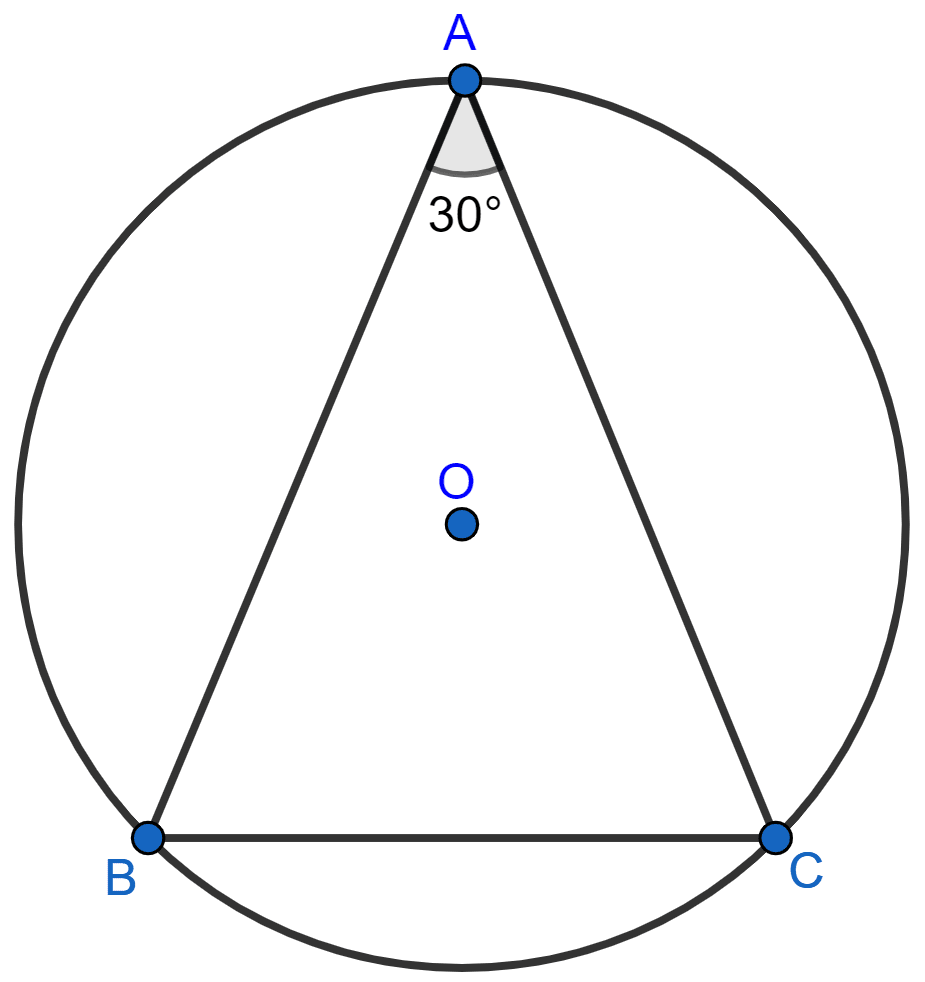
Answer
Join OB and OC.
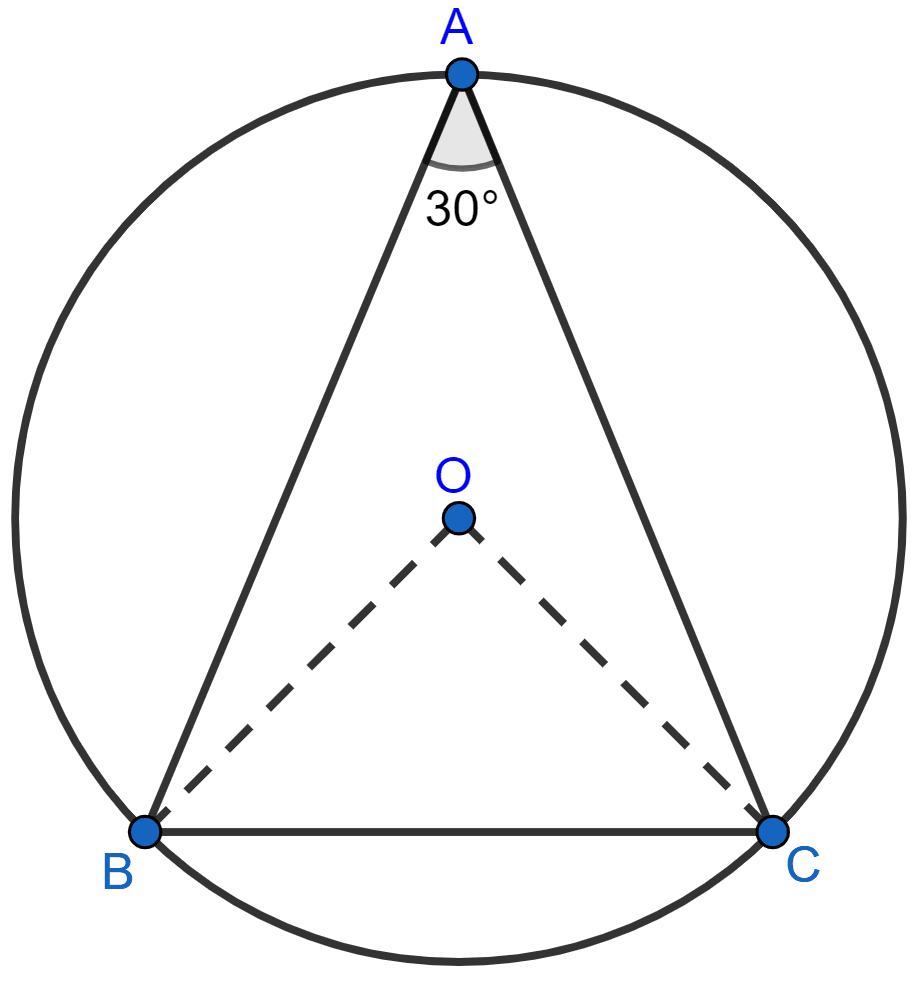
We know that,
Angle at the centre is twice the angle at remaining circumference.
∴ ∠BOC = 2∠BAC = 2 × 30° = 60°
In △OBC,
⇒ OB = OC [Radii of same circle]
⇒ ∠OBC = ∠OCB = x (let) [As angles opposite to equal sides are equal]
⇒ ∠BOC + ∠OBC + ∠OCB = 180°
⇒ 60° + x + x = 180°
⇒ 2x + 60° = 180°
⇒ 2x = 180° - 60°
⇒ 2x = 120°
⇒ x = = 60°.
∴ ∠OBC = ∠OCB = ∠BOC = 60°.
Hence, △OBC is an equilateral triangle.
∴ OB = OC = BC.
Hence, proved that BC is equal to the radius of the circumcircle of the triangle ABC.
In the given figure, chord ED is parallel to diameter AC of the circle. Given ∠CBE = 65°, calculate ∠DEC.
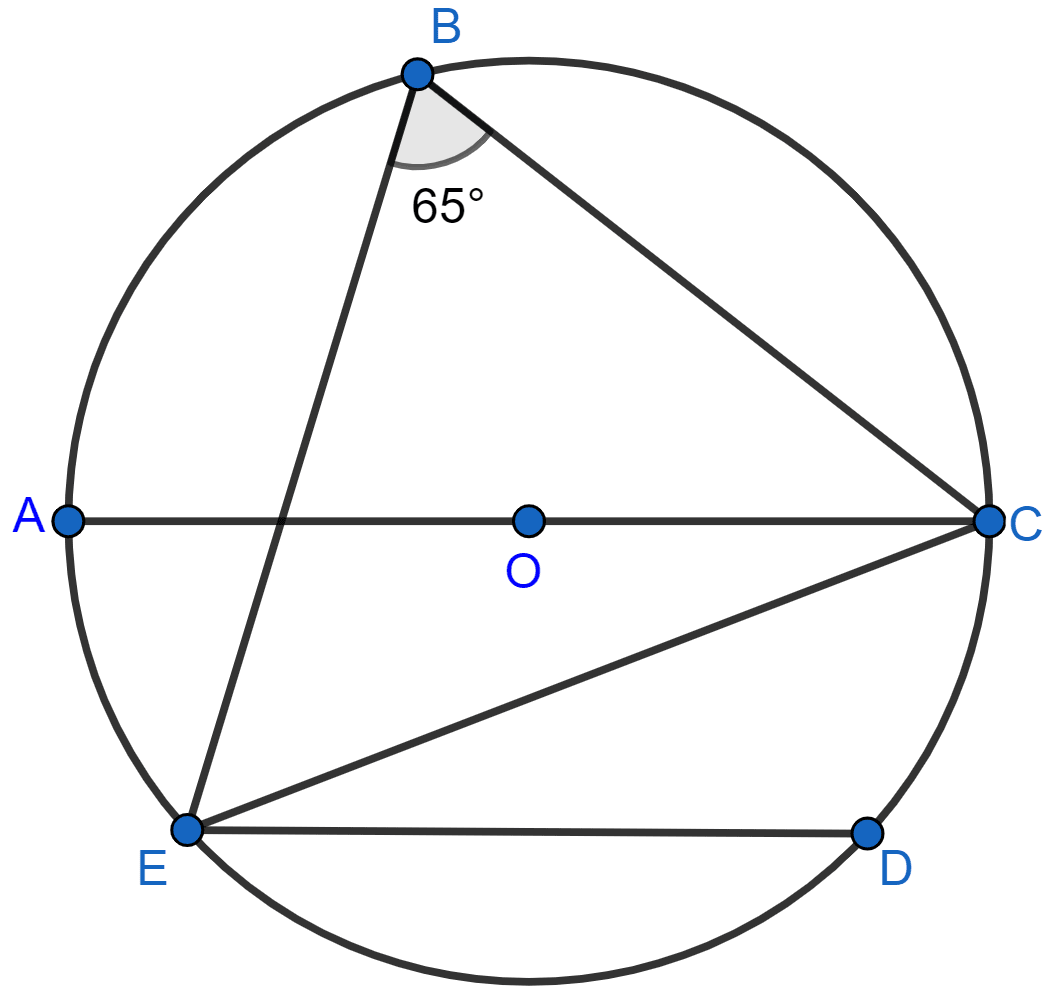
Answer
Join OE and AB.
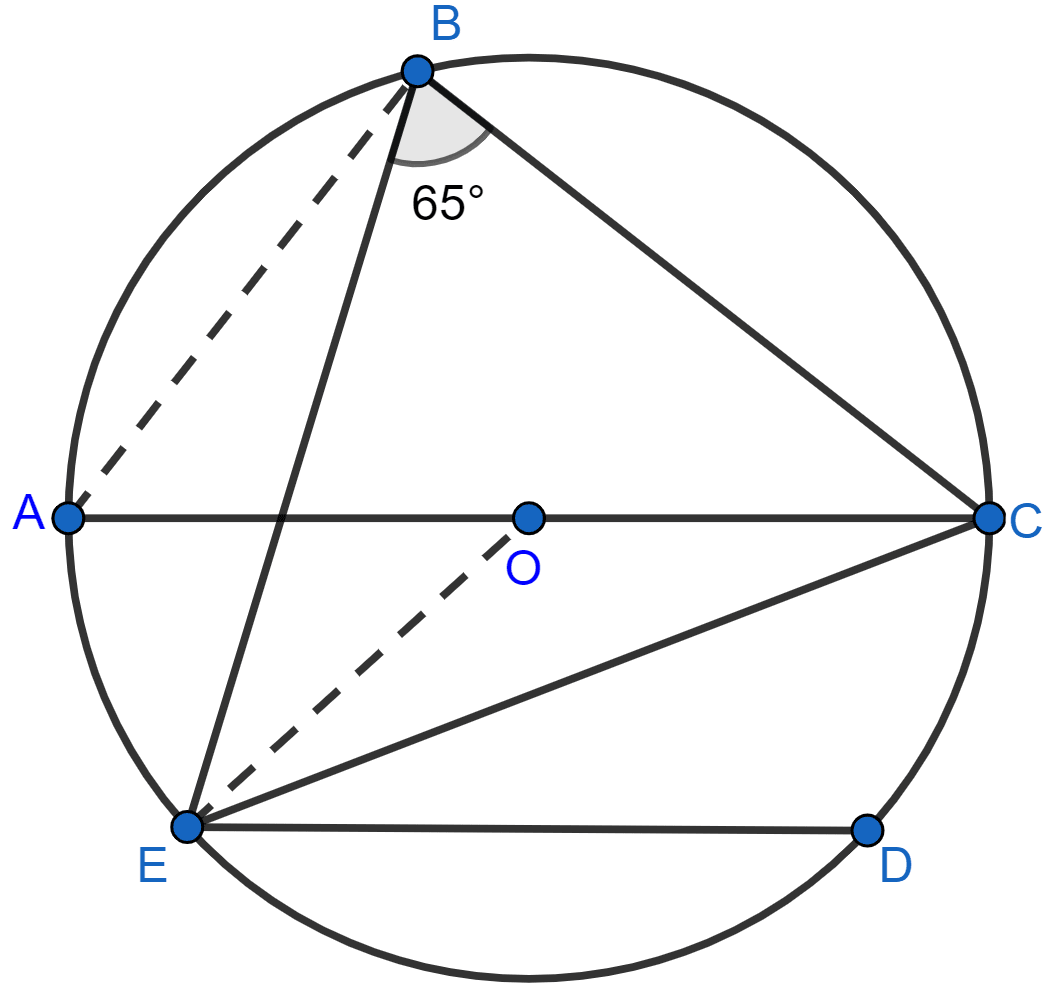
Arc EC subtends ∠EOC at the centre and ∠EBC at the remaining part of the circle.
We know that,
Angle at the centre is twice the angle at remaining circumference.
∴ ∠EOC = 2∠EBC = 2 x 65° = 130°.
Now, in ∆OEC
OE = OC [Radii of the same circle]
So, ∠OEC = ∠OCE [Angle opposite to equal sides are equal.]
In ∆OCE by angle sum property,
⇒ ∠OEC + ∠OCE + ∠EOC = 180°
⇒ 2∠OCE + 130° = 180°
⇒ 2∠OCE = 180° - 130°
⇒ 2∠OCE = 50°
⇒ ∠OCE = = 25°.
Given, AC || ED
∴ ∠DEC = ∠OCE [Alternate angles are equal]
⇒ ∠DEC = 25°.
Hence, ∠DEC = 25°.
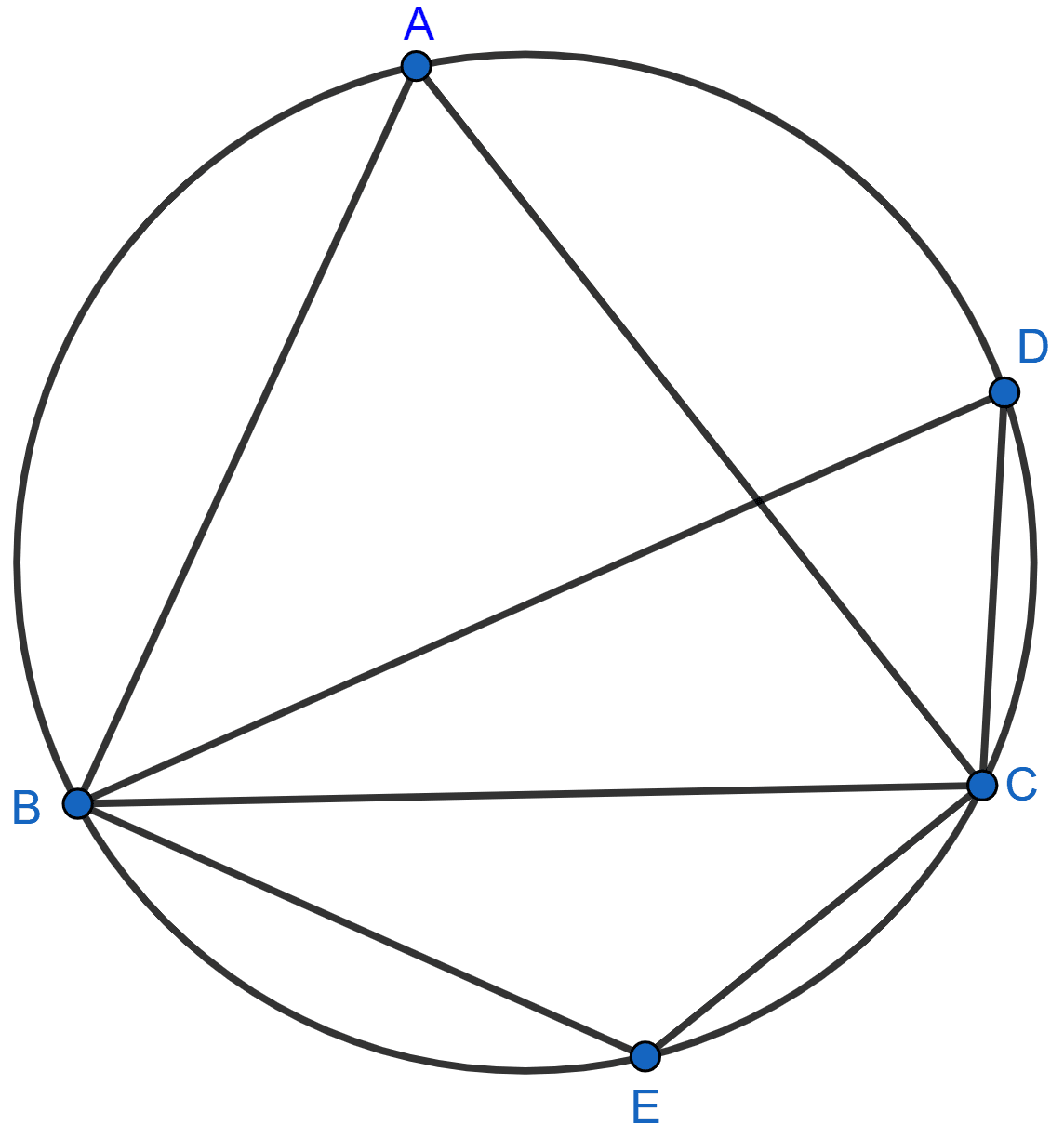
In the figure, ∠DBC = 58°. BD is a diameter of the circle. Calculate :
(i) ∠BDC
(ii) ∠BEC
(iii) ∠BAC
Answer
(i) Given that BD is a diameter of the circle.
We know that,
Angle in a semicircle is a right angle.
So, ∠BCD = 90°
Also given that,
∠DBC = 58°
In ∆BDC,
⇒ ∠DBC + ∠BCD + ∠BDC = 180° [Angle sum property of triangle]
⇒ 58° + 90° + ∠BDC = 180°
⇒ 148° + ∠BDC = 180°
⇒ ∠BDC = 180° - 148° = 32°.
Hence, ∠BDC = 32°.
(ii) We know that, the opposite angles of a cyclic quadrilateral are supplementary.
So, in cyclic quadrilateral BECD
⇒ ∠BEC + ∠BDC = 180°
⇒ ∠BEC + 32° = 180°
⇒ ∠BEC = 180° - 32° = 148°
Hence, ∠BEC = 148°.
(iii) In cyclic quadrilateral ABEC,
⇒ ∠BAC + ∠BEC = 180° [Sum of opposite angles of a cyclic quadrilateral = 180°]
⇒ ∠BAC + 148° = 180°
⇒ ∠BAC = 180° - 148°= 32°.
Hence, ∠BAC = 32°.
In the given figure, ABCD is a cyclic quadrilateral. AF is drawn parallel to CB and DA is produced to point E. If ∠ADC = 92°, ∠FAE = 20°; determine ∠BCD. Given reason in support of your answer.

Answer
Given,
In cyclic quad. ABCD
AF || CB and DA is produced to E such that ∠ADC = 92° and ∠FAE = 20°.
From figure,
⇒ ∠B + ∠D = 180° [As sum of opposite angles in a cyclic quadrilateral = 180°]
⇒ ∠B + 92° = 180°
⇒ ∠B = 180° - 92° = 88°
As AF || CB,
∠FAB = ∠B = 88° [Alternate angles are equal]
But, ∠FAE = 20° [Given]
From figure,
∠BAE = ∠BAF + ∠FAE = 88° + 20° = 108°.
∠BAD = 180° - ∠BAE = 180° - 108° = 72°.
∠BCD + ∠BAD = 180° [As sum of opposite angles in a cyclic quadrilateral = 180°]
⇒ ∠BCD + 72° = 180°
⇒ ∠BCD = 180° - 72° = 108°.
Hence, ∠BCD = 108°.
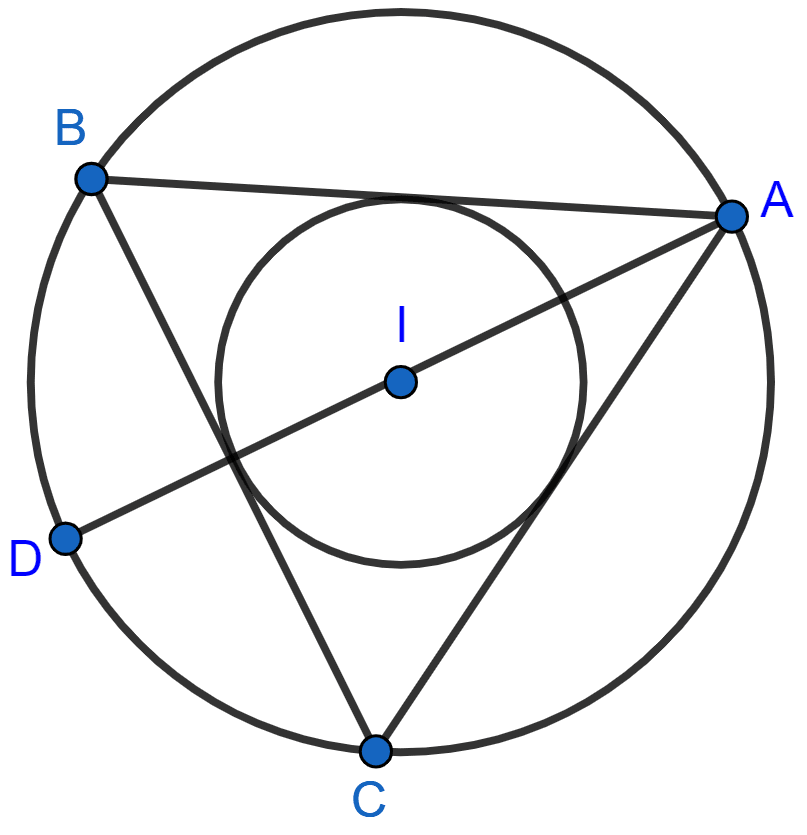
If I is the incentre of triangle ABC and AI when produced meets the circumcircle of triangle ABC in point D. If ∠BAC = 66° and ∠ABC = 80°. Calculate :
(i) ∠DBC,
(ii) ∠IBC,
(iii) ∠BIC.
Answer
Join DB and DC, IB and IC.
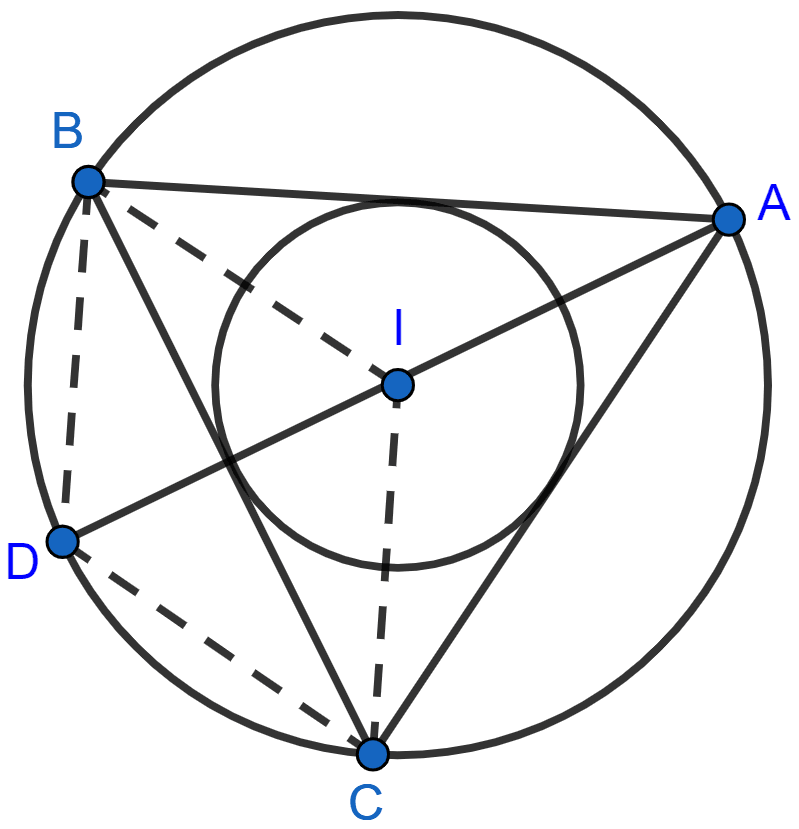
(i) From figure,
∠DAC = ∠BAC [As I is the incenter]
∠DAC = x 66° = 33°.
As angle in same segment are equal.
∴ ∠DBC = ∠DAC = 33°.
Hence, ∠DBC = 33°.
(ii) Since, I is the incentre of ∆ABC, IB bisects ∠ABC.
∴ ∠IBC = ∠ABC
= = 40°.
Hence, ∠IBC = 40°.
(iii) In ∆ABC,
⇒ ∠ACB + ∠ABC + ∠BAC = 180° [By angle sum property]
⇒ ∠ACB = 180° - ∠ABC - ∠BAC
⇒ ∠ACB = 180° - 80° - 66°
⇒ ∠ACB = 180° - 146°
⇒ ∠ACB = 34°.
As I is incenter so, IC bisects ∠C
∴ ∠ICB = ∠ACB = = 17°.
In ∆IBC
⇒ ∠IBC + ∠ICB + ∠BIC = 180° [By angle sum property of triangle]
⇒ 40° + 17° + ∠BIC = 180°
⇒ 57° + ∠BIC = 180°
⇒ ∠BIC = 180° - 57° = 123°.
Hence, ∠BIC = 123°.
In the given Figure, AB = AD = DC = PB and ∠DBC = x°. Determine, in terms of x :
(i) ∠ABD, (ii) ∠APB.
Hence or otherwise, prove that AP is parallel to DB.
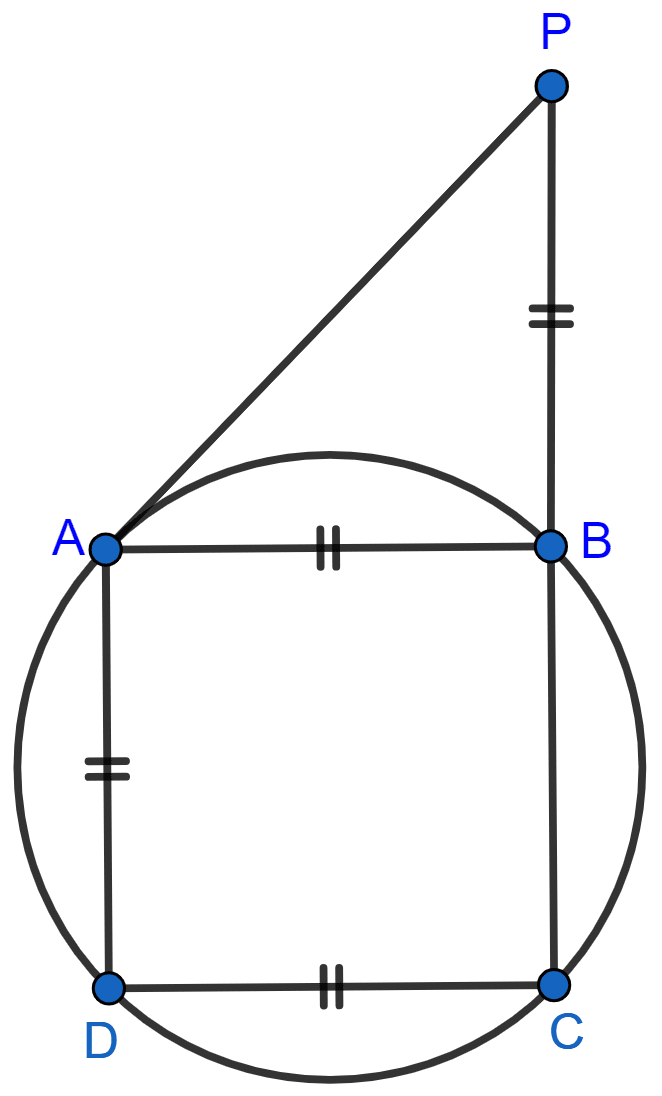
Answer
(i) Join AC and BD.
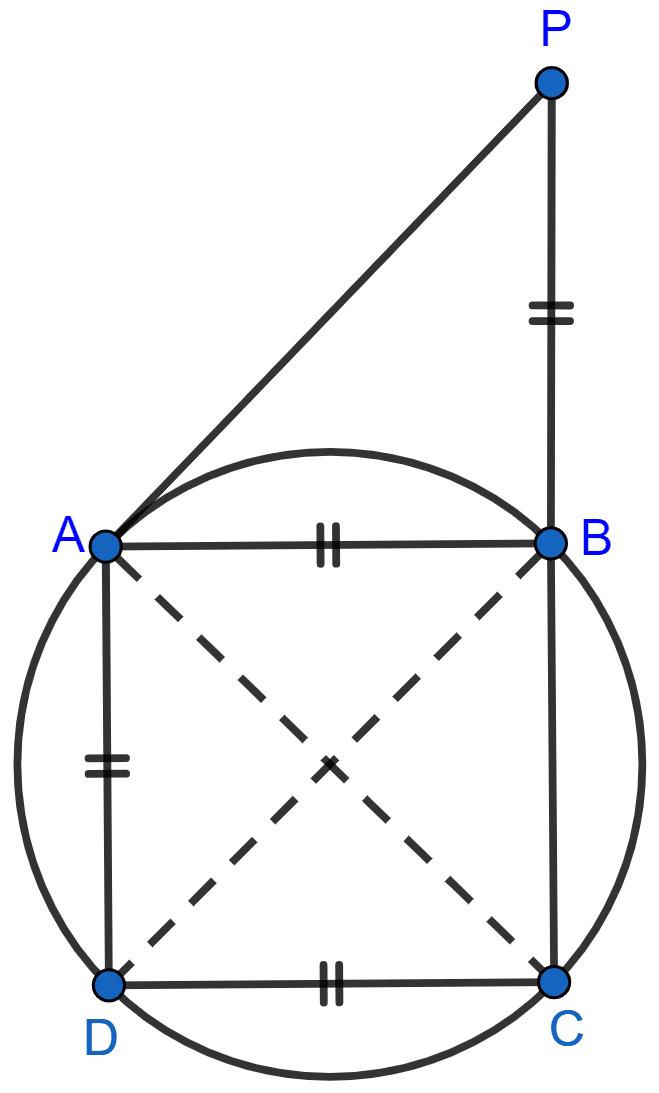
∠DAC = ∠DBC = x° [Angles in the same segment are equal]
∠DCA = ∠DAC = x° [As angles opposite to equal sides are equal]
Also, we have
∠ABD = ∠DCA = x° [Angles in the same segment are equal]
Hence, ∠ABD = x°.
(ii) In ∆ABP
⇒ Ext. ∠ABC = ∠BAP + ∠APB
But, ∠BAP = ∠APB [As angles opposite to equal sides are equal]
⇒ 2x° = ∠APB + ∠APB = 2∠APB
⇒ 2∠APB = 2x°
⇒ ∠APB = x°
Hence, ∠APB = x°.
Thus, ∠APB = ∠DBC = x° [These are corresponding angles]
Hence, proved that AP || DB.
In the given figure; ABC, AEQ and CEP are straight lines. Show that ∠APE and ∠CQE are supplementary.
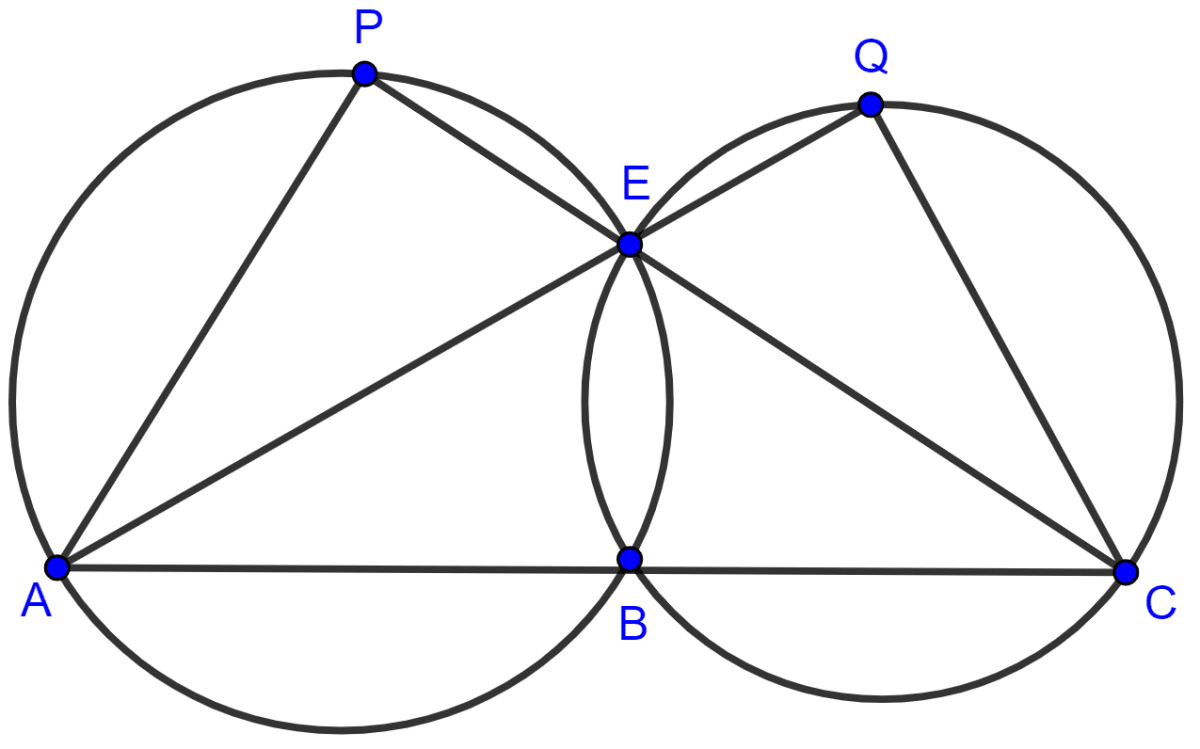
Answer
Join EB.
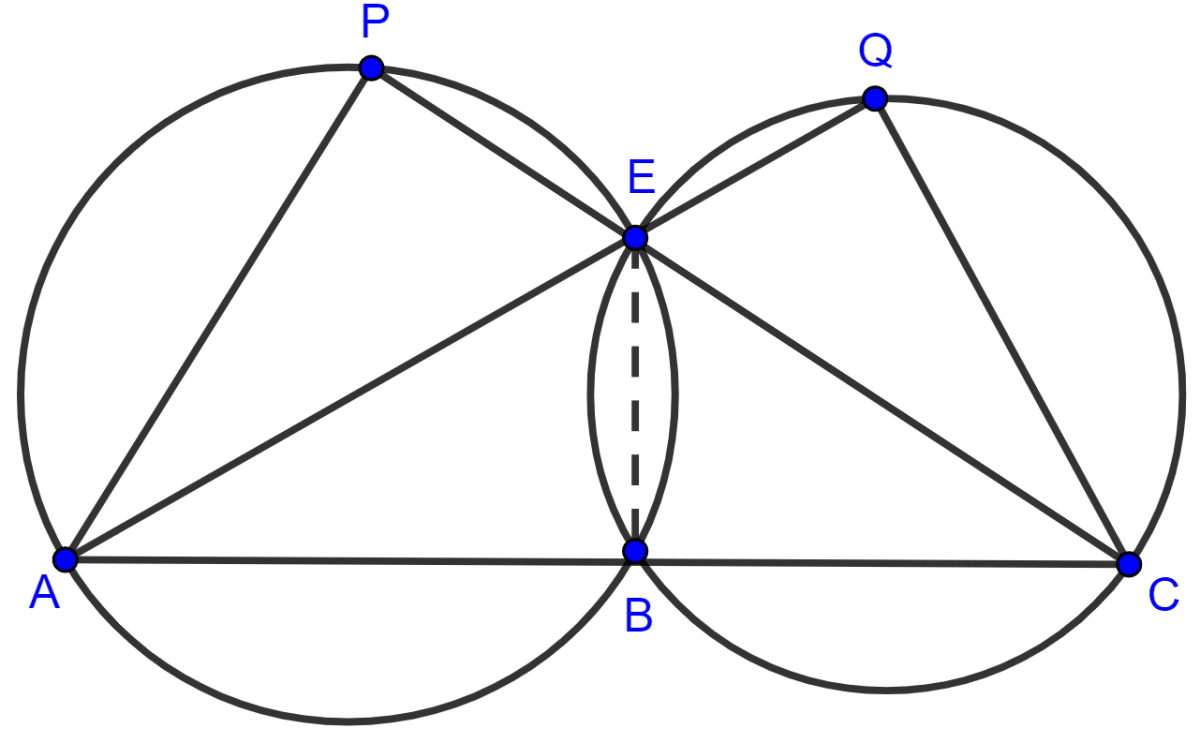
We know that,
In cyclic quadrilateral sum of opposite angles = 180°.
In cyclic quad. ABEP
⇒ ∠APE + ∠ABE = 180° .....(1) [Opposite angles of a cyclic quad. are supplementary]
Similarly, in cyclic quad. BCQE
⇒ ∠CQE + ∠CBE = 180° .....(2)
Adding (1) and (2), we have
⇒ ∠APE + ∠ABE + ∠CQE + ∠CBE = 180° + 180°
⇒ ∠APE + ∠ABE + ∠CQE + ∠CBE = 360° .....(3)
From figure,
∠ABE + ∠CBE = 180° [Linear pair]
Putting this value of ∠ABE + ∠CBE in Eq 3 we get,
∠APE + ∠CQE + 180° = 360°
⇒ ∠APE + ∠CQE = 360° - 180°
⇒ ∠APE + ∠CQE = 180°
Hence, proved that ∠APE and ∠CQE are supplementary.
In the given figure, AB is the diameter of the circle with centre O.
If ∠ADC = 32°, find angle BOC.

Answer
We know that,
Angle at the centre is twice the angle at remaining circumference.
Arc AC subtends ∠AOC at the centre and ∠ADC at the remaining part of the circle.
⇒ ∠AOC = 2∠ADC
⇒ ∠AOC = 2 x 32° = 64°
From figure,
∠AOC and ∠BOC are linear pair,
∴ ∠AOC + ∠BOC = 180°
⇒ 64° + ∠BOC = 180°
⇒ ∠BOC = 180° - 64° = 116°.
Hence, ∠BOC = 116°.
In the following figure, ABCD is a cyclic quadrilateral in which AD is parallel to BC. If the bisector of angle A meets BC at point E and the given circle at point F, prove that :
(i) EF = FC
(ii) BF = DF

Answer
AF is the angle bisector of ∠A,
∴ ∠BAF = ∠DAF
Also,
∠DAE = ∠BAE .......(1)
and
∠DAE = ∠AEB ........(2) [Alternate angles are equal]
From (1) and (2) we get,
∠BAE = ∠AEB
(i) In △ABE,
⇒ ∠BAE + ∠AEB + ∠ABE = 180°
⇒ ∠AEB + ∠AEB + ∠ABE = 180°
⇒ 2∠AEB + ∠ABE = 180°
⇒ ∠ABE = 180° - 2∠AEB
Since, ABCD is a cyclic quadrilateral and sum of opposite angles in a cyclic quadrilateral = 180°.
∴ ∠ABC + ∠ADC = 180°
⇒ ∠ABE + ∠ADC = 180°
⇒ 180° - 2∠AEB + ∠ADC = 180°
⇒ ∠ADC = 180° - 180° + 2∠AEB
⇒ ∠ADC = 2∠AEB .........(3)
Since, ADCF is also a cyclic quadrilateral,
∴ ∠AFC + ∠ADC = 180°
⇒ ∠AFC = 180° - ∠ADC
⇒ ∠AFC = 180° - 2∠AEB [From (3)]
In △ECF,
⇒ ∠EFC + ∠ECF + ∠FEC = 180°
⇒ ∠AFC + ∠ECF + ∠FEC = 180° [From figure, ∠EFC = ∠AFC]
⇒ ∠AFC + ∠ECF + ∠AEB = 180° [∠FEC = ∠AEB (Vertically opposite angles are equal)]
⇒ ∠ECF = 180° - (∠AFC + ∠AEB)
⇒ ∠ECF = 180° - (180° - 2∠AEB + ∠AEB)
⇒ ∠ECF = ∠AEB
⇒ ∠ECF = ∠FEC
∴ EF = FC [As sides opposite to equal angles are equal.]
Hence, proved that EF = FC.
(ii) AF is the angle bisector of ∠A,
∴ ∠BAF = ∠DAF
∴ arc BF = arc DF [As equal arcs subtends equal angles]
∴ BF = DF [Equal arcs have equal chords]
Hence, proved that BF = DF.
In the given figure, AB is the diameter of a circle with center O. If chord AC = chord AD, prove that :
(i) arc BC = arc DB
(ii) AB is the bisector of ∠CAD.
Further, if the length of arc AC is twice the length of arc BC, find :
(a) ∠BAC
(b) ∠ABC

Answer
Join BC and BD.

In △ABC and △ABD,
⇒ AC = AD [Given]
⇒ AB = AB [Common]
⇒ ∠ACB = ∠ADB [Both = 90°, Angle in semi-circle is a right angle.]
∴ △ ABC ≅ △ ABD [By RHS axiom of congruency]
(i) Since,
△ABC ≅ △ABD
∴ BC = BD [By C.P.C.T.]
∴ Arc BC = Arc BD [Equal chords have equal arcs].
Hence, proved that arc BC = arc BD.
(ii) Since,
△ABC ≅ △ABD
∴ ∠BAC = ∠BAD [By C.P.C.T.]
∴ AB is the bisector of ∠CAD.
Hence, proved that AB is the bisector of ∠CAD.
(a) Given,
arc AC = 2 arc BC
∴ ∠ABC = 2∠BAC
But,
⇒ ∠ABC + ∠BAC = 90° [ΔABC is right angled at C]
⇒ 2∠BAC + ∠BAC = 90°
⇒ 3∠BAC = 90°
⇒ ∠BAC = = 30°.
Hence, ∠BAC = 30°.
(b) ∠ABC = 2∠BAC = 2 x 30° = 60°.
Hence, ∠ABC = 60°.
In the given figure, ∠ACE = 43° and ∠CAF = 62°; find the values of a, b and c.
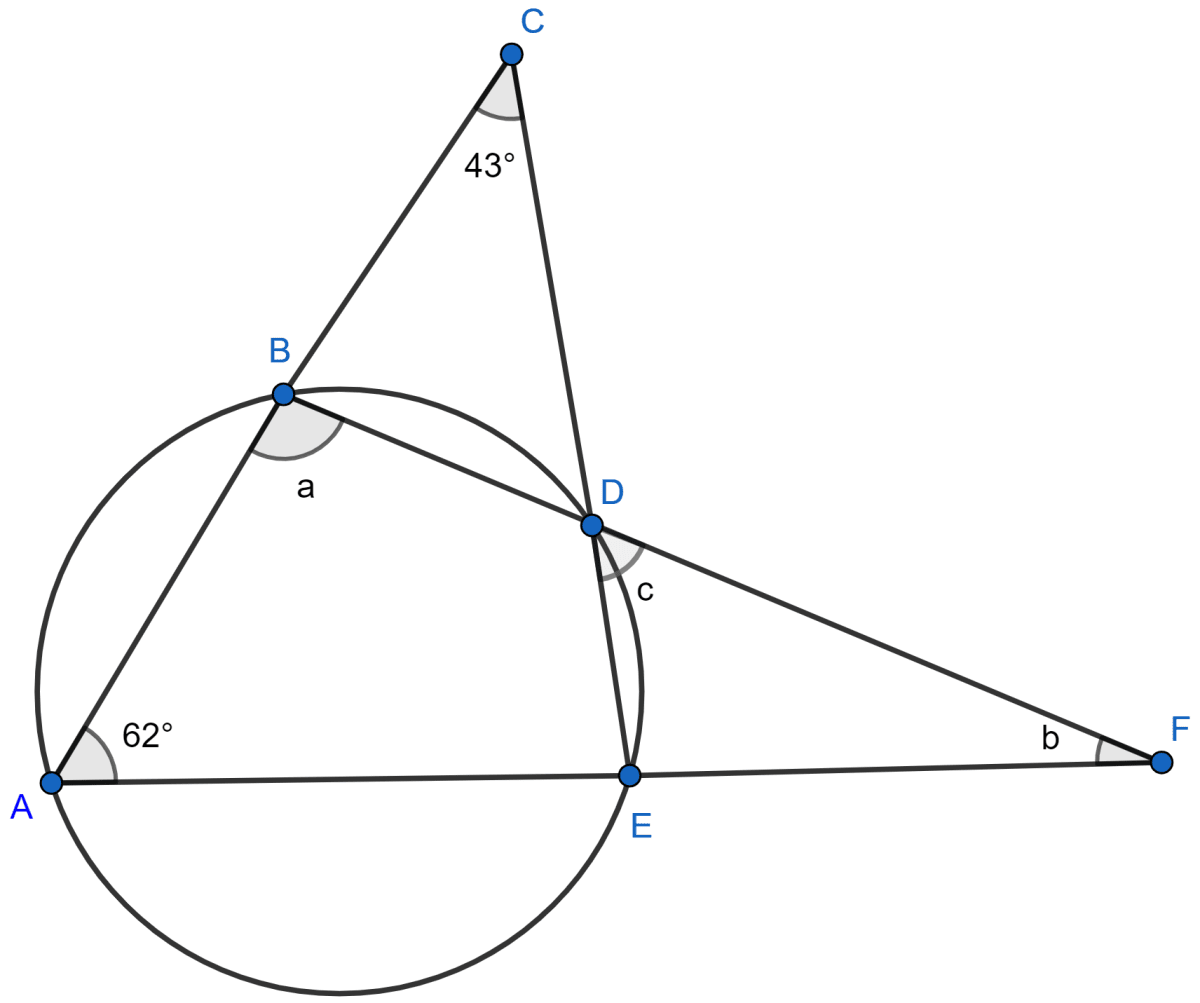
Answer
In △AEC,
⇒ ∠ACE + ∠CAE + ∠AEC = 180°
⇒ 43° + 62° + ∠AEC = 180°
⇒ ∠AEC = 180° - 105° = 75°.
From figure,
⇒ ∠ABD + ∠AED = 180° [As sum of opposite angles in a cyclic quadrilateral = 180°]
⇒ a + ∠AEC = 180° [From figure, ∠AED = ∠AEC]
⇒ a + 75° = 180°
⇒ a = 180° - 75° = 105°.
∠BDC = c [Vertically opposite angles are equal]
∠DBC = 180° - a [Linear pairs]
= 180° - 105°
= 75°.
In △DBC,
⇒ ∠DBC + ∠BCD + ∠BDC = 180° [Angle sum property of triangle]
⇒ 75° + 43° + c = 180°
⇒ 118° + c = 180°
⇒ c = 180° - 118° = 62°.
In △BAF,
⇒ ∠ABF + ∠BAF + ∠AFB = 180° [Angle sum property of triangle]
⇒ a + 62° + b = 180°
⇒ 105° + 62° + b = 180°
⇒ b + 167° = 180°
⇒ b = 180° - 167° = 13°.
Hence, a = 105°, b = 13° and c = 62°.
In the given figure, AB is parallel to DC, ∠BCE = 80° and ∠BAC = 25°.
Find :
(i) ∠CAD
(ii) ∠CBD
(iii) ∠ADC

Answer
(i) We know that,
Exterior angle of a cyclic quadrilateral is equal to interior opposite angle.
∠BAD = Exterior ∠BCE = 80°.
From figure,

∠CAD = ∠BAD - ∠BAC = 80° - 25° = 55°.
Hence, ∠CAD = 55°.
(ii) We know that,
Angles in same segment are equal.
∴ ∠CBD = ∠CAD = 55°.
Hence, ∠CBD = 55°.
(iii) We know that,
Angles in same segment are equal.
∴ ∠BDC = ∠BAC = 25°.
AB || DC and BD is transversal.
So, ∠ABD = ∠BDC = 25°. [Alternate angles are equal]
From figure,
∠ABC = ∠ABD + ∠CBD = 25° + 55° = 80°.
In cyclic quadrilateral ABCD,
⇒ ∠ABC + ∠ADC = 180° [Sum of opposite angles in a cyclic quadrilateral = 180°]
⇒ 80° + ∠ADC = 180°
⇒ ∠ADC = 180° - 80° = 100°.
Hence, ∠ADC = 100°.
In the figure, given below, CP bisects angle ACB. Show that DP bisects angle ADB.
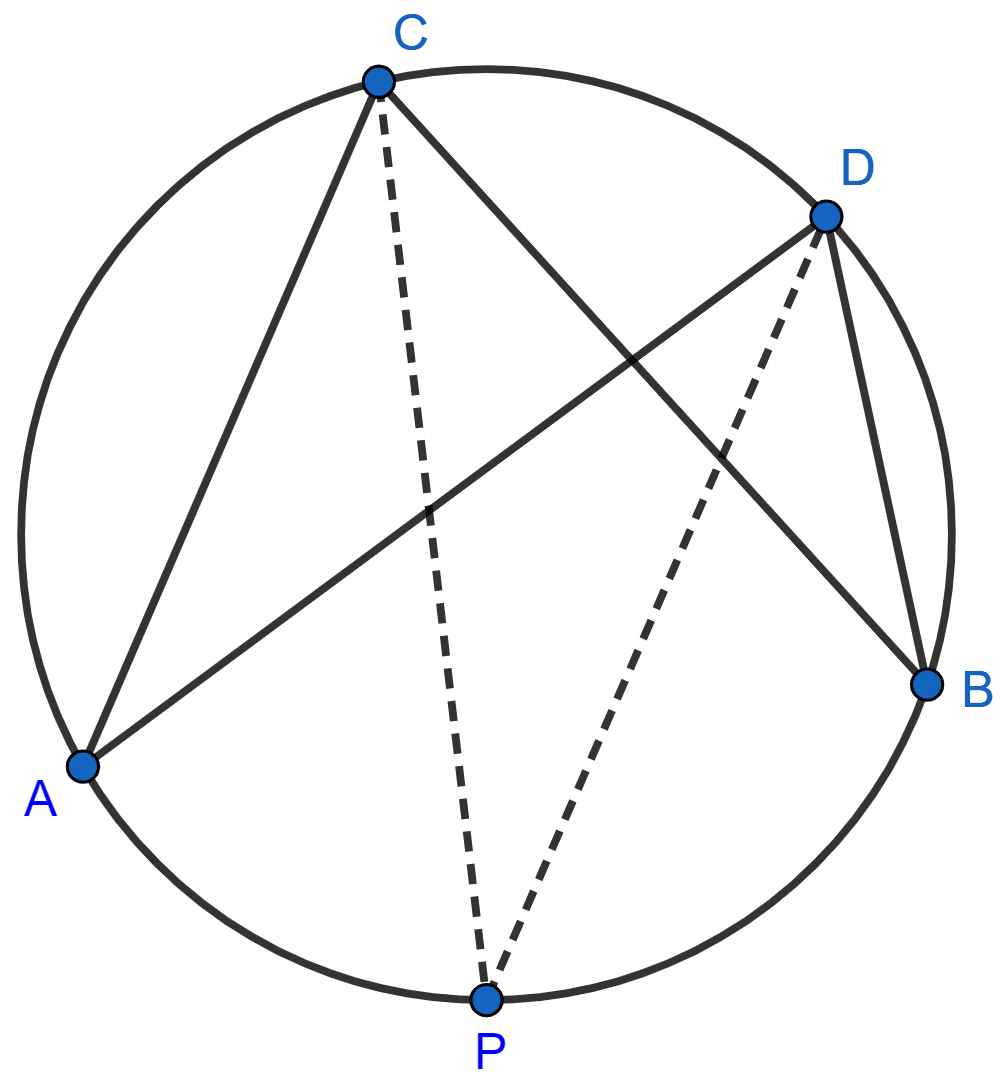
Answer
Since, CP is the bisector of ∠ACB,
∴ ∠ACP = ∠BCP .........(1)
We know that,
Angles in same segment are equal.
∴ ∠ACP = ∠ADP ..........(2)
∠BCP = ∠BDP ...........(3)
From (1) and (2) we get,
∠BCP = ∠ADP ...........(4)
From (3) and (4) we get,
∠ADP = ∠BDP.
∴ DP is the bisector of ∠ADB.
Hence, proved that DP is the bisector of ∠ADB.
In the figure, given below, AD = BC, ∠BAC = 30° and ∠CBD = 70°. Find :
(i) ∠BCD
(ii) ∠BCA
(iii) ∠ABC
(iv) ∠ADB

Answer
We know that,
Angles in same segment are equal.
∴ ∠CAD = ∠CBD = 70°.
From figure,
∠BAD = ∠BAC + ∠CAD = 30° + 70° = 100°.
(i) As sum of opposite angles in cyclic quadrilateral = 180°.
In cyclic quadrilateral ABCD,
⇒ ∠BCD + ∠BAD = 180°
⇒ ∠BCD + 100° = 180°
⇒ ∠BCD = 180° - 100° = 80°.
Hence, ∠BCD = 80°.
(ii) Since, AD = BC.
∴ ABCD is an isosceles trapezium and AB || DC.
∠DCA = ∠BAC = 30° [Alternate angles]
From figure,
∠BCA = ∠BCD - ∠DCA = 80° - 30° = 50°.
Hence, ∠BCA = 50°.
(iii) As angles in same segment are equal.
∠ABD = ∠DCA = 30°
From figure,
∠ABC = ∠ABD + ∠CBD = 30° + 70° = 100°.
Hence, ∠ABC = 100°.
(iv) As angles in same segment are equal.
∠ADB = ∠BCA = 50°.
Hence, ∠ADB = 50°.
In the given figure, AD is a diameter. O is the centre of the circle. AD is parallel to BC and ∠CBD = 32°. Find :
(i) ∠OBD
(ii) ∠AOB
(iii) ∠BED

Answer
(i) Given,
AD || BC
∴ OD || BC and BD is transversal.
∠ODB = ∠CBD = 32° [Alternate angles are equal]
In △OBD,
OB = OD [Radius of same circle]
∠OBD = ∠ODB = 32°.
Hence, ∠OBD = 32°.
(ii) Given,
AD || BC
∴ AO || BC and OB is transversal.
∠AOB = ∠OBC [Alternate angles are equal]
From figure,
∠OBC = ∠OBD + ∠DBC = 32° + 32° = 64°.
∴ ∠AOB = 64°.
Hence, ∠AOB = 64°.
(iii) In △OAB,
OA = OB [Radius of same circle]
∠OAB = ∠OBA = x (let)
⇒ ∠OAB + ∠OBA + ∠AOB = 180°
⇒ x + x + 64° = 180°
⇒ 2x = 180° - 64°
⇒ 2x = 116°
⇒ x = = 58°
i.e., ∠OAB = 58°.
From figure,
∠DAB = ∠OAB = 58°.
We know that,
Angle in same segment are equal.
∠BED = ∠DAB = 58°.
Hence, ∠BED = 58°.
In the figure given, O is the centre of the circle. ∠DAE = 70°. Find giving suitable reasons, the measure of
(i) ∠BCD
(ii) ∠BOD
(iii) ∠OBD
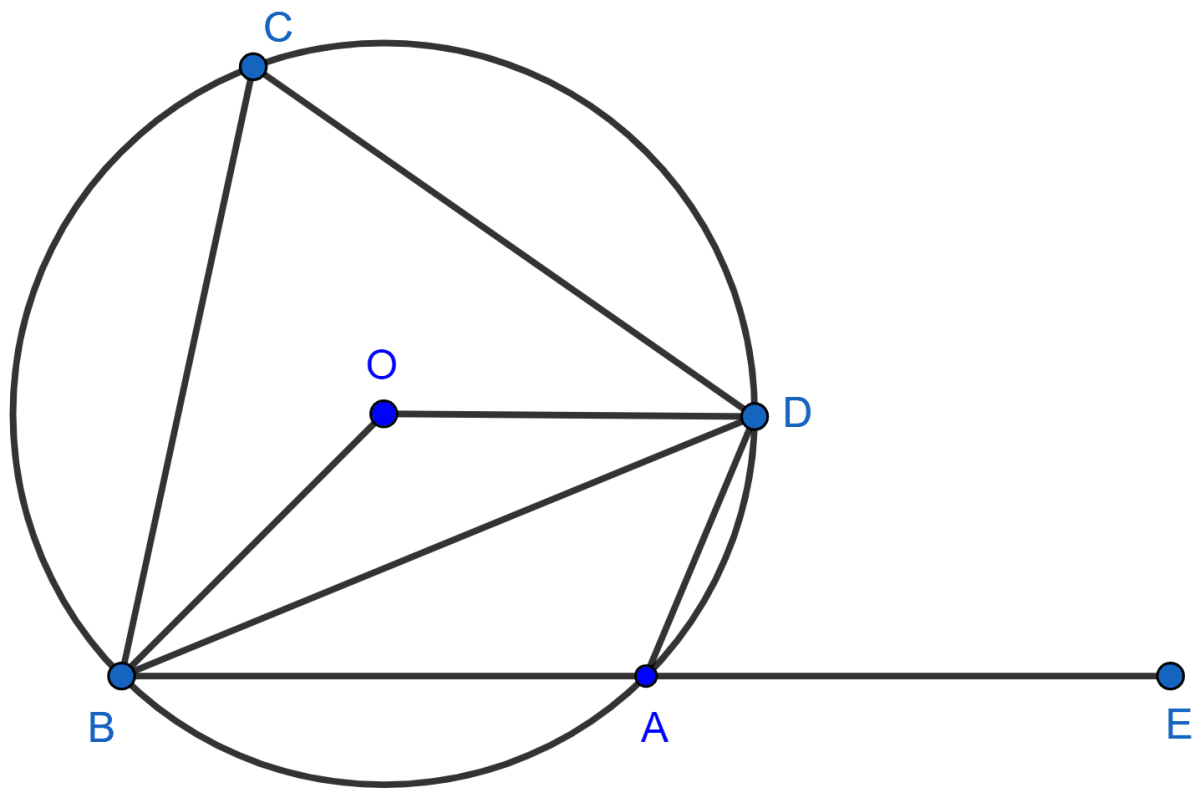
Answer
(i) Given,
∠DAE = 70°
⇒ ∠DAE + ∠BAD = 180° [Linear pairs]
⇒ 70° + ∠BAD = 180°
⇒ ∠BAD = 180° - 70° = 110°.
We know that,
Sum of opposite angles in a cyclic quadrilateral = 180°
⇒ ∠BCD + ∠BAD = 180°
⇒ ∠BCD + 110° = 180°
⇒ ∠BCD = 180° - 110° = 70°.
Hence, ∠BCD = 70°.
(ii) We know that,
Angle which an arc subtends at the centre is double that which it subtends at any point on the remaining part of the circumference.
⇒ ∠BOD = 2∠BCD = 2 × 70° = 140°.
Hence, ∠BOD = 140°.
(iii) In △OBD,
OB = OD [Radius of same circle]
∠OBD = ∠ODB = x.
⇒ ∠OBD + ∠ODB + ∠BOD = 180°
⇒ x + x + 140° = 180°
⇒ 2x = 180° - 140°
⇒ 2x = 40°
⇒ x = = 20°.
∴ ∠OBD = 20°.
Hence, ∠OBD = 20°.