
In the given figure, O is the center of the circle and chord AB : chord CD = 3 : 5. If angle AOB = 60°, angle COD is equal to :
60°
120°
90°
100°
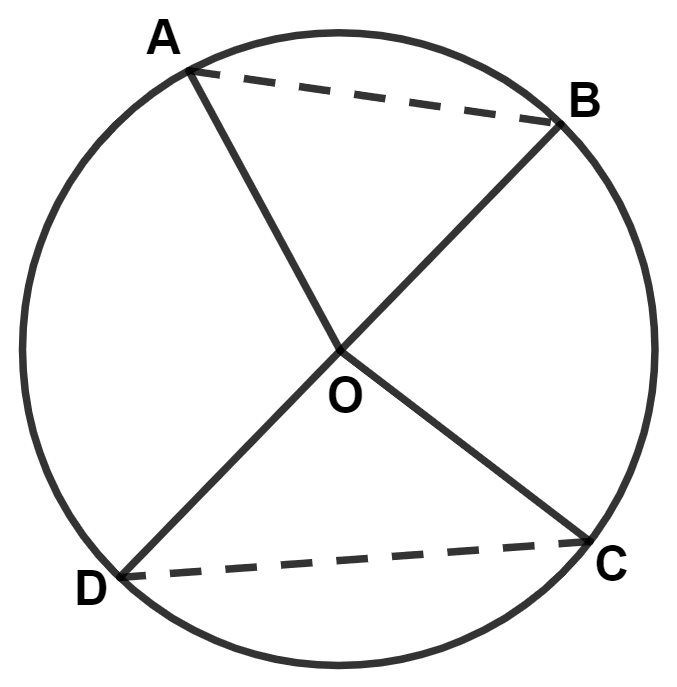
Answer
Given,
Chord AB : Chord CD = 3 : 5
∴ ∠AOB : ∠COD = 3 : 5
⇒ 60° : ∠COD = 3 : 5
⇒
⇒ ∠COD = = 100°.
Hence, Option 4 is the correct option.
In the given figure, O is the center of the circle and angle OAB = 55°, then angle ACB is equal to :
55°
35°
70°
30°
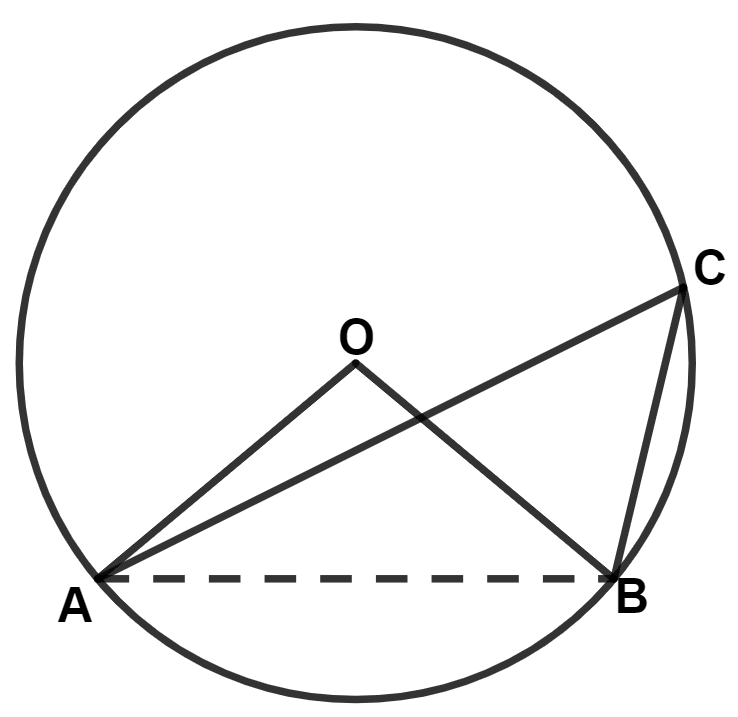
Answer
From figure,
In △OAB,
OA = OB (Radius of same circle)
We know that,
Angles opposite to equal sides are equal.
∴ ∠OBA = ∠OAB = 55°
By angle sum property of triangle,
⇒ ∠OBA + ∠OAB + ∠AOB = 180°
⇒ 55° + 55° + ∠AOB = 180°
⇒ ∠AOB + 110° = 180°
⇒ ∠AOB = 180° - 110° = 70°.
We know that,
The angle which an arc of a circle subtends at the center is double that which it subtends at any point on the remaining part of the circumference.
∴ ∠AOB = 2∠ACB
∠ACB = = 35°.
Hence, Option 2 is the correct option.
In the given figure, O is the center of a circle. AB is the side of a square and BC is side of a regular hexagon. Also arc AD = arc CD. Angle DOC is equal to :
150°
105°
130°
210°
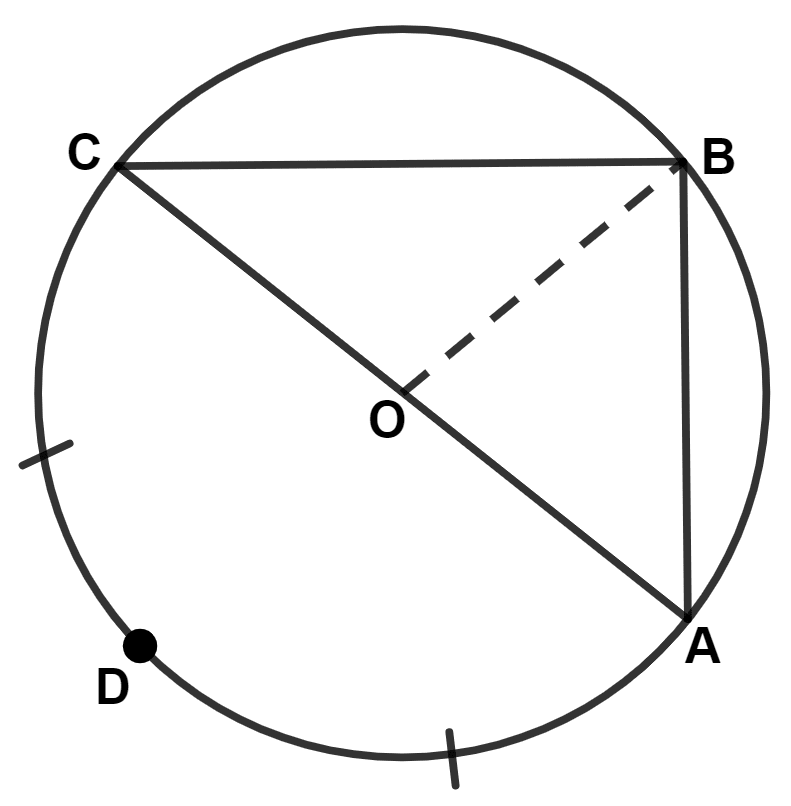
Answer
Join OD.
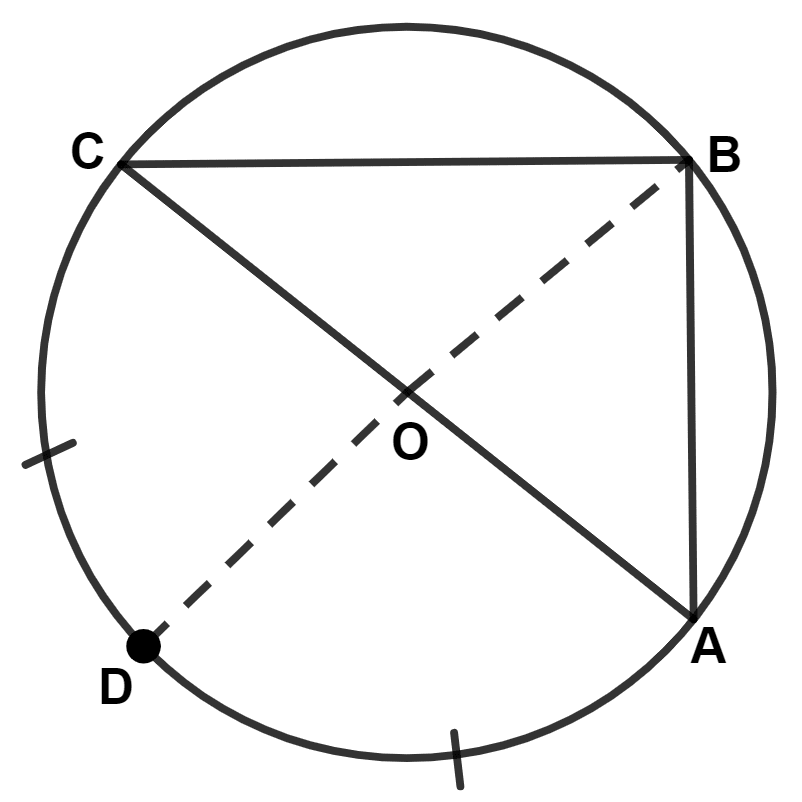
Since, AB is the side of square.
∴ ∠AOB = = 90°.
Since, BC is the side of regular hexagon.
∴ ∠BOC = = 60°.
We know that,
Equal arcs subtends equal angles at the center.
Since, arc AD = arc CD
∴ ∠AOD = ∠COD = x (let)
From figure,
⇒ ∠AOD + ∠COD + ∠AOB + ∠BOC = 360°
⇒ x + x + 90° + 60° = 360°
⇒ 2x + 150° = 360°
⇒ 2x = 360° - 150°
⇒ 2x = 210°
⇒ x = = 105°.
Hence, Option 2 is the correct option.
In the given figure, O is the center of the circle, AB is side of a regular pentagon, then angle ACB is equal to :
36°
72°
50°
40°

Answer
Join OA and OB.

Given,
AB is side of a regular pentagon.
∴ ∠AOB = = 72°.
We know that,
The angle which an arc of a circle subtends at the center is double that which it subtends at any point on the remaining part of the circumference.
∴ ∠AOB = 2∠ACB
∠ACB = = 36°.
Hence, Option 1 is the correct option.
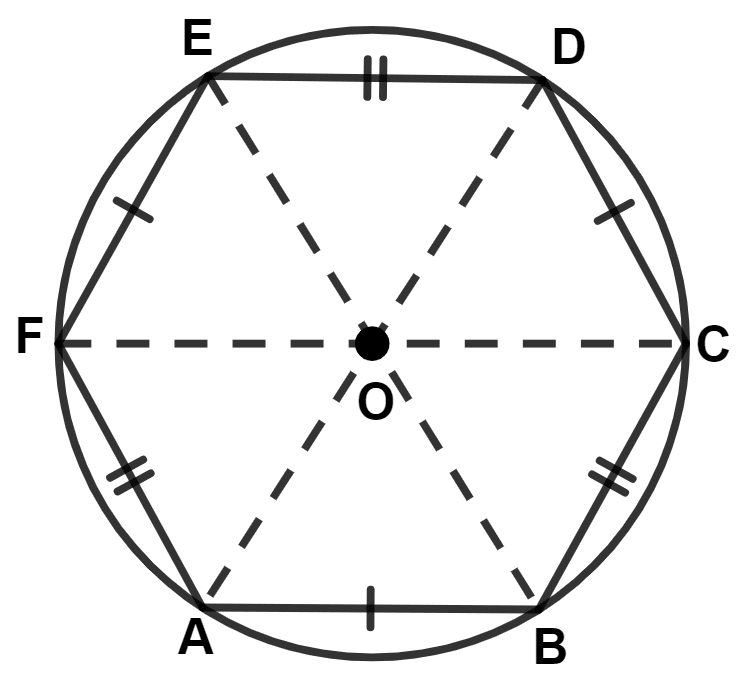
In the given figure, O is the center of the circle, chords AB, CD and EF are equal whereas chords BC, DE and FA are separately equal. The angle AOC is equal to :
80°
100°
90°
120°
Answer
Given,
Chords AB, CD and EF are equal.
∴ ∠AOB = ∠COD = ∠EOF = x (let)
Chords BC, DE and FA are equal.
∴ ∠BOC = ∠DOE = ∠AOF = y (let)
From figure,
⇒ ∠AOB + ∠COD + ∠EOF + ∠BOC + ∠DOE + ∠AOF = 360°
⇒ x + x + x + y + y + y = 360°
⇒ 3x + 3y = 360°
⇒ 3(x + y) = 360°
⇒ x + y =
⇒ x + y = 120°
From figure,
∠AOC = ∠AOB + ∠BOC = x + y = 120°.
Hence, Option 4 is the correct option.
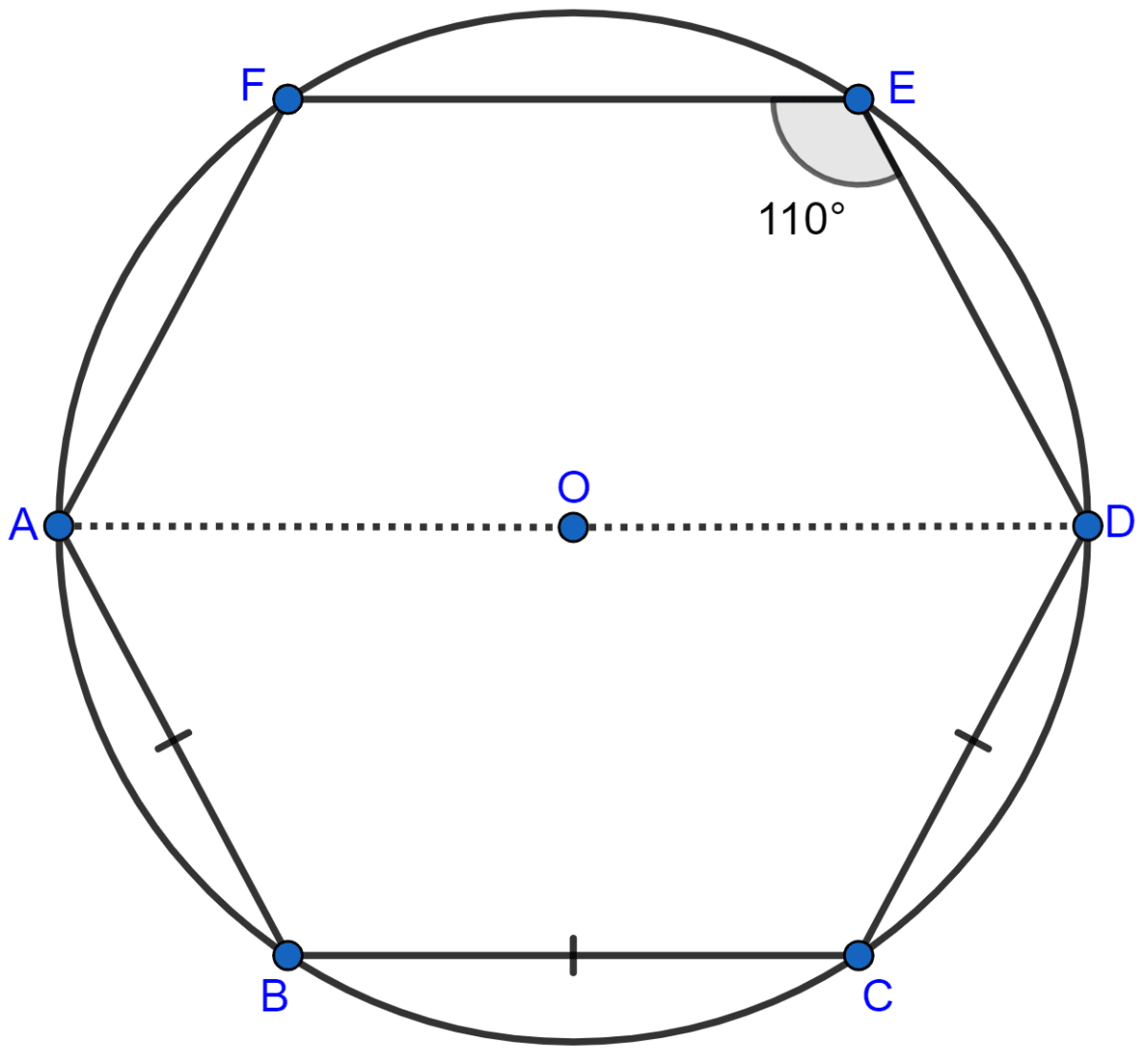
In the following figure, AD is the diameter of the circle with centre O. Chords AB, BC and CD are equal. If ∠DEF = 110°, calculate :
(i) ∠AEF, (ii) ∠FAB.
Answer
Join AE, OB and OC.
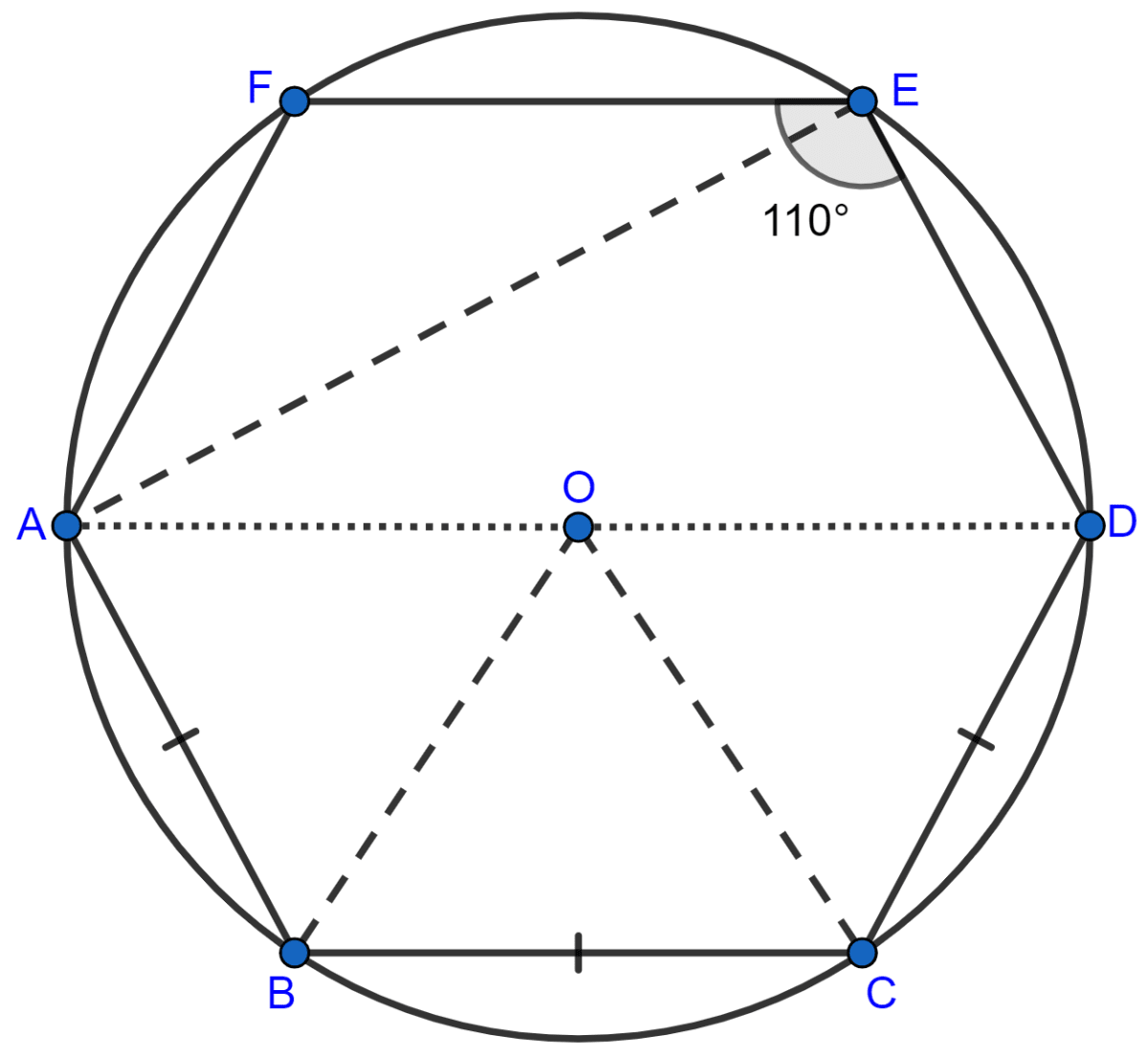
(i) As AOD is the diameter
∠AED = 90° [Angle in a semi-circle is a right angle]
But, given ∠DEF = 110°
So,
∠AEF = ∠DEF - ∠AED = 110° - 90° = 20°.
Hence, ∠AEF = 20°.
(ii) Also given, Chord AB = Chord BC = Chord CD
So,
∠AOB = ∠BOC = ∠COD [Equal chords subtends equal angles at the centre]
From figure,
⇒ ∠AOB + ∠BOC + ∠COD = 180° [AOD is a straight line]
⇒ ∠AOB = ∠BOC = ∠COD = = 60°
Now, in ∆OAB we have
OA = OB [Radii of same circle]
So, ∠OAB = ∠OBA [Angles opposite to equal sides are equal]
In ∆OAB,
⇒ ∠OAB + ∠OBA + ∠AOB = 180° [By angle sum property of triangle]
⇒ ∠OAB + ∠OBA + 60° = 180°
⇒ ∠OAB + ∠OBA = 180° - 60° = 120°.
Since, ∠OAB = ∠OBA
∴ ∠OAB = ∠OBA = = 60°.
Now, in cyclic quadrilateral ADEF
⇒ ∠DEF + ∠DAF = 180° [As sum of opposite angles in cyclic quadrilateral = 180°]
⇒ ∠DAF = 180° - ∠DEF
⇒ ∠DAF = 180° - 110° = 70°.
From figure,
∠FAB = ∠DAF + ∠OAB = 70° + 60° = 130°.
Hence, ∠FAB = 130°.
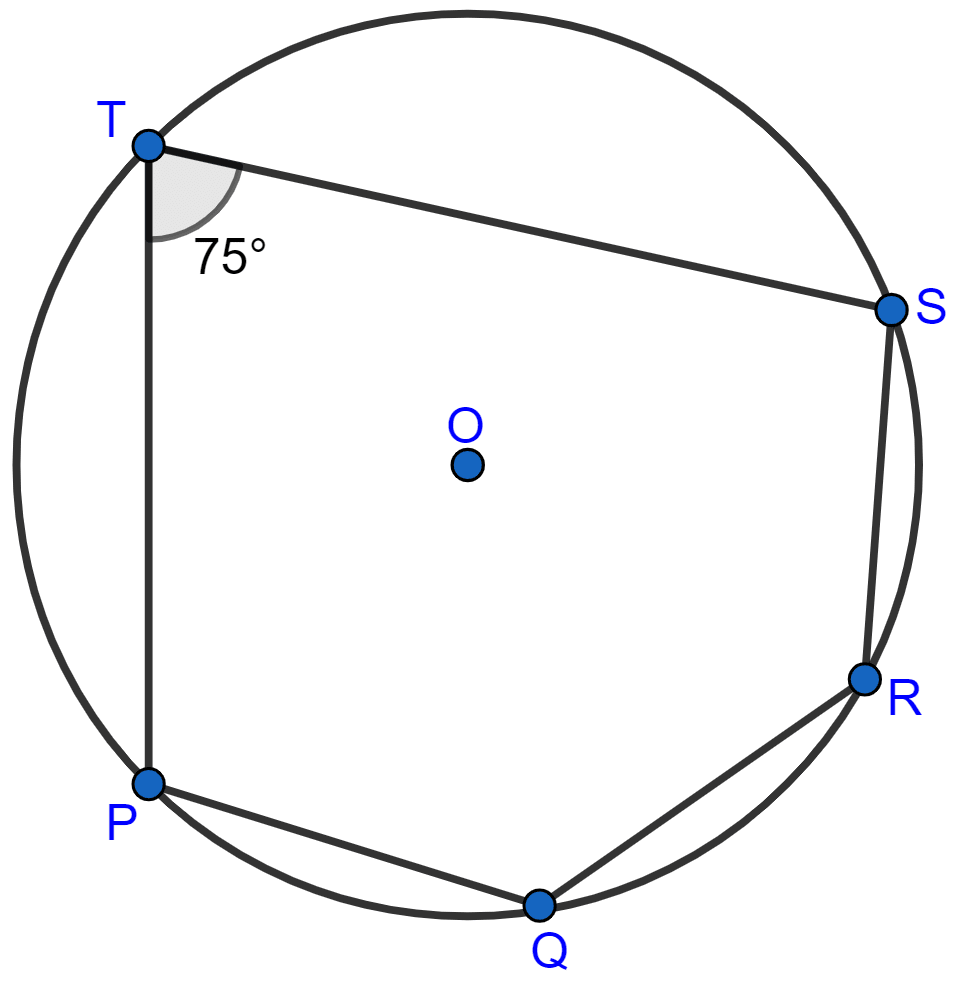
The given figure shows a circle with centre O. Also, PQ = QR = RS and ∠PTS = 75°.
Calculate:
(i) ∠POS,
(ii) ∠QOR,
(iii) ∠PQR.
Answer
Join OP, OQ, OR and OS.
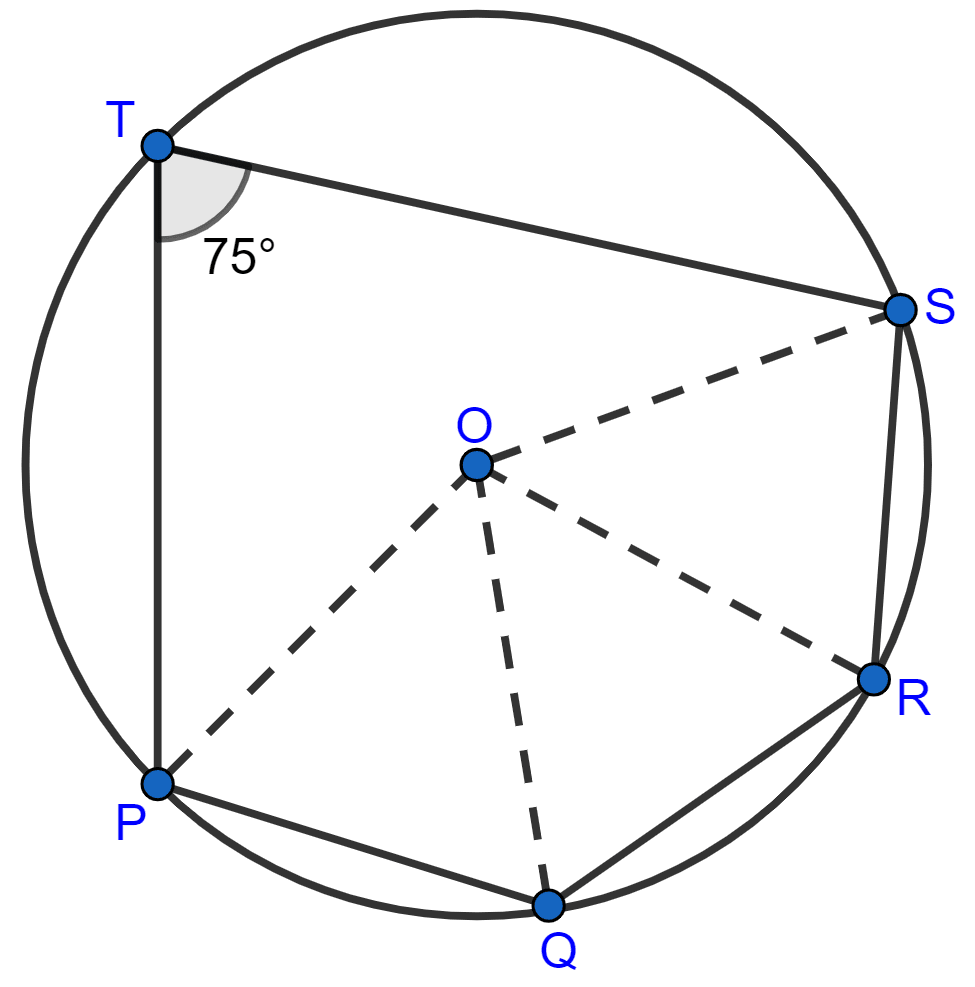
Given, PQ = QR = RS
∴ ∠POQ = ∠QOR = ∠ROS = x (let) [Equal chords subtends equal angles at the centre]
Arc PQRS subtends ∠POS at the centre and ∠PTS at the circumference of the circle.
Thus,
∠POS = 2 x ∠PTS = 2 x 75° = 150° [As angle subtended at the centre by the arc is double that it subtends at any point on the circumference of the circle.]
⇒ ∠POQ + ∠QOR + ∠ROS = 150°
⇒ x + x + x = 150°
⇒ 3x = 150°
⇒ x = = 50°.
In ∆OPQ we have,
⇒ OP = OQ [Radii of the same circle]
⇒ ∠OPQ = ∠OQP = y (let) [Angles opposite to equal sides are equal]
In ∆OPQ,
⇒ ∠OPQ + ∠OQP + ∠POQ = 180°
⇒ ∠OPQ + ∠OQP + 50° = 180°
⇒ ∠OPQ + ∠OQP = 180° - 50°
⇒ ∠OPQ + ∠OQP = 130°
⇒ 2y = 130°
⇒ y = = 65°
⇒ ∠OPQ = ∠OQP = y = 65°.
In ∆OQR we have,
⇒ OQ = OR [Radii of the same circle]
⇒ ∠OQR = ∠ORQ = z (let) [Angles opposite to equal sides are equal]
In ∆OQR
⇒ ∠OQR + ∠ORQ + ∠QOR = 180°
⇒ z + z + 50° = 180°
⇒ 2z = 180° - 50°
⇒ 2z = 130°
⇒ z = = 65°
⇒ ∠OQR = ∠ORQ = z = 65°.
(i) Hence, ∠POS = 150°.
(ii) Hence, ∠QOR = 50°.
(iii) From figure,
∠PQR = ∠PQO + ∠OQR = 65° + 65° = 130°.
Hence, ∠PQR = 130°.
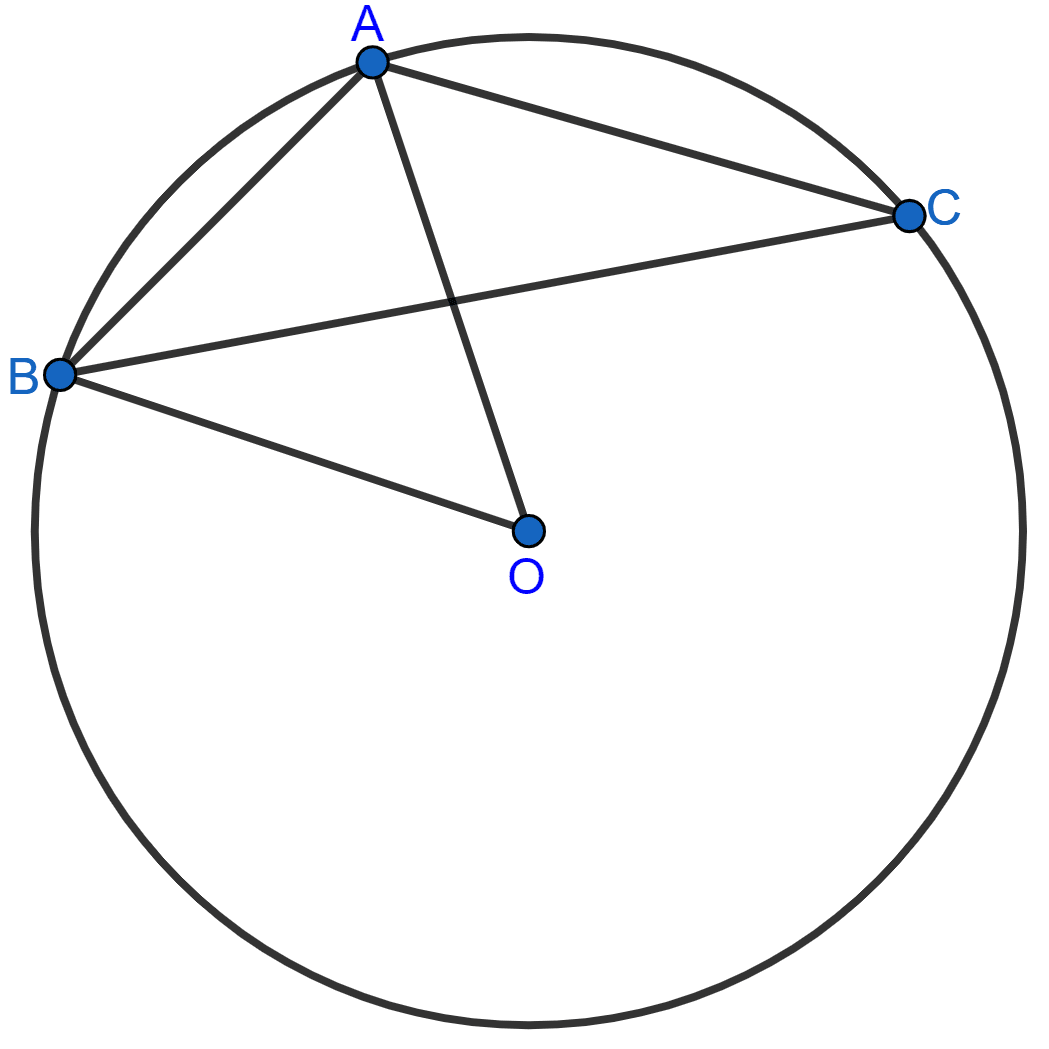
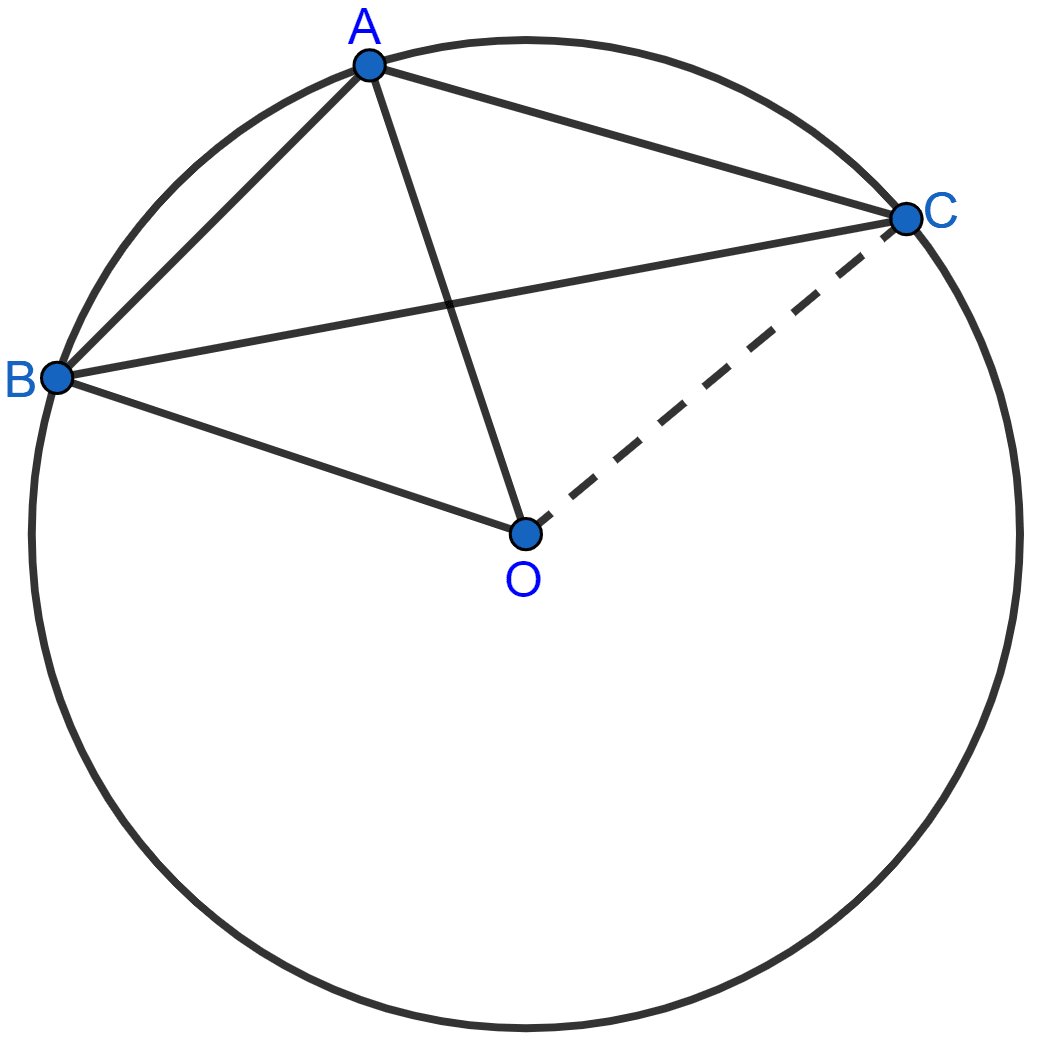
In the given figure, AB is a side of a regular six-sided polygon and AC is a side of a regular eight-sided polygon inscribed in the circle with centre O. Calculate the sizes of :
(i) ∠AOB,
(ii) ∠ACB,
(iii) ∠ABC.
Answer
Join OC.
(i) We know that,
Each side of a regular hexagon, inscribed in a circle subtends an angle of 60° at the centre.
⇒ ∠AOB = 60°.
Hence, ∠AOB = 60°.
(ii) We know that,
Angle at the centre is twice the angle at remaining circumference.
∴ ∠AOB = 2∠ACB
⇒ ∠ACB = ∠AOB = = 30°.
Hence, ∠ACB = 30°.
(iii) Since AC is the side of a regular octagon,
∠AOC = = 45°.
Again, arc AC subtends ∠AOC at the centre and ∠ABC at the remaining part of the circle.
∴ ∠AOC = 2∠ABC
∴ ∠ABC = x ∠AOC = x 45° = 22.5°
Hence, ∠ABC = 22.5°.
In the given figure, AB = BC = CD and ∠ABC = 132°. Calculate :
(i) ∠AEB,
(ii) ∠AED,
(iii) ∠COD.

Answer
(i) Join EB and EC.
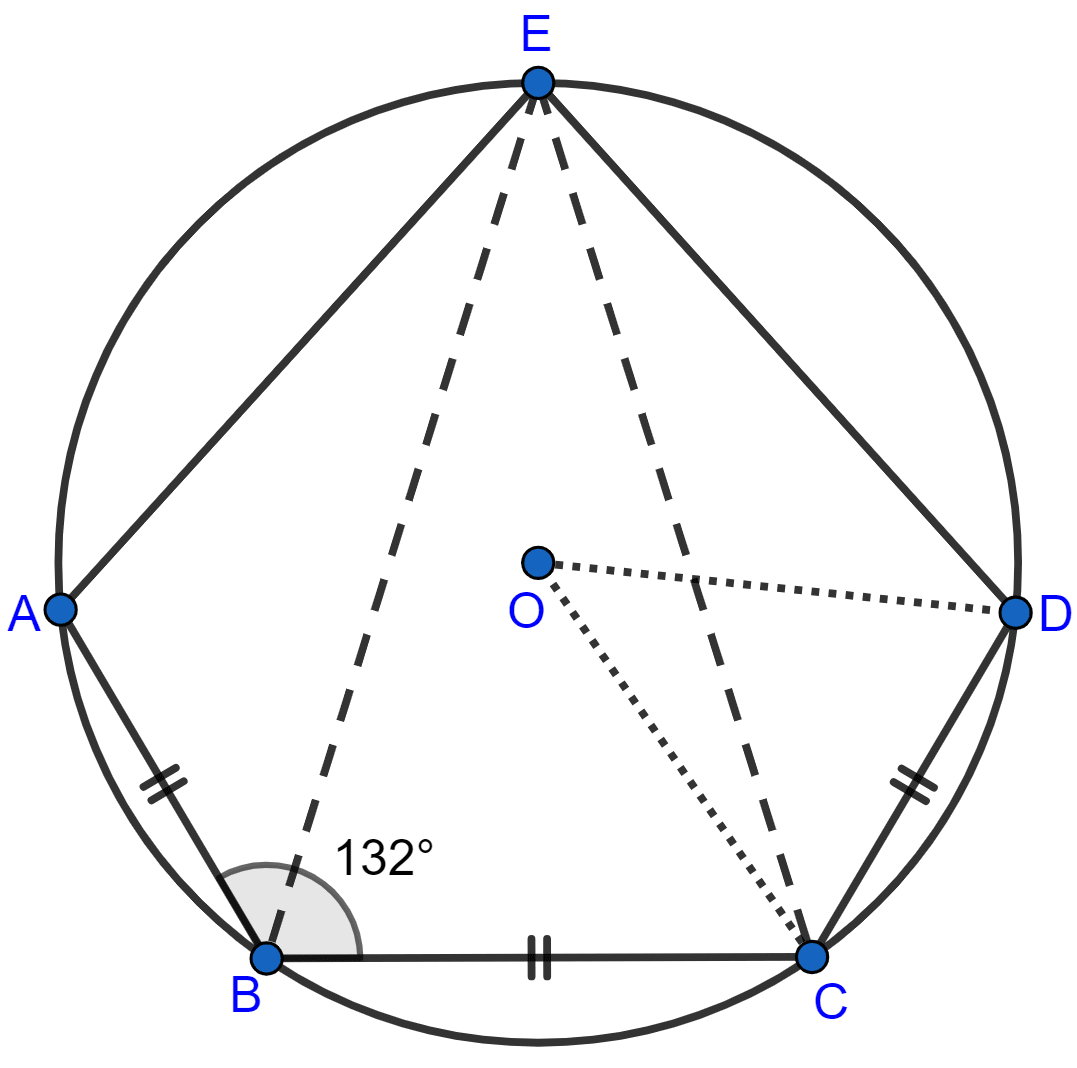
In cyclic quadrilateral ABCE,
⇒ ∠ABC + ∠AEC = 180° [Sum of opposite angles in cyclic quadrilateral = 180°]
⇒ 132° + ∠AEC = 180°
⇒ ∠AEC = 180° - 132° = 48°.
Since, AB = BC.
We know that,
Angle which an arc subtends at the center is double that which it subtends at any point on the remaining part of the circumference.
∴ ∠AEB = ∠AEC
= = 24°.
Hence, ∠AEB = 24°.
(ii) We know that,
Equal chords subtend equal angles at the circumference of the circle.
∠AEB = ∠BEC = ∠CED = 24°
∠AED = ∠AEB + ∠BEC + ∠CED = 24° + 24° + 24° = 72°.
Hence, ∠AED = 72°.
(iii) We know that,
Angle which an arc subtends at the center is double that which it subtends at any point on the remaining part of the circumference.
∴ ∠COD = 2∠CED = 2 × 24° = 48°.
Hence, ∠COD = 48°.
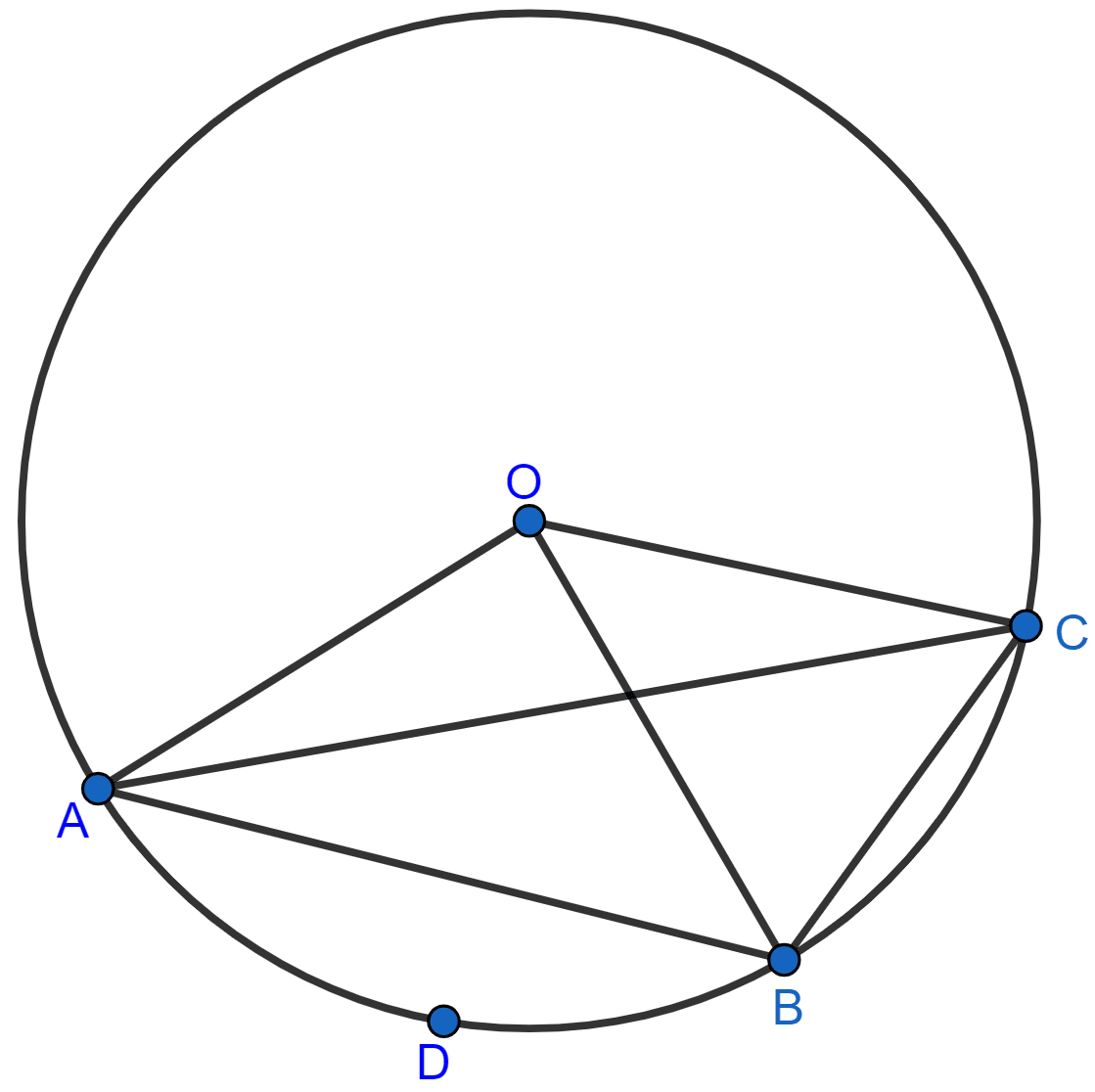
In the figure, O is the centre of the circle and the length of arc AB is twice the length of arc BC. If angle AOB = 108°, find :
(i) ∠CAB,
(ii) ∠ADB.
Answer
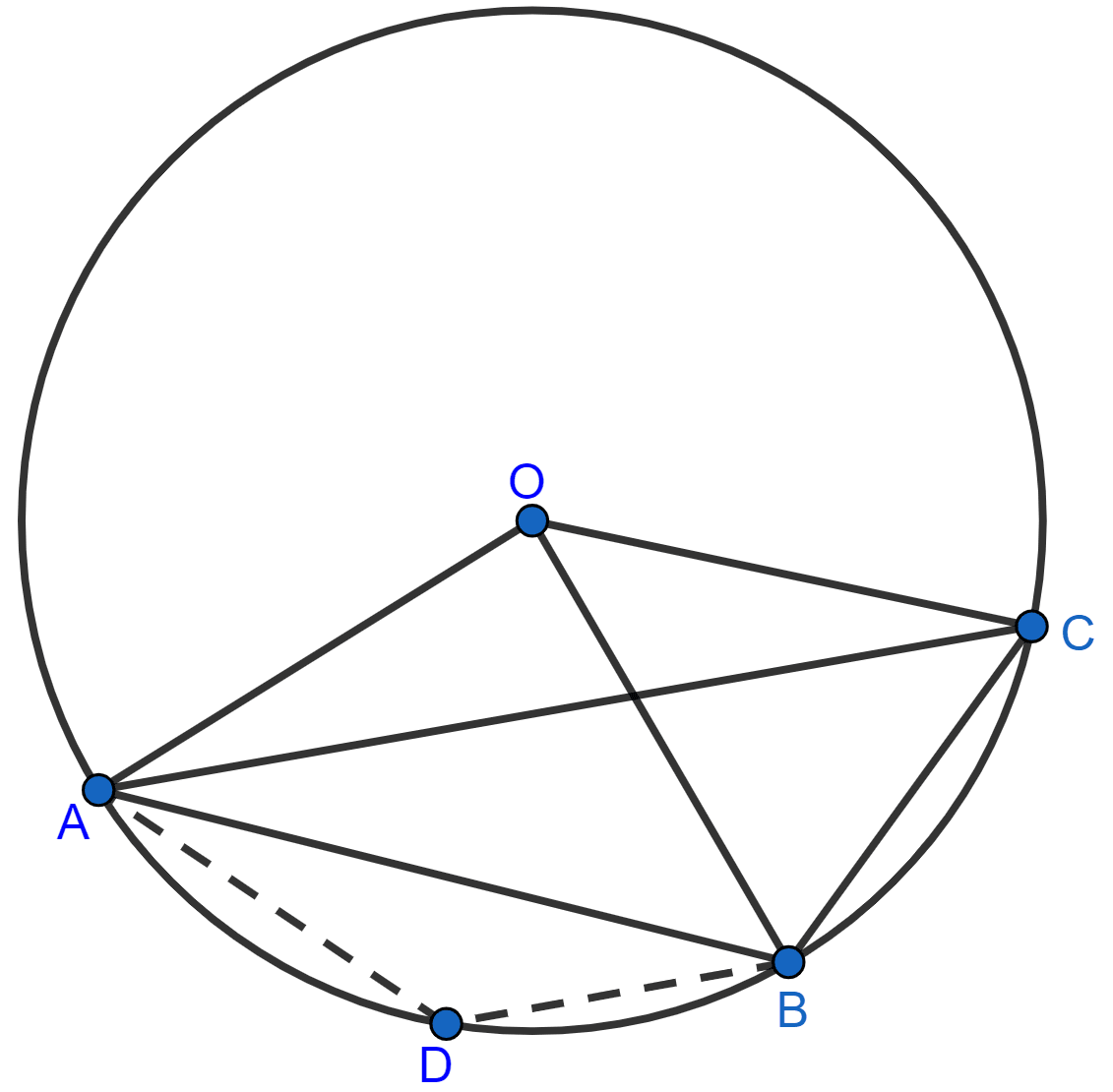
Join AD and BD.
(i) Given,
⇒ arc AB = 2 arc BC
⇒ ∠AOB = 2∠BOC
⇒ ∠BOC = ∠AOB = = 54°.
We know that,
Angle which an arc subtends at the center is double that which it subtends at any point on the remaining part of the circumference.
∴ ∠BOC = 2∠CAB
⇒ ∠CAB = ∠BOC = = 27°.
Hence, ∠CAB = 27°.
(ii) Arc AB subtends ∠AOB at the centre and ∠ACB at the remaining part of the circle.
∴ ∠AOB = 2∠ACB
∠ACB = ∠AOB = = 54°.
In cyclic quadrilateral ADBC,
⇒ ∠ADB + ∠ACB = 180° [As sum of opposite angles in cyclic quadrilateral = 180°]
⇒ ∠ADB + 54° = 180°
⇒ ∠ADB = 180° - 54° = 126°.
Hence, ∠ADB = 126°.
The figure shows a circle with centre O. AB is the side of regular pentagon and AC is the side of regular hexagon.
Find the angles of triangle ABC.

Answer
Join OA, OB and OC.

Since, AB is the side of regular pentagon,
∠AOB = = 72°.
Since, AC is the side of regular hexagon,
∠AOC = = 60°.
From figure,
⇒ ∠AOB + ∠AOC + reflex∠BOC = 360°
⇒ 72° + 60° + reflex∠BOC = 360°
⇒ reflex∠BOC + 132° = 360°
⇒ reflex∠BOC = 360° - 132° = 228°.
We know that,
Angle which an arc subtends at the center is double that which it subtends at any point on the remaining part of the circumference.
Arc BC subtends ∠BOC at the centre and ∠BAC at the remaining part of the circle.
∴ ∠BOC = 2∠BAC
⇒ ∠BAC = = 114°.
Arc AC subtends ∠AOC at the centre and ∠ABC at the remaining part of the circle.
∴ ∠AOC = 2∠ABC
⇒ ∠ABC = = 30°.
Arc AB subtends ∠AOB at the centre and ∠ACB at the remaining part of the circle.
∴ ∠AOB = 2∠ACB
⇒ ∠ACB = = 36°.
Hence, angles of triangle are ∠ABC = 30°, ∠ACB = 36° and ∠BAC = 114°.
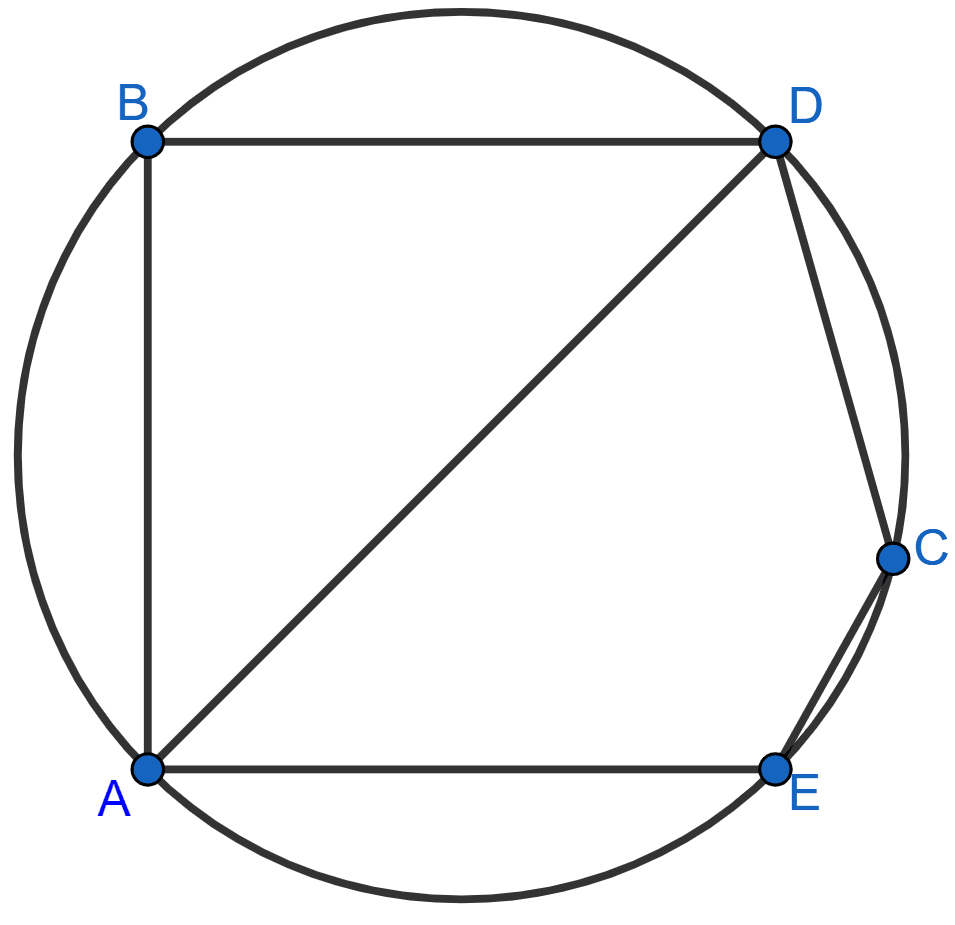
In the given figure, BD is a side of regular hexagon, DC is a side of a regular pentagon and AD is a diameter. Calculate :
(i) ∠ADC,
(ii) ∠BDA,
(iii) ∠ABC,
(iv) ∠AEC.
Answer
Let O be the center of the circle.
Join BC, BO, CO and EO.
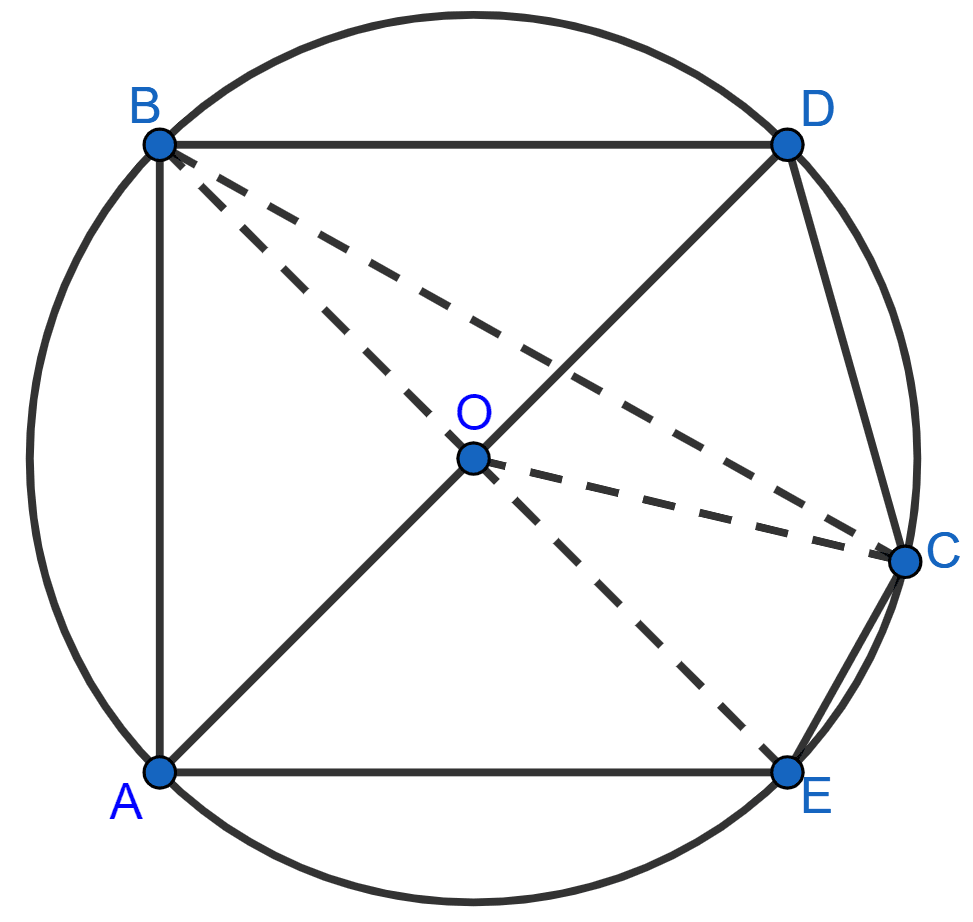
Since, BD is the side of a regular hexagon,
∴ ∠BOD = = 60°.
Since, DC is the side of a regular pentagon,
∴ ∠COD = = 72°.
In △BOD,
OB = OD [Radii of same circle]
∴ ∠OBD = ∠ODB = x (let) [Angles opposite to equal sides are equal]
⇒ ∠OBD + ∠ODB + ∠BOD = 180°
⇒ x + x + 60° = 180°
⇒ 2x = 180° - 60°
⇒ 2x = 120°
⇒ x = = 60°.
(i) In △OCD,
⇒ OD = OC [Radii of same circle]
⇒ ∠ODC = ∠OCD = y (let) [Angles opposite to equal sides are equal]
⇒ ∠OCD + ∠ODC + ∠COD = 180°
⇒ y + y + 72° = 180°
⇒ 2y = 180° - 72°
⇒ 2y = 108°
⇒ y = = 54°.
From figure,
∠ADC = ∠ODC = y = 54°.
Hence, ∠ADC = 54°.
(ii) From figure,
∠BDA = ∠BDO = 60°.
Hence, ∠BDA = 60°.
(iii) We know that,
Angle at the centre is twice the angle at remaining circumference.
Arc AC subtends ∠AOC at the centre and ∠ABC at the remaining part of the circle.
∴ ∠AOC = 2∠ABC
⇒ ∠ABC = ∠AOC
⇒ ∠ABC = [∠AOD - ∠COD]
⇒ ∠ABC = [180° - 72°]
⇒ ∠ABC =
⇒ ∠ABC = 54°.
Hence, ∠ABC = 54°.
(iv) In cyclic quadrilateral AECD,
⇒ ∠AEC + ∠ADC = 180°
⇒ ∠AEC + 54° = 180°
⇒ ∠AEC = 180° - 54°
⇒ ∠AEC = 126°.
Hence, ∠AEC = 126°.