
ABCD is a trapezium with AD parallel to BC. Side BC is produced to point E and angle DCE = 95°. Angle B is equal to :
85°
105°
95°
175°

Answer
Given,
AD || BC
Since,
Side BC is produced to point E.
We can say that,
AD || BE
From figure,
∠ADC = ∠DCE = 95° (Alternate angles are equal)
We know that,
The opposite angles of a cyclic quadrilateral are supplementary.
∴ ∠ADC + ∠CBA = 180°
⇒ ∠CBA = 180° - ∠ADC = 180° - 95° = 85°.
Hence, Option 1 is the correct option.
In the given figure, ABC is an equilateral triangle. Angle ADC is :
60°
100°
80°
120°

Answer
Since, ABC is an equilateral triangle.
∴ ∠ABC = 60°.
We know that,
The opposite angles of a cyclic quadrilateral are supplementary.
∴ ∠ABC + ∠ADC = 180°
⇒ 60° + ∠ADC = 180°
⇒ ∠ADC = 180° - 60° = 120°.
Hence, Option 4 is the correct option.
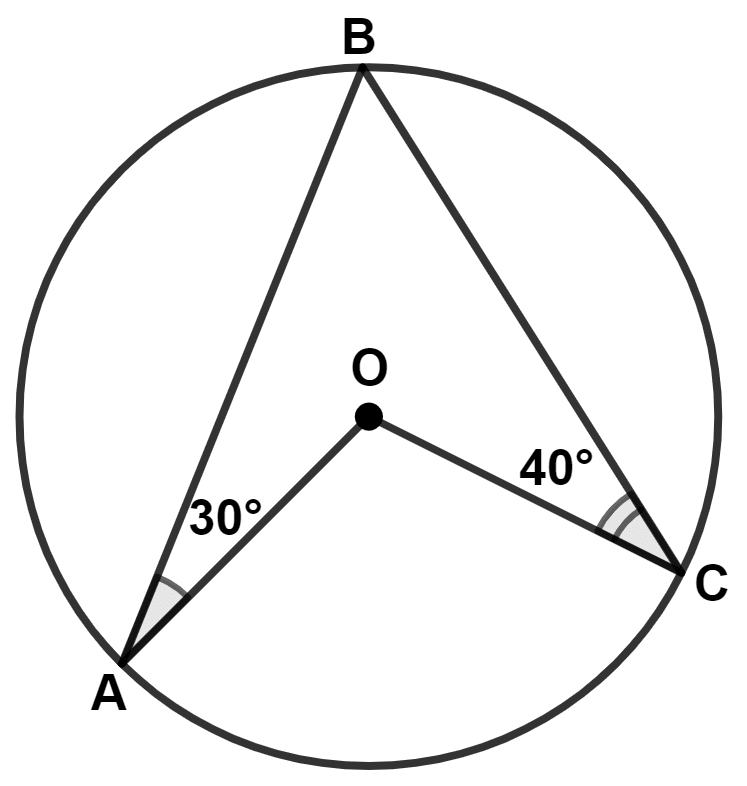
In the given figure, O is the center of the circle. ∠OAB and ∠OCB are 30° and 40° respectively. ∠AOC is equal to :
70°
80°
150°
140°
Answer
Join AC.
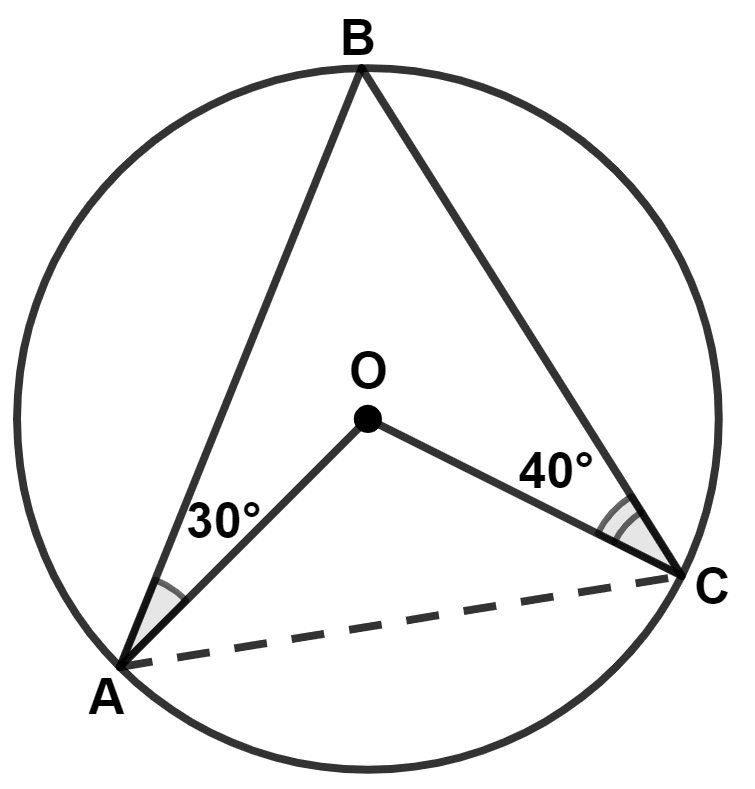
In △AOC,
Since,
OA = OC (Radius of same circle)
∴ ∠OAC = ∠OCA = x (let)
By angle sum property of triangle,
⇒ ∠OAC + ∠OCA + ∠AOC = 180°
⇒ x + x + ∠AOC = 180°
⇒ ∠AOC = 180° - 2x
In △AOC,
By angle sum property of triangle,
⇒ ∠BAC + ∠ACB + ∠CBA = 180°
⇒ (30° + x) + (40° + x) + ∠CBA = 180°
⇒ ∠CBA + 70° + 2x = 180°
⇒ ∠CBA = 180° - 70° - 2x
⇒ ∠CBA = 110° - 2x
We know that,
The angle which an arc subtends at the center is double that which it subtends at any point on the remaining part of the circumference.
∴ ∠AOC = 2∠CBA
⇒ 180° - 2x = 2(110° - 2x)
⇒ 180° - 2x = 220° - 4x
⇒ 4x - 2x = 220° - 180°
⇒ 2x = 40°
⇒ x = = 20°.
⇒ ∠AOC = 180° - 2x
⇒ ∠AOC = 180° - 2(20°) = 180° - 40° = 140°.
Hence, Option 4 is the correct option.
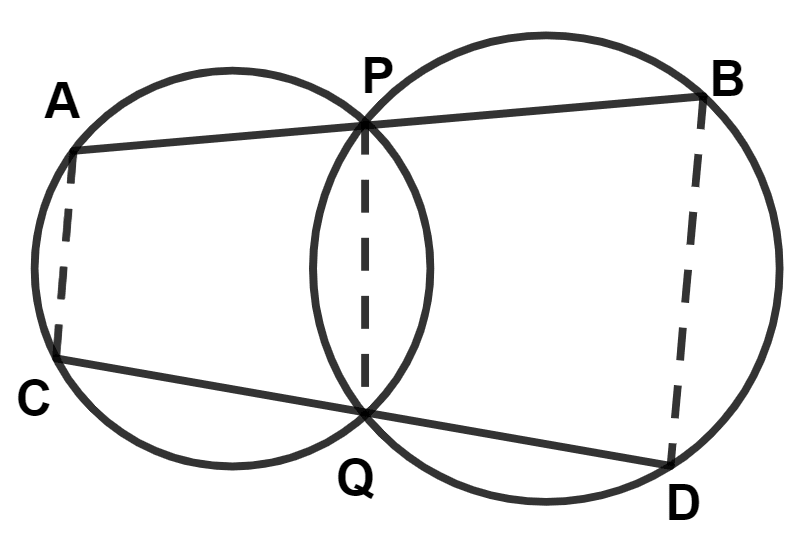
In the given figure APB and CQD are two straight lines, then :
AB || CD
AC || PQ
PQ || BD
AC || BD
Answer
Let ∠BPQ = x and ∠DQP = y
We know that,
The exterior angle of a cyclic quadrilateral is equal to the opposite interior angle.
From figure,
In cyclic quadrilateral APQC,
∠A = ∠DQP = y and ∠C = ∠BPQ = x
From figure,
APB is a straight line.
∴ ∠APQ + ∠BPQ = 180°
⇒ ∠APQ + x = 180°
⇒ ∠APQ = 180° - x
CQD is a straight line.
∴ ∠CQP + ∠DQP = 180°
⇒ ∠CQP + y = 180°
⇒ ∠CQP = 180° - y
In cyclic quadrilateral PQDB,
∠B = ∠CQP = 180° - y and ∠D = ∠APQ = 180° - x
⇒ ∠A + ∠B = y + (180° - y) = 180°
⇒ ∠C + ∠D = x + (180° - x) = 180°
We know that,
Sum of adjacent angles in a trapezium is 180°.
∴ ABDC is a trapezium.
∴ AC || BD.
Hence, Option 4 is the correct option.
In the figure, given below, ∠ABC is equal to :
105°
75°
90°
45°

Answer
We know that,
Sum of co-interior angles in a trapezium is equal to 180°.
⇒ ∠A + ∠D = 180°
⇒ 105° + ∠D = 180°
⇒ ∠D = 180° - 105° = 75°
We know that,
The opposite angles of a cyclic quadrilateral is 180°.
In cyclic quadrilateral ABCD,
⇒ ∠D + ∠B = 180°
⇒ 75° + ∠B = 180°
⇒ ∠B = 180° - 75° = 105°.
Hence, Option 1 is the correct option.
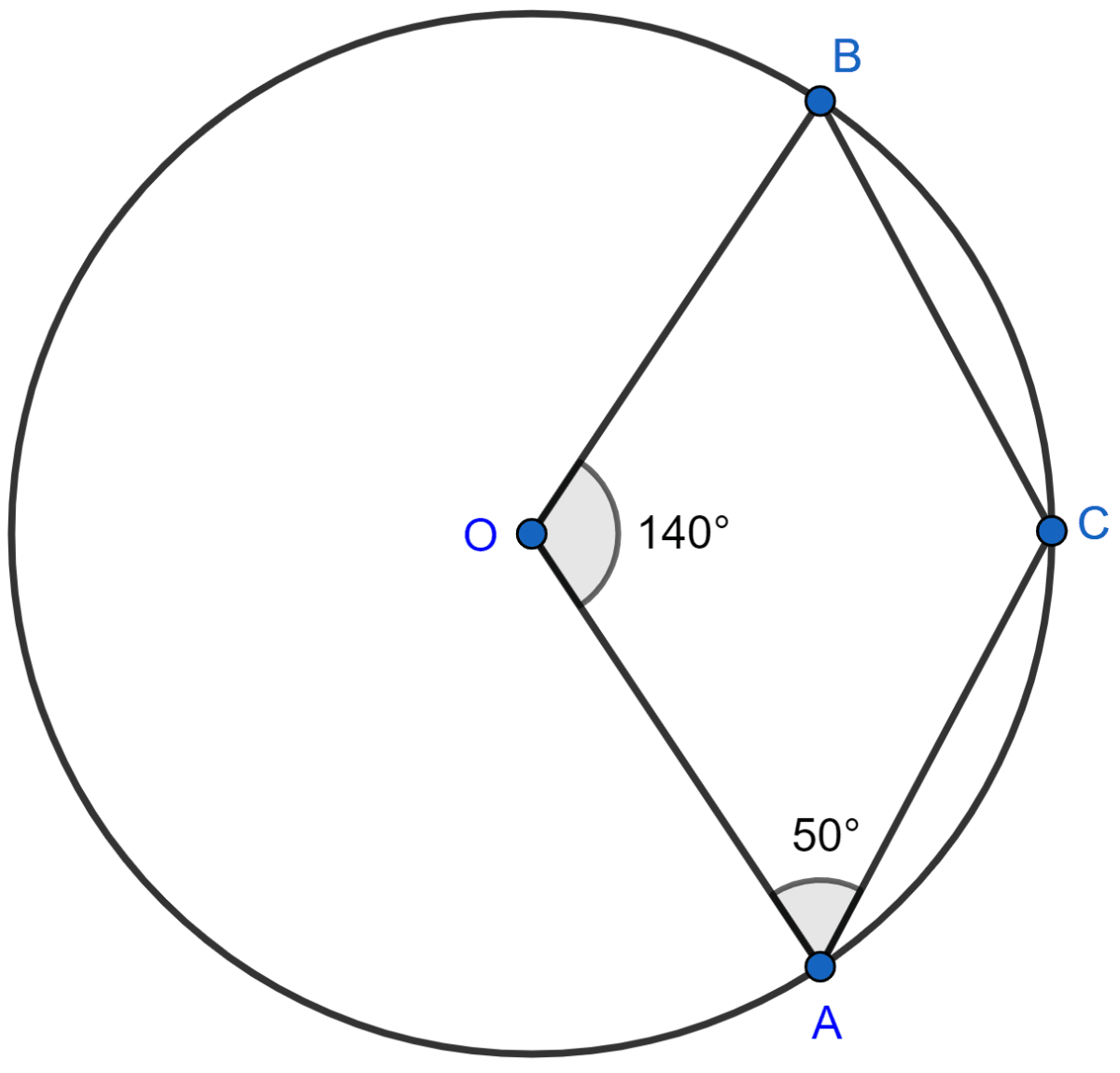
In the given figure, O is the centre of the circle. If ∠AOB = 140° and ∠OAC = 50°; find :
(i) ∠ACB,
(ii) ∠OBC,
(iii) ∠OAB,
(iv) ∠CBA.
Answer
Given, ∠AOB = 140° and ∠OAC = 50°
(i) We know that,
Angle at the center is double the angle at the circumference subtended by the same chord.
∠ACB = Reflex ∠AOB
= (360° - 140°)
= = 110°.
Hence, ∠ACB = 110°.
(ii) We know that,
The sum of angles in a quadrilateral is 360°
In quadrilateral OBCA,
∠OBC + ∠ACB + ∠OAC + ∠AOB = 360°
⇒ ∠OBC + 110° + 50° + 140° = 360°
⇒ ∠OBC + 300° = 360°
⇒ ∠OBC = 360° - 300° = 60°.
Hence, ∠OBC = 60°.
(iii) Join AB.
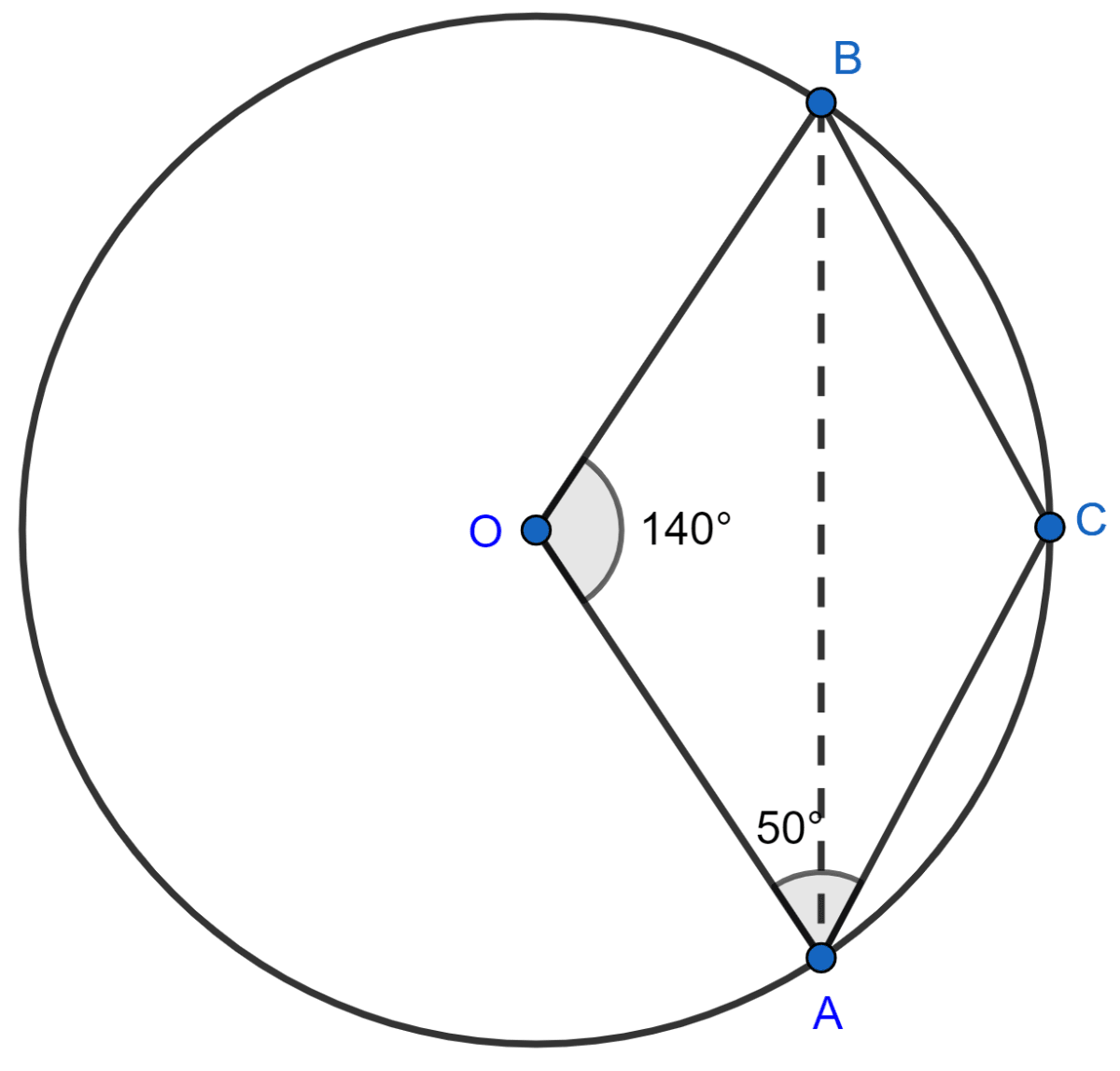
In ∆AOB, we have
OA = OB (radius of circle)
So, ∠OBA = ∠OAB (As angles opposite to equal sides are equal)
By angle sum property of a triangle we get,
⇒ ∠OBA + ∠OAB + ∠AOB = 180°
⇒ 2∠OAB + 140° = 180°
⇒ 2∠OAB = 40°
⇒ ∠OAB = = 20°
Hence, ∠OAB = 20°.
(iv) We already found, ∠OBC = 60°.
⇒ ∠OBC = ∠CBA + ∠OBA
⇒ 60° = ∠CBA + 20°
⇒ ∠CBA = 60° - 20° = 40°
Hence, ∠CBA = 40°.
In the figure, given below, ABCD is a cyclic quadrilateral in which ∠BAD = 75°; ∠ABD = 58° and ∠ADC = 77°. Find :
(i) ∠BDC,
(ii) ∠BCD,
(iii) ∠BCA.
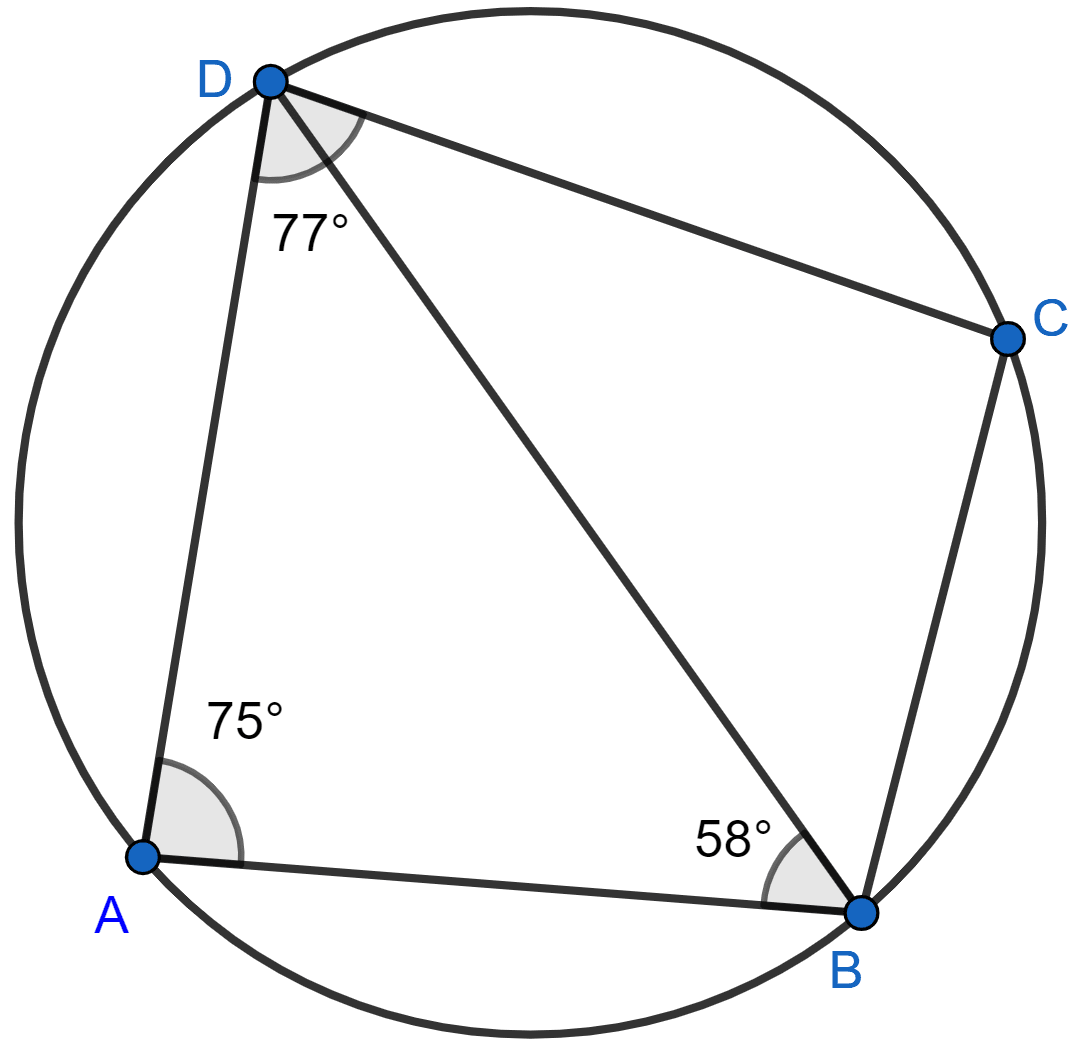
Answer
(i) We know,
Sum of angles in a triangle = 180°.
In △ABD,
⇒ ∠ADB + ∠ABD + ∠DAB = 180°
⇒ ∠ADB + 58° + 75° = 180°
⇒ ∠ADB + 133° = 180°
⇒ ∠ADB = 180° - 133° = 47°
From figure,
∠BDC = ∠ADC - ∠ADB = 77° - 47° = 30°.
Hence, ∠BDC = 30°.
(ii) We know that,
Sum of opposite angles of a cyclic quadrilateral is 180°.
⇒ ∠BAD + ∠BCD = 180°
⇒ ∠BCD = 180° - 75° = 105°.
Hence, ∠BCD = 105°.
(iii) Join AC.
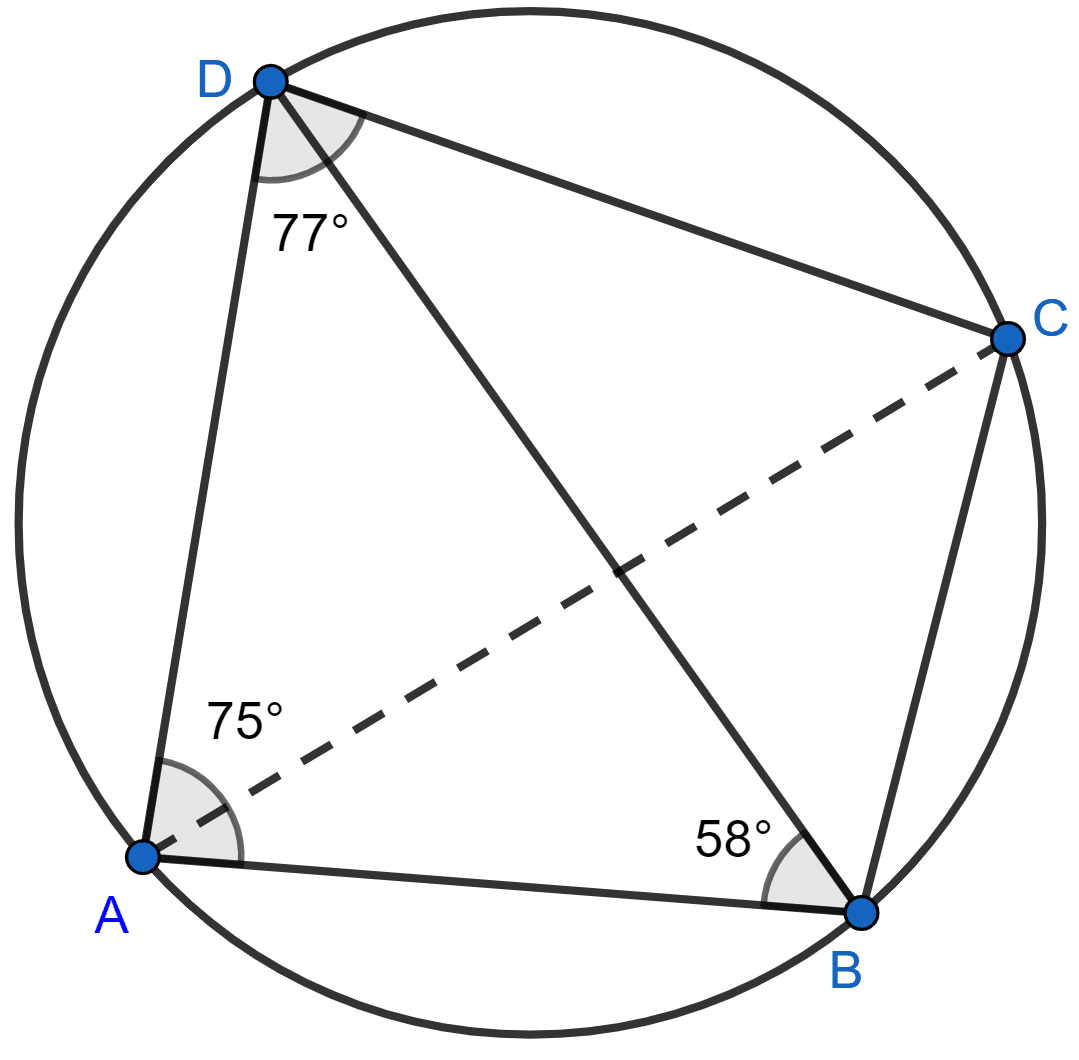
We know that,
Angles subtended by the same chord on the circle are equal.
∠BCA = ∠ADB = 47°
Hence, ∠BCA = 47°.
In the following figure, O is the centre of the circle and ΔABC is equilateral.
Find:
(i) ∠ADB, (ii) ∠AEB.
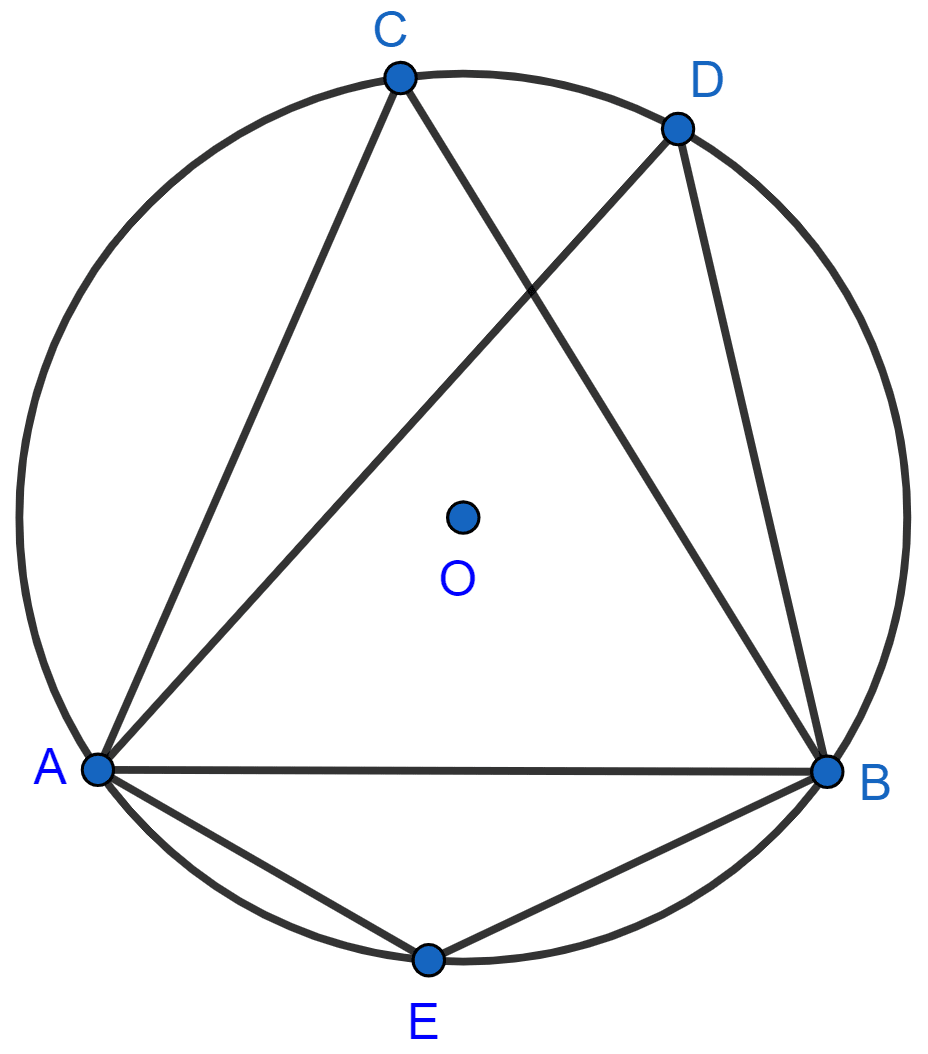
Answer
(i) We know that each angle in an equilateral triangle = 60°.
∴ ∠ACB = 60°
As angles in same segment are equal.
∴ ∠ADB = ∠ACB = 60°.
Hence, ∠ADB = 60°.
(ii) Join OA and OB.
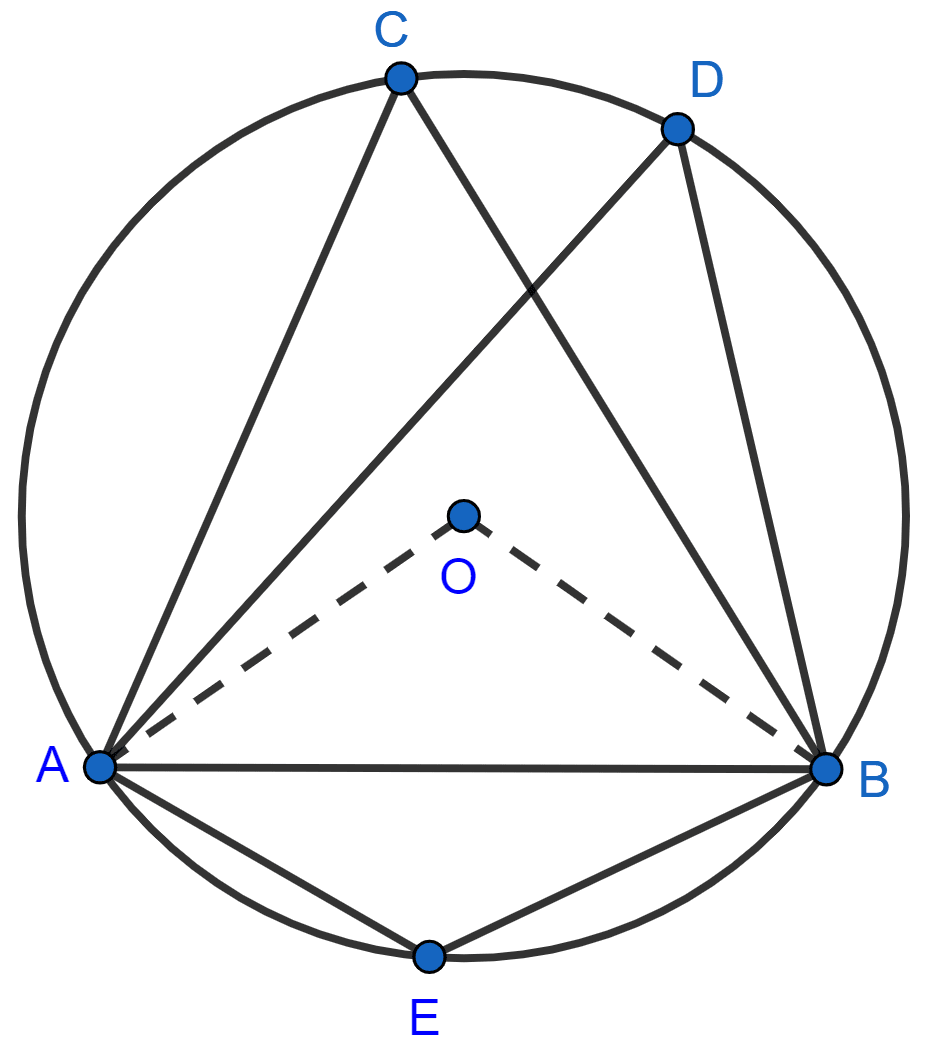
We know that,
Angle at the center is double the angle at the circumference subtended by the same chord.
∴ ∠AOB = 2∠ACB = 2 x 60° = 120°.
∴ ∠AEB = Reflex ∠AOB
= (360° - 120°) =
= 120°.
Hence, ∠AEB = 120°.
ABCD is a cyclic quadrilateral in a circle with centre O. If ∠ADC = 130°, find ∠BAC.

Answer
We know that,
Angle in a semi-circle is 90°.
∠ACB = 90°.
We know that,
Sum of opposite angles of a cyclic quadrilateral = 180°.
⇒ ∠ABC = 180° - ∠ADC = 180° - 130° = 50°.
In △ACB,
⇒ ∠ACB + ∠CBA + ∠BAC = 180° [Angle sum property]
⇒ 90° + 50° + ∠BAC = 180°
⇒ ∠BAC + 140° = 180°
⇒ ∠BAC = 180° - 140° = 40°.
Hence, ∠BAC = 40°.
In the following figure,
(i) if ∠BAD = 96°, find ∠BCD and ∠BFE.
(ii) Prove that AD is parallel to FE.
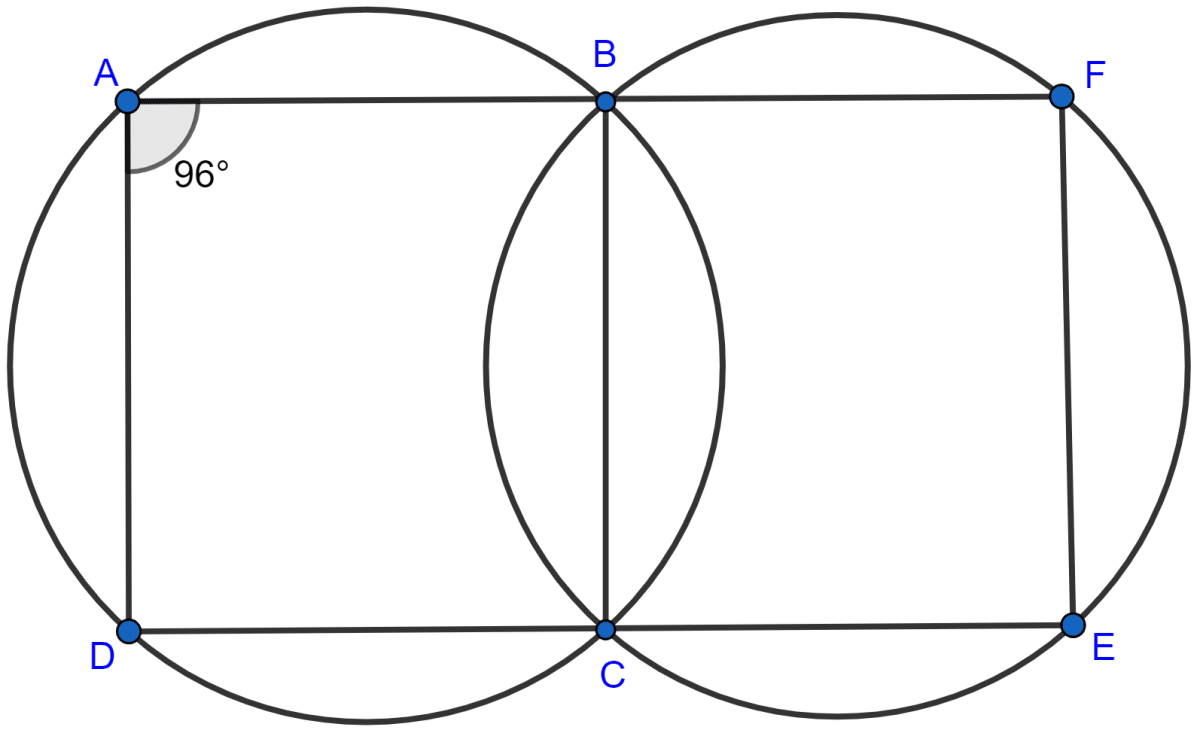
Answer
(i) ABCD is a cyclic quadrilateral.
So, ∠BAD + ∠BCD = 180° [As sum of opposite angles in a cyclic quadrilateral = 180°]
⇒ ∠BCD = 180° - ∠BAD
= 180° - 96°
= 84°.
As DCE is a straight line.
∴ ∠BCE = 180° - ∠BCD
= 180° - 84° = 96°.
BCEF is a cyclic quadrilateral,
So, ∠BCE + ∠BFE = 180°
⇒ ∠BFE = 180° - ∠BCE
= 180° - 96°
= 84°.
Hence, ∠BCD = 84° and ∠BFE = 84°.
(ii) Now, ∠BAD + ∠BFE = 96° + 84° = 180°.
But these two are interior angles on the same side of a pair of lines AD and FE.
Hence, proved that AD || FE.
ABCD is a parallelogram. A circle through vertices A and B meets side BC at point P and side AD at point Q. Show that quadrilateral PCDQ is cyclic.
Answer
The figure of the parallelogram ABCD with a circle through its vertices A and B meeting side BC at point P and side AD at point Q is shown below:
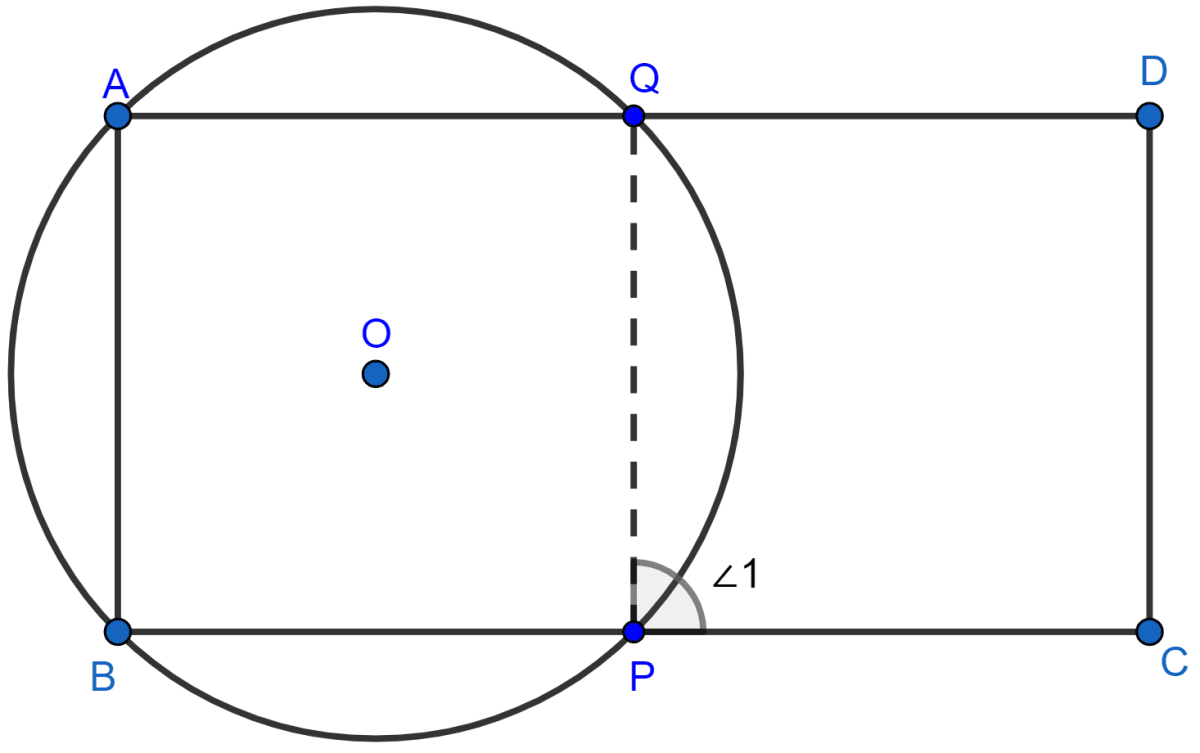
We know that,
An exterior angle of a cyclic quadrilateral is equal to its opposite interior angle.
∴ ∠1 = ∠A ....... (i)
Also,
∠A = ∠C ...........(ii) [Opposite angles of a parallelogram are equal.]
From (i) and (ii) we get,
∠1 = ∠C .........(iii)
Also,
⇒ ∠C + ∠D = 180° [Sum of co-interior angles of a parallelogram = 180°]
⇒ ∠1 + ∠D = 180°
Hence, proved that PCDQ is cyclic.
Prove that:
(i) the parallelogram, inscribed in a circle, is a rectangle.
(ii) the rhombus, inscribed in a circle, is a square.
Answer
(i) Let's assume that ABCD is a parallelogram which is inscribed in a circle.

⇒ ∠A = ∠C and ∠B = ∠D [Opposite angles of a parallelogram are equal]
⇒ ∠A + ∠C = 180° and ∠B + ∠D = 180° [Pair of opposite angles in a cyclic quadrilateral are supplementary]
⇒ 2∠A = 180° and 2∠B = 180°
⇒ ∠A = 90° and ∠B = 90°
⇒ ∠A = ∠C = 90° and ∠B = ∠D = 90°.
Also,
AB = CD and AD = BC [Opposite sides of parallelogram are equal]
Hence, proved that ABCD is a rectangle.
(ii) Let's assume that ABCD is a rhombus which is inscribed in a circle.

So, we have
∠BAD = ∠BCD [Opposite angles of a rhombus are equal]
From figure,
∠BAD + ∠BCD = 180° [Pair of opposite angles in a cyclic quadrilateral are supplementary]
⇒ 2∠BAD = 180°
Thus, ∠BAD = ∠BCD = 90°.
Also,
∠ABC = ∠ADC [Opposite angles of a rhombus are equal]
From figure,
∠ABC + ∠ADC = 180° [Pair of opposite angles in a cyclic quadrilateral are supplementary]
⇒ 2∠ABC = 180°
Thus, ∠ABC = ∠ADC = 90°.
Since, each side of rhombus are equal.
Thus,
Each angle of quadrilateral = 90° and all sides are equal.
Hence, proved that ABCD is a square.
In the given figure, AB = AC. Prove that DECB is an isosceles trapezium.
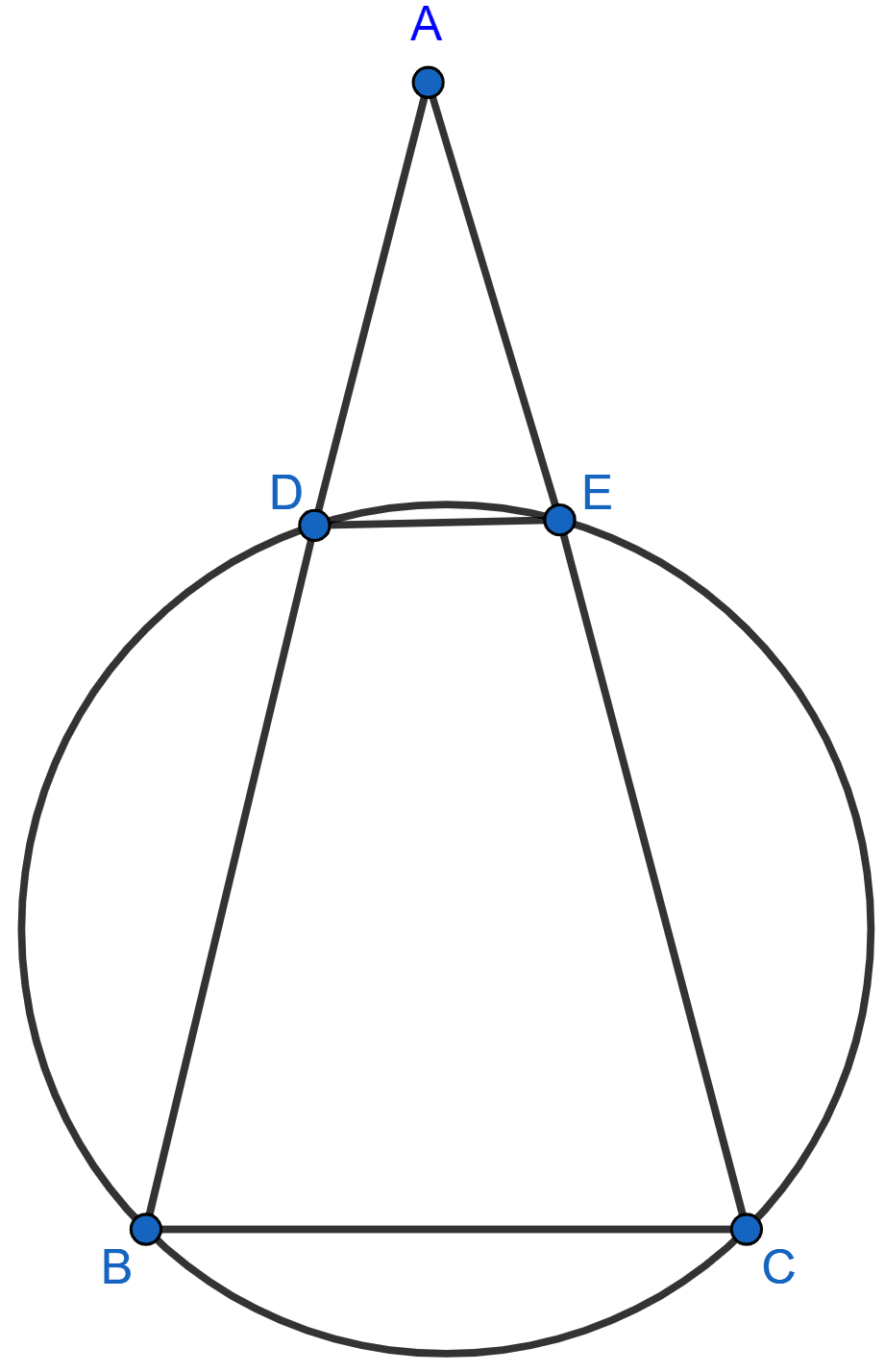
Answer
Given, AB = AC
So, ∠B = ∠C ........(1) [As Angles opposite to equal sides are equal]
From figure,
DECB is a cyclic quadrilateral.
∴ ∠B + ∠DEC = 180° [Sum of opposite angles in cyclic quadrilateral = 180°]
⇒ ∠C + ∠DEC = 180° (Using 1)
But this is the sum of interior angles on one side of a transversal.
∴ DE || BC.
∴ ∠ADE = ∠B and ∠AED = ∠C [Corresponding angles]
Thus, ∠ADE = ∠AED
∴ AD = AE
⇒ AB - AD = AC - AE [As AB = AC]
⇒ BD = CE
Hence, we have DE || BC and BD = CE.
Hence, proved that DECB is an isosceles trapezium.
The figure given below, shows a circle with centre O.
Given : ∠AOC = a and ∠ABC = b.
(i) Find the relationship between a and b.
(ii) Find the measure of angle OAB, if OABC is a parallelogram.
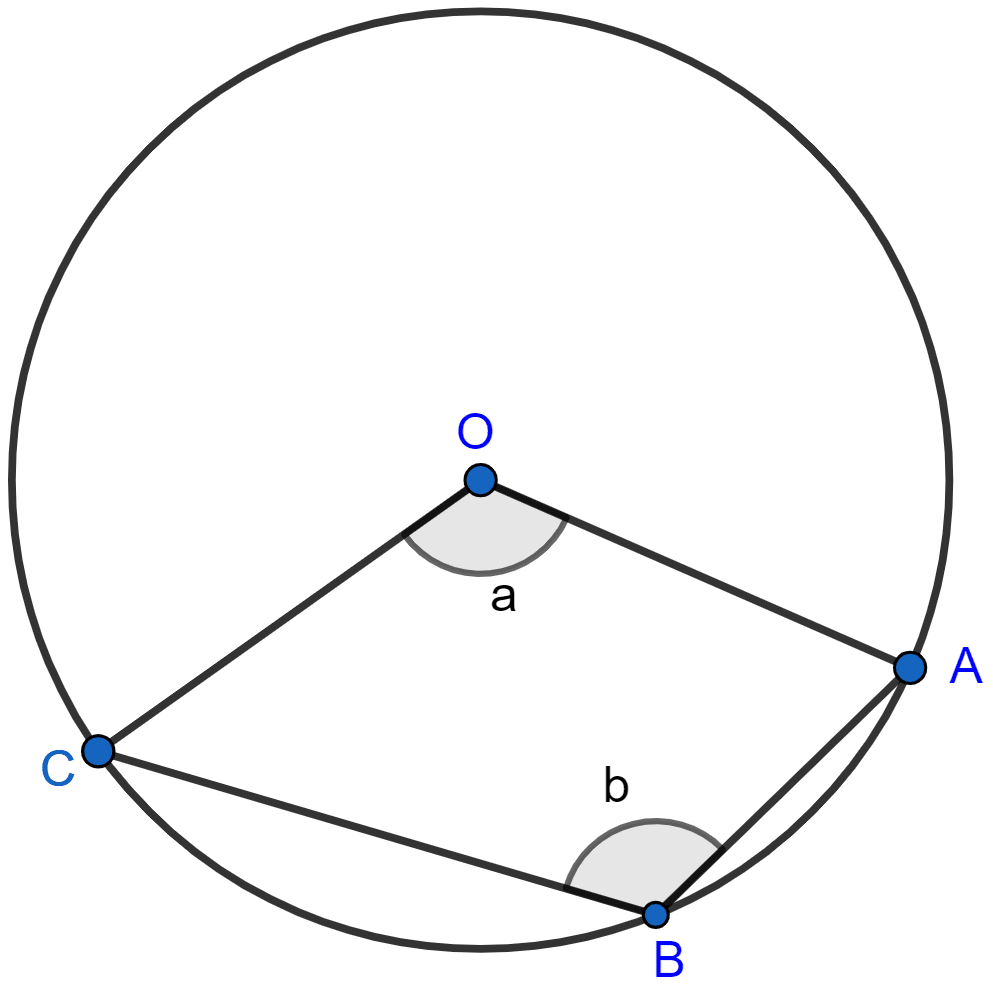
Answer
(i) We know that,
Angle at the centre is double the angle at the circumference subtended by the same chord
∴ ∠ABC = Reflex ∠COA
⇒ b = (360° - a)
⇒ 2b = 360° - a
⇒ a + 2b = 360° .....(1)
Hence, relationship between a and b is given by the equation : a + 2b = 360°.
(ii) From equation 1, we get :
⇒ a + 2b = 360°
⇒ a = 360° - 2b
As OABC is a parallelogram, the opposite angles are equal.
So, a = b
⇒ 360° - 2b = b
⇒ 3b = 360°
⇒ b = = 120°
Let ∠OAB = x and ∠OCB = x.
⇒ ∠OAB + ∠OCB + ∠AOC + ∠ABC = 360°
⇒ x + x + a + b = 360°
⇒ 2x + 120° + 120° = 360°
⇒ 2x + 240° = 360°
⇒ 2x = 120°
⇒ x = = 60°.
Hence, ∠OAB = 60°.
In the figure given, RS is a diameter of the circle. NM is parallel to RS and ∠MRS = 29°.
Calculate :
(i) ∠RNM,
(ii) ∠NRM.

Answer
(i) Join RN and MS.

∠RMS = 90° [Angle in a semi-circle is a right angle]
In ∆RMS
⇒ ∠RMS + ∠RSM + ∠MRS = 180° [Angle sum property of triangle]
⇒ 90° + ∠RSM + 29° = 180°
⇒ ∠RSM + 119° = 180°
⇒ ∠RSM = 180° - 119° = 61°.
Sum of opposite angles in a cyclic quadrilateral = 180°.
⇒ ∠RNM + ∠RSM = 180°
⇒ ∠RNM + 61° = 180°
⇒ ∠RNM = 180° - 61° = 119°.
Hence, ∠RNM = 119°.
(ii) Now as RS || NM,
∠NMR = ∠MRS = 29° [Alternate angles are equal]
From figure,
∠NMS = ∠NMR + ∠RMS = 29° + 90° = 119°.
Sum of opposite angles in a cyclic quadrilateral = 180°.
In quadrilateral NMSR,
⇒ ∠NRS + ∠NMS = 180°
⇒ ∠NRM + ∠MRS + ∠NMS = 180°
⇒ ∠NRM + 29° + 119° = 180°
⇒ ∠NRM = 180° - 119° - 29°
⇒ ∠NRM = 32°.
Hence, ∠NRM = 32°.
In the given figure, SP is the bisector of ∠RPT and PQRS is a cyclic quadrilateral. Prove that :
SQ = SR.
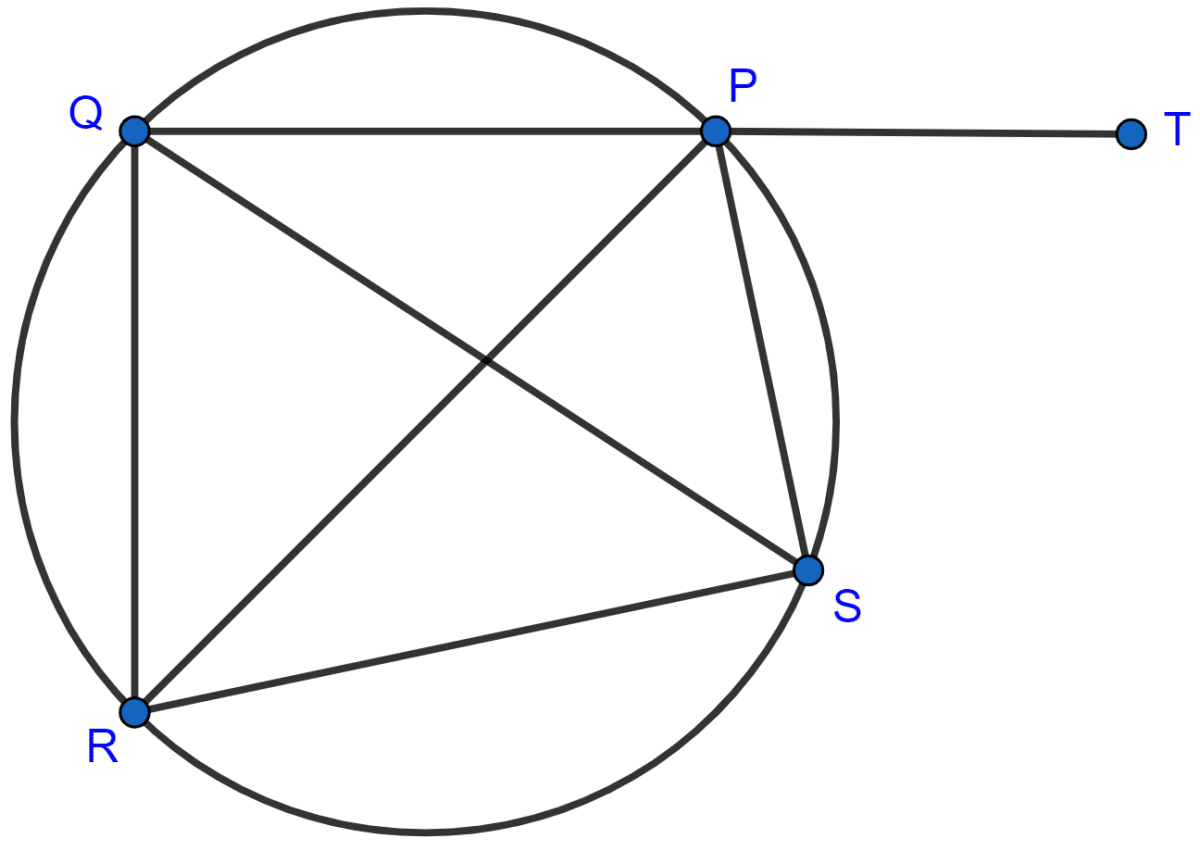
Answer
PQRS is a cyclic quadrilateral.
Sum of opposite angles in a cyclic quadrilateral = 180°.
∴ ∠QRS + ∠QPS = 180° ...........(1)
Also,
∠QPS + ∠SPT = 180° [As QPT is a straight line] ........(2)
Subtracting equation (2) from (1) we get,
⇒ ∠QRS + ∠QPS - (∠QPS + ∠SPT) = 180° - 180°
⇒ ∠QRS - ∠SPT = 0
⇒ ∠QRS = ∠SPT ..........(3)
∠RQS = ∠RPS [Angles in same segment are equal] ........(4)
∠RPS = ∠SPT [As PS bisects ∠RPT] .......(5)
From (3), (4) and (5) we get :
⇒ ∠QRS = ∠RQS.
∴ SQ = SR [As sides opposite to equal angles are also equal]
Hence, proved that SQ = SR.
In the figure, O is the center of the circle, ∠AOE = 150°, ∠DAO = 51°. Calculate the sizes of the angles CEB and OCE.
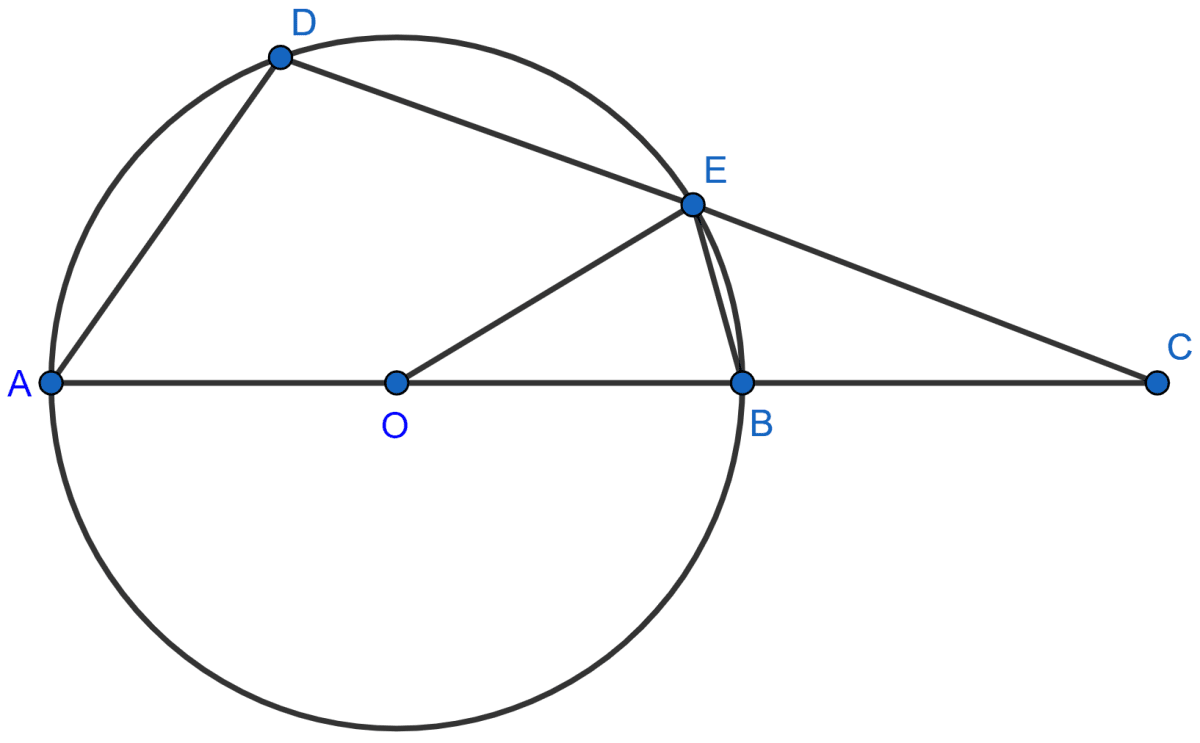
Answer
We know that,
Angle at the center is double the angle at the circumference subtended by the same chord.
⇒ Reflex ∠AOE = 2∠ADE
⇒ ∠ADE = Reflex ∠AOE
⇒ ∠ADE = (360° - 150°)
⇒ ∠ADE = = 105°.
From figure,
⇒ ∠DAB + ∠BED = 180° [Sum of opposite angles in a cyclic quadrilateral = 180°.]
⇒ ∠BED = 180° - ∠DAB = 180° - 51° = 129°.
Also,
⇒ ∠CEB + ∠BED = 180° [As CED is a straight line]
⇒ ∠CEB = 180° - ∠BED = 180° - 129° = 51°.
In △ADC,
⇒ ∠ADC + ∠ACD + ∠DAC = 180°
⇒ ∠ADE + ∠ACD + ∠DAO = 180° [From figure, ∠ADC = ∠ADE and ∠DAC = ∠DAO]
⇒ 105° + ∠ACD + 51° = 180°
⇒ ∠ACD = 180° - 105° - 51° = 24°.
From figure,
∠OCE = ∠ACD = 24°.
Hence, ∠CEB = 51° and ∠OCE = 24°.
In the figure, given below, P and Q are the centers of two circles intersecting at B and C. ACD is a straight line. Calculate the numerical value of x.

Answer
We know that,
Angle at the center is double the angle at the circumference subtended by the same chord.
⇒ ∠APB = 2∠ACB
⇒ ∠ACB = ∠APB
⇒ ∠ACB = 150° = 75°.
From figure,
⇒ ∠ACB + ∠BCD = 180° [As ACD is a straight line]
⇒ 75° + ∠BCD = 180°
⇒ ∠BCD = 180° - 75° = 105°.
Also,
⇒ Reflex ∠BQD = 2∠BCD [Angle at the center is double the angle at the circumference subtended by the same chord.]
⇒ (360° - x) = 2 x 10⁵°
⇒ x = 360° - 210° = 150°.
Hence, x = 150°.
The figure shows two circles which intersect at A and B. The center of the smaller circle is O and lies on the circumference of the larger circle. Given ∠APB = a°.
Calculate, in terms of a°, the value of :
(i) obtuse ∠AOB,
(ii) ∠ACB,
(iii) ∠ADB.
Give reasons for your answers clearly.
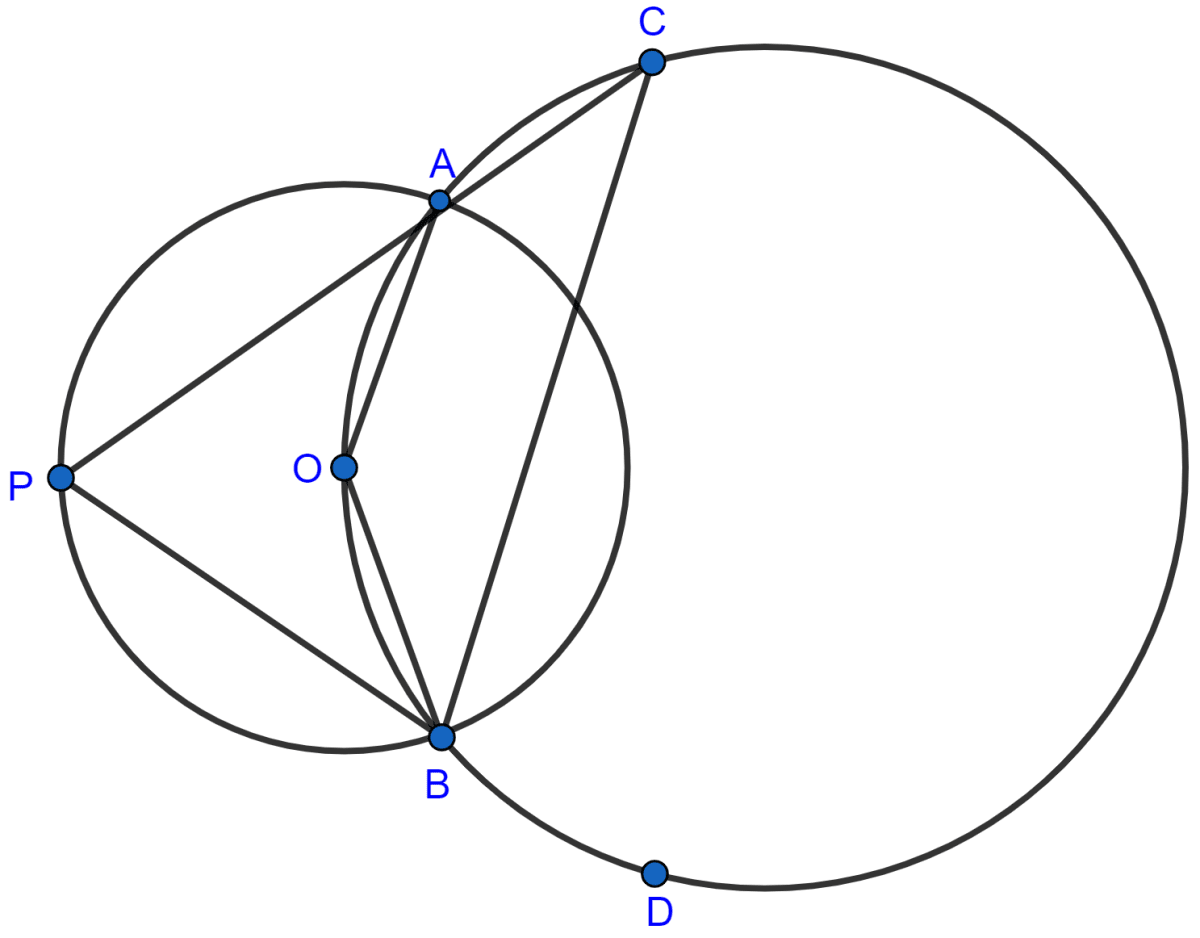
Answer
(i) We know that,
Angle at the center is double the angle at the circumference subtended by the same chord.
obtuse ∠AOB = 2∠APB = 2a°.
Hence, obtuse ∠AOB = 2a°.
(ii) OACB is a cyclic quadrilateral.
⇒ ∠AOB + ∠ACB = 180° [Sum of opposite angles in a cyclic quadrilateral = 180°.]
⇒ ∠ACB + 2a° = 180°
⇒ ∠ACB = 180° - 2a°.
Hence, ∠ACB = 180° - 2a°.
(iii) Join AD and BD.
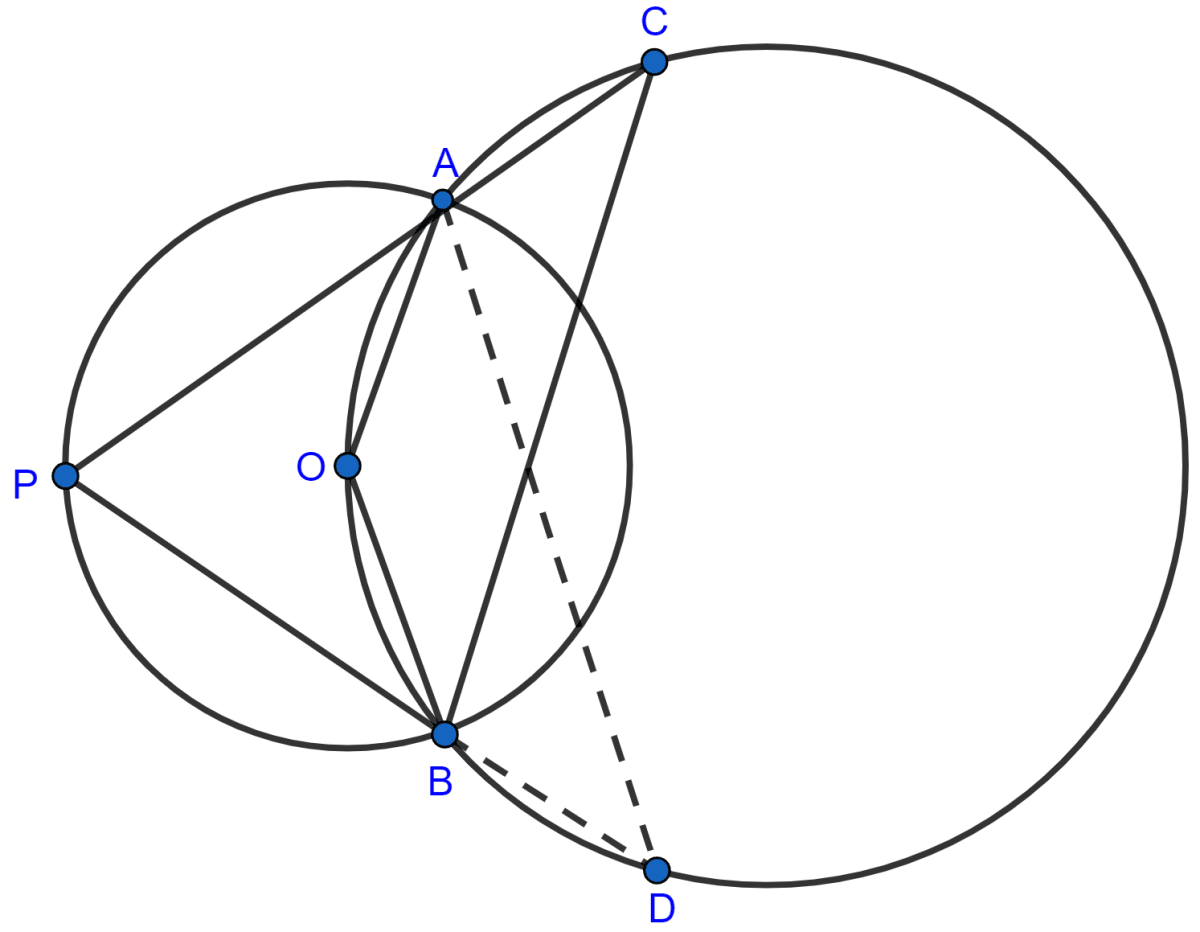
As, angles in same segment are equal.
∴ ∠ADB = ∠ACB = 180° - 2a°.
Hence, ∠ADB = 180° - 2a°.
In the given figure, O is the centre of the circle and ∠ABC = 55°. Calculate the values of x and y.

Answer
We know that,
Angle at the center is double the angle at the circumference subtended by the same chord.
∠AOC = 2∠ABC = 2 × 55° = 110°.
∴ x = 110°.
ABCD is a cyclic quadrilateral.
∴ ∠ADC + ∠ABC = 180°
⇒ y + 55° = 180°
⇒ y = 180° - 55° = 125°.
Hence, x = 110° and y = 125°.
ABCD is a cyclic quadrilateral in which AB is parallel to DC and AB is a diameter of the circle. Given ∠BED = 65°; calculate :
(i) ∠DAB,
(ii) ∠BDC.

Answer
(i) We know that,
Angles in same segment are equal.
∴ ∠DAB = ∠BED = 65°.
Hence, ∠DAB = 65°.
(ii) We know that,
Angle in semi-circle is a right angle.
∴ ∠ADB = 90°.
In △ADB,
⇒ ∠ABD + ∠ADB + ∠DAB = 180°
⇒ ∠ABD + 90° + 65° = 180°
⇒ 155° + ∠ABD = 180°
⇒ ∠ABD = 180° - 155° = 25°.
As, AB || DC
∠BDC = ∠ABD = 25°.
Hence, ∠BDC = 25°.
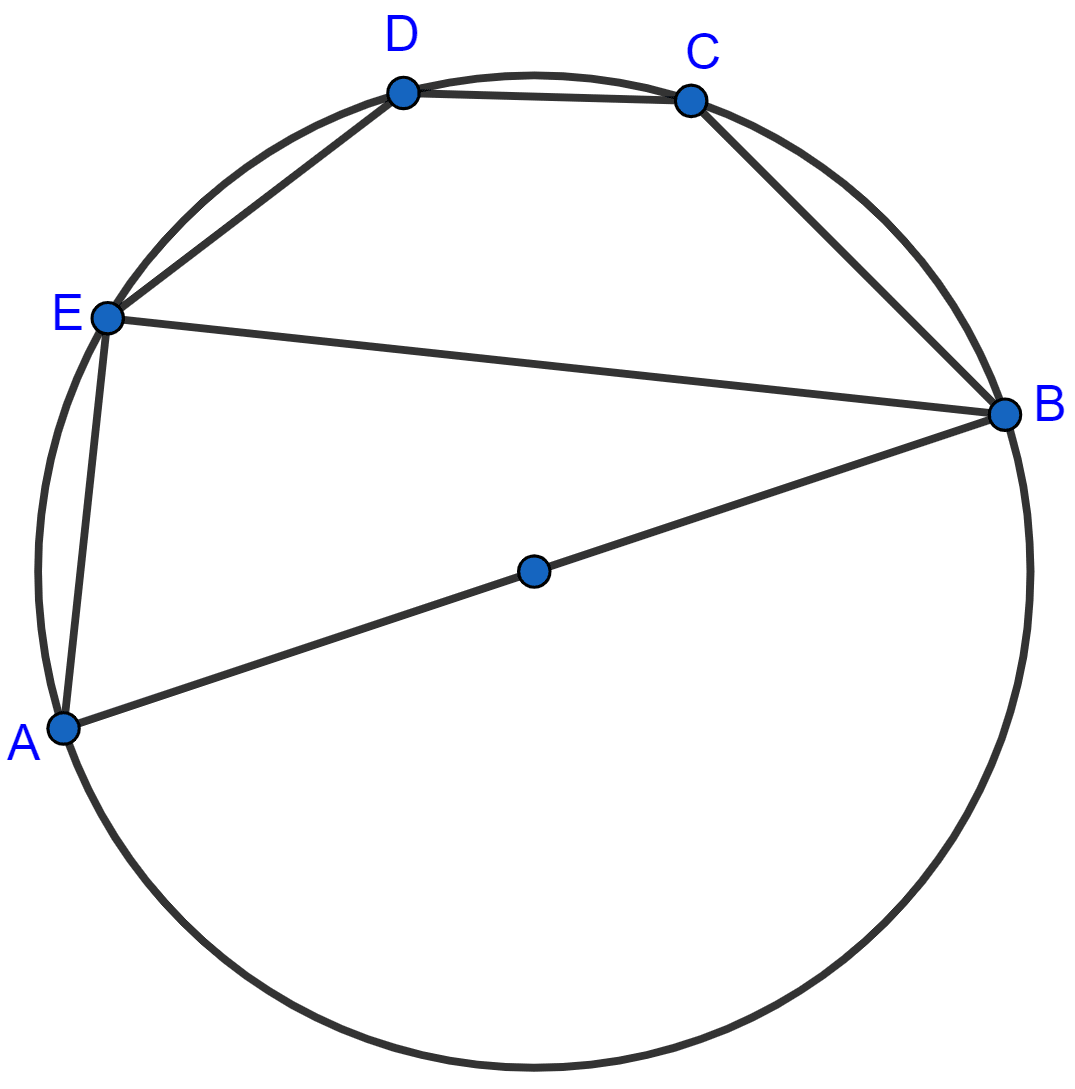
In the given figure, AB is a diameter of the circle. Chord ED is parallel to AB and ∠EAB = 63°. Calculate :
(i) ∠EBA,
(ii) ∠BCD.
Answer
(i) We know that,
Angle in semi-circle is a right angle.
∴ ∠AEB = 90°.
In △AEB,
⇒ ∠AEB + ∠EBA + ∠EAB = 180°
⇒ 90° + ∠EBA + 63° = 180°
⇒ 153° + ∠EBA = 180°
⇒ ∠EBA = 180° - 153° = 27°.
Hence, ∠EBA = 27°.
(ii) As, AB || ED
∴ ∠DEB = ∠EBA = 27° [Alternate angles]
BCDE is a cyclic quadrilateral.
∴ ∠DEB + ∠BCD = 180° [Sum of opposite angles in a cyclic quadrilateral = 180°.]
⇒ 27° + ∠BCD = 180°
⇒ ∠BCD = 180° - 27° = 153°.
Hence, ∠BCD = 153°.
In the given figure, AB is a diameter of the circle with center O. DO is parallel to CB and ∠DCB = 120°. Calculate :
(i) ∠DAB,
(ii) ∠DBA,
(iii) ∠DBC,
(iv) ∠ADC.
Also, show that the △AOD is an equilateral triangle.

Answer
(i) ABCD is a cyclic quadrilateral.
∴ ∠DCB + ∠DAB = 180° [Sum of opposite angles in a cyclic quadrilateral = 180°.]
⇒ ∠DAB = 180° - ∠DCB
⇒ ∠DAB = 180° - 120° = 60°.
Hence, ∠DAB = 60°.
(ii) We know that,
Angle in a semi-circle is a right angle.
∠ADB = 90°.
In △DAB,
⇒ ∠ADB + ∠DAB + ∠DBA = 180°
⇒ 90° + 60° + ∠DBA = 180°
⇒ 150° + ∠DBA = 180°
⇒ ∠DBA = 180° - 150° = 30°.
Hence, ∠DBA = 30°.
(iii) OD = OB (Radius of circle)
∴ ∠ODB = ∠OBD [Angles opposite to equal sides are equal]
From figure,
∠OBD = ∠DBA = 30°.
∴ ∠ODB = 30°.
As, DO || BC
∴ ∠DBC = ∠ODB = 30° [Alternate angles are equal.]
Hence, ∠DBC = 30°.
(iv) From figure,
∠ABC = ∠ABD + ∠DBC = 30° + 30° = 60°.
In cyclic quadrilateral ABCD,
∴ ∠ADC + ∠ABC = 180° [Sum of opposite angles in a cyclic quadrilateral = 180°.]
⇒ ∠ADC = 180° - ∠ABC
⇒ ∠ADC = 180° - 60° = 120°.
Hence, ∠ADC = 120°.
In △AOD,
OA = OD [Radius of same circle]
∠AOD = ∠DAO [Angles opposite to equal sides are equal]
From figure,
⇒ ∠DAO = ∠DAB = 60°.
∴ ∠AOD = ∠DAO = ∠ADO = 60°
Hence, proved that △AOD is an equilateral triangle.
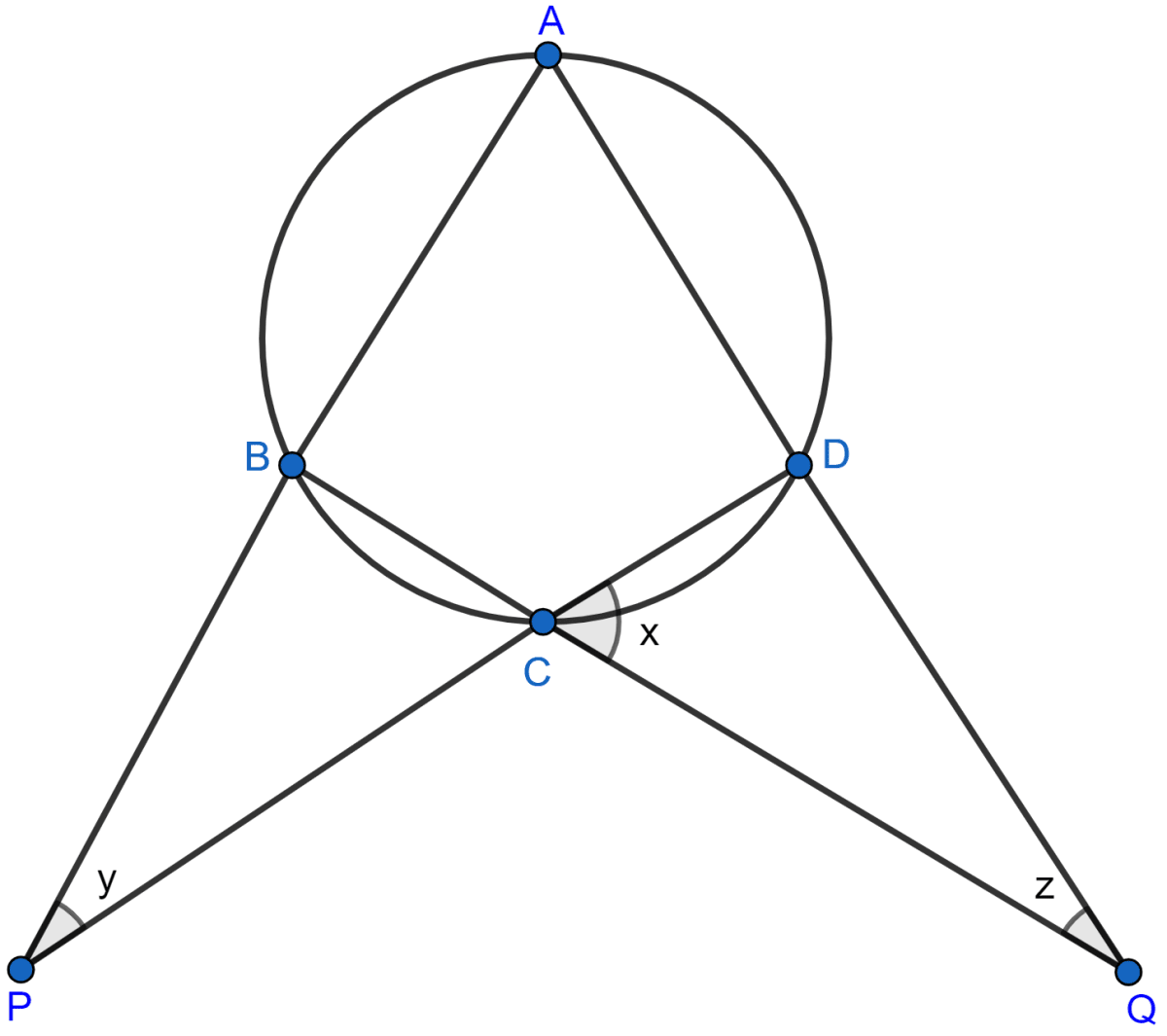
Calculate the angles x, y and z if :
Answer
Let = k.
∴ x = 3k, y = 4k and z = 5k.
From figure,
∠BCP = ∠DCQ [Vertically opposite angles are equal.]
Exterior angle of a triangle is equal to the sum of two opposite interior angles.
∠ABC = ∠BCP + ∠BPC = x + y = 3k + 4k = 7k
∠ADC = ∠DCQ + ∠DQC = x + z = 3k + 5k = 8k.
ABCD is a cyclic quadrilateral.
We know that,
⇒ ∠ABC + ∠ADC = 180° [Sum of opposite angles in a cyclic quadrilateral = 180°]
⇒ 8k + 7k = 180°
⇒ 15k = 180°
⇒ k = = 12°.
x = 3k = 3 x 12° = 36°
y = 4k = 4 x 12° = 48°
z = 5k = 5 x 12° = 60°.
Hence, x = 36°, y = 48° and z = 60°.
In the given figure, AC is the diameter of the circle with center O. CD and BE are parallel. Angle ∠AOB = 80° and ∠ACE = 10°. Calculate :
(i) Angle BEC,
(ii) Angle BCD,
(iii) Angle CED.

Answer
(i) From figure,
⇒ ∠BOC + ∠BOA = 180° [As AOC is a straight line.]
⇒ ∠BOC + 80° = 180°
⇒ ∠BOC = 180° - 80° = 100°.
We know that,
Angle at the centre is double the angle at the circumference subtended by the same chord.
⇒ ∠BOC = 2∠BEC
⇒ ∠BEC = ∠BOC = = 50°.
Hence, ∠BEC = 50°.
(ii) Given,
DC || EB
∴ ∠DCE = ∠BEC = 50° [Alternate angles are equal]
We know that,
Angle at the centre is double the angle at the circumference subtended by the same chord.
⇒ ∠AOB = 2∠ACB
⇒ ∠ACB = ∠AOB = = 40°.
From figure,
∠BCD = ∠ACB + ∠ACE + ∠DCE = 40° + 10° + 50° = 100°.
Hence, ∠BCD = 100°.
(iii) As sum of opposite angles of cyclic quadrilateral = 180°.
⇒ ∠BED + ∠BCD = 180°
⇒ ∠BED = 180° - ∠BCD = 180° - 100° = 80°.
From figure,
⇒ ∠BED = ∠BEC + ∠CED
⇒ 80° = 50° + ∠CED
⇒ ∠CED = 80° - 50° = 30°.
Hence, ∠CED = 30°.
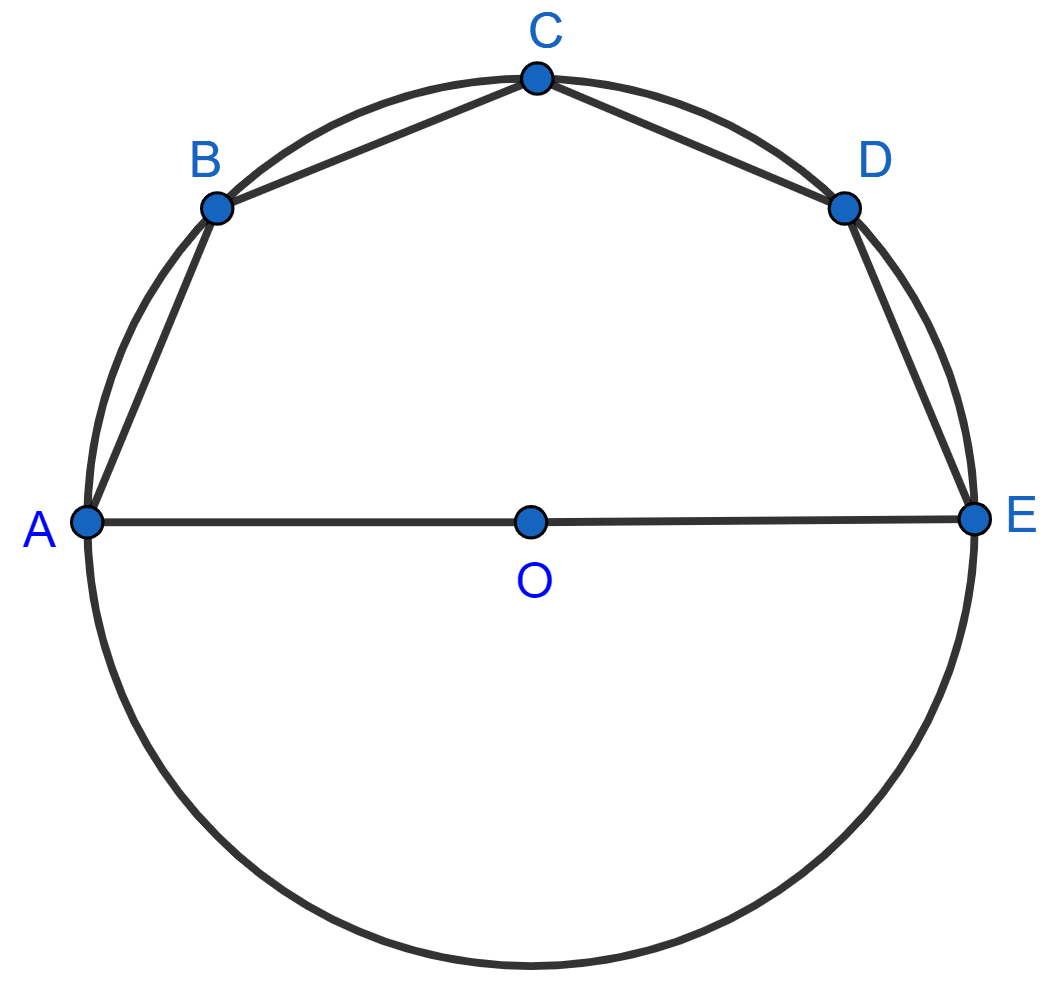
In the given figure, AE is the diameter of the circle. Write down the numerical value of ∠ABC + ∠CDE. Give reasons for your answer.
Answer
Join OA, OB, OC, OD.
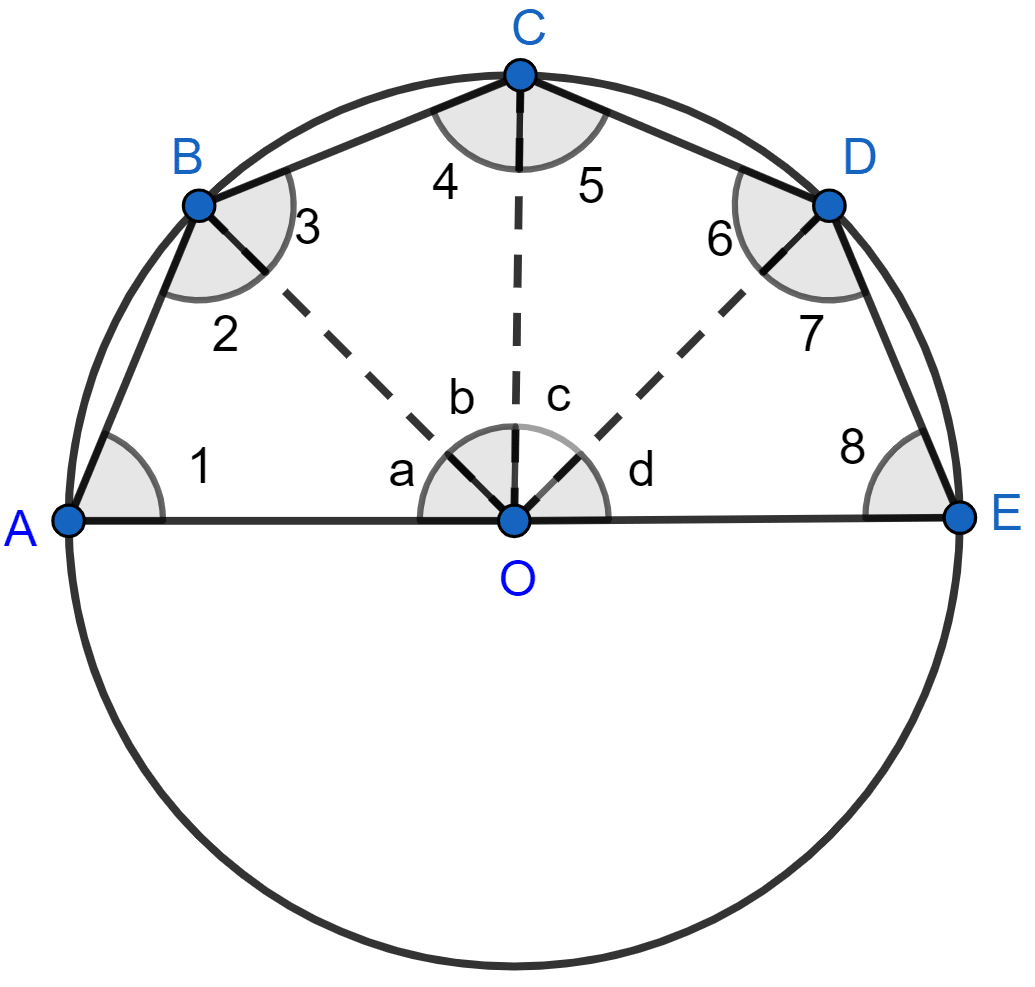
In △OAB,
OA = OB [Radius of same circle]
∠1 = ∠2.
In △OBC,
OB = OC [Radius of same circle]
∠3 = ∠4.
In △OCD,
OC = OD [Radius of same circle]
∠5 = ∠6.
In △ODE,
OD = OE [Radius of same circle]
∠7 = ∠8.
In △OAB,
⇒ ∠1 + ∠2 + ∠a = 180° [By angle sum property of triangle] ..........(1)
In △OBC,
⇒ ∠3 + ∠4 + ∠b = 180° [By angle sum property of triangle] ..........(2)
In △OCD,
⇒ ∠5 + ∠6 + ∠c = 180° [By angle sum property of triangle] ..........(3)
In △ODE,
⇒ ∠7 + ∠8 + ∠d = 180° [By angle sum property of triangle] .........(4)
Adding (1), (2), (3) and (4) we get,
⇒ ∠1 + ∠2 + ∠a + ∠3 + ∠4 + ∠b + ∠5 + ∠6 + ∠c + ∠7 + ∠8 + ∠d + = 180° + 180° + 180° + 180°
⇒ ∠2 + ∠2 + ∠a + ∠3 + ∠3 + ∠b + ∠6 + ∠6 + ∠c + ∠7 + ∠7 + ∠d + = 720°
⇒ 2∠2 + 2∠3 + 2∠6 + 2∠7 + ∠a + ∠b + ∠c + ∠d = 720°
⇒ 2[∠2 + ∠3] + 2[∠6 + ∠7] + 180° = 720° [As ∠a + ∠b + ∠c + ∠d = 180°]
⇒ 2∠ABC + 2∠CDE = 540°
⇒ ∠ABC + ∠CDE = 270°.
Hence, ∠ABC + ∠CDE = 270°.
In the given figure, AOC is a diameter and AC is parallel to ED. If ∠CBE = 64°, calculate ∠DEC.

Answer
Join AB.

∠ABC = 90° [As angle in a semi-circle is a right angle.]
From figure,
∠ABE = ∠ABC - ∠CBE = 90° - 64° = 26°.
As angles in same segment are equal.
∠ACE = ∠ABE = 26°.
Given,
AC || ED
∴ ∠DEC = ∠ACE = 26° [Alternate angles are equal]
Hence, ∠DEC = 26°.
Use the given figure to find :
(i) ∠BAD
(ii) ∠DQB.

Answer
(i) In △ADP,
⇒ ∠PAD + ∠ADP + ∠DPA = 180° [Angle sum property of triangle]
⇒ ∠PAD + 85° + 40° = 180°
⇒ ∠PAD + 125° = 180°
⇒ ∠PAD = 180° - 125° = 55°.
From figure,
⇒ ∠BAD = ∠PAD = 55°.
Hence, ∠BAD = 55°.
(ii) We know that,
Sum of opposite angles in a cyclic quadrilateral = 180°.
⇒ ∠ABC + ∠ADC = 180°
⇒ ∠ABC + 85° = 180°
⇒ ∠ABC = 180° - 85° = 95°.
In △AQB,
⇒ ∠AQB + ∠QAB + ∠ABQ = 180° [Angle sum property of triangle]
⇒ ∠AQB + ∠BAD + ∠ABC = 180° [From figure, ∠QAB = ∠BAD and ∠ABQ = ∠ABC]
⇒ ∠AQB + 55° + 95° = 180°
⇒ ∠AQB + 150° = 180°
⇒ ∠AQB = 180° - 150° = 30°.
From figure,
⇒ ∠DQB = ∠AQB = 30°.
Hence, ∠DQB = 30°.
In the given figure, PQ is a diameter. Chord SR is parallel to PQ. Given that ∠PQR = 58°, Calculate :
(i) ∠RPQ
(ii) ∠STP.

Answer
Join PR.

(i) ∠PRQ = 90° [Angle in semi-circle is a right angle.]
In △PQR,
⇒ ∠RPQ + ∠PRQ + ∠PQR = 180° [Angle sum property of triangle]
⇒ ∠RPQ + 90° + 58° = 180°
⇒ ∠RPQ + 148° = 180°
⇒ ∠RPQ = 180° - 148° = 32°.
Hence, ∠RPQ = 32°.
(ii) As, SR || PQ,
∠PRS = ∠RPQ = 32° [Alternate angles are equal]
In cyclic quadrilateral PRST,
⇒ ∠STP + ∠PRS = 180° [As sum of opposite angles in a cyclic quadrilateral = 180°]
⇒ ∠STP = 180° - ∠PRS = 180° - 32° = 148°.
Hence, ∠STP = 148°.
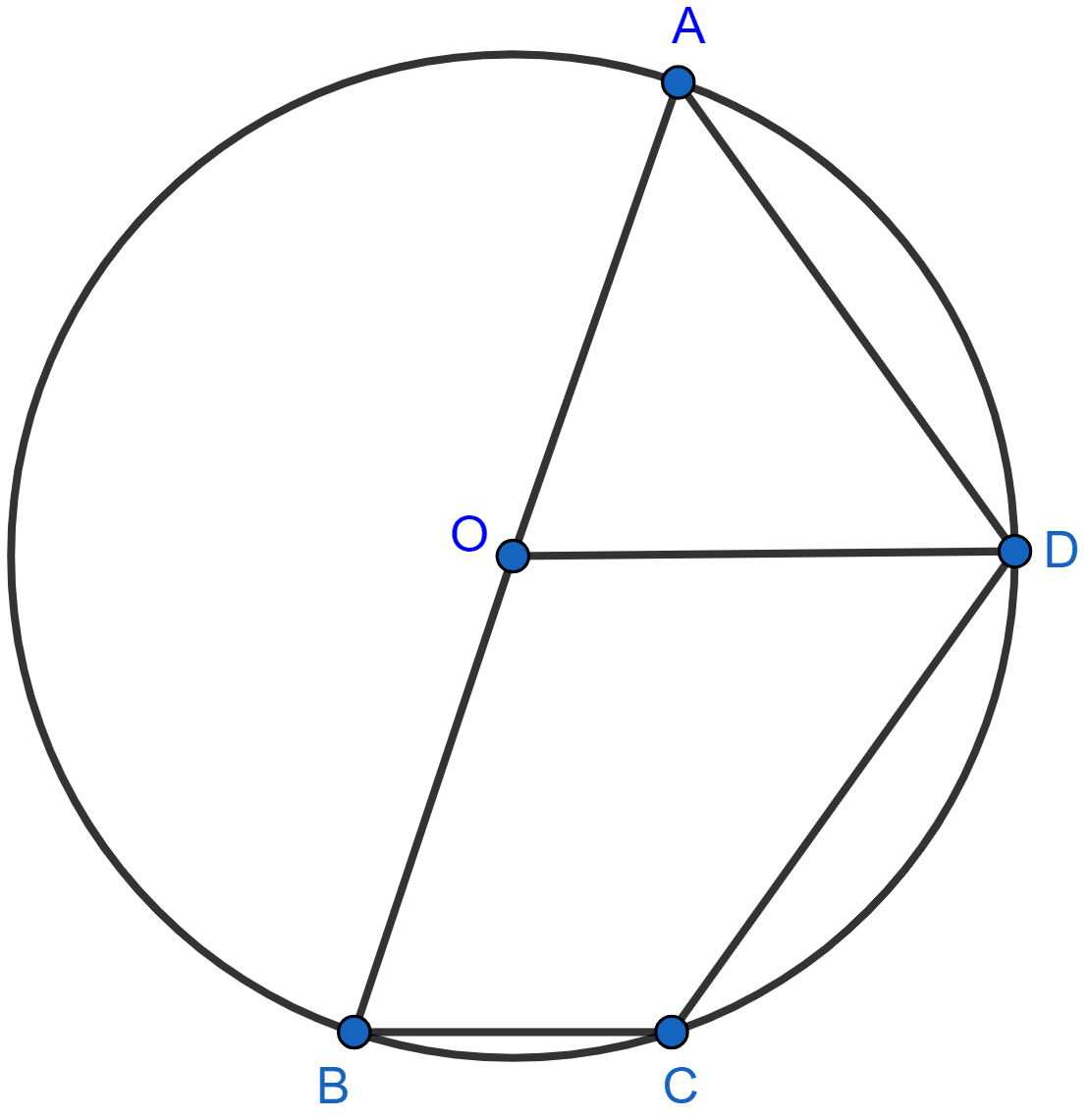
AB is the diameter of the circle with center O. OD is parallel to BC and ∠AOD = 60°. Calculate the numerical values of :
(i) ∠ABD,
(ii) ∠DBC,
(iii) ∠ADC.
Answer
Join BD.
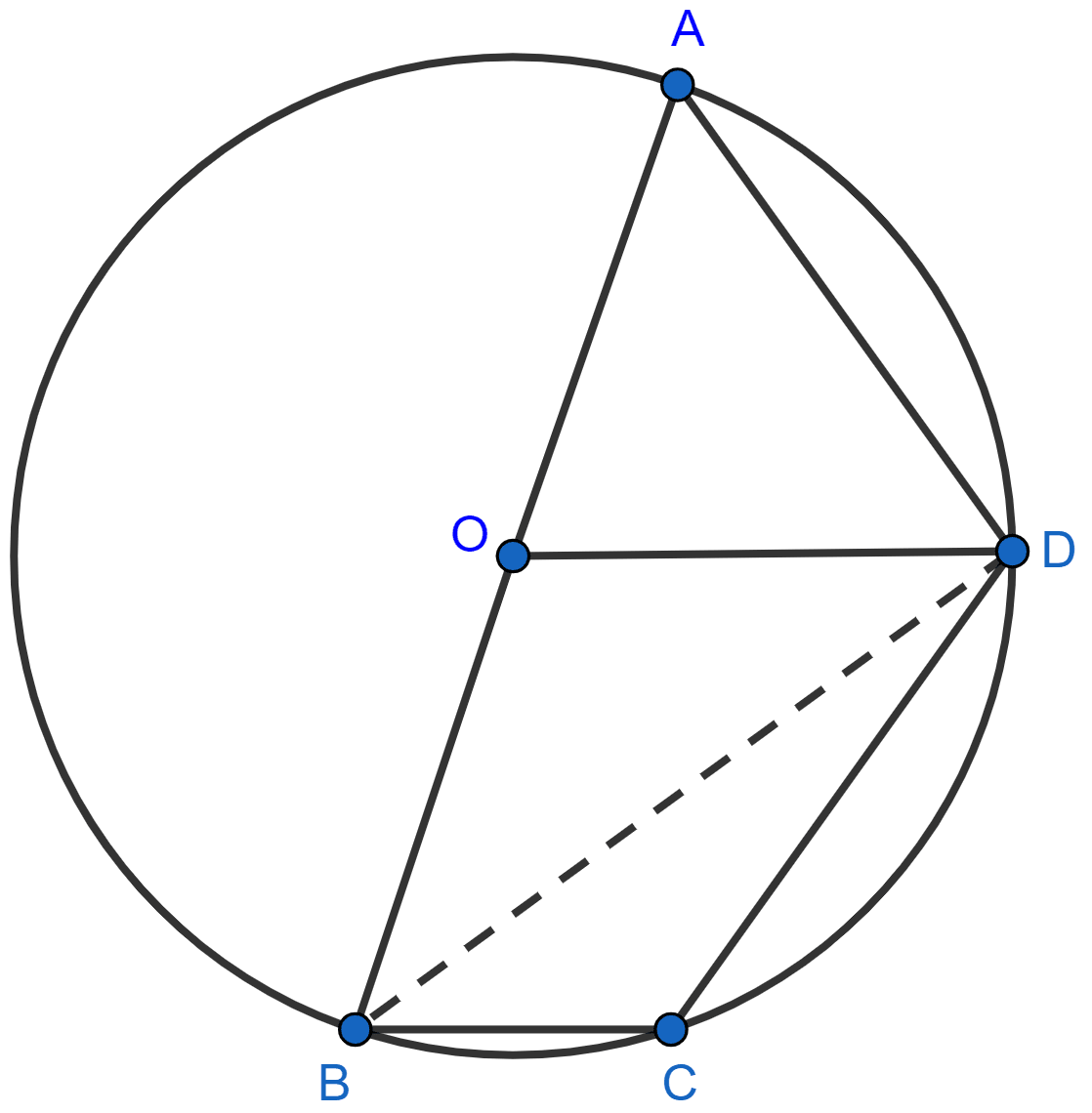
(i) From figure,
⇒ ∠BDA = 90° [Angle in semi-circle is a right angle.]
In △OAD,
OA = OD [Radius of same circle]
∠OAD = ∠ODA = x (let) [As angles opposite to equal side are equal]
In △OAD,
⇒ ∠OAD + ∠ODA + ∠AOD = 180° [Angle sum property of triangle]
⇒ x + x + 60° = 180°
⇒ 2x = 180° - 60°
⇒ 2x = 120°
⇒ x = = 60°.
From figure,
∠ODB = ∠BDA - ∠ADO = 90° - 60° = 30°.
Given, OD || BC
∠DBC = ∠ODB = 30° [Alternate angles are equal]
Hence, ∠DBC = 30°.
(ii) We know that,
Angle in a semi-circle is a right angle.
∴ ∠BDA = 90°.
Since,
∠OAD = ∠ODA = ∠AOD = 60°.
From figure,
⇒ ∠BDA = ∠ODA + ∠ODB
⇒ 90° = 60° + ∠ODB
⇒ ∠ODB = 90° - 60° = 30°.
Given,
OD || BC
∴ ∠DBC = ∠ODB = 30° [Alternate angles are equal].
Hence, ∠DBC = 30°.
(iii) From figure,
∠ABC = ∠ABD + ∠DBC = 30° + 30° = 60°.
Since, sum of opposite nagles in a cyclic quadrilateral = 180°.
∴ ∠ABC + ∠ADC = 180°
⇒ 60° + ∠ADC = 180°
⇒ ∠ADC = 120°.
Hence, ∠ADC = 120°.
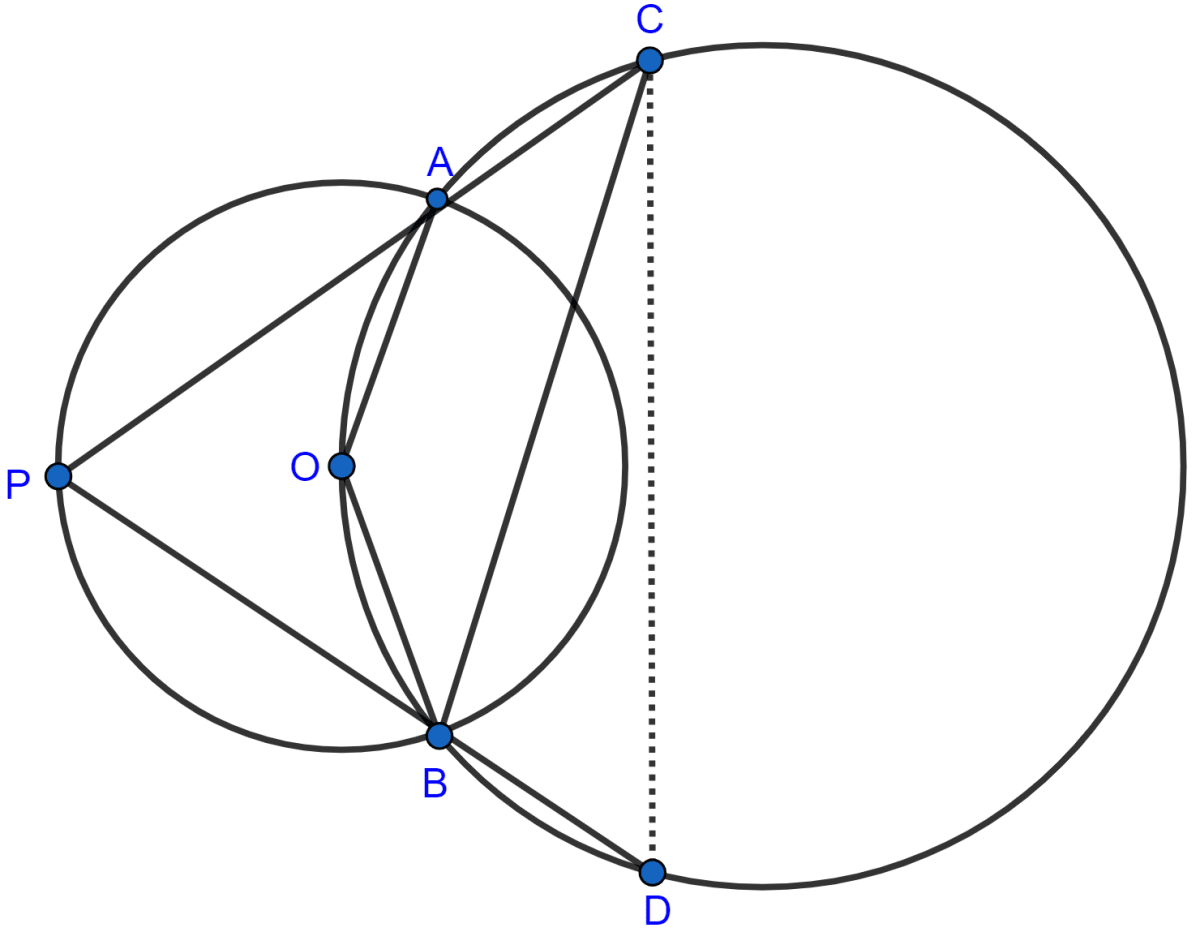
In the given figure, the center O of the small circle lies on the circumference of the bigger circle. If ∠APB = 75° and ∠BCD = 40°, find :
(i) ∠AOB,
(ii) ∠ACB,
(iii) ∠ABD,
(iv) ∠ADB.
Answer
Join AB and AD.
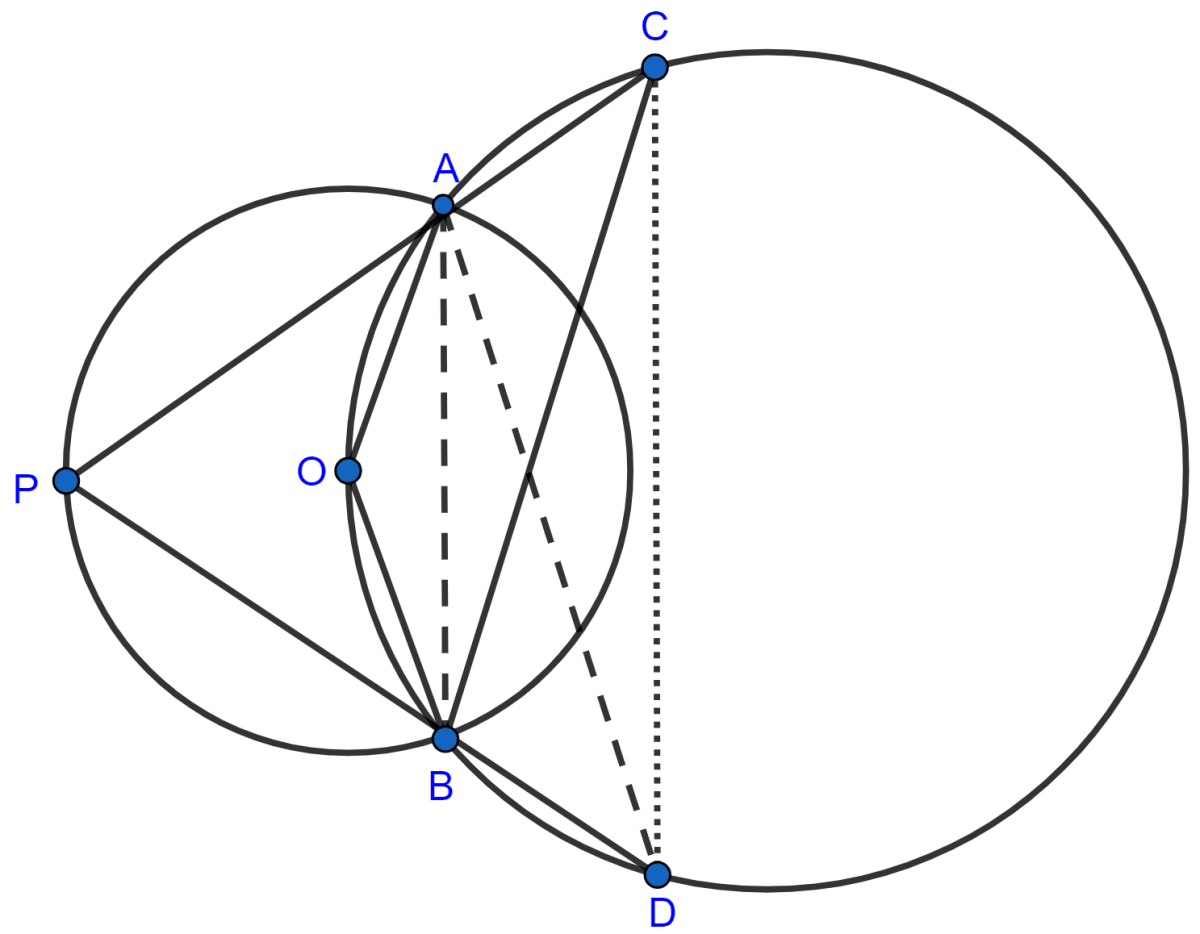
(i) We know that,
Angle which an arc subtends at the center is double that which it subtends at any point on the remaining part of the circumference.
∴ ∠AOB = 2∠APB = 2 × 75° = 150°.
Hence, ∠AOB = 150°.
(ii) We know that,
Sum of opposite angles in a cyclic quadrilateral = 180°.
∴ ∠ACB + ∠AOB = 180°
⇒ ∠ACB + 150° = 180°
⇒ ∠ACB = 180° - 150° = 30°.
Hence, ∠ACB = 30°.
(iii) From figure,
∠ACD = ∠ACB + ∠BCD = 30° + 40° = 70°.
We know that,
Sum of opposite angles in a cyclic quadrilateral = 180°.
In cyclic quadrilateral ABDC,
∴ ∠ABD + ∠ACD = 180°
⇒ ∠ABD + 70° = 180°
⇒ ∠ABD = 180° - 70° = 110°.
Hence, ∠ABD = 110°.
(iv) We know that,
Sum of opposite angles in a cyclic quadrilateral = 180°.
In cyclic quadrilateral AOBD,
∴ ∠ADB + ∠AOB = 180°
⇒ ∠ADB + 150° = 180°
⇒ ∠ADB = 180° - 150° = 30°.
Hence, ∠ADB = 30°.
In the given figure, ∠BAD = 65°, ∠ABD = 70° and ∠BDC = 45°. Find :
(i) ∠BCD
(ii) ∠ACB
Hence, show that AC is a diameter.

Answer
(i) We know that,
Sum of opposite angles in a cyclic quadrilateral = 180°.
In cyclic quadrilateral ABCD,
∴ ∠BCD + ∠BAD = 180°
⇒ ∠BCD + 65° = 180°
⇒ ∠BCD = 180° - 65° = 115°.
Hence, ∠BCD = 115°.
(ii) In △ABD,
⇒ ∠ADB + ∠BAD + ∠DBA = 180° [Angle sum property of triangle]
⇒ ∠ADB + 65° + 70° = 180°
⇒ ∠ADB + 135° = 180°
⇒ ∠ADB = 180° - 135° = 45°.
We know that,
Angles in same segment are equal.
∴ ∠ACB = ∠ADB = 45°.
Hence, ∠ADB = 45°.
From figure,
∠ADC = ∠ADB + ∠BDC = 45° + 45° = 90°.
Since, angle in a semi-circle is a right angle.
Hence, proved that AC is a diameter.