
Which of the following does the given picture depict?
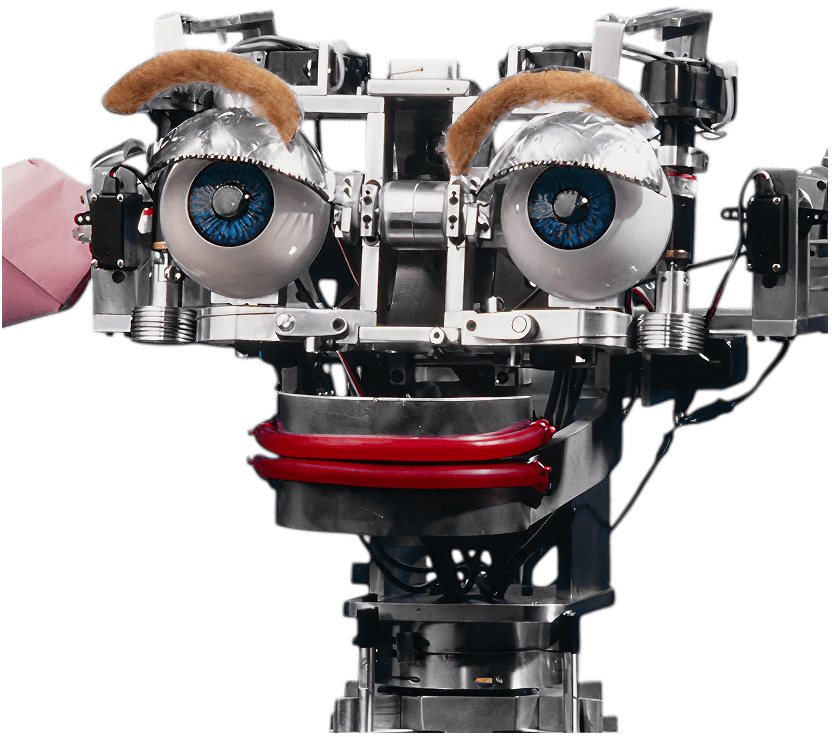
- Industrial Robot
- Mobile Robot
- Humanoid Robot
- None of these
Answer
Humanoid Robot
Reason — The picture depicts a humanoid robot, which is a robot designed to resemble humans and interact with them.
Which of the following are simple machine?
- Pulley
- Inclined Plane
- Lever
- All of these
Answer
All of these
Reason — The six simple machines include the wheel and axle, the lever, the inclined plane, the pulley, the screw and the wedge.
The word robota has been derived from the language ............... .
- Czech
- English
- French
- Chinese
Answer
Czech
Reason — The word robot derives from the Czech word “robota”, which means forced labour.
Cobot stands for ............... robot.
- collaborate
- collaborative
- collaboration
- cooperate
Answer
collaborative
Reason — A cobot stands for collaborative robot, which is also known as a companion robot. It is designed to work alongside humans in shared spaces.
Which of the following is not true for cobots?
- They are equipped with sensors.
- They allow safe human-robot interaction.
- They are capable of automating the repetitive tasks.
- They are comparatively costlier than traditional industrial robots.
Answer
They are comparatively costlier than traditional industrial robots.
Reason — Cobots are equipped with sensors, allow safe human-robot interaction, and are capable of automating repetitive tasks. They are also cost-effective and lower in cost than traditional industrial robots.
Which of the following is a cobot?
- Washing Machine
- Micro Oven
- iRobot
- Universal Robot (UR20)
Answer
Universal Robot (UR20)
Reason — UR20 is a welding cobot developed by Universal Robots. It is a collaborative robot designed to work alongside humans and is used for tasks such as palletising, welding and material handling. Washing machine and microwave oven are machines, while iRobot (Roomba) is an autonomous robot and not a cobot.
State whether the following statements are True or False:
- Machines are used to convert one form of energy into another.
- Robots are referred to as the programmable machines that can execute specific tasks with little or no human intervention.
- The cobots are autonomous machines to perform tasks independently.
- Robotics is an interdisciplinary field combining engineering, computer science along AI.
- Unimate is known as the first general-purpose mobile robot.
- Bajaj Auto became the first company in India to use collaborative robots (cobots) in their assembly line.
Answer
- True
- True
- False
Corrected Statement: Cobots are designed to collaborate and work alongside humans. Whereas, the robots are autonomous machines to perform tasks independently. - True
- False
Corrected Statement: Unimate became the first industrial robot, whereas Shakey is known as the first general-purpose mobile robot. - True
| Column A | Column B |
|---|---|
| Pulley | George Devol |
| Roomba | Cobot |
| Unimate | Machine |
| U20 | Karel Capek |
| Robot | Vacuum Cleaner |
Answer
| Column A | Column B |
|---|---|
| Pulley | Machine |
| Roomba | Vacuum Cleaner |
| Unimate | George Devol |
| U20 | Cobot |
| Robot | Karel Capek |
Assertion (A): Kismet is a robot which is derived from an Arabic word meaning fate or luck.
Reason (R): It is a humanoid robot designed to interact with humans through emotional expressions.
Based on the above discussion, choose an appropriate statement from the options given below:
- Both A and R are true and R is the correct explanation of A.
- Both A and R are true and R is not the correct explanation of A.
- A is true but R is false.
- A is false but R is true.
- Both A and R are false.
Answer
Both A and R are true and R is the correct explanation of A.
Reason — Kismet is a humanoid robot built in 1997 and its name is derived from an Arabic word meaning fate or luck. It is designed to interact with humans through emotional expressions, using a robotic face capable of conveying emotions such as happiness, sadness and surprise.
There are some cobots which are used for specific tasks in our daily life. Read these statements carefully and name the cobots used for these purposes. The statements given below:
(a) This cobot is a collaborative robot designed to assist in agricultural tasks, particularly in delicate crop handling.
(b) It is a cleaning cobot, designed to autonomously handle cleaning tasks in various environments, like offices and hospitals.
(c) It is a retail cobot, used in retail stores for tasks like stocking shelves, inventory management and assisting customers.
Answer
(a) Singrow
(b) Whiz
(c) Nova
Write short notes on Machine.
Answer
A machine is a device designed to perform a specific task or function by using energy to apply mechanical power. Machines can simplify tasks, increase efficiency as well as reduce the amount of human effort needed. They can range from simple tools like levers and pulleys to complex systems such as engines and computers.
Write short notes on Robot.
Answer
Robots are referred to as the programmable machines that can execute specific tasks with little or no human intervention. They typically have sensors, actuators and a control system that enables them to interact with their environment. They are assumed to be vital devices which can be used to replace human and human activities in near future.
Write short notes on Industrial Robot.
Answer
An industrial robot is a robot used in manufacturing industries to perform repetitive and hazardous tasks with precision and consistency. Unimate was the first industrial robot, invented by George Devol in 1954 and later used in the General Motors assembly line, which revolutionised industrial manufacturing by improving safety and efficiency.
Write short notes on Cobot.
Answer
A cobot stands for collaborative robot, which is also known as a companion robot. It is designed to work alongside humans in shared spaces, enhancing productivity and safety. Unlike traditional industrial robots, cobots have sensors and safety features allowing them to assist with tasks such as assembly, packaging and quality control without the need for extensive safety barriers.
Write short notes on Agricultural Cobot.
Answer
An agricultural cobot is a collaborative robot designed to assist in agricultural tasks, particularly in delicate crop handling. The Singrow cobot combines advanced sensors and AI for efficient and precise work, enabling safe interaction with humans. Its application optimises labour, enhances productivity and supports sustainable farming practices by reducing manual strain.
Write short notes on Retail Cobot.
Answer
A retail cobot is a collaborative robot used in retail stores for tasks like stocking shelves, inventory management and assisting customers. Nova is a retail cobot equipped with sensors and AI. It can navigate passages, scan products and provide information to shoppers, helping improve store efficiency and enhance customer experience.
What are the features of a machine?
Answer
The features of a machine are as follows:
- Machines are used to convert one form of energy into another, such as electrical energy into mechanical movement.
- They reduce the amount of manual effort and time required to perform tasks, often improving productivity.
- Machines allow users to apply less force to achieve greater work output (mechanical advantage), using principles like torque, leverage and hydraulics.
- They are designed for accuracy, allowing precise operations essential in fields like manufacturing and medicine.
- Advanced machines can operate autonomously or semi-autonomously, especially with programmed or AI-based systems.
Who coined the term 'Robot'? What does it mean?
Answer
The term "robot" was coined by the Czech writer Karel Capek in his 1920 play R.U.R. (Rossum’s Universal Robots).
The word robot derives from the Czech word "robota", which means forced labour.
How is 'Pick and Place' robot useful in present days?
Answer
The 'Pick and Place' robot is useful in present days as it is designed to pick up an object, swivel and place it elsewhere with precision. These robots are much faster and are ideal for rapidly inserting small components, such as in the manufacturing of computer chips and watches. Hence, they are widely used in modern manufacturing industries where speed and accuracy are required.
'Kismet' is a humanoid robot. In what ways, it is significant to us?
Answer
Kismet is significant because it was designed to interact with humans through emotional expressions. It has a robotic face capable of conveying a range of emotions, such as happiness, sadness and surprise. Using vision and auditory sensors, Kismet interprets human facial expressions and voice tones. Its primary purpose was to study human-robot interaction and emotional communication, which helped advance the understanding of how robots can engage with humans on an emotional and social level.
What are the characteristics of a robot?
Answer
The characteristics of a robot are as follows:
- Autonomy: Robots can function independently, performing tasks without constant human guidance.
- Sensing: They possess sensors to perceive their surroundings, allowing them to collect data and respond accordingly.
- Manipulation: Robots are capable of handling objects, whether it involves picking them up, moving them or executing intricate tasks.
- Mobility: Many robots can navigate their environment, utilising wheels, legs, or other locomotion mechanisms.
- Programmability: They can be programmed to execute various tasks and behaviours, granting them versatility in functionality.
- Precision: Robots are often engineered to carry out tasks with exactness and accuracy.
- Consistency: They can repeat tasks reliably and consistently, making them suitable for repetitive operations.
- Adaptability: Some robots can adjust to changes in their environment or tasks, either through predefined responses or learning algorithms.
- Safety: Safety measures are typically integrated into robots to ensure safe operation, minimising risks to themselves and others.
- Integration: Robots can be integrated with other systems and technologies, enabling collaboration with humans or other robots to accomplish complex objectives.
Why are Cobots considered more suitable for collaborative tasks?
Answer
Cobots are considered more suitable for collaborative tasks because they are designed to work alongside humans in shared spaces, enhancing productivity and safety. They are equipped with sensors and safety features that allow safe human-robot interaction without the need for extensive safety barriers. Cobots are also easy to program, flexible and adaptable, making them ideal for dynamic work environments.
What are the characteristics of a cobot?
Answer
Some characteristics of a cobot are:
- Safety: They are equipped with sensors and collision detection to prevent injury, allowing safe human-robot interaction.
- Ease of Use: They are equipped with simple interfaces. As a result, they enable the users to program the tasks without specialised knowledge.
- Flexibility and Adaptability: They are designed with lightweight and are adaptable. Thus, cobots can perform various tasks and easily shift between roles in dynamic environments.
- Productivity: They are capable of automating repetitive tasks. Thus, cobots improve efficiency and free up human workers from complex and creative tasks.
- Cost-Effective: These robots are lower in cost than traditional industrial robots and therefore making them accessible to small and medium-sized businesses.
How will you identify whether a given device is a robot or a machine?
Answer
To identify whether a given device is a machine or a robot, the following factors are considered:
- Autonomy: If the device can perform tasks on its own with minimal or no human intervention, it is likely a robot. Machines typically require direct human intervention.
- Decision-Making: Robots are often enabled with sensors and processing capabilities, allowing them to make decisions, adapt to changes and perform multiple tasks. Machines usually perform fixed, repetitive actions without any decision-making.
- Interaction with Environment: Robots are designed to interact dynamically with the environment, using sensors to adjust their actions. Machines typically do not sense or respond to environmental changes in real time.
- Complexity of Task: Robots can handle complex or flexible tasks, like navigating spaces, manipulating objects or interacting with people. Machines usually perform simpler, single-purpose functions, such as drilling, grinding or moving objects in a fixed manner.
Mention any three applications of a cobot to our daily life.
Answer
Any three applications of a cobot in our daily life are:
- Agriculture: Cobots are used for agricultural tasks such as delicate crop handling, helping to optimise labour and enhance productivity.
- Cleaning: Cleaning cobots are designed to autonomously handle cleaning tasks in environments like offices, hospitals and industrial spaces.
- Retail: Retail cobots are used for stocking shelves, inventory management and assisting customers in retail stores.
Distinguish between Machine and Robot.
Answer
| Machine | Robot |
|---|---|
| A machine needs inputs to perform the tasks. | Robots are often programmed or AI-driven autonomy, enabling them to perform tasks independently. |
| Machines require constant human supervision to ensure their operations well. | Robots are automated through programmable instructions unless some bugs enter in the programmed instructions. |
| Machines usually perform single or limited functions. | They are complex system capable of multitasking and interacting with the environment through sensors and control systems. |
| Machines generally follow fixed mechanical operations without any form of intelligence or adaptive behaviour. | Robots are designed to process information, make decisions and can often reprogram them to a new situation. |
| Machines usually stay in one place and cannot move much. | Robots can move their parts all around to do their tasks. |
Distinguish between Robot and Cobot.
Answer
| Robot | Cobot |
|---|---|
| Robots are autonomous machines to perform tasks independently. | They are designed to collaborate and work alongside humans. |
| They are suited for high-speed repetitive tasks in large-scale industrial processes. | They are versatile for small-scale tasks and ideal for dynamic workspaces. |
| They require specialised programming and often needed skilled technicians. | They are designed for easy programming and often making them accessible for non-experts. |
| They typically require cages or safety enclosures to separate them from human workers due to higher speed and force. | They are built with safety features like force-limiting, sensors and collision detection to operate safely alongside humans without barriers. |