Which type of actuator does this picture depict?
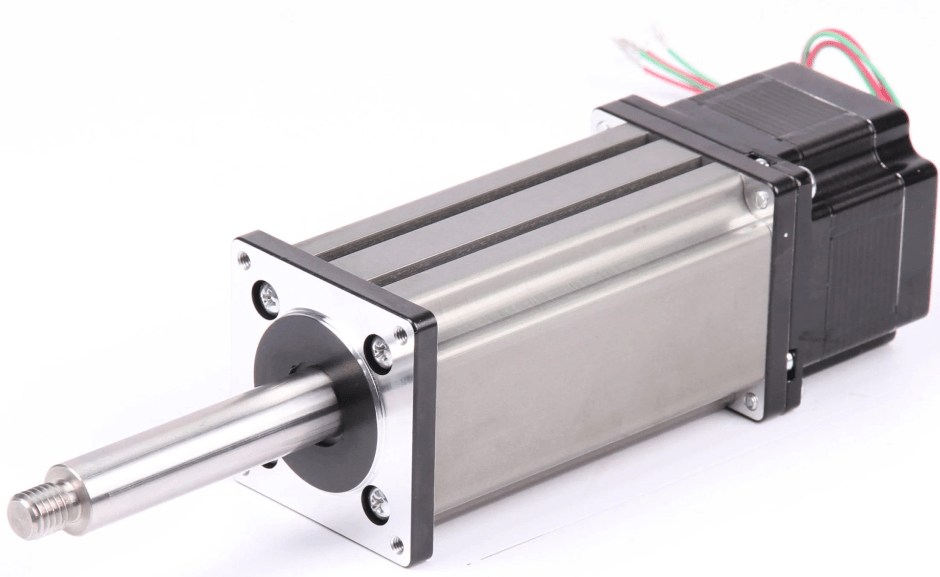
- Linear
- Direct
- Rotatory
- Indirect
Answer
Linear
Reason — The picture depicts a linear actuator which converts energy into straight-line motion. It is ideal for tasks requiring precise and linear movements.
Which of the following is not the part of a robot?
- Gears
- Sensors
- Actuators
- Punctuators
Answer
Punctuators
Reason — Gears, sensors and actuators are essential components used in the construction and functioning of a robotic system, whereas punctuators are not used as components of robots.
Which of the following consists non-parallel and non-intersecting gears?
- Spur gears
- Helical gears
- Worm gears
- None of these
Answer
Worm gears
Reason — Worm gears are used to transmit power between non-parallel and non-intersecting shafts, which distinguishes them from spur and helical gears that work on parallel shafts.
In which of the following machines, gear ratio is applicable?
- Bicycles
- Vehicles
- Industrial devices
- All of these
Answer
All of these
Reason — Gear ratio is used in bicycles, vehicles and industrial devices to control speed and torque for efficient power transmission.
In a robot, the vision sensor acts as a/an ............... .
- ear
- eye
- arm
- hand
Answer
eye
Reason — In a robot, a vision sensor functions like an eye by capturing and processing visual information from its surroundings, enabling the robot to detect objects, track movement and make decisions based on visual input.
Which of the following statements hold true for GPS?
- It is a space-based radio navigation system.
- It comprises satellites that emit navigational signals.
- It is supported by control and ground monitoring stations.
- All of these
Answer
All of these
Reason — GPS is a space-based radio navigation system that consists of satellites emitting navigational signals and is supported by control and ground monitoring stations, therefore all the given statements are correct.
Which of following type of sensor is used to measure the rate of change in velocity?
- Force sensor
- Position sensor
- Acceleration sensor
- Velocity sensor
Answer
Acceleration sensor
Reason — An acceleration sensor is used to measure the rate of change in velocity, indicating whether the speed of a robot is increasing or decreasing.
............... actuators use compressed air to create motion in robotics to perform the tasks.
- Pneumatic
- Electric
- Hydraulic
- Rotatory
Answer
Pneumatic
Reason — Pneumatic actuators use compressed air to create motion and are commonly used in robotics for performing various tasks due to their simple and reliable operation.
Fill in the blanks:
- Gear teeth are also known as cogs which has been derived from the term ................ .
- ................ teeth refer to the interlocking of gear teeth to transmit motion and power effectively.
- ................ gears are one of the most commonly used gears to transmit power between parallel shafts, with teeth aligned parallel to the shaft axis.
- In robotics, electric actuators are the commonly used actuators which convert electric energy into ................ motion.
- The controller serves as the ................ of a robot which helps in processing and executes programmed commands.
- In ................ systems, the users select fan speeds ie., low, medium, high with the help of a regulator.
- ................ actuators are the actuators that generate motion by using pressurised fluid.
- In robotics, ................ control system uses technology and machines to complete the tasks.
Answer
- Gear teeth are also known as cogs which has been derived from the term cogwheel.
- Meshing teeth refer to the interlocking of gear teeth to transmit motion and power effectively.
- Spur gears are one of the most commonly used gears to transmit power between parallel shafts, with teeth aligned parallel to the shaft axis.
- In robotics, electric actuators are the commonly used actuators which convert electric energy into mechanical motion.
- The controller serves as the brain of a robot which helps in processing and executes programmed commands.
- In manual systems, the users select fan speeds ie., low, medium, high with the help of a regulator.
- Hydraulic actuators are the actuators that generate motion by using pressurised fluid.
- In robotics, automatic control system uses technology and machines to complete the tasks.
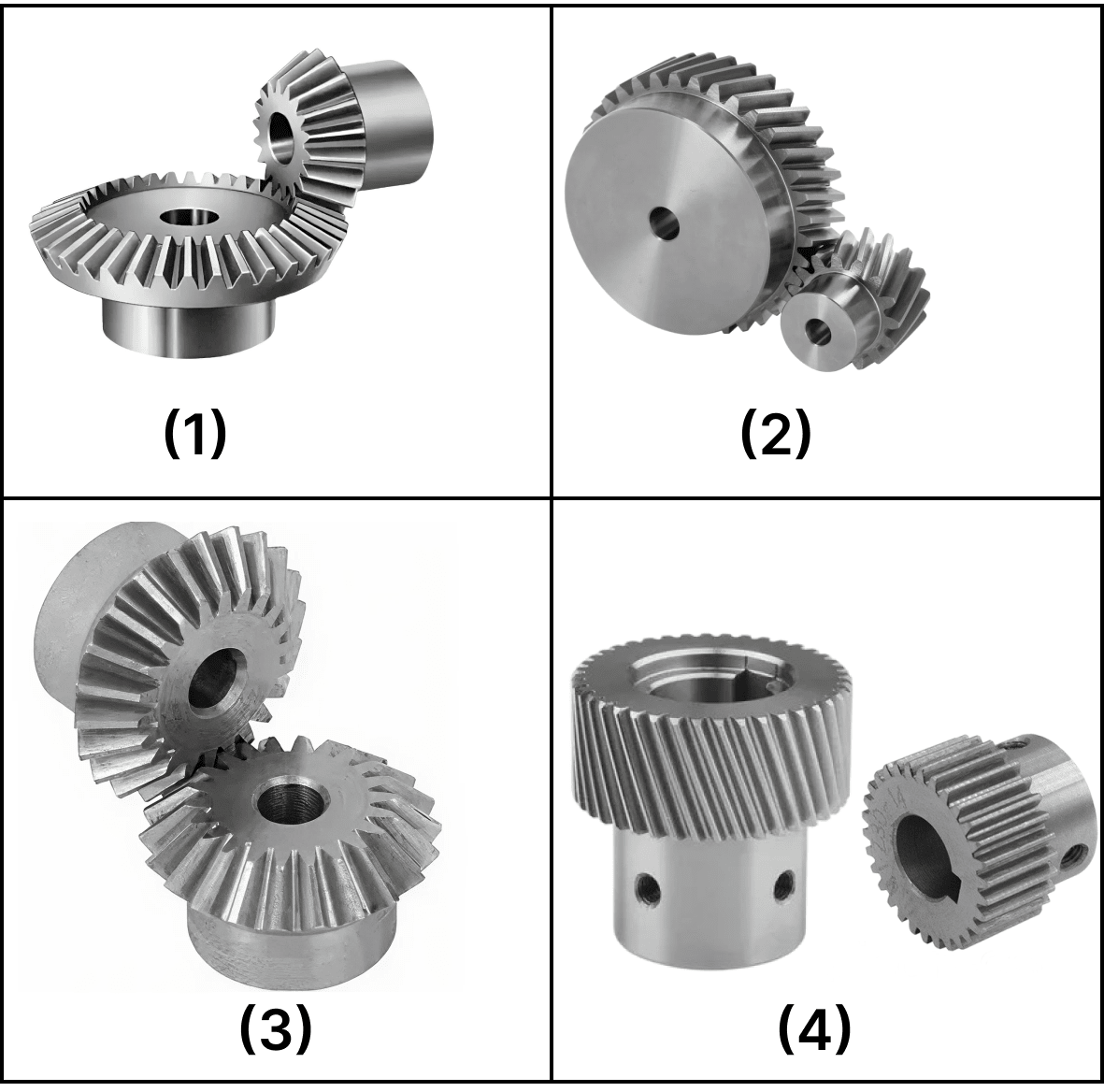
Answer
- Bevel gear
- Spur gear
- Miter gear
- Helical gear
Assertion (A): An automatic control system operates independently with the help of a controller.
Reason (R): It means that this control system requires continuous human intervention and decision-making to perform the desired tasks.
Based on the above discussion, choose an appropriate statement from the options given below:
- Both A and R are true and R is the correct explanation of A.
- Both A and R are true and R is not the correct explanation of A.
- A is true but R is false.
- A is false but R is true.
- Both A and R are false.
Answer
A is true but R is false.
Reason — An automatic control system operates independently with the help of a controller, without requiring human intervention. However, the reason statement is incorrect because continuous human intervention is a feature of a manual control system, not an automatic one.
The seamless integration of sensors, actuators and controllers is essential for an effective robotic system. It maintains precision and operate autonomously, with the controller managing complex interactions between sensors and actuators in real time. Each of these components has its own role in a robotics system.
Read the following statements and identify the components used in a robotic system.
(a) It provides input by detecting environmental conditions (like temperature, distance or pressure) or internal states (such as position or speed), sending this information to the controller.
(b) It acts as the brain of the system and after processing sensor data, makes decisions based on programmed algorithms. It determines the necessary actions for the robot to perform tasks accurately.
(c) Finally, it executes the actions and converting electrical signals from the controller into mechanical movement, such as turning a wheel, moving a robotic arm or gripping an object.
Answer
(a) Sensors
(b) Controller
(c) Actuators
Write short notes on Spur Gears.
Answer
Spur gears are one of the most commonly used gears to transmit power between parallel shafts, with teeth aligned parallel to the shaft axis. It results in radial reaction loads on the shaft without axial loads. As compared to helical gears, spur gears are comparatively noisier due to their single line of contact between teeth. As the teeth mesh, they roll off one contact and accelerate to the next.
Write short notes on Bevel Gears.
Answer
Bevel gears are primarily used to transfer power between shafts that intersect at a 90-degree angle, making them ideal for right-angle gear drives. The teeth of these gears are cut on conical surfaces. They can be either straight bevel gears or spiral bevel gears. Bevel gears are used to change the direction of rotation. Bevel gears tend to be more expensive and generally transmit less torque per size compared to parallel shaft arrangements.
Write short notes on Miter Gears.
Answer
Miter gears are a specific type of bevel gear. They are used where two rotational axes intersect, typically at a 90-degree angle. Unlike other bevel gears, miter gears cannot change the speed, as both the gears in this pair have the same number of teeth, resulting in a 1:1 gear ratio. The primary function of these gears is to change the direction of transmission. Miter gears come in both straight-cut and spiral-cut forms, sharing the fundamental characteristics of bevel gears.
Write short notes on Tactile Sensor.
Answer
A tactile or fingertip force sensor measures forces generated during physical contact or pressure with the environment. This sensor mimics the human sense of touch, which responds to mechanical stimulation of the skin. Tactile sensors are widely used in robotics, computer hardware and security systems. A significant challenge in robotics is achieving finger dexterity, which limits the ability of conventional robotic systems to perform complex manual tasks effectively.
Write short notes on Proximity Sensor.
Answer
A proximity sensor detects the presence or absence of objects without physical contact. It includes infrared (IR) sensors, which emit infrared light and detect the reflected signal when an object is nearby, and ultrasonic sensors, which use sound waves to measure the distance to an object based on the time taken for the sound to bounce back. Proximity sensors are widely used in robots for navigation, obstacle detection and interaction with surroundings, enhancing operational safety.
Write short notes on Actuators.
Answer
An actuator is an integral part of a device or a machine which directs the device to perform physical actions such as moving, rotating or gripping, after processing the input received from the sensors. In robotics, actuators are essential to any robotic system and are powered by air, electricity or fluids. They enable movement ranging from basic joint rotations to complex tasks like walking or object handling. Without actuators, robots would lack the ability to move or perform tasks.
What is meant by Gears? Give two examples.
Answer
Gears are toothed mechanical components designed to transfer motion and power between parts of a machine. They work in matched pairs, where the teeth of each gear interlock to prevent slippage during power transmission. Gears can also change the direction of rotation, speed and torque depending on their design and size.
Examples:
- Spur gear
- Bevel gear
Explain the type of gear to be used to convert the rotatory motion into linear motion.
Answer
The rack and pinion mechanism is used to convert rotatory motion into linear motion. In this system, the pinion is a circular gear that engages with a flat, toothed component known as the rack. When the pinion rotates, its teeth mesh with those of the rack, causing the rack to move in a linear direction. This mechanism is commonly used where precise linear motion is required in robotic systems and machinery.
Enlist any five uses of gears in Robotics.
Answer
Five uses of gears in Robotics are:
- Power Transmission — Gears transmit power from the motor to various parts of the robot.
- Speed Reduction — By using gear ratios, the robots can reduce motor speed while increasing torque.
- Torque Amplification — Gears help to amplify torque that allow robots to lift and manipulate heavy objects with relative ease.
- Direction Change — Bevel gears and miter gears are used to change the direction of rotation.
- Linear Motion Conversion — Rack and pinion systems are used to convert rotational motion into linear motion.
Explain the role of gears in robotic systems.
Answer
Gears play an important role in robotic systems by transmitting motion and power from one component to another. They help in changing the speed, torque, and direction of motion, allowing the robot to move smoothly and perform tasks efficiently.
What is meant by Sensors? Explain with the reference to Robotics.
Answer
Sensors are devices that detect changes in physical conditions such as light, temperature, pressure, motion or distance and convert these changes into electrical signals.
In robotics, sensors act like the sense organs of a robot. They collect information from the robot’s surroundings or internal conditions and send it to the robot’s control unit (controller/brain). The controller uses this data to make decisions and control the robot’s actions.
Example: A proximity sensor helps a robot detect obstacles and avoid collisions, while a vision sensor (camera) helps in object recognition and accurate handling of objects.
Distinguish between Internal Sensors and External Sensors.
Answer
| Internal Sensors | External Sensors |
|---|---|
| Internal sensors are used to monitor and assess the internal state of the robot itself, ensuring smooth operation and effective control. | External sensors in robots are devices that detect environmental factors outside the robot. |
| These sensors provide feedback on mechanical and electrical functions within the robot. | These sensors enable robots to navigate, recognise objects and interact with surroundings. |
| They help in maintaining balance, stability and performance of the robot. | They help the robot to sense distance, detect objects and understand the environment. |
| Examples include position sensors, velocity sensors, acceleration sensors and force sensors. | Examples include cameras, LiDAR, ultrasonic sensors and infrared sensors. |
Distinguish between Hydraulic Actuators and Pneumatic Actuators.
Answer
| Hydraulic Actuators | Pneumatic Actuators |
|---|---|
| Hydraulic actuators generate motion by using pressurised fluid (oil). | Pneumatic actuators use compressed air to create motion. |
| They can deliver very high force, making them suitable for heavy-duty applications. | They provide lower force compared to hydraulic actuators and are used for lighter tasks. |
| They are commonly used in industrial and construction robotics where large forces are required. | They are lightweight, simple and cost-effective, suitable for repetitive movements. |
| They require more maintenance due to fluid handling systems. | They have fewer moving parts, making them easier to maintain. |
Distinguish between Automatic Control System and Manual Control System.
Answer
| Automatic Control System | Manual Control System |
|---|---|
| Automatic control system uses technology and machines to complete the tasks. | Manual control system involves human effort and relies on personal skills. |
| The processes are faster and more accurate. | The processes are comparatively slower and more error-prone. |
| It allows tasks to be performed without human intervention. | It requires continuous human intervention to perform tasks. |
| It uses sensors, processors and feedback loops to operate autonomously. | It is operated using external control devices like joysticks or levers. |
Mention any five functions of Sensors, applied in robots.
Answer
Five functions of sensors, applied in robots, are:
- Environmental Awareness — The sensors measure elements such as temperature, light, distance, chemical composition, enabling robots to interpret their surroundings and make informed choices.
- Robot Health Monitoring — The sensors keep a track of the internal conditions of robots which help them in maintaining optimal performance.
- Informed Decision-Making — Sensors gather critical information to help robots to make informed decisions and perform tasks autonomously.
- Navigation and Pathfinding — The sensors help robots to map their surroundings to detect obstacles and choose safe and efficient routes.
- Collision Avoidance — By continuously monitoring nearby objects, the sensors allow robots to detect and avoid collisions, preventing damage.
What is the role of actuators in Robotics?
Answer
Actuators play a critical role in robotics as they allow the robots to interact with their surroundings by converting energy into movement. They act as the driving force behind motion, responding to signals from a robot’s control system to produce physical actions such as turning a wheel or coordinating the complex motions of a multi-jointed robotic arm.
Beyond facilitating movement, actuators also enhance the ability of a robot to sense and adapt to its environment. They enable robots to carry out tasks ranging from simple actions to complex operations with accuracy and precision.
Enlist any five applications of actuators in daily life.
Answer
Five applications of actuators in daily life are:
- Automotive Systems — The actuators control various functions in cars like automatic windows, seat adjustments and fuel injection.
- Home Appliances — In appliances like washing machines and dishwashers, the actuators handle tasks like opening valves, rotating drums or controlling water flow.
- Smart Home Devices — The actuators power features in smart blinds, automated doors and other smart devices, improving convenience and security.
- Medical Devices — The actuators are precisely used in hospital beds, prosthetics and surgical tools to assist in precise movements and enhance patient comfort.
- Industrial Equipment — In factories, actuators are crucial in robotic arms and machinery for assembly, packaging and material handling.
Explain the function of Control System with the reference to Robotics.
Answer
- Monitoring: Control systems constantly monitor the system’s parameters such as speed, temperature and position to ensure they remain within the desired range.
- Decision-making: Based on the input from sensors or other feedback, the control system makes decisions to adjust or maintain specific conditions.
- Execution: The control system sends commands to the actuators or other components to adjust the system’s performance, such as moving a robotic arm or adjusting temperature.
- Feedback Loop: Control systems often use a feedback loop, where the output is fed back to the controller to ensure accurate performance and make necessary adjustments.
- Error Correction: If a deviation from the desired condition is detected, the system adjusts parameters to minimise errors and maintain optimal performance.
Explain the importance of integrating sensors, actuators and controllers in a robotic system.
Answer
Integrating sensors, controllers and actuators is essential for the proper functioning of a robotic system, as it ensures accurate response to real-time conditions.
- Sensors detect environmental or internal conditions (e.g., distance, temperature, speed) and send this information to the robot.
- The controller acts as the brain; it processes the sensor data and decides the required action using programmed instructions.
- Actuators act as the muscles; they convert the controller’s electrical signals into mechanical movement such as moving a wheel/arm or gripping an object.
Thus, this integration enables the robot to interact precisely with its environment, adapt to changes, and operate efficiently and autonomously.
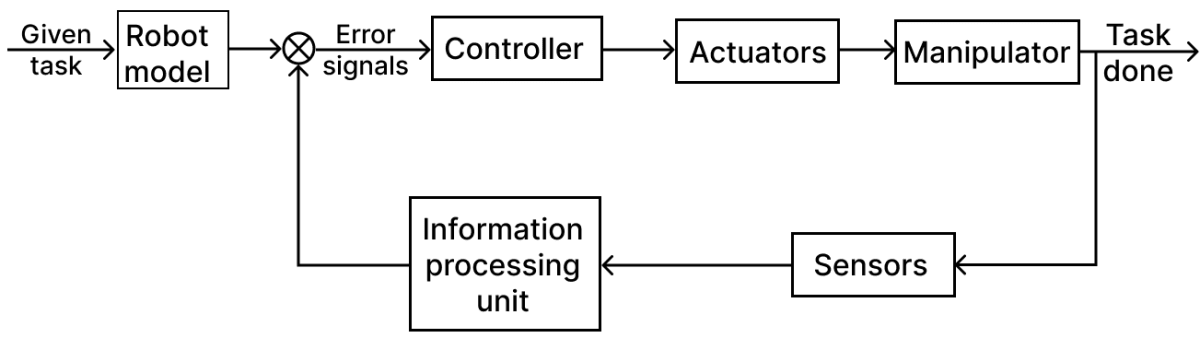
Draw a neat labelled diagram of a Control System used in Robotics.
Answer
Labelled diagram of a Control System used in Robotics is given below: