
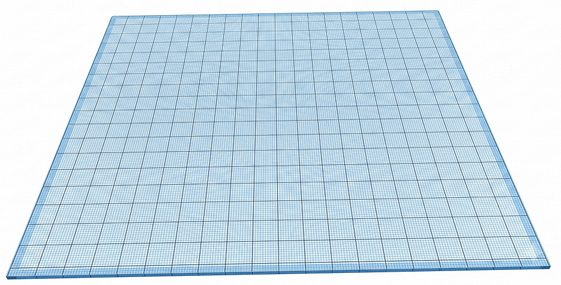
Which of the following components of Tinkercad is depicted in this image?
- Hardplane
- Softplane
- Workplane
- Solidplane
Answer
Workplane
Reason — The Workplane is the virtual workspace or grid where users create and manipulate 3D objects in Tinkercad. The image shows this grid-based working area used for placing, aligning, and designing 3D components.
Which of the following is not the components of a robot?
- Sensor
- Actuator
- Radiator
- Controller
Answer
Radiator
Reason — The components of a robot include sensors, actuators, and controllers, which are used for sensing the environment, performing actions, and directing operations. Radiator is not a component of a robot.
............... joint allows rotational movement in multiple directions around a single point.
- Spherical
- Knee
- Elbow
- None of these
Answer
Spherical
Reason — A spherical joint (also known as a ball-and-socket joint) allows rotational movement in multiple directions around a single point, providing greater freedom of motion.
Tinkercad is a user-friendly, web-based design and tool primarily used for ............... modelling.
- 1D
- 2D
- 3D
- 4D
Answer
3D
Reason — Tinkercad is a user-friendly, web-based design and modelling tool primarily used for 3D design, allowing users to create digital 3D models using simple shapes.
The ............... block provides the physical structure and movement for the robot.
- mechanical
- electrical
- electronic
- None of these
Answer
mechanical
Reason — The mechanical block provides the physical structure and movement for the robot by forming the overall mechanical structure that supports and integrates various components.
State whether the following statements are True or False:
- A spherical joint provides three degrees of freedom, enabling more complex and flexible motions.
- The sensor enables the execution of physical actions based on decisions made by the robot.
- The Workplane in Tinkercad is the virtual workspace or grid, where the users create and manipulate 3D objects.
- A prismatic joint is a hinge joint which allows links of a robot to rotate around a fixed axis.
- The RR mechanism in robotics is the Revolute-Revolute (RR) joint mechanism, where two joints in a robotic manipulator are rotational or revolute.
- Prismatic joint is ideal for tasks requiring direct forward or backward movements without rotating.
Answer
- True
- False
Corrected Statement: The actuator enables the execution of physical actions based on decisions made by the robot. - True
- False
Corrected Statement: A revolute joint is a hinge joint which allows links of a robot to rotate around a fixed axis. - True
- True
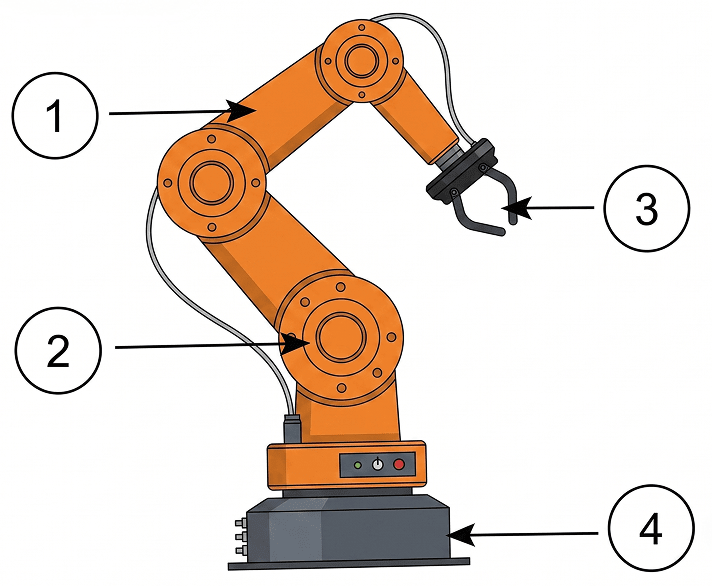
Name the components of 3D prototype of the given device.
Answer
- Arm
- Joint
- Grippers
- Base
Assertion (A): The mechanical block provides the physical structure and movement for the robot.
Reason (R): It provides a stable and rigid platform so that the various components can be mounted for its proper functioning.
Based on the above discussion, choose an appropriate statement from the options given below:
- Both A and R are true and R is the correct explanation of A.
- Both A and R are true and R is not the correct explanation of A.
- A is true but R is false.
- A is false but R is true.
- Both A and R are false.
Answer
Both A and R are true and R is the correct explanation of A.
Reason — The mechanical block provides the physical structure and movement for the robot and it provides a stable and rigid platform so that the various components can be mounted for its proper functioning.
Tinkercad is an intuitive drag-and-drop interface which allows the users to create complex 3D models easily. Using this interface, you can create various components of a robot. Read the following statements and identify the name of the components of a robot. They are given as under:
(a) The arms of a robot that can move in different directions.
(b) They are attached to the end of the robot’s arm to perform the tasks like gripping or picking up objects.
(c) It is known as the brain of a robot, which directs the actions of a robot.
(d) They provide the power of movement.
Answer
(a) Manipulators
(b) End effectors
(c) Controller
(d) Motors
Write short notes on Robotics.
Answer
Robotics is a branch of engineering and computer science focused on designing, building and operating robots. Its goal is to develop intelligent machines capable of assisting humans across various tasks and applications. It is an interdisciplinary field that combines engineering, electronics and computer science to create machines that can respond to their environment and perform tasks autonomously or semi-autonomously.
Write short notes on Prismatic Joint.
Answer
A prismatic joint is also known as a sliding or linear joint. It allows the links of a robot to move linearly along an axis without rotating. This type of joint changes the distance between connected parts and is used in applications that require precise positioning and extension, such as robotic arms, SCARA robots and automated material handling systems.
Write short notes on Revolute Joint.
Answer
A revolute joint is also known as a rotational or hinge joint. It allows links of a robot to rotate around a fixed axis. This type of joint provides angular movement, enabling rotational motion similar to a human elbow or knee. These joints are widely used in robotic arms, allowing rotation at the shoulder, elbow and wrist joints for tasks like welding, painting or assembly.
Write short notes on Spherical Joint.
Answer
A spherical joint is also known as a ball-and-socket joint, which allows rotational movement in multiple directions around a single point. This joint provides three degrees of freedom viz. pitch (up/down), yaw (left/right) and roll (rotation around the axis), enabling more complex and flexible motions.
Write short notes on Tinkercad.
Answer
Tinkercad is a user-friendly, web-based design and modelling tool primarily used for 3D design, electronics and coding projects. It is created by Autodesk and allows users to create digital models by combining simple geometric shapes, making it an ideal platform for beginners. It has an intuitive drag-and-drop interface that allows users to create complex 3D models easily.
Write short notes on RR Mechanism.
Answer
The RR mechanism in robotics refers to the Revolute-Revolute (RR) joint mechanism, where two joints in a robotic manipulator are rotational or revolute. Each joint can rotate independently about a fixed axis, giving the robot the ability to manoeuvre in two degrees of freedom (2-DOF) within a plane. This mechanism is commonly used in planar robotic arms for precise and repeatable positioning of the end effector.
What is the goal of Robotics?
Answer
The goal of robotics is to develop intelligent machines capable of assisting humans across various tasks and applications.
Name the following:
(a) Three components in Robotics
(b) Three building blocks in Robotics
Answer
(a) Three components in Robotics:
- Sensors
- Actuators
- Controller
(b) Three building blocks in Robotics:
- Mechanical Block
- Electronic Block
- Computational Block
Explain the purpose of the following components with reference to Robotics:
(a) Sensor
(b) Actuator
(c) Controller
Answer
(a) The sensor provides data and feedback to the controller of a robot.
(b) The actuator enables the execution of physical actions based on decisions made by the robot.
(c) The controller is known as the brain of a robot, which directs the actions of a robot.
What is meant by joints in Robotics? Give examples.
Answer
Joints are mechanical components that allow relative movement between different parts of a robot, such as links or arms. They enable motions like rotation, translation and bending, which are important for achieving flexibility and precision in tasks.
Examples:
- Prismatic Joint
- Revolute Joint
- Spherical Joint
What are the advantages of revolute joints in Robotics?
Answer
The advantages of revolute joints in robotics are:
- It enables a wide range of movements by allowing parts to rotate at different angles.
- It is versatile and essential for performing tasks that require rotational adjustments such as manipulating objects or changing orientation.
- It offers accurate control over the angle and speed of movement, allowing robots to perform tasks with high precision.
Explain the use of Tinkercad in designing robotic components.
Answer
Tinkercad is a user-friendly platform for designing robotic components. It allows users to create 3D models, simulate assemblies and test mechanical designs such as gears, joints, arms and end effectors. Thus, it provides a practical way to visualise and refine robotic components before making them physically.
Distinguish between revolute joints and spherical joints.
Answer
Differences between revolute joints and spherical joints are:
| Revolute Joint | Spherical Joint |
|---|---|
| A revolute joint is also known as a rotational or hinge joint. | A spherical joint is also known as a ball-and-socket joint. |
| It allows links of a robot to rotate around a fixed axis. | It allows rotational movement in multiple directions around a single point. |
| This type of joint provides angular movement, enabling rotational motion similar to a human elbow or knee. | This joint provides three degrees of freedom viz. pitch (up/down), yaw (left/right) and roll (rotation around the axis). |
| These joints are widely used in robotic arms for tasks like welding, painting or assembly. | These joints are used in humanoid robots, particularly at the shoulders and hips for complex movements. |
Explain the purpose of the following with reference to Tinkercad:
(a) Workplane
(b) Basic Shapes
Answer
(a) The Workplane in Tinkercad is the virtual workspace or grid where users create and manipulate 3D objects. It allows users to position, align and rotate shapes and models precisely, and acts as the foundation for building models in Tinkercad.
(b) In Tinkercad, Basic Shapes are pre-designed 3D objects that serve as foundational elements for creating more complex models. These shapes include simple geometric forms like boxes, cylinders, spheres, cones, wedges, as well as custom shapes like text, polygons and symbols.
What are the advantages of visualising motion using Tinkercad?
Answer
The advantages of visualising motion using Tinkercad are:
- It allows users to simulate motion in real time, making it easier to understand mechanical movements and design dynamics.
- The motion visualisation helps to detect design flaws during the development process and saves resources.
- It provides a hands-on way to grasp complex motion concepts intuitively for beginners.
- The visualisation ensures proper alignment and compatibility of moving components in the model.
- As a user-friendly platform, it enables motion visualisation without any advanced software or hardware.