
Name the following :
Two parts of a leaf allowing transpiration.
The instrument used to measure transpiration.
Time when stomata are open.
The special openings on the older stem for transpiration.
A thin layer of wax on the leaf.
Answer
Stomata and cuticle.
Potometer (Ganong's potometer).
During the day (in the presence of sunlight).
Lenticels.
Cuticle.
Write the functional activity against each of the following :
Leaf spines and ............... .
Lenticels and ............... .
Thick cuticle and ............... .
Stomata and ............... .
Answer
Leaf spines and reduced transpiration (protection).
Lenticels and lenticular transpiration.
Thick cuticle and reduced transpiration.
Stomata and stomatal transpiration (gaseous exchange).
Fill in the blanks with the appropriate option given below :
Transpiration is the ............... (loss/gain) of water from the aerial parts.
Major type of transpiration is ............... (lenticular/stomatal).
Transpiration rate is the ............... (lowest/highest) during summer.
Answer
Transpiration is the loss of water from the aerial parts.
Major type of transpiration is stomatal.
Transpiration rate is the highest during summer.
Which of the following is not a function of transpiration ?
- Cooling of leaves
- Uptake of water
- Intake of water
- Excretion of minerals
Answer
Excretion of minerals
Reason — Transpiration helps in cooling the leaves and creates a suction force that assists the uptake of water from the soil. Excretion of minerals is not a function of transpiration.
Which one of the following does not affect the rate of transpiration?
- Light
- Humidity
- Wind
- Age of the plant
Answer
Age of the plant
Reason — The rate of transpiration is affected by external factors such as light, humidity, wind and temperature, and by internal features of the leaf. The age of the plant is not a factor that affects the rate of transpiration.
Which of the following is an anti-transpirant?
- Auxin
- Gibberellin
- Abscisic acid
- Cytokinin
Answer
Abscisic acid
Reason — Abscisic acid (ABA) is a chemical substance used to reduce the rate of transpiration, hence it is an antitranspirant. Auxin, gibberellin and cytokinin are growth hormones.
Which adaptation is NOT associated with desert plants to minimise water loss through transpiration ?
- Reduced number of stomata
- Thick, waxy cuticle
- Deep root systems
- Increased leaf surface area
Answer
Increased leaf surface area
Reason — Desert plants have small or fewer leaves to reduce water loss. Increasing leaf surface area would cause more water to evaporate, so they do not have this adaptation.
Loss of water as droplets from hydathodes is called
- Transpiration
- Bleeding
- Guttation
- Evaporation
Answer
Guttation
Reason — Guttation is the loss of water in the form of liquid droplets from the margins of leaves through special pores called hydathodes.
Transpiration occurs
- more from the lower surface of a dicot leaf.
- more from the upper surface of a dicot leaf.
- equal from both the surfaces of dicot leaf.
- more from upper surface of a monocot leaf.
Answer
more from the lower surface of a dicot leaf.
Reason — In a dicot leaf, the stomata are more numerous on the lower (abaxial) surface than on the upper surface, so more transpiration occurs from the lower surface.
A paper used to demonstrate unequal transpiration in a dicot leaf is:
- Filter paper
- Litmus paper
- Starch paper
- Cobalt chloride paper
Answer
Cobalt chloride paper
Reason — Cobalt chloride paper turns from blue to pink when exposed to moisture. Hence, it is used to demonstrate unequal transpiration in a dicot leaf.
Which of the following is true ?
- Greater the thickness of cuticle, greater is the transpiration.
- Greater the number of lenticels, lesser is the transpiration.
- Lesser the number of lenticels, greater is the transpiration.
- Greater the thickness of cuticle, lesser is the transpiration.
Answer
Greater the thickness of cuticle, lesser is the transpiration.
Reason — The cuticle is a waxy layer that prevents evaporation of water from the leaf surface. The thicker the cuticle, the lesser is the loss of water by transpiration.
To demonstrate transpiration, which of the following is correct ?
- When pink cobalt chloride paper turns blue with moisture
- When litmus paper turns blue with moisture
- When blue cobalt chloride paper turns pink with moisture
- When blue cobalt chloride paper turns yellow with moisture
Answer
When blue cobalt chloride paper turns pink with moisture
Reason — Dry cobalt chloride paper is blue. When water vapour lost during transpiration reaches it, the paper absorbs the moisture and turns pink.
Assertion (A): Guttation occurs through the margins of the leaf.
Reason (R): Bleeding occurs through the injured parts of the plant
- Both (A) and (R) are true
- Both (A) and (R) are false
- Both (A) and (R) are true and (R) is the correct explanation of (A)
- Both (A) and (R) are true but (R) is not the correct explanation of (A)
Answer
Both (A) and (R) are true but (R) is not the correct explanation of (A)
Explanation — Guttation occurs through hydathodes present at the margins of the leaf, and bleeding occurs through the cut or injured parts of a plant. Both statements are true, but bleeding does not explain why guttation occurs, so (R) is not the correct explanation of (A).
Lenticels are found on
- Old stem
- Young and old stem
- Old stem and root
- Young root and old stem
Answer
Old stem
Reason — Lenticels are special openings that develop on the older woody stem in place of stomata and allow lenticular transpiration.
Transpiration is the loss of water from the surface of leaves in the form of vapours. It depends on several factors as listed below.
A. Light intensity B. Carbon dioxide concentration C. Wind velocity D. Temperature
Determine the factors that are directly proportional to the rate of transpiration.
- A and B
- A, C and D
- B and C
- B, C and D
Answer
A, C and D
Reason — Light intensity, wind velocity and temperature are all directly proportional to the rate of transpiration. An increase in carbon dioxide concentration causes stomata to close and thus decreases transpiration, so it is inversely related.
PMA is an antitranspirant. The full form of it is
- Phenyl Mercuric Agent
- Phenyl Mercuric Acetate
- Phenyl Mercuric Acid
- Paraphenyl Mercuric Acid
Answer
Phenyl Mercuric Acetate
Reason — PMA stands for Phenyl Mercuric Acetate, a chemical substance used to reduce the rate of transpiration.
Which of the following is not an antitranspirant?
- PMA
- ABA
- NAA
- Aspirin
Answer
NAA
Reason — PMA, ABA and aspirin are used to reduce the rate of transpiration and are antitranspirants. NAA (naphthalene acetic acid) is a growth-regulating auxin and is not an antitranspirant.
Permanently open structures seen on the barks of old woody stems:
- Stomata
- Hydathodes
- Lenticels
- Epidermal pores
Answer
Lenticels
Reason — Lenticels are the openings on the bark of old woody stems. They have no mechanism to open and close, so they remain permanently open.
Transpiration is useful to the plant because it:
- Creates a suction force for absorption of water from the soil
- Helps in Photophosphorylation
- Synthesises glucose
- Splits water molecules
Answer
Creates a suction force for absorption of water from the soil
Reason — Transpiration develops a suction force (transpirational pull) which helps in the ascent of sap and in the absorption of water from the soil through the roots.
Transpiration:
- It is the loss of water in the form of droplets from the aerial parts of the plant.
- It is the loss of water in the form of water vapour from the underground parts of the plant.
- It is the loss of water in the form of water vapour from the aerial parts of the plant.
- It is the loss of water in the form of water vapour from all parts of the plant.
Answer
It is the loss of water in the form of water vapour from the aerial parts of the plant.
Reason — Transpiration is the loss of water in the form of water vapour (not droplets) from the aerial parts of the plant, mainly the leaves.
Guard Cells:
- Around the root hairs
- Around the lenticels
- Around the thylakoids
- Around the stoma
Answer
Around the stoma
Reason — Each stoma is bordered by two kidney-shaped guard cells which regulate the opening and closing of the stoma.
Cuticle on leaves:
- Prevents photosynthesis
- Reduces transpiration
- Protects leaves from grazing animals
- Gives colour to leaves
Answer
Reduces transpiration
Reason — The cuticle is a waxy layer secreted by the epidermis. It prevents evaporation of water from the leaf surface and thus reduces transpiration.
Hydathodes:
- Transpiration
- Absorption of water
- Photosynthesis
- Guttation
Answer
Guttation
Reason — Hydathodes are special marginal pores of the leaf through which excess water oozes out as droplets during guttation.
A student uses a potometer to measure water uptake in a plant and observes a rapid movement of the air bubble in the capillary tube. What environmental factor is most likely responsible for this observation ?
- High soil moisture
- High humidity
- Low light intensity
- High temperature and low humidity
Answer
High temperature and low humidity
Reason — High temperature and low humidity both increase the rate of transpiration, so more water is taken up and the air bubble moves rapidly.
In an experiment with two plants, one is placed in sunlight and the other in shade. Cobalt chloride paper is used to detect moisture around the plants. After one hour, which outcome is most likely observed ?
- The paper turns pink faster around the plant in shade due to high transpiration.
- The paper around both plants turns pink at the same rate.
- The paper turns pink faster around the plant in sunlight due to higher transpiration.
- The paper will not change colour near either plant.
Answer
The paper turns pink faster around the plant in sunlight due to higher transpiration.
Reason — Sunlight (light and higher temperature) increases the rate of transpiration, so more water vapour is released. Hence the cobalt chloride paper turns pink faster around the plant kept in sunlight.
In an experiment to measure transpiration using a potometer, an air bubble is introduced into the ............... (P) tube, and its movement reflects the rate of ............... (Q).
- P- side; Q- water absorption
- P- capillary; Q- water uptake
- P- main; Q- photosynthesis
- P- stomatal; Q- evaporation
Answer
P- capillary; Q- water uptake
Reason — In a potometer, the air bubble is introduced into the graduated capillary tube. As transpiration proceeds, a suction force pulls water and the bubble moves, and this movement reflects the rate of water uptake.
Name the following:
(i) Structure responsible for the regulation of the opening and closing of stomata.
(ii) The plant in which stomata are absent.
(iii) A plant with sunken stomata.
(iv) The openings on the barks of trees through which transpiration occurs.
(v) The loss of water from injured parts of a plant.
(vi) An apparatus that measures the rate of water uptake in a cut shoot due to transpiration.
(vii) The waxy layer on the upper epidermis of leaves meant to reduces transpiration.
Answer
(i) Guard cells.
(ii) Hydrilla.
(iii) Nerium.
(iv) Lenticels.
(v) Bleeding.
(vi) Potometer (Ganong's potometer).
(vii) Cuticle.
Mention if the following statements are true or false. If false, rewrite the sentence by changing only the words printed in bold face:
(i) Gaseous exchange occurs in all body cells.
(ii) Transpiration takes place only in aerial parts of the plants.
(iii) Moist cobalt chloride paper turns blue in colour.
(iv) The wall of guard cells towards stomata is thin.
(v) Most transpiration occurs during midday.
(vi) Voltmeter is an instrument used to measure the rate of transpiration.
Answer
(i) True.
(ii) True.
(iii) False.
Corrected statement — Moist cobalt chloride paper turns pink in colour.
(iv) False.
Corrected statement — The wall of guard cells towards stomata is thick.
(v) True.
(vi) False.
Corrected statement — Potometer is an instrument used to measure the rate of transpiration.
Define Transpiration.
Answer
Transpiration is the loss of water in the form of water vapour from the surface of the aerial parts (leaves and stem) of a plant.
Define guttation.
Answer
Guttation is the loss of water in the form of liquid droplets from the margins of leaves through hydathodes, when the root pressure is high and transpiration is low.
Define bleeding in plants.
Answer
Bleeding is the exudation (oozing out) of cell sap from the cut or injured parts of a plant due to root pressure.
Define root pressure.
Answer
Root pressure is the positive pressure that develops in the roots due to the active absorption of water, which helps to push water upward into the stem.
Differentiate between guttation and bleeding in plants.
Answer
Differences between guttation and bleeding in plants are:
| Guttation | Bleeding |
|---|---|
| It occurs from the margins of leaves through hydathodes in uninjured plants. | It occurs from any cut or injured part of a plant. |
| The exudate is mainly water with some dissolved mineral salts. | The exudate is mainly cell sap and sugars. |
| It occurs during early mornings or late nights. | It occurs at the time of injury. |
Differentiate between Transpiration and evaporation.
Answer
Differences between Transpiration and evaporation are:
| Transpiration | Evaporation |
|---|---|
| It is the loss of water in the form of vapour from the aerial parts of the plant. | It is the loss of water in the form of vapour from any free surface. |
| It is a physiological process. | It is a physical process. |
| It is controlled by osmosis and other physiological processes. | It is not controlled by osmosis or such processes. |
| It is a slow process. | It is a fast process. |
Differentiate between Transpiration and guttation.
Answer
Differences between Transpiration and guttation are:
| Transpiration | Guttation |
|---|---|
| It is the loss of water as water vapour from the aerial parts of the plant. | It is the loss of water as water droplets from the hydathodes of leaves. |
| Water is lost through stomata, lenticels and cuticle. | Water is lost through pores (hydathodes) present at the ends of veins. |
| It occurs in the presence of sunlight. | It occurs at night or in the early morning. |
| It has a cooling effect on the plant body. | It has no cooling effect on the plant. |
Differentiate between Stomatal transpiration and lenticular transpiration.
Answer
Differences between Stomatal transpiration and lenticular transpiration are:
| Stomatal transpiration | Lenticular transpiration |
|---|---|
| It occurs through the stomata of leaves. | It occurs through the lenticels of old woody stems. |
| It accounts for the maximum loss of water (about 90%). | It accounts for very little loss of water. |
| Stomata can open and close, being regulated by guard cells. | Lenticels remain permanently open and cannot close. |
Differentiate between Stoma and Stroma.
Answer
Differences between Stoma and Stroma are:
| Stoma | Stroma |
|---|---|
| It is a minute pore in the epidermis of leaves (and young stems). | It is the colourless ground matrix of a chloroplast. |
| It is bordered by two guard cells. | It surrounds the grana inside the chloroplast. |
| It is the site of transpiration and gaseous exchange. | It is the site of the dark reaction of photosynthesis. |
Write one main function of the following:
(i) Stomata
(ii) Hydathodes
(iii) Sunken stomata
(iv) Leaf spines
(v) Lenticels
Answer
(i) Stomata — allow transpiration and exchange of gases.
(ii) Hydathodes — allow guttation (exudation of water droplets).
(iii) Sunken stomata — reduce the rate of transpiration.
(iv) Leaf spines — reduce the surface area and thus reduce transpiration (also give protection).
(v) Lenticels — allow lenticular transpiration and exchange of gases.
Give reason — The rate of transpiration increases in hot and dry weather.
Answer
In hot weather the high temperature makes the water molecules evaporate faster, and in dry weather the low humidity keeps a steep water potential gradient between the leaf and the air. Both conditions increase the rate of transpiration.
Give reason — Water transpired is water absorbed.
Answer
The water lost by transpiration from the leaves sets up a suction force (transpirational pull) that draws water up through the xylem from the roots. Thus almost the same amount of water that is transpired is absorbed by the roots.
Give reason — In some xerophytes leaves are modified into spines.
Answer
Leaves are modified into spines to reduce the surface area exposed to the atmosphere. This greatly reduces the loss of water by transpiration in dry conditions.
Give reason — Antitranspirants can be used to keep cut flowers fresh for a long time.
Answer
Antitranspirants reduce the rate of transpiration. With less water lost, the cut flowers remain turgid and stay fresh for a longer time.
Give reason — Balsam plants wilt during midday even if the soil is well watered.
Answer
At midday the rate of transpiration exceeds the rate of absorption of water by the roots. As a result the cells lose their turgidity and the plant wilts, even when the soil has enough water. It recovers in the evening when transpiration slows down.
Give reason — The leaves of certain plants roll up on a bright sunny day.
Answer
On a bright sunny day the leaves roll up to reduce the exposed surface area of the leaf. This reduces the loss of water by transpiration.
Given below is an experiment to demonstrate the magnitude of transpiration in a dicot leaf. Read the information given below and fill in the blanks.
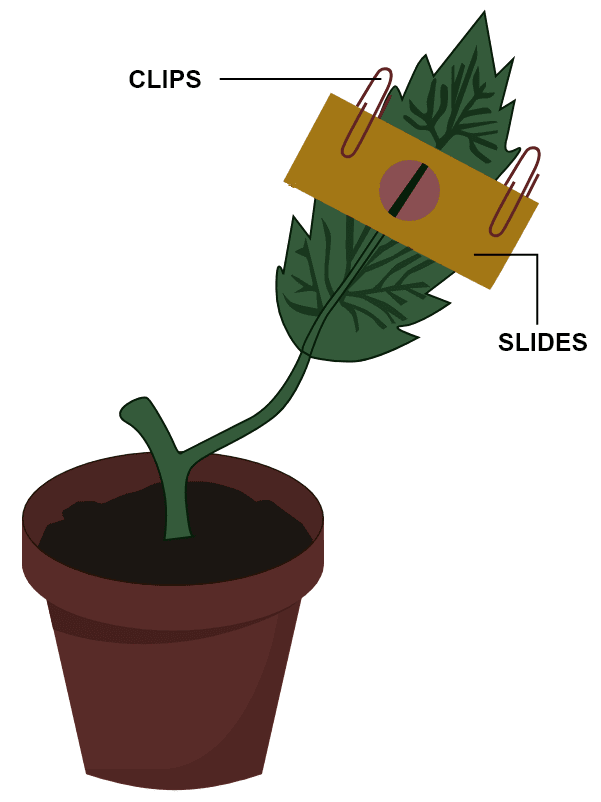
Transpiration is the process of loss of water as water vapour from the aerial parts of the plant. It is the essential driving force for the ascent of sap. Less than 1% of the water absorbed by the roots is used in photosynthesis and plant growth. The rest of the water is lost during transpiration.
Pieces of dried (a) ............... paper are fixed to the two surfaces of a leaf. The leaf should remain attached to the plant. The plant is exposed to bright sunlight for a few hours. The colour of the paper on the lower surface of the leaf turns (b) ............... faster than the one on the upper surface. This proves that more (c) ............... occurs from the (d) ............... surface of the leaf as it has a greater number of (e) ............... .
Answer
Pieces of dried (a) cobalt chloride paper are fixed to the two surfaces of a leaf. The leaf should remain attached to the plant. The plant is exposed to bright sunlight for a few hours. The colour of the paper on the lower surface of the leaf turns (b) pink faster than the one on the upper surface. This proves that more (c) transpiration occurs from the (d) lower surface of the leaf as it has a greater number of (e) stomata.
Given below is a picture of a tree. Mention the scientific phenomena occurring in the parts labelled (a), (b) and (c).
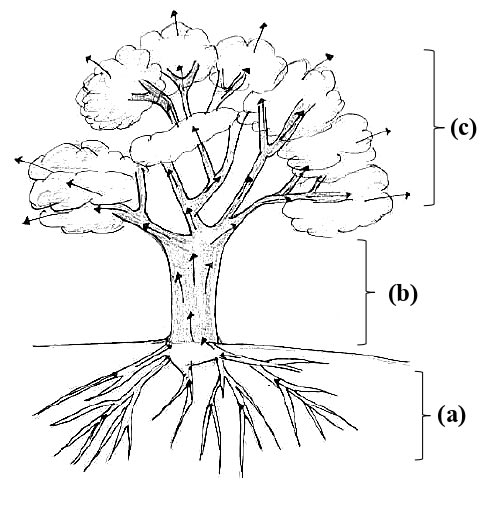
Answer
(a) Absorption of water
(b) Transportation of water
(c) Transpiration
Name the three types of transpiration. Which of these accounts for maximum transpiration in the plant?
Answer
The three types of transpiration are:
- Stomatal transpiration (through the stomata of leaves).
- Cuticular transpiration (through the cuticle of the leaf).
- Lenticular transpiration (through the lenticels of old stems).
Stomatal transpiration accounts for the maximum transpiration in the plant (about 90% of the total water loss).
Explain the potassium ion exchange theory for the stomatal transpiration.
Answer
According to the potassium ion exchange theory, the opening of stomata during the day takes place as follows:
- During the day, due to rapid photosynthesis, the concentration of CO2 in the guard cells decreases, so their pH increases.
- At this higher pH, the starch stored in the guard cells is converted into organic acid.
- The organic acid dissociates into H+ ions and malate ions in the guard cells.
- The H+ ions are actively transported (using ATP) into the neighbouring subsidiary cells in exchange for K+ ions.
- The uptake of K+ ions is balanced by the uptake of Cl- ions.
- The increased concentration of K+, malate and Cl- ions raises the osmotic pressure of the guard cells, so water enters them from the subsidiary cells by endosmosis.
- The guard cells become turgid, their outer thin walls bulge out and the inner thick walls are pulled apart, so the stoma opens and transpiration takes place.
What is an anti-transpirant? Name some anti-transpirants.
Answer
An antitranspirant is a chemical substance that is applied to a plant to reduce the rate of transpiration. Some antitranspirants are phenyl mercuric acetate (PMA), abscisic acid (ABA) and silicon emulsions.
Where are hydathodes located?
Answer
Hydathodes are located at the margins (tips) of the leaves, at the ends of the veins.
State any two adaptations in plants to reduce transpiration.
Answer
Two adaptations in plants to reduce transpiration are:
- Presence of sunken stomata covered with hair.
- Presence of a thick, waxy cuticle over the epidermis.
Name the structures through which transpiration and guttation occur in a plant.
Answer
Transpiration occurs through stomata, lenticels and cuticle, while guttation occurs through hydathodes.
How does transpiration help in the uptake of water from the soil?
Answer
Transpiration from the leaves creates a suction force called transpirational pull in the xylem. This pull draws water upwards through the xylem and thereby helps in the absorption and uptake of water from the soil by the roots.
Define wilting. Why do some plants show wilting of their leaves at noon even in well watered soil?
Answer
Wilting is the drooping and withering of the leaves and soft parts of a plant due to loss of turgidity when the water lost exceeds the water absorbed.
Some plants show wilting at noon even in well watered soil because at noon the rate of transpiration is very high and exceeds the rate of absorption of water by the roots. The cells therefore lose their turgidity and the leaves wilt. In the evening, when transpiration slows down, the water is made up by absorption and the leaves regain their turgidity.
How does the rate of transpiration differ when there is:
Answer
(i) High temperature — the rate of transpiration increases, because a higher temperature makes the water molecules evaporate faster.
(ii) High humidity — the rate of transpiration decreases, because the air is already moist and the water potential gradient between the leaf and the air is reduced.
Mention four disadvantages of transpiration to the plant.
Answer
Four disadvantages of transpiration to the plant are:
- Wilting — when water loss exceeds absorption, the cells become flaccid and the plant wilts.
- Stunted growth — excessive transpiration results in stunted growth of the plant.
- Abscission — shortage of water causes premature fall of leaves and delayed flowering.
- Energy expenditure — most of the absorbed water is lost in transpiration, so a lot of the energy spent by the plant is wasted.
The given below figure represents the vertical section of a leaf. Study the structure and answer the questions that follow:
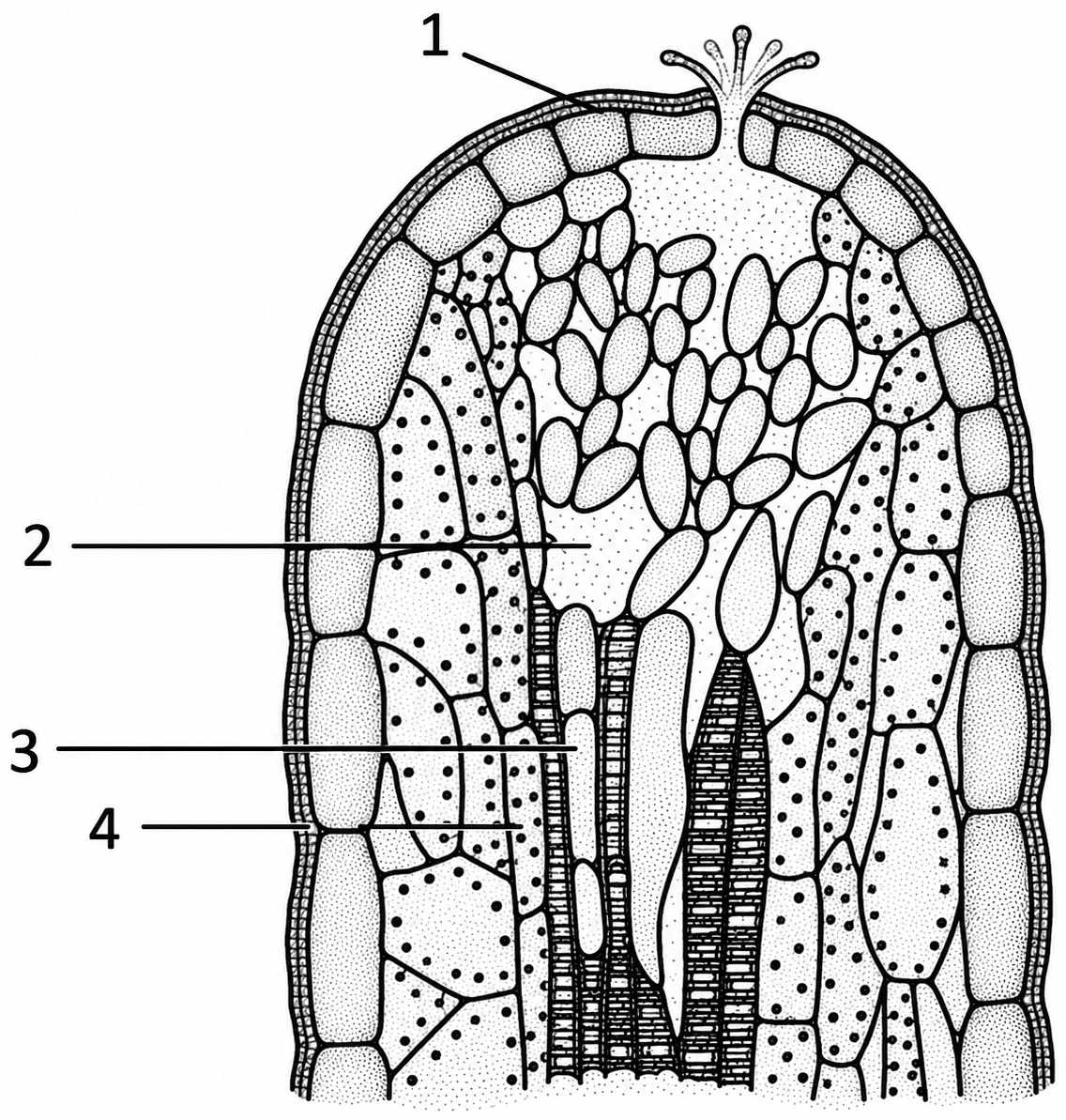
(i) Name the structure shown in the leaf section. (ii) Name the parts labelled 1 to 4. (iii) Explain the function of part labelled as 1.
Answer
(i) The structure shown is a hydathode (water stoma).
(ii) The parts labelled 1 to 4 are:
- Guard cell (water pore)
- Intercellular space
- Tracheids
- Chlorenchyma
(iii) Part labelled 1 is the guard cell bordering the water pore of the hydathode. This pore stays open and allows the excess water, along with dissolved mineral salts, to ooze out as droplets during guttation.
Navya is a high school biology student who recently visited a local farm as part of a school project. She observed water droplets on the leaves of certain plants early in the morning as shown in the figure.

(i) Name the process observed.
(ii) Explain the process mentioned in (i).
(iii) Give the reason for the occurrence of the above-mentioned process.
Answer
(i) Guttation
(ii) Guttation is the process by which water droplets are exuded from the edges or tips of leaves through special pores called hydathodes, usually during the early morning or at night.
(iii) Guttation occurs when root pressure is high and transpiration is low, especially at night, pushing out extra water through special pores called hydathodes.
The diagram given below represents a structure found in a leaf. Study the same and answer the questions that follow :
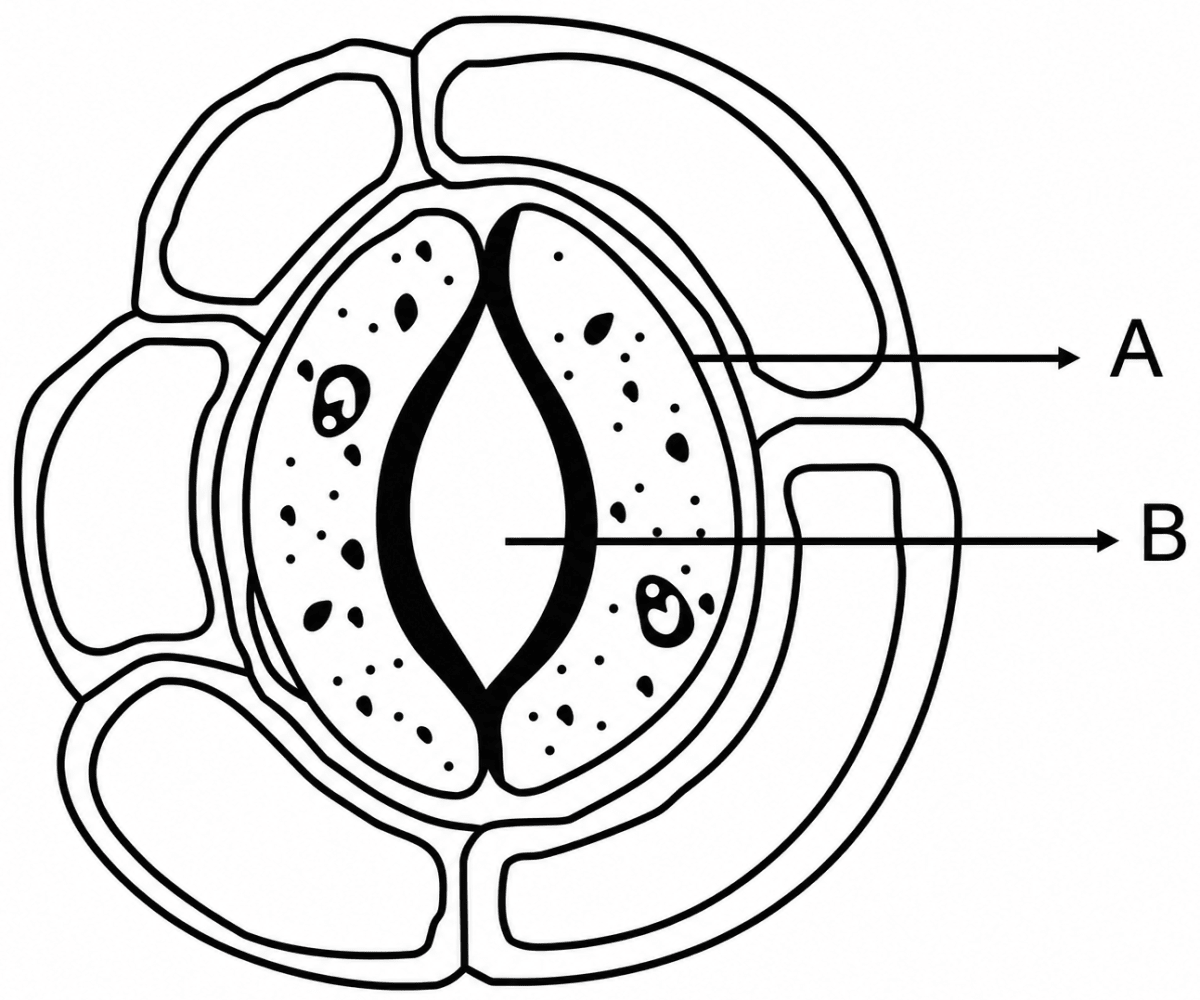
(i) Name the parts labelled A and B.
(ii) What is the biological term for the above structure?
(iii) What is the function of the part labelled A?
(iv) Mention two structural features of A, which help in the function mentioned in (iii) above.
(v) Where is this structure likely to be found in a leaf?
(vi) How does the above structure help the plant?
(vii) How many other cells are found surrounding this structure as seen in the diagram?
Answer
(i) A → Guard cell, B → Stoma (stomatal pore).
(ii) The biological term for the above structure is stomata (stoma).
(iii) The guard cell (A) regulates the opening and closing of the stoma.
(iv) Two structural features of A that help in this function are:
- The guard cells are kidney (bean) shaped.
- Their inner wall (bordering the stoma) is thick and inelastic, while the outer wall is thin and elastic, so a change in turgidity makes them bend and open or close the pore.
(v) This structure is found mainly on the lower (abaxial) surface of a dicot leaf, and on both surfaces of a monocot leaf.
(vi) The structure helps the plant by allowing transpiration (loss of water vapour) and the exchange of gases — intake of CO2 for photosynthesis and O2 for respiration.
(vii) As seen in the diagram, five epidermal (subsidiary) cells surround this structure.
The figure given below represents an experimental setup with a weighing machine to demonstrate a particular process in plants. The experimental setup was placed in bright sunlight. Study the diagram and answer the following questions:

(i) Name the process intended for study.
(ii) Define the above mentioned process.
(iii) What is observed when the weight of the test tube (A & B) is taken before and after the experiment? Give reasons to justify your observation in A & B.
(iv) What is the purpose of keeping the test tube B in the experimental setup?
Answer
(i) Transpiration.
(ii) Transpiration is the process in which water is lost in the form of vapour from the aerial parts of the plant.
(iii) The weight of test tube A is greater before the experiment than after the experiment. This is because the leafy shoot absorbs water from test tube A and loses it as water vapour by transpiration.
The weight of test tube B remains the same before and after the experiment because there is no plant to transpire, and the oil layer prevents direct evaporation of water.
(iv) It is a control experiment where the purpose of using test tube B is to compare the level of water in both test tubes.
Given below is the diagram of an experimental setup to study the process of Transpiration. Cobalt chloride papers are fixed on the upper as well as lower surface of the leaf. Answer the questions that follow:
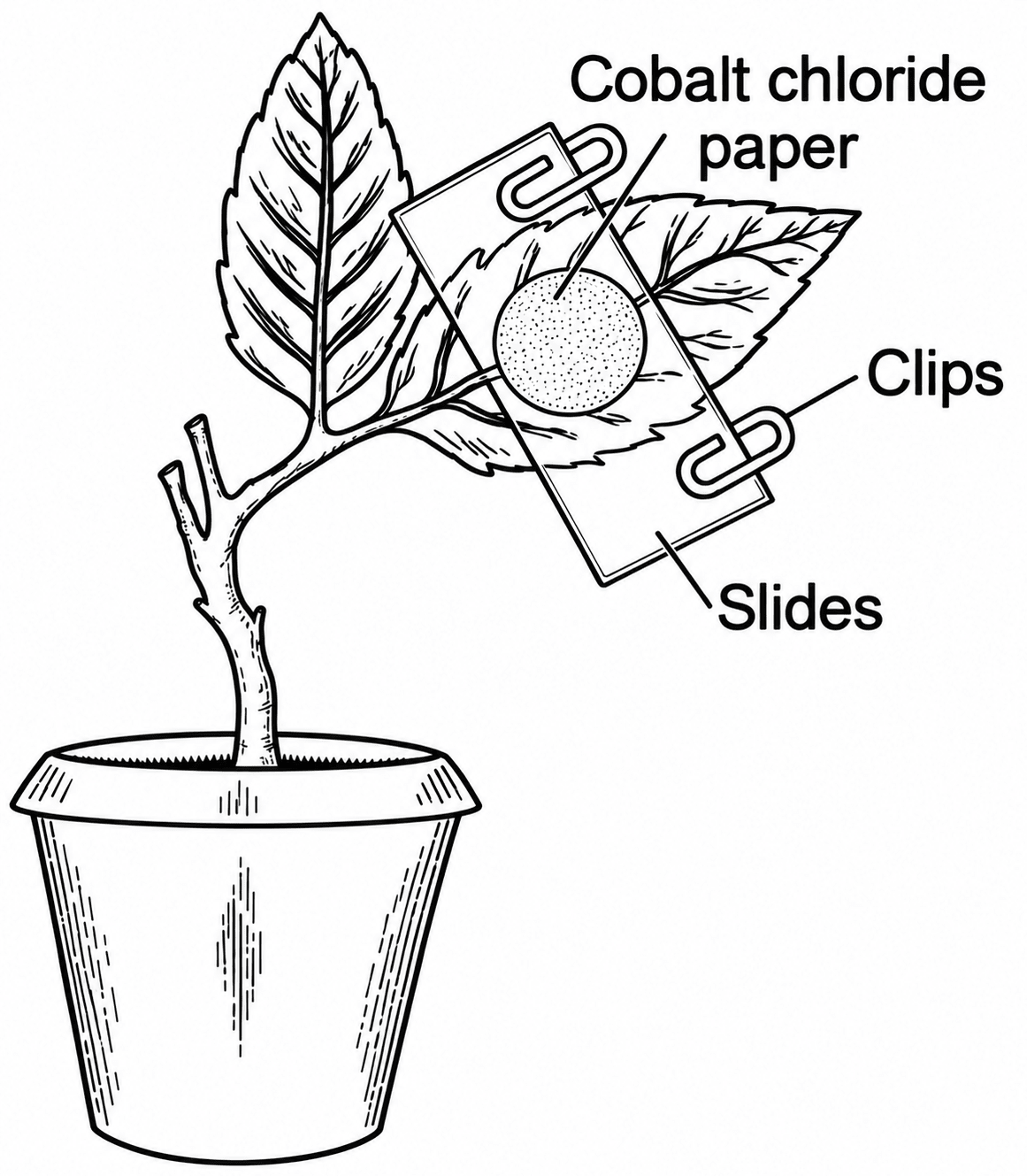
(i) What is the aim of the experiment?
- To prove that more transpiration occurs from the lower surface of a dicot leaf.
- To prove that more transpiration occurs from the upper surface of a dicot leaf.
- To prove that transpiration is equal on both sides of the leaf.
- To prove that transpiration does not take place in a dicot leaf.
(ii) What is the colour of dry cobalt chloride paper?
- Pink
- Blue
- Brown
- White
(iii) After about an hour, what change if any, would you expect to find in the cobalt chloride paper placed on the upper and lower surface of the leaf?
- Upper surface – Pink, Lower Surface – Blue.
- Upper surface – White, Lower surface – Blue.
- Upper surface – less pink, Lower surface – more pink.
- Upper surface – more pink, Lower surface – less pink.
(iv) Two adaptations in plants to reduce transpiration are :
- Narrow leaves, Thin cuticle.
- Fewer stomata, Broad lamina of leaves.
- Thin cuticle, Sunken stomata.
- Narrow leaves, Fewer stomata.
(v) The rate of transpiration is less when there is :
- High humidity in the air and low temperature.
- Less humidity in the air and decrease in atmospheric pressure.
- Bright sunlight and high temperature.
- More wind and low intensity of sunlight.
Answer
(i) To prove that more transpiration occurs from the lower surface of a dicot leaf.
Reason — In most dicot leaves, the lower surface has more stomata than the upper surface. Therefore, more water vapour is lost from the lower surface.
The upper surface has fewer stomata, so transpiration is less. Stomata are unevenly distributed in dicot leaves. Transpiration occurs continuously through the stomata and cuticle.
(ii) Blue.
Reason — Dry cobalt chloride paper is blue and turns pink when it absorbs moisture.
Cobalt chloride paper becomes pink only after absorbing water. brown is not the colour of cobalt chloride paper. Cobalt chloride paper is blue when dry, not white.
(iii) Upper surface – less pink, Lower surface – more pink.
Reason — The lower surface has more stomata, so it loses more water vapour. Hence, the cobalt chloride paper on the lower surface turns pink more rapidly.
The upper surface has fewer stomata and therefore loses less water. Cobalt chloride paper changes from blue to pink, not white.
(iv) Narrow leaves, Fewer stomata.
Reason — Narrow leaves reduce the exposed surface area, and fewer stomata reduce the number of openings for water loss, thereby decreasing transpiration.
Although narrow leaves reduce transpiration, a thin cuticle increases water loss. Broad leaf has a larger surface area, increasing transpiration. Sunken stomata reduce transpiration, but a thin cuticle increases water loss.
(v) High humidity in the air and low temperature.
Reason — High humidity reduces the diffusion gradient for water vapour, and low temperature slows evaporation. Both conditions decrease transpiration.
Low humidity increases transpiration by increasing the water vapour gradient. Bright sunlight and high temperature increase the rate of transpiration. Low light reduces transpiration, strong wind removes moist air around the leaf and increases transpiration.
The diagram of an apparatus given below demonstrates a particular process in plants. Study the same and answer the questions that follow:

(i) Name the apparatus.
(ii) Which phenomenon is demonstrated by this apparatus?
(iii) Explain the phenomenon mentioned in (ii) above.
(iv) State two limitations of using this apparatus.
(v) What is the importance of the air bubble in the experiment?
(vi) Name the structures in a plant through which the above process takes place.
Answer
(i) Ganong's Potometer
(ii) Transpiration
(iii) It is the loss of water as water vapour from the aerial parts of the plant.
(iv) Two limitations of using Ganong's Potometer are:
- Introducing the air bubble is not very easy.
- The twig may not remain fully alive for a long time.
(v) The movement of the air bubble indicates the volume of water taken up by the cut shoot in a given time. This water uptake is used to estimate the rate of transpiration.
(vi) Stomata, Lenticels, Cuticle.
Transpiration is useful in giving cooling effect, distribution of water, translocation of food and osmosis. Transpiration is affected by light, humidity, temperature of air, wind, soil, water and leaf structure.
Based on the above information, answer the questions given below:
(i) The waxy layer on the epidermis of the leaf is called
- Spongy parenchyma
- Cuticle
- Cambium
- Phloem
(ii) A plant in which stomata are absent, is
- Hydrilla
- Nerium
- Neem
- Lotus
(iii) A plant with sunken stomata, is
- Neem
- Banyan
- Nerium
- Croton
(iv) The structures on dark woody stem for transpiration are called
- Stomata
- Hydathods
- Root hairs
- Lenticels
(v) Loss of water as droplets from leaf margins is called
- Bleeding
- Guttation
- Transpiration
- Evaporation
Answer
(i) Cuticle
Reason — The cuticle is a thin, waxy layer covering the epidermis of leaves. It reduces water loss by transpiration and protects the leaf.
Spongy parenchyma is a tissue inside the leaf that helps in gaseous exchange and photosynthesis. Cambium is a meristematic tissue responsible for secondary growth in stems and roots. hPloem is a vascular tissue that transports food.
(ii) Hydrilla
Reason — Hydrilla is a submerged aquatic plant. Since it remains completely under water, gaseous exchange occurs directly through its surface, and stomata are absent.
Nerium is a xerophyte with sunken stomata to reduce transpiration. Neem is a terrestrial plant with stomata on its leaves. Lotus is a floating aquatic plant with stomata on the upper surface of its leaves.
(iii) Nerium
Reason — Nerium is a xerophytic plant. Its sunken stomata reduce water loss by transpiration.
Neem has normal stomata and is not a xerophyte with sunken stomata. Banyan is a mesophytic plant and does not possess sunken stomata. Croton has ordinary stomata and is not known for having sunken stomata.
(iv) Lenticels
Reason — Lenticels are permanently open pores present on old woody stems. They allow a small amount of transpiration and gaseous exchange.
Stomata are mainly present on leaves and young green stems. Hydathodes occur at the tips and margins of leaves and are involved in guttation. Root hairs absorb water and minerals from the soil.
(v) Guttation
Reason — Guttation is the loss of liquid water droplets from the tips or margins of leaves through hydathodes, usually when root pressure is high and transpiration is low.
Bleeding is the oozing of sap from a cut or injured part of a plant. Transpiration is the loss of water vapour, mainly through stomata, not liquid water droplets. Evaporation is the conversion of liquid water into water vapour from any exposed surface.
The diagram below represents a process in plants. The set up was placed in bright sunlight. Answer the following questions:

(i) Name the physiological process depicted in the diagram. Why was oil added to the water?
(ii) When placed in bright sunlight for four hours, what do you observe with regard to the initial and final weight of the plant? Give a suitable reason for your answer.
(iii) What happens to the level of water when this setup is placed in:
- Humid conditions?
- Windy conditions?
(iv) Mention any three adaptations found in plants to overcome the process mentioned in (i).
(v) Explain the term 'Guttation'
Answer
(i) Transpiration process is depicted in the diagram. Oil was added to the water in order to prevent the loss of water by evaporation.
(ii) When the setup is placed in bright sunlight for four hours, its final weight will be less than its initial weight because water is lost from the aerial parts of the plant by transpiration.
(iii) The level of water is affected as follows:
- Humid conditions — Slight or no drop in water level.
- Windy conditions — Drop in level of water in the jar as rate of transpiration increases.
(iv) Three adaptations found in plants to overcome transpiration are:
- Sunken stomata
- Narrow leaves
- Reduced exposed surface by rolling or folding of leaves.
(v) Loss of water in the form of droplets from the margins (hydathodes) of leaves is called guttation.
Given below is an apparatus which was set up to investigate a physiological process in plants. The setup was placed in bright sunlight. Answer the questions that follow:

(i) Name the process being studied. Define the process.
(ii) Why was the pot enclosed in a rubber sheet?
(iii) Mention two external factors which can accelerate the above process.
(iv) List two adaptations in plants to reduce the above process.
(v) Draw a neat, labelled diagram of a stomatal apparatus.
Answer
(i) The process being studied is Transpiration. Transpiration is the process during which water is lost in the form of water vapour through aerial parts of the plant.
(ii) The pot was enclosed in a rubber sheet to prevent evaporation of water from the soil.
(iii) Two external factors which can accelerate Transpiration are:
- Bright sunlight
- Low humidity
(iv) Two adaptations in plants to reduce the above process are:
- Sunken stomata
- Narrow leaves
(v) Stomatal apparatus is shown in the labelled diagram below:
