
Who among the following was not one of the founders of the Muslim League?
- Agha Khan
- Muhammad Ali Jinnah
- Nawab Waqar-ul-Mulk
- Nawab Mohasin-ul-Mulk
Answer
Muhammad Ali Jinnah
Reason — The Muslim League was founded in 1906 under the leadership of Agha Khan (Nawab of Dhaka), Nawab Waqar-ul-Mulk, and Nawab Mohsin-ul-Mulk.
Who among the following led the Aligarh Movement after the death of Syed Ahmad Khan in 1898?
- Nawab Mohsin-ul-Mulk
- Shaukat Ali
- Muhammad Ali Jinnah
- Rehman Ali
Answer
Nawab Mohsin-ul-Mulk
Reason — Nawab Mohsin-ul-Mulk led the Aligarh Movement after the death of Sir Syed Ahmad Khan in 1898, instilling in the Muslims a spirit of loyalty towards the British and keeping them away from the mainstream of Indian political life.
Name the Viceroy who was associated with the formation of the Muslim League.
- Lord Chelmsford
- Lord Minto
- Lord Hardinge
- Lord Ripon
Answer
Lord Minto
Reason — Lord Minto received the Muslim deputation led by Agha Khan on 1 October 1906 and committed himself to grant the Muslims separate electorates, thus becoming associated with the formation of the Muslim League.
Who among the following was successful to a great extent in keeping the Muslims away from the Hindus, the Congress and National Movement and in this way inciting communalism in India?
- Maulana Abul Kalam Azad
- Khan Abdul Ghaffar Khan
- Sir Syed Ahmad Khan
- Dr. M.A. Ansari
Answer
Sir Syed Ahmad Khan
Reason — Sir Syed Ahmad Khan advised the Muslims to remain away from the Hindus, the Congress and the National Movement and to support British Rule, thereby inciting communalism in India.
Muslim League was formed in 1906 at
- Karachi
- Dhaka
- Multan
- Lahore
Answer
Dhaka
Reason — a meeting of the Mohammedan Educational Conference was held at Dhaka in December 1906, where the Muslim League was founded.
In the question given below, there are two statements marked as Assertion (A) and Reason (R). Read the statements and choose the correct option.
Assertion (A) : Nawab Mohsin-ul-Mulk led the Aligarh movement after death of Sir Syed Ahmad Khan.
Reason (R) : The Aligarh Movement instilled into Muslims a spirit of loyalty towards the British and moved them away from freedom movement.
- Both Assertion (A) and Reason (R) are correct and Reason (R) is the correct explanation of Assertion (A).
- Both Assertion (A) and Reason (R) are correct but Reason (R) is not the correct explanation of Assertion (A).
- Assertion (A) is true, but Reason (R) is false.
- Assertion (A) is false, but Reason (R) is true.
Answer
Both Assertion (A) and Reason (R) are correct but Reason (R) is not the correct explanation of Assertion (A).
Explanation — Nawab Mohsin-ul-Mulk did lead the Aligarh Movement after the death of Sir Syed Ahmad Khan. The Aligarh Movement also aimed to instill loyalty towards the British Government and keep Muslims away from the mainstream of Indian political life. However, these aims do not explain why Nawab Mohsin-ul-Mulk became the leader of the movement.
Identify the reasons for the foundation of the Muslim League.
P : British policy of divide and rule after the Uprising of 1857.
Q : Rise of Radical Nationalism
R : Communal politics incited by M.A. Jinnah.
S : Rise in social status and economic prosperity of Muslims.
- P and Q
- Q and R
- R and S
- P and S
Answer
P and Q
Reason — the British policy of divide and rule after 1857 (P) and the rise of radical nationalism (Q) were among the factors that led to the foundation of the Muslim League. The League was not founded on communal politics incited by M.A. Jinnah (R), as he was not among its founders, and the Muslims suffered economic backwardness rather than a rise in prosperity (S).
Read the two statements given below regarding the aims of the Muslim League. Select the option that shows the correct relationship between (A) and (B).
(A) Promotion of the feelings of loyalty to the British Government.
(B) Prevention of rise of hostility towards other communities.
- (B) contradicts (A)
- (B) is the reason for (A)
- (A) is true but (B) is false
- (A) and (B) are independent of each other
Answer
(A) and (B) are independent of each other
Reason — Both statements were separate objectives of the Muslim League as stated at the time of its formation. Promoting loyalty to the British Government and preventing the growth of hostility towards other communities were independent aims; one was not intended to explain the other.
From the given list, identify the aims of the Muslim League.
- To train and organise public opinion of the Muslims in the country
- To promote friendly relations between nationalists political leaders.
- To promote among Muslims of India support for the British Government.
- To agitate through constitutional means.
Answer
To promote among Muslims of India support for the British Government.
Reason — One of the declared aims of the Muslim League was the promotion of the feelings of loyalty to the British Government; the other options were not among its objectives.
Which one of the following was NOT the objective of the Muslim League?
- To promote among Muslims of India, support for the British government
- To remove any misconceptions regarding the intention of the government
- To protect and advance the political rights and interests of the Muslims
- To abolish the zamindari system
Answer
To abolish the zamindari system
Reason — Abolition of the zamindari system was never an objective of the Muslim League; its declared aims were to promote loyalty to the British Government and to protect and advance the political rights and interests of the Muslims of India.
When was the Muslim League founded?
Answer
The Muslim League was founded in December, 1906 at Dhaka.
In what way did the economic backwardness of the Muslims lead to the rise of communalism in India?
Answer
The economic backwardness of the Muslims led to the rise of communalism in India in the following ways:
- The Muslims were not recruited to civil and military services.
- Government jobs were mostly given to the Hindus. The Muslims remained poor and unemployed.
- They found few opportunities in trade, industry, business or professions.
- The crippling of arts and crafts in villages also led to poverty among the Muslims.
Why did the British follow the policy of 'Divide and Rule'?
Answer
After the Uprising of 1857, the British treated the Muslims with suspicion. They adopted the policy of 'Divide and Rule' to prevent the unification of the different classes of Indian society so that no united challenge could be posed to British rule.
How did the misinterpretation of the Indian history by the British historians cause communalism in India?
Answer
The British divided the Indian history into Hindu and the Muslim periods. In the Hindu period, they dubbed the Muslims as foreign invaders who settled here as conquerors. In the Muslim period, they identified the Muslims as rulers and the Hindus as a subjugated people. By exposing and playing aloud the atrocities committed by individual rulers, the English historians tried to create hatred among the Hindus against the Muslims and the Muslims against the Hindus. All this created a rift between the two communities.
Who established the Mohammedan Anglo-Oriental College at Aligarh?
Answer
Sir Syed Ahmad Khan founded the Mohammedan Anglo-Oriental (MAO) College at Aligarh in 1875 .
What two promises were made by Lord Minto to the deputation which met him in 1906 under the leadership of Agha Khan?
Answer
Lord Minto assured the Muslim deputation that:
- The Muslims would be granted separate electorates.
- Their political rights and interests would receive special consideration through adequate representation in the legislatures.
Mention any two factors that led to the formation of the Muslim League.
Answer
Two factors that led to the formation of the Muslim League are given below:
- British Policy of 'Divide and Rule': After the uprising of 1857, the British treated the Muslims with suspicion and encouraged communalism to sow the seeds of disunity between the Hindus and the Muslims.
- Economic Backwardness of the Muslims: The Muslims were not recruited to civil and military services and remained poor and unemployed. This economic backwardness gave birth to feelings of resentment and separatism among them.
State any two objectives of the Muslim league?
Answer
Two objectives of the Muslim League are given below:
- Promotion of the feelings of loyalty towards the British government.
- Protection and advancement of the political rights and interests of the Muslims of India.
Briefly describe the main factors responsible for the foundation of the Muslim League, with reference to :
(a) British Policy of 'Divide and Rule'.
(b) Rise of Assertive/Radical Nationalism.
(c) Efforts of Sir Syed Ahmad Khan.
Answer
(a) After the uprising of 1857, the British treated the Muslims with suspicion. They followed the policy of 'Divide and Rule' to prevent the unification of the different classes of Indian society.
- They presented the Muslim rulers as plunderers and tyrannical bigots to create hatred for them among the Hindus. Similarly, they painted several Hindu rulers as cruel to their Muslim subjects.
- In 1905, they tried to justify the partition of Bengal by telling the Muslims that Bengal was being partitioned to create a new Muslim majority province where the Hindus would not be able to subvert their interests.
- The foundation of the Muslim League in 1906 was an attempt to drive a wedge between the two communities. As a result, the Muslims began to support the partition of Bengal and called the Swadeshi Movement a mere hoax.
- The Morley-Minto Reforms of 1909 introduced the principle of communal representation in the legislatures.
(b) The Radical nationalists gave great impetus to the National Movement but some of their actions led to the growth of communalism.
- Tilak organised Shivaji and Ganapati festivals.
- Aurobindo Ghosh considered India as mother and nationalism as religion. There was a certain tinge of religion in the political work and ideas of the radical nationalists.
As a result, a large number of educated Muslims remained aloof or turned hostile to the National Movement.
(c) Sir Syed Ahmad Khan played a crucial role in the foundation of the Muslim League. He believed that the interests of Muslims were different from those of Hindus, and he feared that the growing political consciousness among Indians, especially the rise of the Indian National Congress, might harm the interests of the Muslim community.
- Sir Syed Ahmad Khan advised the Muslims to receive western education.
- He founded the Mohammedan Anglo-Oriental (MAO) College at Aligarh in 1875 to spread education among the Muslims.
- He advised the Muslims to remain away from the Hindus, the Congress and the National Movement, and to support the British Rule in India and receive Western education.
The foundation of the Muslim League in 1906 had great repercussions on the later history of India. In this context, answer the following :
(a) Main objectives of the Muslim League.
(b) Main impact of the Muslim League on the National Movement.
Answer
(a) The main objectives of the Muslim League were declared as follows :
- Promotion of the feelings of loyalty to the British Government.
- Protection and advancement of the political rights and interests of the Muslims of India.
- Prevention of the rise of hostility towards other communities.
(b) The formation of the Muslim League weakened the National Movement.
- The Muslim League's political activities were directed against the Hindus and the National Congress, hence they began to oppose every nationalist and democratic demand of the Congress.
- It strengthened the policy of 'Divide and Rule'.
- Demand for separate electorates for Muslims was only accepted by the Congress after the Lucknow Pact was signed. This added to the communal bitterness.
Thus, the formation of the Muslim League weakened the National Movement.
With reference to the given picture, answer the following questions :
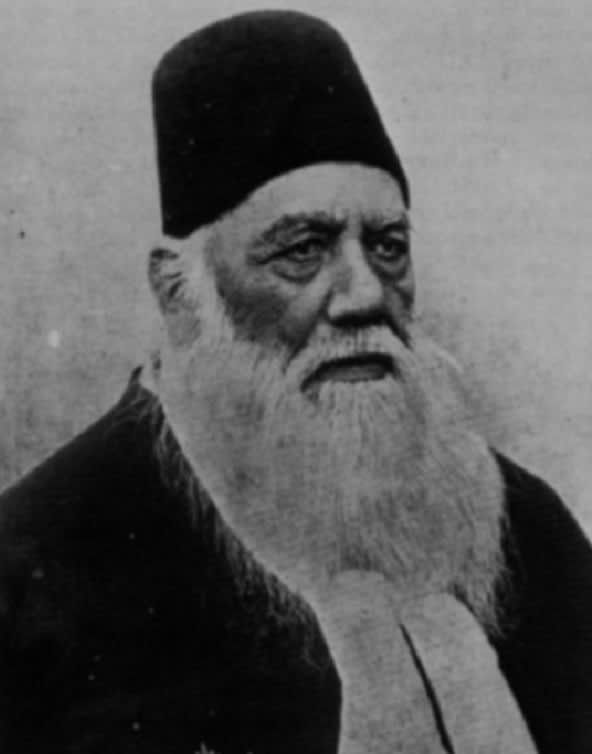
(a) Identify and name the personality.
(b) Name one famous educational institution founded by him.
(c) Describe two of his ideas or views.
Answer
(a) The given picture shows Sir Syed Ahmad Khan.
(b) Sir Syed Ahmad Khan founded the Mohammedan Anglo-Oriental (MAO) College at Aligarh in 1875.
(c) Two ideas/views of Sir Syed Ahmad Khan are given below:
Loyalty to the British Government: Sir Syed Ahmad Khan believed that Muslims should remain loyal to the British. He advised the Muslim community not to join political movements against the British, as he felt cooperation with the rulers would help Muslims progress socially and economically.
Promotion of Western Education: Sir Syed Ahmad Khan urged Muslims to receive Western education. To spread modern education among Muslims, he founded the Mohammedan Anglo-Oriental College at Aligarh in 1875.