
The principal leaders of the Congress, Dr. Satyapal and Dr. Saifuddin Kitchlew were arrested and deported to
- Lucknow
- Dharamsala
- Kanpur
- Shimla
Answer
Dharamsala
Reason — After the peaceful protests against the Rowlatt Act at Amritsar, the principal Congress leaders Dr. Satyapal and Dr. Saifuddin Kitchlew were arrested and deported to Dharamsala.
The All India Khilafat Committee in May 1920 adopted its ............... programme to fight against the British.
- Satyagraha
- Non-Cooperation
- Quit India
- Civil disobedience
Answer
Non-Cooperation
Reason — the All India Khilafat Committee, meeting in May 1920, adopted its Non-Cooperation programme to fight against the British, and on 31 August 1920 launched the Non-Cooperation Movement.
The angry crowd attacked and burnt the police station at Chauri Chaura, killing
- 16 policemen
- 18 policemen
- 14 policemen
- 22 policemen
Answer
22 policemen
Reason — When the police opened fire on the procession at Chauri Chaura, the angry crowd attacked and burnt the police station, killing 22 policemen.
According to Mahatma Gandhi, Harijans are
- Deprived people
- Wandering people
- Children of God
- None of these
Answer
Children of God
Reason — Gandhi regarded untouchability as a curse to Hindu society. He called the untouchables 'Harijans' (Children of God) and asked people to give them respect worthy of human beings.
Which among the following, according to Mahatma Gandhi is an essential principle of Satyagraha?
- Non-Violence
- Truth
- Infinite capacity of suffering
- All of these
Answer
All of these
Reason — Satyagraha was based on truth and non-violence. A Satyagrahi had to be morally and spiritually strong and possess an infinite capacity for suffering.
Read the two statements given below about the political strategy of Mahatma Gandhi and select the option that shows the correct relationship between (A) and (B)
(A) Gandhi's political strategy was based on Ahimsa and Satyagraha
(B) He never believed that non-violence was a weapon of the weak
- (B) contradicts (A)
- (B) is the reason for (A)
- (A) is true but (B) is false
- (A) and (B) are independent of each other
Answer
(B) is the reason for (A)
Explanation — Gandhi believed that non-violence was not the weapon of the weak but of the morally and spiritually strong. Therefore, his political strategy was based on Ahimsa and Satyagraha.
What was the cause for the sudden suspension of the Non-Cooperation Movement?
- Repressive measures of the British
- The Chauri-Chaura Incident
- The Gandhi-Irwin Pact
- The Jallianwala Bagh Massacre
Answer
The Chauri-Chaura Incident
Reason — The Chauri Chaura incident shocked Gandhi because the protesters turned violent and burnt a police station, killing 22 policemen. Therefore, he suspended the Non-Cooperation Movement.
How did the Lahore session of 1929 lead to the Civil Disobedience Movement?
- The Declaration of Poorna Swaraj was passed
- Subhash Chandra Bose was made the President of the Congress
- Simon Commission recommendations were accepted
- Congress passed a resolution to begin the Civil Disobedience Movement
Answer
The Declaration of Poorna Swaraj was passed
Reason — At the Lahore Session of 1929, held under Pt. Jawaharlal Nehru, Complete Independence or Poorna Swaraj was declared as the goal of the Congress. This declaration paved the way for the launch of the Civil Disobedience Movement.
The Khilafat Movement was started under the leadership of ............... .
- Ali Brothers
- Dr. Saifuddin Kitchlu
- Khan Abdul Ghaffar Khan
- Sir Sayyid Ahmed Khan
Answer
Ali Brothers
Reason — The Muslims started a powerful agitation known as the Khilafat Movement under the leadership of the Ali Brothers, Mohammed Ali and Shaukat Ali.
Which of these statements is NOT associated with the Jallianwala Bagh massacre?
- It happened in the year 1919.
- General Dyer was responsible for this massacre.
- It became a cause for the Non-Cooperation Movement.
- It became a cause for the Civil Disobedience Movement.
Answer
It became a cause for the Civil Disobedience Movement.
Reason — The Jallianwala Bagh massacre took place in 1919, General Dyer was responsible for it, and it became one of the causes of the Non-Cooperation Movement. It was not a cause of the Civil Disobedience Movement.
Identify the option which shows the correct chronology of the following events:
1. The Dandi March 2. The Second Round Table Conference 3. The Simon Commission
- 3-1-2
- 1-3-2
- 3-2-1
- 2-1-3
Answer
3-1-2
Reason — The Simon Commission came first (1928), followed by the Dandi March (1930), and then the Second Round Table Conference (1931). Hence, the correct sequence is 3-1-2.
Replace the underlined phrase with the correct option.
The objective of the Non-Cooperation Movement was to demobilise public opinion all over the country.
- to make the movement rare and unique.
- to provide an international base for Congress.
- to generate a wedge between Hindu-Muslim unity.
- to attain self-governance.
Answer
to attain self-governance.
Reason — The objective of the Non-Cooperation Movement was to attain self-governance.
Assertion (A): Gandhiji called off the Non-Cooperation Movement in 1922.
Reason (R): An unruly crowd burnt down a police station at Chauri-Chaura in 1922.
- Both A and R are true, and R is the correct explanation of A.
- Both A and R are true, but R is not the correct explanation of A.
- A is true, but R is false.
- A is false, but R is true.
Answer
Both A and R are true, and R is the correct explanation of A.
Explanation — Gandhiji believed in 'Ahimsa' or Non-violence and this violent turn of events went against the principles of 'Satyagraha' (non-violent resistance based on truth). He felt that the people were not yet ready for a non-violent struggle, so he suspended the movement to prevent further violence.
The issue on which the Civil Disobedience Movement of 1930 was launched was
- equal employment opportunities for Indians
- the proposed execution of Bhagat Singh.
- salt monopoly exercised by the British Government.
- complete freedom.
Answer
salt monopoly exercised by the British Government.
Reason — The Civil Disobedience Movement of 1930 was launched against the salt monopoly of the British Government; Gandhi and his followers made salt from seawater at Dandi and violated the Salt Law during the Dandi March.
What was Satyagraha according to Mahatma Gandhi?
Answer
According to Mahatma Gandhi, Satyagraha was based on truth and non-violence. A Satyagrahi should be fearless, honest, morally and spiritually strong, and possess an infinite capacity for suffering.
Name two leaders of the Khilafat Movement. Why is the Khilafat Movement significant in the history of the National Movement?
Answer
The Khilafat Movement was led by the Ali brothers — Mohammed Ali and Shaukat Ali. It is significant because it was later merged with the Non-Cooperation Movement launched by Gandhiji. The movement helped to create a strong sense of Hindu-Muslim unity. It played an important role in strengthening nationalist feelings and led to political awakening among the Indian people.
Why did the people oppose the Rowlatt Act?
Answer
The Rowlatt Act gave powers to the Government to arrest and to detain suspected persons, to search them without a warrant and to imprison them without a trial. Under this Act, a person had no right to appeal, no vakil (lawyer), and no dalil (defence).
This Act was a blow to the self-respect of Indians and their national honour. It went against all principles of justice and liberty. Therefore, the people strongly opposed the Rowlatt Act.
When did the Jallianwala Bagh Tragedy take place? Who was responsible for the Jallianwala Bagh Tragedy?
Answer
The Jallianwala Bagh Tragedy took place on April 13, 1919. General Dyer was responsible for this tragedy.
What was the main objective of the Non-Cooperation Movement?
Answer
The main objective of the Non-Cooperation Movement was to attain self-government within the British Empire if possible and outside it if necessary.
Name the two methods adopted in the Non-Cooperation Movement.
Answer
The two methods adopted in the Non-Cooperation Movement were:
- Renunciation of titles and honours.
- Boycott of government educational institutions, law courts, councils and foreign goods.
Why did Mahatma Gandhi withdraw the Non-Cooperation Movement in 1922?
Answer
The Non-Cooperation Movement was withdrawn by Mahatma Gandhi after the Chauri Chaura incident, where a violent mob set a police station on fire, leading to the death of 22 policemen. Gandhiji felt that the movement was becoming violent in many places. He strongly believed in peaceful and non-violent protest, and the violent turn of events deeply distressed him.
What was the main impact of the Non-Cooperation Movement?
Answer
With the launching of the Non-Cooperation Movement, the National Movement became a mass movement, and the Indian National Congress transformed into a mass organisation. Its aims and objectives closely resembled those of agitational nationalism, though its methods were non-violent and open, rather than violent and secret.
State any two causes that led to the Civil Disobedience Movement in 1930.
Answer
Two causes that led to the Civil Disobedience Movement in 1930 are given below:
- The boycott of the Simon Commission (1928), which had no Indian member and was regarded as an insult to Indians.
- The demand for Poorna Swaraj (Complete Independence), declared as the goal of the Congress at the Lahore Session in 1929.
State any four clauses of the Cabinet Mission Plan of 1946.
Answer
Four clauses of the Cabinet Mission Plan of 1946 are given below:
- A Union of India was to be formed, comprising both British India and the Princely States.
- The Union Government would control Defence, Foreign Affairs and Communications. The Provinces would enjoy full autonomy for all subjects other than the Union Subjects.
- The provinces were to be grouped into three sections (A, B and C) on the basis of geography and community.
- A Constituent Assembly was to be constituted to frame the Constitution of India. An Interim Government was to be set up at the Centre with the cooperation of the major political parties.
State any two causes for the Non-Cooperation Movement.
Answer
Two causes for the Non-Cooperation Movement were:
- The Rowlatt Act, 1919
- The Jallianwala Bagh Tragedy, 1919
Name any two leaders of the Khilafat Movement.
Answer
Two leaders of the Khilafat Movement were Mohammed Ali and Shaukat Ali (the Ali Brothers).
'The Lahore Session of the Indian National Congress in 1929 was a significant milestone in the Indian independence movement.'
Concerning the above statement, explain what made the Lahore session a momentous event in India's struggle for independence.
Answer
In the Lahore Session of the Indian National Congress in 1929, the demand for 'Purna Swaraj' or 'Complete Independence' was made the objective of the Congress. This session was a momentous event in India's struggle for independence because it marked a decisive shift towards the goal of complete sovereignty, laid the groundwork for the Civil Disobedience Movement, and symbolised the growing strength and unity of the Indian nationalist movement.
Read the excerpt given below and answer the question that follows:
A commission, without any Indian members, was sent to India to discuss constitutional reforms. The step agitated the people, and the Indian political parties boycotted the commission. When the Commission visited Lahore on October 30, 1928, Rai led the nonviolent march to protest the commission. (Source: Modern History, NCERT)
Name the movement that ensued with the commission coming to India. State any two significant impacts of the movement.
Answer
Civil Disobedience Movement.
Two significant impacts of the Civil Disobedience Movement were:
- It marked greater participation of women in politics, inspiring many to step out and join the freedom struggle.
- It inspired the youth to follow Gandhi's path of non-violence in the freedom struggle instead of using violence as a political weapon.
When and where was the Second Round Table conference held? State the demand raised during this conference.
Answer
The Second Round Table conference was held in London in 1931. It was attended by Gandhiji as the sole representative of the Congress.
Gandhiji demanded the immediate grant of responsible government for India. However, the conference became deadlocked on the minorities issue, with separate electorates being demanded not only by Muslims but also by the Depressed Classes, Indian Christians, Anglo-Indians and Europeans.
The question of Independence or setting up of a responsible Government receded into the background. The British Government refused to concede the immediate grant of dominion status.
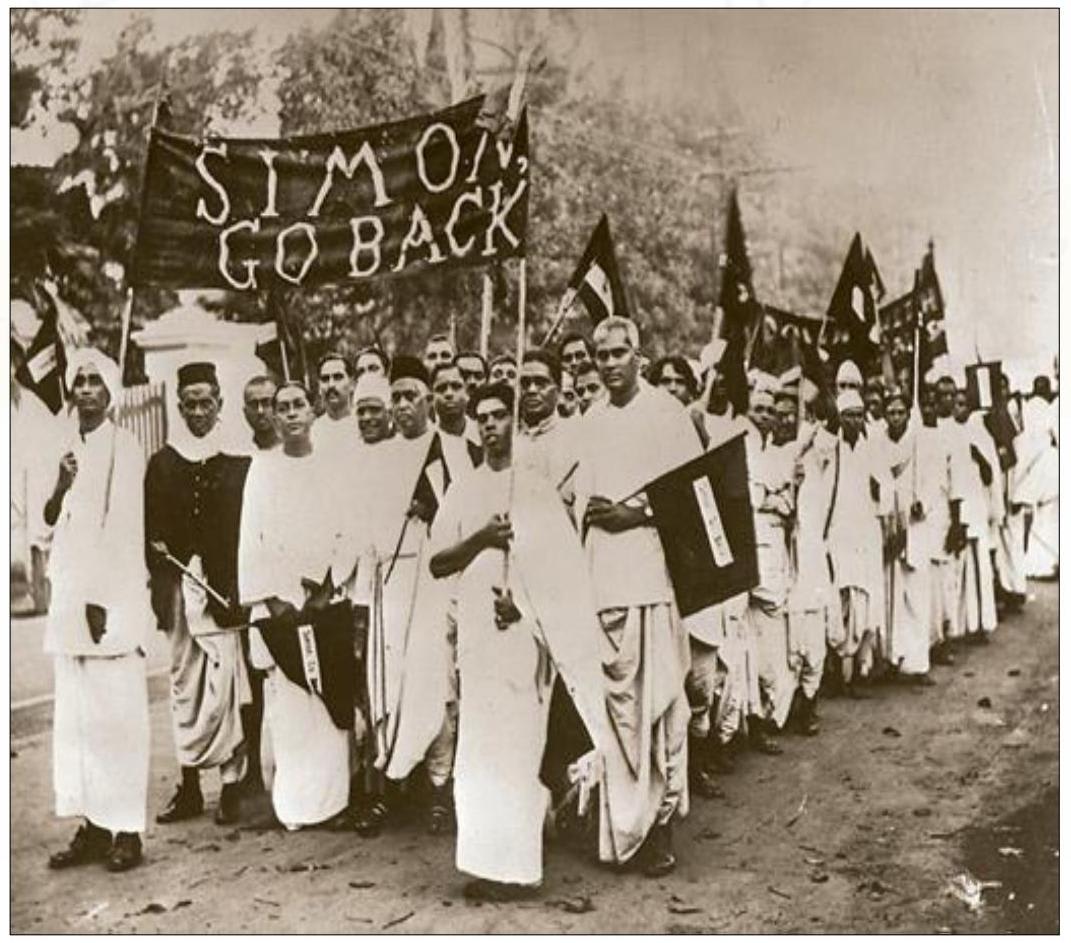
(a) Identify the event associated with the above-mentioned slogan.
(b) Why did the Indian leaders decide to boycott the event?
Answer
(a) The event associated with the above-mentioned slogan is Simon Commission.
(b) Indian leaders boycotted the Commission because it had no Indian members, which was seen as a denial of self-determination and an insult to the self-respect of the Indians. Major political parties, including the Congress, Muslim League, and Hindu Mahasabha, opposed it.
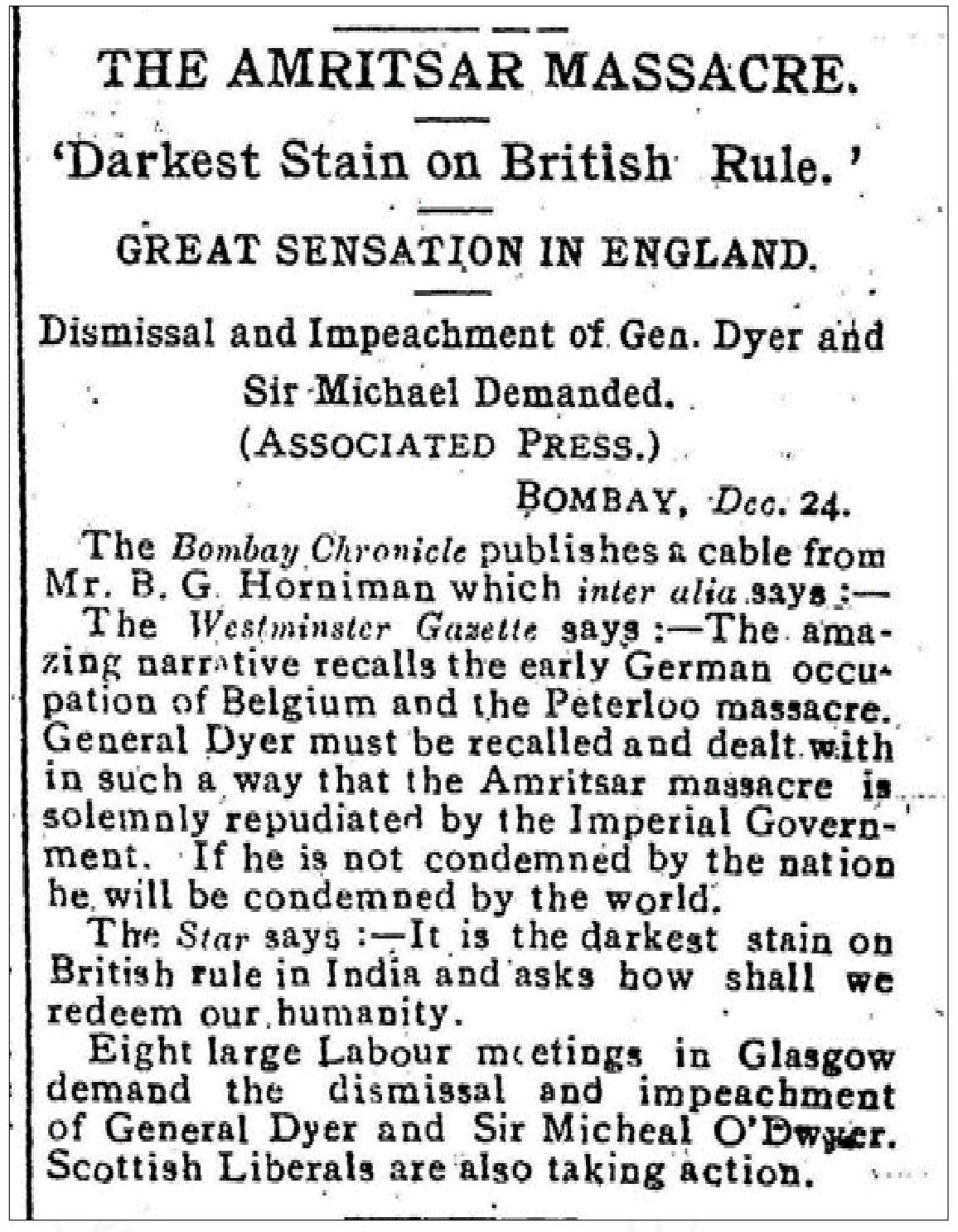
Name the incident related to the above newspaper article and examine the cause and effect of the incident.
Answer
The incident was the Jallianwala Bagh Tragedy (Amritsar Massacre) of 13 April 1919.
Cause of the Jallianwala Bagh Tragedy — In 1919, widespread protests were organised against the Rowlatt Act. In Amritsar, popular leaders Dr. Saifuddin Kitchlu and Dr. Satya Pal were arrested. On 13 April, a large peaceful gathering assembled at Jallianwala Bagh to protest against their arrest. General Dyer entered the Bagh with his troops, blocked the exit and ordered them to fire on the unarmed crowd.
Effect of the Jallianwala Bagh Tragedy —
- According to the official statement, 379 persons were killed and several thousand were wounded; unofficial estimates placed the number of casualties much higher.
- Martial law was imposed in Punjab, and severe restrictions were placed on the people.
- The massacre shocked the entire nation. Rabindranath Tagore renounced his Knighthood in protest.
- The British refused to withdraw the Rowlatt Act or adequately make amends for the atrocities in Punjab.
- The incident destroyed Gandhiji's faith in British justice. He changed from a cooperator to a non-cooperator and decided to launch the Non-Cooperation Movement.
Using the following points, briefly describe the Non-Cooperation Movement of 1920-22:
(a) Objective of this movement.
(b) Suspension of the movement in 1922.
(c) Any two far-reaching effects of this movement.
Answer
(a) The objectives of the Non-Cooperation Movement are given below:
- To attain self-government within the British Empire if possible and outside if necessary.
- Annulment of the Rowlatt Act and redressal of the Punjab wrongs.
- Redressal of the Khilafat wrong [Restore the old status of the Caliph].
- To cripple the government and to create hindrances that would make it difficult to function without the cooperation of the Indians.
(b) The Non-Cooperation Movement was withdrawn by Mahatma Gandhi after the Chauri Chaura incident (February 4, 1922), where a violent mob set a police station on fire, leading to the death of 22 policemen. Gandhiji felt that the movement was turning violent in many places. He believed in peaceful and non-violent protests, and the violent turn of events deeply distressed him.
(c) Two far-reaching effects of the Non-Cooperation movement are given below:
- The national movement became a mass movement as common people, peasants, workers, students, and women, all participated on a large scale.
- The movement promoted the use of Swadeshi goods, and urged Indians to boycott the British-made products. Khadi became a symbol of freedom. Takli and Charkha appeared in every house.
Using the following points, describe the main events leading to the Civil Disobedience Movement:
(a) The Simon Commission, 1928.
(b) Demand for Poorna Swaraj, 1929.
Answer
(a) The Simon Commission arrived in India in 1928 to find out how far the reforms introduced by the Government of India Act of 1919 was successful. But as this commission did not have any Indian member so it was boycotted everywhere. When it reached Lahore Lala Lajpat Rai led a procession against it. But he was lathi-charged as a result of which he died in 1928. This very fact generated a feeling of distrust and anger against the British Government.
(b) The death of Lajpat Rai caused nationwide anger and in 1929 the Congress Session was held at Lahore under the Presidentship of Pt. Jawaharlal Nehru. Complete Independence or Poorna Swaraj was declared as the goal of the Congress. There was huge upsurge of nationalist feelings. The public opinion was quite favourable and the nationalist forces were united in driving the British out.
The advent of Mahatma Gandhi on the Indian political scene gave a new impetus to the freedom struggle. With reference to the Non-Cooperation Movement under Mahatma Gandhi, answer the following questions:
(a) What were the causes which led to the launch of the Non-Cooperation Movement?
(b) Describe the programme of the movement.
(c) State the importance of the movement and the reasons for its withdrawal.
Answer
(a) The causes which led to the launch of the Non-Cooperation Movement are given below:
- The Rowlatt Act, 1919 — The British Government passed the Rowlatt Act in March, 1919. It gave powers to the Government to arrest and to detain suspected persons and to search them without a warrant and to imprison them without a trial. Any person under this Act had no right to Appeal, Vakil and Dalil.
- The Jallianwala Bagh Tragedy, 1919 — A peaceful meeting was held at Jallianwala Bagh in Amritsar on April 13, 1919 to protest against the arrest of principal leaders of the Congress, Dr. Satyapal and Dr. Saifuddin Kitchlew. General Dyer reached there and ordered his troops to open fire on the unarmed people. Firing continued till all the ammunition was exhausted. About 1,000 persons were shot dead and several thousands were wounded. They could not escape because there was only one narrow exit to the Bagh. It was followed by a series of humiliating orders. Curfew was imposed in the city. The water and electricity supply were cut off. People were flogged and put in jails. People were made to crawl in lanes. Arrested persons were confined in cages, property was confiscated or destroyed.
(b) The programme of the movement included the following:
- Popularisation of Swadeshi and Khadi by reviving hand spinning and hand weaving.
- Hindu-Muslim unity.
- Removal of untouchability.
- Prohibition of intoxicating drinks.
- Establishment of National Schools and Colleges.
- Emancipation and upliftment of women.
- Degrees, titles, awards and honours bestowed by the British government were returned.
(c) The Non-Cooperation Movement had its own importance in the history of the Freedom Movement of India.
- Inspiring the People with New Confidence : The people showed a remarkable degree of courageousness, fearlessness and strength to face any difficulty for the freedom of their country.
- The Indian National Congress Became a Mass Organisation : The movement transformed the Indian National Congress into an organisation for action. It became the organiser and leader of the masses in their national struggle.
- Hindu-Muslim Unity : The amalgamation of the Khilafat Movement and the Non-Cooperation Movement led to such Hindu-Muslim unity as was not witnessed before.
- The Notion that the British Rule was for the Good of the Indians was shattered.
- It Promoted Many Social Reforms : As a result of the Non-Cooperation Movement-
- many national schools and colleges were founded.
- boycott of the foreign goods led to the promotion of Indian industries and crafts.
- Khadi became the symbol of the National Movement.
- prohibition and removal of untouchability.
- The Cult of Swaraj Became More Pronounced : Swaraj or self-rule was one of the aims of the Non-Cooperation Movement.
- Instilled Confidence Among the People : A new sense of self-confidence and self-esteem was born to openly defy the foreign rulers and the British government. It generated a desire for freedom and inspired people to challenge the colonial rule.
Reasons for the withdrawal of the Non-Cooperation Movement — About 3,000 peasants organised a procession at Chauri Chaura, a village in the Gorakhpur district of UP. The police opened fire on this procession. The angry crowd attacked and burnt the police station, killing 22 policemen. This incident, which took place on February 4, 1922, shocked Gandhiji so much that he at once suspended the movement. Gandhiji could hardly tolerate that his followers should indulge in violence.
With reference to the National Movement from 1930 to 1947, answer the following:
(a) State any three features of the Programme of the Civil Disobedience Movement launched in 1930.
(b) What was the significance of the Second Round Table Conference held in 1931?
(c) State any four clauses of the Cabinet Mission Plan of 1946.
Answer
(a) Three features of the Programme of the Civil Disobedience Movement launched in 1930 are given below:
- Gandhiji and his followers made salt from the seawater at Dandi and violated the Salt Law, beginning with the famous Dandi March on March 12, 1930.
- Foreign goods were boycotted, foreign cloth was burnt in bonfires at road crossings, and liquor and foreign-cloth shops were picketed.
- People refused to pay land revenue and taxes, defied forest laws, resigned from government service and the legislatures, and courted arrest.
(b) The significance of the Second Round Table Conference (September 7 to December 1, 1931) was as follows:
- Gandhiji attended it as the sole representative of the Congress. The conference soon became deadlocked on the minorities issue, with separate electorates being demanded not only by Muslims but also by the Depressed Classes, Indian Christians, Anglo-Indians and Europeans.
- The British Government refused to concede the immediate grant of Dominion Status.
- The failure of the conference led Gandhiji to revive the Civil Disobedience Movement.
(c) Four clauses of the Cabinet Mission Plan of 1946 are given below:
- A Union of India was to be formed, comprising both British India and the Princely States.
- The Union Government would control Defence, Foreign Affairs and Communications. The Provinces would enjoy full autonomy for all subjects other than the Union Subjects.
- The provinces were to be grouped into three sections (A, B and C) on the basis of geography and community.
- A Constituent Assembly was to be constituted to frame the Constitution of India. An Interim Government was to be set up at the Centre with the cooperation of the major political parties.
With reference to the given picture, answer the following questions:
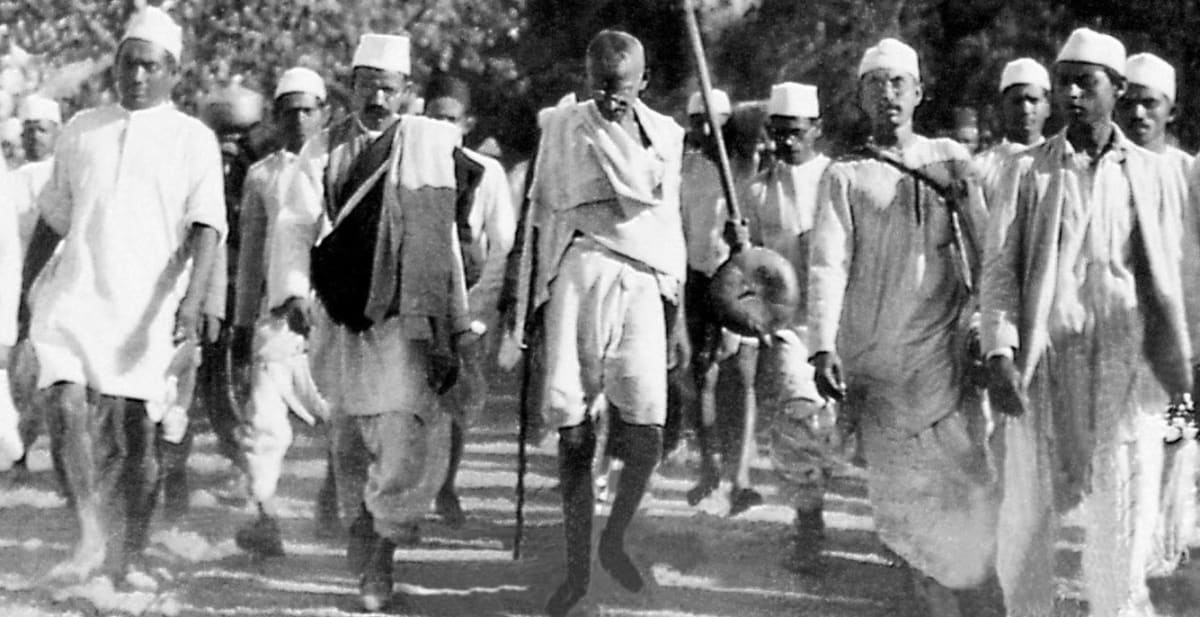
(a) Identify the leader and the event.
(b) State the causes of the Non-Cooperation Movement.
(c) Mention the conditions that Congress agreed to and the conditions that the British Government agreed to according to the Gandhi-Irwin Pact.
Answer
(a) The leader is Mahatma Gandhi and the event is the Dandi March (Salt March), which began on March 12, 1930 from the Sabarmati Ashram to Dandi, launching the Civil Disobedience Movement.
(b) The causes of the Non-Cooperation Movement are given below:
- The Rowlatt Act, 1919.
- The Jallianwala Bagh Tragedy, 1919.
- The Khilafat Movement.
(c) The conditions of the Gandhi-Irwin Pact (March 1931) are given below:
Conditions that the British Government agreed to —
- Withdraw all ordinances and end prosecutions.
- Release all political prisoners, except those guilty of violence.
- Permit peaceful picketing of liquor and foreign cloth shops.
- Restore the confiscated properties of the satyagrahis.
- Permit the free collection or manufature of salt by persons near the seacoast.
Conditions that the Congress agreed to —
- Suspend the Civil Disobedience Movement.
- Participate in the Second Round Table Conference.
- Not to press for investigation into police atrocities.
With reference to the given picture, answer the following questions:

(a) (i) Identify the Memorial built for those who were killed in this incident.
(ii) Where did this incident take place?
(iii) Name the movement launched by Gandhi in 1920 as a consequence.
(b) Explain briefly the reason for the suspension of this particular movement by Gandhi in 1922.
(c) State any four impacts of the movement.
Answer
(a) (i) The memorial shown in the picture is the Jallianwala Bagh Memorial.
(ii) This incident took place at Jallianwala Bagh in Amritsar (Punjab).
(iii) The movement launched by Gandhi in 1920 as a consequence was the Non-Cooperation Movement.
(b) Mahatma Gandhi suspended the Non-Cooperation Movement in 1922 because of the Chauri Chaura incident (February 4, 1922). About 3,000 peasants organised a procession at Chauri Chaura, a village in the Gorakhpur district of UP. When the police opened fire, the angry crowd attacked and burnt the police station, killing 22 policemen. This incident shocked Gandhiji so much that he at once suspended the movement, as he could not tolerate his followers indulging in violence.
(c) Four impacts of the Non-Cooperation Movement are given below:
- It inspired the people with new confidence and made them courageous and fearless in facing the British power.
- The Indian National Congress became a mass organisation and the leader of the masses in their national struggle.
- It strengthened Hindu-Muslim unity, as the Khilafat and the Non-Cooperation Movements were amalgamated.
- It promoted many social reforms — national schools and colleges were founded, Khadi became the symbol of the National Movement, and steps were taken towards prohibition and the removal of untouchability.