
Mahatma Gandhi rejected proposals of ............... as a 'post-dated cheque'.
- Cripps Mission
- Government of India Act, 1919
- Cabinet Mission
- Simon Commission
Answer
Cripps Mission
Reason — Mahatma Gandhi rejected the proposals of the Cripps Mission as a "post-dated cheque" because the proposals disappointed the Congress and did not provide immediate transfer of power to Indians. This expression is specifically used in the section on the Rejection of Proposals.
About 10,000 people died in firing and 70,000 were put behind the bars during the
- Civil Disobedience Movement
- Champaran Satyagraha
- Quit India Movement
- Kheda Satyagraha
Answer
Quit India Movement
Reason — The chapter records that during the Quit India Movement about 10,000 people died in firing and about 70,000 were put behind the bars, such wide-scale repression not having been seen in India since the Rising of 1857.
The Forward Bloc was formed by
- Dr. Rajendra Prasad
- Khan Abdul Ghaffar Khan
- Subhas Chandra Bose
- Maulana Abul Kalam Azad
Answer
Subhas Chandra Bose
Reason — After resigning from the presidentship of the Congress in 1939, Subhas Chandra Bose laid the foundation of the Forward Bloc, a radical and progressive party meant to bring the entire left wing under one banner.
The ............... did not accept the August Offer (1940), as it did not give a clear assurance for the establishment of Pakistan.
- Muslim League
- Communist Party of India
- Indian National Congress
- Congress Socialist Party
Answer
Muslim League
Reason — The Muslim League's chief demand was the establishment of a separate Pakistan; as the August Offer (1940) gave no clear assurance on this, the League did not accept it. (The chapter notes that the August Offer failed to satisfy both the Congress and the League.)
In 1942, the threat of ............... invasion of India convinced the Indian leaders that for India's safety, the British should withdraw from India immediately.
- German
- French
- Japanese
- Italian
Answer
Japanese
Reason — In the summer of 1942 Japan was rapidly advancing towards India, and the Congress leaders felt that to save India from a Japanese attack the British should withdraw and quit the country.
The slogan 'Dilli Chalo' is related to
- Dr. Sangeeta Narang
- Avneet Kaur
- S.C. Bose
- G.S. Dhillon
Answer
S.C. Bose
Reason — 'Dilli Chalo' was the battle-cry given by Subhas Chandra Bose to the soldiers of the INA; hence the slogan is associated with him.
Identify the reasons why Subhash Chandra Bose resigned from the Presidentship of Congress in 1939.
P : Majority of the delegates who had supported him reaffirmed their faith in Gandhiji's leadership.
Q : Gandhiji openly declared the defeat of Sitaramayya as his own defeat.
R : A request was made to him to give up presidentship.
S : He wanted to lead the INA and begin a violent struggle to liberate India.
- P and Q
- Q and R
- R and S
- P and S
Answer
P and Q
Reason — Statements P and Q are correct. After Bose defeated Pattabhi Sitaramayya, Gandhiji declared the defeat as his own. The majority of delegates who had supported Bose reaffirmed their faith in Gandhiji. Bose resigned because he could not form the Working Committee according to Gandhiji's wishes.
The statement, "We shall either free India or die in the attempt", is associated with which of the following?
- Non-Cooperation Movement
- Civil Disobedience Movement
- Individual Satyagraha
- Quit India Movement
Answer
Quit India Movement
Reason — "We shall either free India or die in the attempt" is a famous statement from Mahatma Gandhi, delivered during the Quit India Movement in 1942. It emphasized the commitment to either achieve complete freedom or sacrifice their lives in the process.
At Wardha, the Congress Working Committee adopted a resolution that was passed in Bombay. Name the resolution.
- Poorna Swaraj Resolution
- Quit India Resolution
- Non-Cooperation Resolution
- Swaraj Resolution
Answer
Quit India Resolution
Reason — The Congress Working Committee met at Wardha in July 1942. It adopted the Quit India Resolution. It stated: "British rule in India must end immediately."
Arrange the following events of Netaji's life in chronological order.
i. Supreme Commander of INA
ii. Provisional Government of Free India
iii. Formation of Forward Bloc
iv. Congress Presidentship
- i, iii, iv, ii
- iv, iii, ii, i
- i, ii, iii, iv
- iv, iii, i, ii
Answer
iv, iii, i, ii
Reason —
Congress Presidentship (1938–1939)
Formation of Forward Bloc (1939)
Supreme Commander of INA (1943)
Provisional Government of Free India (1943)
Read the two statements given below regarding the Subhas Chandra Bose. Select the option that shows the correct relationship between (A) and (B).
(A) His chief objective was to organise all progressive and radical elements in the Congress under one head.
(B) He wanted to establish a socialist society after Independence.
- (B) contradicts (A)
- (B) is the reason for (A)
- (A) is true but (B) is false
- (A) and (B) are independent of each other
Answer
(B) is the reason for (A)
Explanation — Bose wanted to establish a socialist society after Independence, and to achieve this he sought to bring all the progressive and radical (left-wing) elements of the Congress together under one head through the Forward Bloc. Thus (B) is the reason for (A).
Complete the given analogy.
Simon Commission : Civil Disobedience Movement :: Cripps Mission : ?
- Non-Cooperation Movement
- Anti Partition Movement
- Quit India Movement
- Khilafat Movement
Answer
Quit India Movement
Reason — Just as the Simon Commission led to the Civil Disobedience Movement, the failure of the Cripps Mission was a major cause that led to the launching of the Quit India Movement in 1942.
The Supreme Commander of the Indian National Army:
- Subhas Chandra Bose
- Ras Behari Ghosh
- Jawaharlal Nehru
- Lord Wavell
Answer
Subhas Chandra Bose
Reason — On taking charge of the Indian Independence League, Subhas Chandra Bose also became the Supreme Commander of the Indian National Army.
Given below are the objectives of the Indian National Army. Identify the odd one out of the following:
- To organise a provisional government of Free India
- Total mobilisation of Indian manpower and money
- Unity, faith and sacrifice
- To train and organise public opinion in the country
Answer
To train and organise public opinion in the country
Reason — To train and organise public opinion in the country is not the main objective of the Indian National Army.
Identify the contributions of Subhas Chandra Bose:
P : Was the Supreme Commander of INA
Q : Signed the Lucknow Pact
R : Led the Quit India Movement
S : Founded the Forward Bloc
- P and Q
- Q and R
- P and S
- R and S
Answer
P and S
Reason — Statements P and S are correct: Subhas Chandra Bose was the Supreme Commander of the INA and founded the Forward Bloc in 1939. Statement Q is wrong, as he did not sign the Lucknow Pact, and Statement R is wrong, as the Quit India Movement was led by Gandhiji, not Bose.
When did the Cripps Mission come to India? Why did Congress reject the Cripps Mission?
Answer
The Cripps Mission came to India on 22 March 1942.
Congress rejected the Cripps Mission because Gandhiji regarded its proposals as a 'post-dated cheque'. The Congress now wanted to settle for nothing less than 'Purna Swaraj' or 'Complete Independence'.
What is meant by the Quit India Movement? Give one reason for passing the Quit India Resolution in 1942.
Answer
The Quit India Movement was launched to call upon the British to hand over power to the Indians and quit the country.
One reason for passing the Quit India Resolution in 1942 was Japan's advance towards India. There was a growing threat of Japanese invasion on India. The Congress leaders believed that to save India, the British must hand over power to the Indians and quit the country.
In which two ways did the Quit India Movement influence the National Movement?
Answer
Two ways in which the Quit India Movement influenced the National Movement are given below:
- In the Quit India Movement people from all walks of life took part irrespective of religion, gender, caste, and creed. In some areas, the revolutionaries set up 'parallel governments'. It was clear that the national feelings had become too deep-rooted to be uprooted by any one.
- The Indians showed great capacity for struggle and sacrifice. It was made clear to the British that the Indians would accept no less than complete independence.
How did the Quit India Movement make the British feel that their days were numbered in India?
Answer
The pace and depth of the Quit India Movement made the English realise that their days were numbered in India. They were surprised seeing their unity and the great capacity of the people for struggle and sacrifice. No matter how they were punished, their determination remained unshaken. They could never think of ruling the country against the wishes of such a resolute people.
Give one reason which led to the split in the Congress in 1939.
Answer
Despite Mahatma Gandhi's support for Pattabhi Sitaramayya, Subhas Chandra Bose won the presidential election. This led to serious differences between Bose and the Gandhian group, and Bose resigned from the presidentship of the Congress in 1939.
When and why did Subhas Chandra Bose resign from the presidentship of the Congress?
Answer
Majority of the delegates who had supported Subhas Chandra Bose for presidentship reaffirmed their faith in the leadership of Gandhiji. It created a deadlock between Subhas and Gandhiji. The Gandhi wing began to oppose the President with a view to make it impossible for him to function. That's why S.C. Bose resigned from the presidentship of the Congress on April 29, 1939.
Imagine you are a young member of the Forward Bloc, how would you and your party work towards establishing a socialist state?
Answer
Me and my party would work for the establishment of a Socialist State through:
- Reorganisation of agriculture and industry on socialist lines.
- Abolition of the Zamindari system.
- Introduction of a new monetary and credit system.
"It is our duty to pay for our liberty with our own blood. The Freedom that we shall win through our sacrifice and Exertions, we shall be able to preserve with our own strength."
With reference to the above quote, put forth the slogans given by the great Indian freedom fighter Subhas Chandra Bose.
Answer
Some of the slogans given by Subhash Chandra Bose were:
- Give me blood and I shall give you freedom.
- Chalo Delhi.
- Jai Hind
Mention any two ways in which the British Government in India reacted to the Quit India Resolution.
Answer
Two ways in which the British Government in India reacted to the Quit India Resolution are given below:
- Rebellious villages had to pay huge sums such as punitive fines, and the villagers had to undergo mass floggings.
- Gandhiji was detained at Agha Khan's palace in Pune, and the other leaders were sent to jail in Ahmednagar Fort.
What was the objective of the Indian National Army? Name three officers of the INA who were prosecuted for treason by the British.
Answer
The main objectives of the INA were —
- To organise an armed rebellion and to attack the British army with modern arms.
- The rebellion to be organised by the Indians living in East Asia.
- To set up a provisional government of Free India in order to mobilise the forces effectively.
- Total mobilisation of Indian manpower and money for the rebellion.
Three officers of the INA who were prosecuted for treason by the British were — Prem Sehgal, G.S. Dhillon and Shahnawaz Khan.
What was the contribution of the INA to the Freedom Movement of India?
Answer
The contributions made by the INA are given below:
- The INA set an inspiring example of patriotism before the Indian people.
- The heroic deeds and sacrifices of the soldiers of INA led to political consciousness among the Indian forces.
- The British now realised that they could not rely on the Indian forces to continue their rule in India.
- The INA trial attracted great attention in India and England. The decision to hold the trial in public in the Red Fort in Delhi, created huge excitement. It became a rallying point for independence movement from autumn 1945.
- Later on the release of INA prisoners and suspension of the trial gave a great impetus to the campaign for Freedom.
- Most of the historians agree that the INA trials and its effects brought a decisive shift in British policy. They now began to feel that their days were numbered.
Thus, the INA played an important role in the British decision to finally quit India.
Mention any two objectives of the Forward Bloc.
Answer
Two objectives of the Forward Bloc were:
- Liberation of India with the support of workers, peasants, youth, and other organizations.
- After independence, establishment of a socialist state through measures such as reorganisation of agriculture and industry on socialist lines and abolition of the Zamindari system.
Mention any two causes of the Quit India Movement.
Answer
Two causes of the Quit India Movement were:
- Failure of the Cripps Mission
- Japanese threat
The Indian National Army, built by Subhash Chandra Bose, was far ahead of its time and was a unique army. Mention any two traits that made it unique.
Answer
Indian National Army was a unique army that was far ahead of its time. Two traits that made Indian National Army unique are as follows:
- It was an army organised on foreign soil, hundreds of kilometres away from its motherland.
- INA had a women's regiment called the Rani Jhansi Regiment was led by Dr. Lakshmi Swaminathan.
'The Quit India Movement made Independence of India as the only agenda of the National Movement. It proved that there could be no retreat and future negotiations could only be on the manner of the transfer of power.'
With reference to the above statement, enlist the impact of the Quit India Movement.
Answer
The impact of the Quit India Movement is given below:
- It Demonstrated the Depth of the National Feelings : People from all walks of life took part in the Movement irrespective of religion, gender, caste and creed. In some areas, the revolutionaries set up 'parallel governments'. It was clear that the national feelings had become too deep-rooted to be uprooted by any one.
- People Acquired Great Capacity for Struggle and Sacrifice : The Indians showed great capacity for struggle and sacrifice. It was made clear to the British that the Indians would accept no less than complete independence.
- It Made the English Realise that Their Days were Numbered in India : The pace and depth of the Quit India Movement made the English realise that their days were numbered in India. The tremor, though short-lived, left the British quite aghast and they read the writing on the wall.
With reference to the Cripps Mission, explain :
(a) Why was the Cripps Mission sent to India?
(b) Mention four causes of their proposals.
(c) Why did both Congress and Muslim League reject it?
Answer
(a) Cripps Mission was sent to India on 22 March 1942 to solve the constitutional problems of India.
(b) Four causes of the Cripps Mission are given below:
- After the war, India would be given the same status as the other Dominions like Canada and Australia.
- A Constituent Assembly would be set up after the war. This elected assembly would frame the Constitution of free India.
- It proposed that an 'Interim Government' would be formed during the war.
- Until the new Constitution was framed the government wanted Indian leaders to take effective part in the Viceroy's Executive Council.
(c) The Cripps Mission was rejected as its proposals disappointed both the Congress and the Muslim League. Gandhiji rejected it as 'a postdated cheque'. The Muslim League rejected it as it felt the prospects of achieving Pakistan were remote. It demanded 'a definite pronouncement in favour of Pakistan'.
The All India Congress Committee which met at Bombay on 8th August, 1942 passed the famous Quit India Resolution.
In this context, answer the following questions :
(a) Mention the reasons that led to the passing of the Resolution.
(b) Explain the spread of the Quit India Movement.
(c) State the repressive measures practised by the British Government.
(d) State the importance of the Movement.
Answer
(a) The Quit India Movement started in 1942. The reasons for starting the same were the following :
- Failure of the Cripps Mission : The Cripps Mission (March 1942) failed to solve the constitutional problem of India. It led to discontent, dissatisfaction and anger. Indian people were filled with distrust and hostility towards the British.
- Japanese Threat : Japan was rapidly advancing towards India and there was a growing threat of Japanese invasion on India. The Congress leaders believed that to save India from the Japanese attack, the British must handover power to the Indians and quit the country.
(b) All India Congress Committee (AICC) was held at Bombay on August 8, 1942. It passed the famous Quit India resolution.
- Gandhiji raised the slogan 'Do or Die' and declared that it would be his final struggle for the freedom of the country.
- Gandhiji and other leaders of the Congress were arrested in the early hours of the morning of August 9, 1942.
- The Congress was declared illegal and its funds were confiscated.
- The people started the Quit India Movement over the whole of the country.
- The people were leaderless, unorganised, unprepared and undirected. So the movement assumed a violent turn.
- They observed hartals and took out processions and organised demonstrations. Public life came to a standstill and all business was suspended.
- People became violent and burnt post offices, telegraph offices, police stations, railway stations and other Government buildings. They cut off telegraph, telephone and electric lines. Bridges were blown up and roads were dug up.
- They shot down notorious police officers and hurled bombs upon them. The movement became a popular upsurge and the whole country rose to overthrow the British Rule.
(c) The repressive measures practised by the British Government are given below:
- Thousands of people were imprisoned without trial.
- The undertrials were tortured. Lathi-charge, firing, beating and flogging became the order of the day.
- The press was completely muzzled.
- Many villages were looted and burnt. Collective fines were also imposed on them.
- By using repressive measures the Government ultimately succeeded in crushing the movement within a few weeks.
- About 10,000 people died in firing and about 70,000 were put behind the bars.
(d) The Quit India Movement was short-lived but its results were of far-reaching consequences.
- It Demonstrated the Depth of the National Feelings : In the Quit India Movement people from all walks of life took part irrespective of religion, gender, caste, and creed. In some areas, the revolutionaries set up 'parallel governments'. It was clear that the national feelings had become too deep-rooted to be uprooted by any one.
- People Acquired Great Capacity for Struggle and Sacrifice : The Indians showed great capacity for struggle and sacrifice. It was made clear to the British that the Indians would accept no less than complete independence.
- It Made the English Realise that Their Days were Numbered in India : The pace and depth of the Quit India Movement made the English realise that their days were numbered in India. The tremor, though short-lived, left the British quite aghast and they read the writing on the wall.
Netaji Subhas Chandra Bose played a great part in the National Movement. In this context, explain the following :
(a) Political aims of Netaji.
(b) Part played by him in liberating India from the British yoke.
Answer
(a) The political aims of Netaji Subhas Chandra Bose are given below:
- To organise all the progressive and radical elements in the Congress under one head.
- To establish a socialist society after Independence.
- To abolish the Zamindari system.
- To reduce land revenue and make proper arrangements for rural loans.
- The State should encourage the formation of trade unions.
(b) Netaji played a significant role in liberating India from the British yoke.
- S.C. Bose laid the foundation of a radical and progressive party within the Congress in 1939, with a view to bringing the entire left wing under one banner. This party was known as the Forward Bloc.
- In Singapore, he organised the Azad Hind Fauj (the Indian National Army or INA) for the freedom of his country.
- He set up Recruitment and Training Departments as well. Training Camps were opened for men and women.
- He also founded the Provisional Government of Free India at Singapore in October 1943.
- He gave the call to his soldiers, "Give me blood and I shall give you freedom." His battle-cry was, "Dilli Chalo."
Study the picture given and answer the following questions:
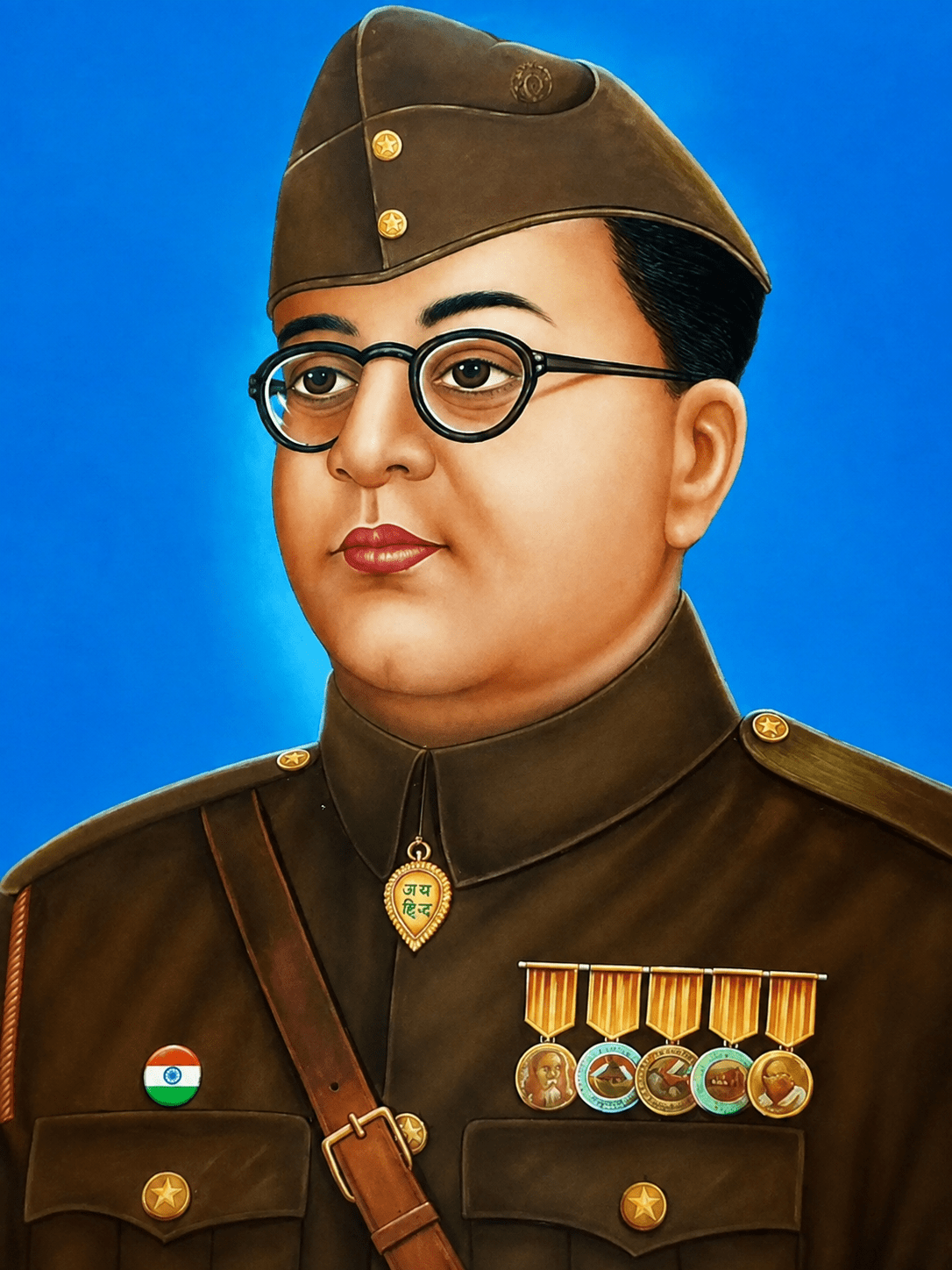
(a) Identify the leader given in the picture. Name the Political party and the Military Organisation that he formed.
(b) State any three objectives of the Political party that he founded.
(c) Mention any four objectives of the Military Organisation that he formed.
Answer
(a) The leader given in the picture is Subhas Chandra Bose (Netaji). The political party he formed was the Forward Bloc and the military organisation he formed was the Indian National Army (Azad Hind Fauj).
(b) Three objectives of the Forward Bloc founded by Subhas Chandra Bose are given below:
- To organise all the progressive and radical elements in the Congress under one head.
- To vehemently oppose the British Government.
- To struggle for immediate liberation of the country.
(c) Four objectives of the Indian National Army formed by Subhas Chandra Bose are given below:
- To organise an armed rebellion and to attack the British army with modern arms.
- The rebellion to be organised by the Indians living in East Asia.
- To set up a provisional government of Free India in order to mobilise the forces effectively.
- Total mobilisation of Indian manpower and money for the rebellion.