
The Ministers are individually responsible to
- the Prime Minister
- the President
- the people
- the Parliament
Answer
the President
Reason — The ministers hold office during the pleasure of the President. They may be dismissed by him on the advice of the Prime Minister.
The meetings of the Council of Ministers are presided over by
- the President
- the Vice President
- the Prime Minister
- the senior most member of Parliament
Answer
the Prime Minister
Reason — The entire Council of Ministers works as a team with the Prime Minister acting as the skipper. All the meetings of the Council as a whole or of the Cabinet are presided over by the Prime Minister.
The Prime Minister is
- appointed by the President
- appointed by President on the recommendation of the Speaker
- elected by the Lok Sabha
- elected by the Upper House
Answer
appointed by the President
Reason — The leader of the political party securing absolute majority in the Lok Sabha is appointed by the President as the Prime Minister and he has no discretion in this matter.
The office of the Prime Minister of India
- has a constitutional basis
- has a statutory basis
- has conventional basis
- none of these
Answer
has a constitutional basis
Reason — Article 74 of the Constitution of India lays down that there shall be a Council of Ministers with a Prime Minister at its head to aid and advise the President. The office thus derives its existence from the Constitution itself.
The Prime Minister is :
- the head of the state
- head of the government
- head of the state as well government
- none of these
Answer
head of the government
Reason — The President is the nominal head of the State, while the Prime Minister is the real head of the executive. Therefore, the Prime Minister is the head of the government.
Generally, all important decisions are taken by
- the Council of Ministers
- the Cabinet
- the Prime Minister
- none of these
Answer
the Cabinet
Reason — The Cabinet is an inner body within the Council of Ministers in which the real executive powers are vested. It determines the policy and programme of the government and exercises all powers in the name of the Council of Ministers.
In reality the Council of Ministers stays in office as long as it enjoys
- the confidence of Lok Sabha
- the confidence of Prime Minister
- the confidence of President
- the confidence of Rajya Sabha
Answer
the confidence of Lok Sabha
Reason — The Prime Minister and the Council of Ministers are directly responsible to the Lok Sabha and can remain in office so long as they enjoy the majority support in the House of the People. When a vote of no-confidence is passed against them in the Lok Sabha, they have to resign collectively.
Read the passage given below and answer the following questions.
The Ministers are individually responsible to the President, i.e., they hold office during the pleasure of the President and may be dismissed by him on the advice of the Prime Minister. The principle of individual responsibility to the head of the state is embodied in Art. 75 (2) — "The Ministers shall hold office during the pleasure of the President." Though the ministers are collectively responsible to the Legislature, they shall be individually responsible to the President and shall be liable to be dismissal even when they have the confidence of the House of people. But since the Prime Minister's advice will be available in the matter of dismissing other Ministers individually, it may be expected that this power of the President will virtually be a power of the Prime Minister against his colleagues. Thus, in effect, a minister is individually responsible to the Prime Minister.
(i) Union Ministers are individually responsible to
- President
- Prime Minister
- Parliament
- Supreme Court
(ii) The Ministers hold office during the pleasure of
- President
- Prime Minister
- Parliament
- Supreme Court
Answer
(i) President
Reason — The Ministers are individually responsible to the President, i.e., they hold office during the pleasure of the President and may be dismissed by him on the advice of the Prime Minister.
(ii) President
Reason — The principle of individual responsibility is embodied in Article 75 (2) which states that the Ministers shall hold office during the pleasure of the President. They are liable to be dismissed by him even when they have the confidence of the House of the People.
Identify the correct meaning and implication of 'individual responsibility' of the union ministers to the President.
P : The Ministers are individually responsible to the President.
Q : The President can dismiss a Minister as and when he likes.
R : The President can dismiss a Minister only on the advice of the Prime Minister.
S : The Ministers are not responsible to the Prime Minister but only to the President.
- P and Q
- Q and S
- P and R
- P and S
Answer
P and R
Reason — P is correct as the Ministers are individually responsible to the President. R is correct because the President dismisses a Minister only on the advice of the Prime Minister, which makes Q wrong. S is also wrong because this power of the President is virtually a power of the Prime Minister, so in effect a minister is individually responsible to the Prime Minister.
Consider the two statements given below regarding 'collective responsibility' of the Council of Ministers, and select the option that shows the correct relationship between (A) and (B).
(A) If a vote of no-confidence is passed against any Minister in the Lok Sabha, entire council of ministers has to tender resignation.
(B) The Council of Ministers shall be collectively responsible to the House of the People.
Options :
- (B) contradicts (A)
- (B) is the reason for (A)
- (A) is true but (B) is false
- (A) and (B) are independent of each other.
Answer
(B) is the reason for (A)
Reason — Article 75 (3) provides that the Council of Ministers shall be collectively responsible to the House of the People. It is because of this collective responsibility that a vote of no-confidence against one Minister is a vote against the whole ministry, and such a ministry has to resign.
Choose the incorrect statement :
- The President is only the constitutional head of state.
- The real executive powers are vested in the Union Cabinet headed by the Prime Minister.
- If the President resigns, the Union Cabinet is automatically dissolved.
- If the Prime Minister resigns due to any reason, the cabinet is automatically dissolved.
Answer
If the President resigns, the Union Cabinet is automatically dissolved.
Reason — The cabinet is automatically dissolved when the Prime Minister leaves his office due to resignation, illness or death, and not when the President does so. The President is only the constitutional head of state, while the real executive powers are vested in the Union Cabinet headed by the Prime Minister.
An ordinance is called a temporary law. Which of the following statements correctly describes the same?
- Only the Cabinet can prepare an ordinance.
- It is issued when the Parliament is not functioning.
- If the Parliament does not approve it within six weeks it becomes inoperative.
- Only the President can promulgate an ordinance.
Answer
If the Parliament does not approve it within six weeks it becomes inoperative.
Reason — An Ordinance is called a temporary law, as it ceases to operate after six weeks from the re-assembly of Parliament, unless they are approved by the Houses. It also lapses if it is replaced by an Act of Parliament.
Given below are details of a few Indian Citizens.
| Person | Age (In years) | Description |
|---|---|---|
| W | 20 | Is a famous actor |
| X | 48 | Has been convicted by court for corruption |
| Y | 35 | Has accepted a foreign citizenship |
| Z | 50 | Is a scientist |
Select the one who is eligible to be appointed as the Prime Minister of India.
- X
- W
- Y
- Z
Answer
Z
Reason — The President invites the leader of the majority party in the Lok Sabha to form the Government, and to be a member of the Lok Sabha, a person must be an Indian citizen, with at least 25 years of age, and not a proclaimed criminal. Only Person Z meets the required criteria.
Which feature of collective responsibility of the Cabinet is depicted in the picture given below?
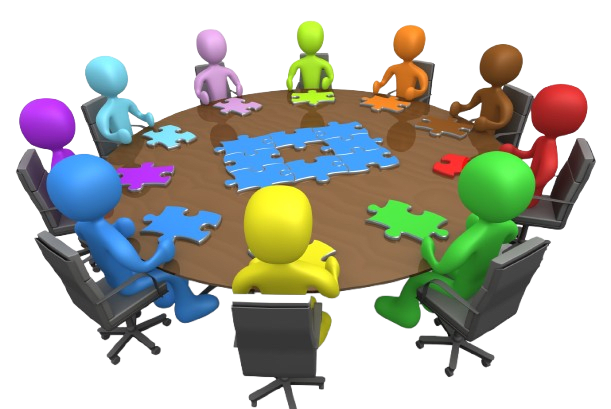
- All the ministers are collectively responsible to the Lok Sabha.
- All the ministers must function as a team and discuss policies.
- The ministers are responsible to the President.
- The Prime Minister is the head of the Cabinet.
Answer
All the ministers must function as a team and discuss policies.
Reason — The given picture shows all ministers sitting together around a table, arranging puzzle pieces, which represents teamwork, unity, and joint policy discussions.
The Council of Ministers is collectively responsible to the ............... .
- Lok Sabha
- President
- Rajya Sabha
- Prime Minister
Answer
Lok Sabha
Reason — The ministers remain in office until they enjoy the confidence of majority of members in the Lok Sabha. If a vote of no-confidence is passed in the Lok Sabha against the Prime Minister, or the Ministry as a whole or any of its members, the whole Ministry has to resign.
By whom and on whose advice are the Union Ministers appointed?
Answer
The Union ministers are appointed by the President of India on the advice of the Prime Minister.
Under what provision can a non-member of the legislature be made a Minister?
Answer
A non-member appointed as a Minister must be elected to either House of Parliament within six months from the date of appointment; otherwise, he shall resign from the post of Minister.
Mention different categories of ministers in the Union Council of Ministers.
Answer
The Council of Ministers has three categories of Ministers besides the Prime Minister. They are :
- Cabinet Ministers
- Ministers of State
- Deputy Ministers.
What do you mean by 'collective responsibility'?
Answer
Collective responsibility means that the Council of Ministers is collectively responsible to the House of the People (Lok Sabha). Since the policy of the Government is not that of one minister but of all the ministers, a vote of no-confidence against one Minister is a vote against the whole Ministry. Such a Ministry, having lost the confidence of the Lok Sabha, has to resign.
What is meant by 'individual responsibility'?
Answer
Individual responsibility means that the Ministers hold office during the pleasure of the President. They are individually responsible to the President and may be dismissed by him on the advice of the Prime Minister.
What happens if a 'vote of no-confidence' is passed against a Minister in the Lok Sabha?
Answer
The Council of Ministers is collectively responsible to the Lok Sabha. A vote of no-confidence against one Minister is a vote against the whole Ministry. Such a Ministry, having lost the confidence of the Lok Sabha, has to resign.
What is meant by the Cabinet?
Answer
The Cabinet is a small group of full-fledged Ministers who hold important portfolios such as Home, Finance and Defence. It is an inner body within the Council of Ministers in which the real executive powers are vested. It determines the policy and programme of the Government and exercises all powers in the name of the Council of Ministers.
How long can a Ministry stay in office?
Answer
The Prime Minister and the Council of Ministers can remain in office so long as they enjoy the majority support in the Lok Sabha. If the Lok Sabha passes a vote of no-confidence against the Council of Ministers, they have to resign collectively.
State any one administrative function of the Cabinet.
Answer
The cabinet is the policy framing organ of the government. It thus frames governmental policies, both external and domestic.
Mention any two powers of the Prime Minister with reference to the President.
Answer
Two powers of the Prime Minister with reference to the President are:
- It is on the advice of the Prime Minister that the President summons and prorogues the Parliament and dissolves the Lok Sabha.
- The PM advises the President on various appointments to important posts such as the Judges of the Supreme Court, the Governors and Ambassadors.
Who appoints the Prime Minister of India?
Answer
The Prime Minister is appointed by the President of India. The President appoints the leader of the political party securing absolute majority in the Lok Sabha as the Prime Minister and he has no discretion in this matter.
State the body that decides the major policies of the Government.
Answer
The Council of Ministers decides the major policies of the Government.
State any two legislative powers of the Cabinet.
Answer
Two legislative powers of the Cabinet are:
- Amendment to the Constitution: The Cabinet is instrumental in planning and moving the Amendment to the Constitution.
- Issuing Ordinances: Cabinet also advises the President to issue ordinances when the Parliament is not in session.
Mention any two powers of the Prime Minister with reference to the Cabinet.
Answer
Two powers of the Prime Minister with reference to the Cabinet are:
- The Prime Minister is the head of the Cabinet.
- His resignation implies the resignation of the whole Cabinet.
- He appoints and removes ministers, calls meetings of Cabinet, allots portfolios, co-ordinates all departments and presides over Cabinet meetings.
While the President is the Head of the State, the Prime Minister is the Head of the Government. In this connection, explain the following :
(a) Who becomes the Prime Minister after new elections?
(b) What are his functions or powers?
(c) Explain his relation with the Council of Ministers.
Answer
(a) The leader of the political party securing absolute majority in the Lok Sabha is appointed by the President as the Prime Minister. When no political party or coalition of parties enjoys a majority in Lok Sabha, only then the President has discretion in inviting the leader of a party or coalition of parties to form government, who in his opinion, is able to form a stable government.
(b) The functions of the Prime minister are given below:
- He communicates to the President all the decisions of the Council of Ministers relating to the administration and legislation. He is a link between the President and the cabinet.
- He allocates the different portfolios of the Ministers and assigns the ranks of the Ministers. He can transfer a minister from one department to another, and if necessary may even ask a minister to resign.
- The Prime Minister is the chief spokesman and defender of the government.
- He decides on India's internal and foreign policies.
(c) The Prime Minister is the head of the Council of Ministers. The Council of Ministers are appointed by the President on his advice. The entire Council of Ministers works as a team with the Prime Minister acting as the skipper. All the meetings of the Council as a whole or of the Cabinet are presided over by the Prime Minister. Though Ministers are individually responsible to the President, in effect they are individually responsible to the Prime Minister.
The Union Executive which consists of the President, Prime Minister and the Council of Ministers is a powerful body in a Parliamentary Democracy. In this context answer the following questions :
(a) State the position of the Prime Minister and state any two of his powers in relation to the President.
(b) Mention the three categories of Ministers in order of their rank and status.
(c) Mention any four Legislative powers of the Cabinet.
Answer
(a) While the President is the nominal head of the executive, the Prime Minister is the real head of the executive. Two powers of Prime Minister in relation to the President are:
- He communicates to the President all the decisions of the Council of Ministers relating to the administration and legislation. He is a link between the President and the cabinet.
- The President, on the advice of the Prime Minister, appoints as well as dismisses any member of the Council of Ministers.
(b) Three categories of Ministers in order of their rank and status are:
- Cabinet Ministers : They are the most important members of the Council of Ministers. They are full-fledged Ministers who hold important portfolios.
- Ministers of State : They are the second category of Ministers. They may or may not hold an independent charge of any portfolio. The Prime Minister may or may not consult them.
- Deputy Ministers : They are the third category of Ministers who assist the Cabinet Ministers and the Council of Ministers. They take no part in cabinet deliberations.
(c) Four legislative powers of the Cabinet are:
- Introduction of Bills
- Amendment to the Constitution
- President's Address to the Parliament
- Summoning and proroguing Parliament
The Council of Ministers headed by the Prime Minister is the most powerful institution in the Indian polity. In this context answer the following :
(a) State briefly the position of the Prime Minister in the Parliamentary system of Government. State any two powers the Prime Minister has as a leader of the Nation.
(b) Distinguish between the Council of Ministers and the Cabinet.
(c) Write any four functions of the 'Cabinet'.
Answer
(a) While the President is the nominal head of the executive, the Prime Minister is the real head of the executive. Though he is the head of the government, he is answerable to the Parliament and through it to the people of the country. Questions raised by the opposition parties act as an effective check on the Prime Minister's authority. The press and public opinion also serve as important check on his authority. He is responsible for the lapses and the failure of the policies of his government. Thus, the Parliamentary system of government provides him real executive powers as the head of the government, but also provides a mechanism to keep his power in check.
Two powers the Prime Minister has as a leader of the Nation are:
- The Prime Minister decides on India's internal and foreign policies.
- He represents the country in international conferences like those sponsored by the UN, the NAM summits, SAARC, etc. where he puts forward the views of entire nation.
(b) The differences between the Council of Ministers and the Cabinet are:
| Council of Ministers | Cabinet |
|---|---|
| The Council of Ministers consists of Cabinet Ministers, Ministers of state and Deputy Ministers. | The Cabinet consists of a small group of 15 to 18 ministers holding important portfolios such as home, finance, defence, etc. |
| The Prime Minister may or may not consult the Ministers below the Cabinet rank. | They are always consulted by the Prime Minister as they are his most trusted colleagues. The decision of the Cabinet is binding on all ministers. |
| In the day-to-day working the Council of Ministers rarely meet. | The Cabinet determines the policy and programme of the government; so they meet frequently. |
| The Constitution lays down that there shall be a Council of Ministers to aid and advise the President. | Cabinet is an inner body within the Council of Ministers. It acts in the name of Council of Ministers and exercises all powers on its behalf. |
(c) Four functions of the Cabinet are:
- The cabinet is the policy framing organ of the government. It thus frames governmental policies, both external and domestic.
- The decisions taken and policies framed by the cabinet are communicated to the respective ministers, and the junior ministers and civil servants work towards their implementation.
- All appointments — appointment of the Governors of states, judges of the Supreme Court and High Courts, and many others — though made by the President, are actually decided by the cabinet.
- The President cannot declare a proclamation of General Emergency under article 352 of the Constitution, without a written approval of the Cabinet. Proclamation of Financial Emergency and President's rule in a state are also decided by the cabinet.
The Council of Ministers headed by the Prime Minister aids and advises the President. In this context, answer the following questions :
(a) Mention any three points to distinguish between the Council of Ministers and the Cabinet.
(b) (i) Who appoints the Cabinet Ministers?
(ii) Mention any two administrative powers of the Cabinet.
(c) The President is the nominal head of the Indian Union. Mention any four functions of the Prime Minister with reference to the President.
Answer
(a) Three points of distinction between the Council of Ministers and the Cabinet are:
| Council of Ministers | Cabinet |
|---|---|
| The Council of Ministers consists of all categories of Ministers Cabinet Ministers, Ministers of State and Deputy Ministers. | The 'Cabinet' is a smaller group consisting of senior Ministers holding important portfolios such as Defence, Finance, Home, etc. |
| The Prime Minister may or may not consult the other Ministers, below the rank of Cabinet Ministers. | They are the most trusted colleagues of the Prime Minister. The Prime Minister always consults them. The decisions of the Cabinet are binding on all the ministers. |
| In the day-to-day working of the government, the Council of Ministers as a whole rarely meets. | The Cabinet is a small cohesive group of senior Ministers who determine the policy and programme of the Government; so they meet as frequently as possible. |
(b) The President appoints the Cabinet ministers as per the advice of the Prime Minister. Two administrative powers of the Cabinet are:
- Policy making: The Cabinet formulates both external and domestic policies and decides on crucial government matters concerning various domains like defense, economy and foreign affairs.
- Coordination: The Cabinet ensures smooth collaboration and coordination between different government departments for effective policy implementation.
(c) The President of India is referred to as a nominal head of the Indian Union because of the following reasons -
- All authority vested in the President is exercised by the Prime Minister. He/She is the principal advisor of the President. Thus, the President is the nominal head and the Prime Minister is the real executive of the Indian Union.
- It is on the advice of the Prime Minister that the President summons and prorogues the Parliament and dissolves the Lok Sabha.
- The Prime Minister chooses the ministers and, on his/her advice, the President appoints them. The ministers may be dismissed on the advice of the Prime Minister.
- He/She advises the President on various appointments to important posts such as the Judges of the Supreme Court, the Governors and Ambassadors.
Read the conversation given below and answer the following questions :
Priscila : The Prime Minister is like a king, he decides everything in our country.
Kiran : Lord Morely described the Prime Minister as 'primus inter pares' (first among equals) and 'keystone of the cabinet arch'. He is the chief executive of the nation and works as head of the Union Government.
Balvinder : The Prime Minister has to consider the expectations of the party members and other support of the government. But after all, the Prime Minister has a greater say in policy-making and in choosing the ministers.
Source (Edited) : https://dspmuranchi.ac.in/pdf/Blog/pm.pdf
In light of the above conversation, answer the following.
(a) Do you agree with Priscila's or Kiran's statement? Justify your answer with reference to the position of the Prime minister in our country.
(b) As the leader of the cabinet, what are the powers of the Prime Minister of India?
Answer
(a) I agree with Kiran's statement.
The Prime Minister is not a king. He is the real head of the executive and the leader not only of the Council of Ministers but also of his party, of the Lok Sabha and of the nation. He is rightly called the 'Keystone of the Cabinet Arch', because the cabinet is formed by him and is automatically dissolved if he resigns, falls ill or dies.
However, he does not decide everything by himself. Though he is the head of the government, he is answerable to the Parliament and through it to the people of the country, and he is responsible for the lapses and the failure of the policies of his government. Even though he is the leader of the ruling party in the House, he still needs to secure the support of his ministers, and he is closely watched not only by the opposition but also by the members of his own party. Questions raised by the opposition parties act as an effective check on the Prime Minister's authority. The press and public opinion also serve as important check on his authority.
Hence, Priscila's statement that the Prime Minister is like a king who decides everything is incorrect.
(b) As the leader of the cabinet, the powers of the Prime Minister of India are:
- The Prime Minister allocates the different portfolios of the Ministers and assigns the ranks of the Ministers. He can transfer a minister from one department to another, and if necessary may even ask a minister to resign.
- The Prime Minister decides the agenda of cabinet meetings and presides or chairs such meetings.
- He is the link between the President and the cabinet and is its spokesperson.
- Cabinet ministers appointed by the President on the advice of the Prime Minister. They can also be removed by the President on the advice of the Prime Minister.
- He works as a coordinator among various Ministers so that the administration is carried on smoothly.
- If the Prime Minister resigns or loses the support of the majority in the House, then the entire government has to resign.
Read the following excerpt and answer the questions that follow :
As railway and transport minister, Lal Bahadur Shastri sent his resignation twice to Nehru after train accidents. Only once he was persuaded to take it back.....When it appeared that Nehru seemed inclined to accept the (second) resignation, thirty MPs appealed to Nehru not to let Shastri go. They were of the view that while Shastri should be lauded for having offered to resign, his resignation should not be accepted, as he was not personally responsible for the accident.
(a) Does Shastri's resignation reflect Individual Responsibility or Collective Responsibility? Justify.
(b) Highlight two important differences between both types.
Answer
(a) Lal Bahadur Shastri's resignation reflects Individual Responsibility. This is because he was himself in charge of the Railway and Transport Ministry and not the entire Council of Ministers.
(b) Two important differences between Individual and Collective Responsibility are as follows:
| Individual Responsibility | Collective Responsibility | |
| 1. | The Ministers are individually responsible to the President, i.e., they hold office during the pleasure of the President and may be dismissed by him/her, on the advice of the Prime Minister even when they may have the confidence of the Legislature. | The Council of Ministers is collectively responsible to the Parliament and has to resign if it loses the confidence of the Lok Sabha. A Vote of No-Confidence against one Minister is a vote against the whole Ministry. Such a Ministry that has lost the confidence of the Lok Sabha has to resign. |
| 2. | Each Minister is answerable to Parliament for the department under his/her control. It is obligatory for him/her to answer all the questions asked by the MPs, regarding the functioning of his/her department. | All Ministers jointly share the responsibility for the government's policies and performance. The Ministers must function as a team in supporting and defending government policies inside as well as outside Parliament. |