In the figure (i) given below, if DE ∥ BC, AD = 3 cm, BD = 4 cm and BC = 5 cm, find (i) AE : EC (ii) DE.
Answer
(i) Considering △ABC and △ADE,
∠ A = ∠ A (Common angle)
∠ ADE = ∠ABC (Alternate angle)
So, by AA rule of similarity △ABC ~ △ADE.
∴ACAE=ABAD⇒AE+ECAE=AD+BDAD⇒AE+ECAE=3+43⇒7AE=3(AE+EC)⇒7AE=3AE+3EC⇒7AE−3AE=3EC⇒4AE=3EC⇒ECAE=43.
Hence, AE : EC = 3 : 4.
(ii) Since, △ABC ~ △ADE
∴BCDE=ABAD⇒BCDE=AD+BDAD⇒5DE=3+43⇒DE=715⇒DE=271.
Hence, DE = 271.
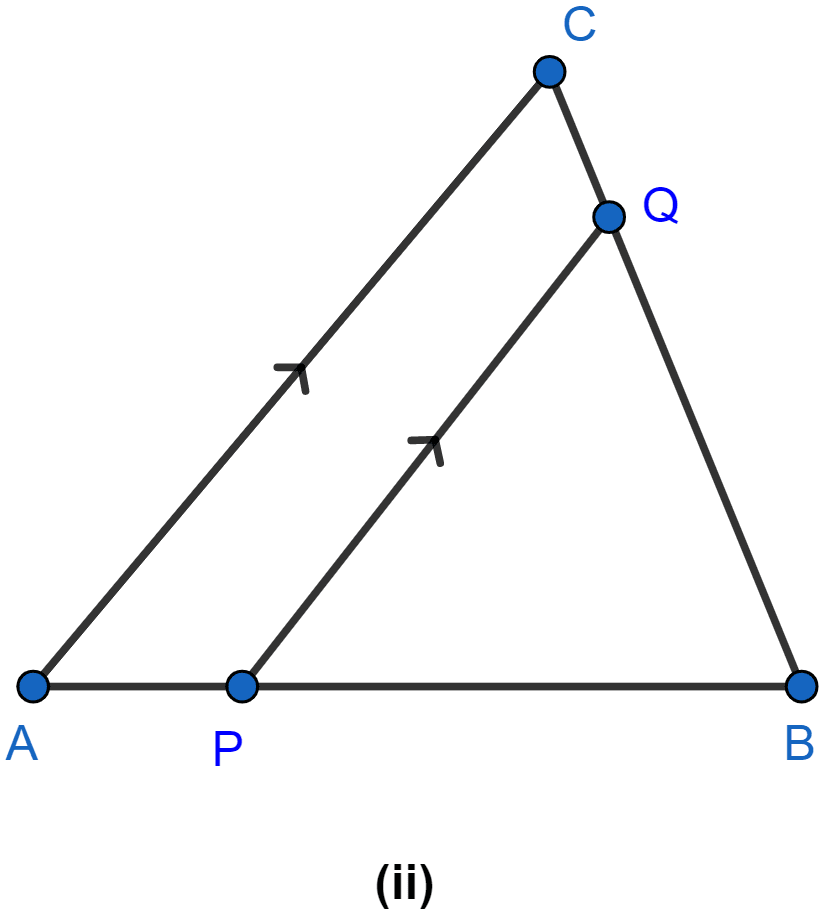
In the figure (ii) given below, PQ ∥ AC, AP = 4 cm, PB = 6 cm and BC = 8 cm, find CQ and BQ.
Answer
Considering △ABC and △PBQ,
∠B = ∠B (Common angle)
∠BPQ = ∠BAC (Corresponding angle are equal)
So, by AA rule of similarity △ABC ~ △PBQ.
∴BCBQ=ABBP⇒8BQ=AP+PB6⇒8BQ=4+66⇒BQ=1048⇒BQ=4.8
CQ = BC - BQ = 8 - 4.8 = 3.2 .
Hence, BQ = 4.8 cm and CQ = 3.2 cm.
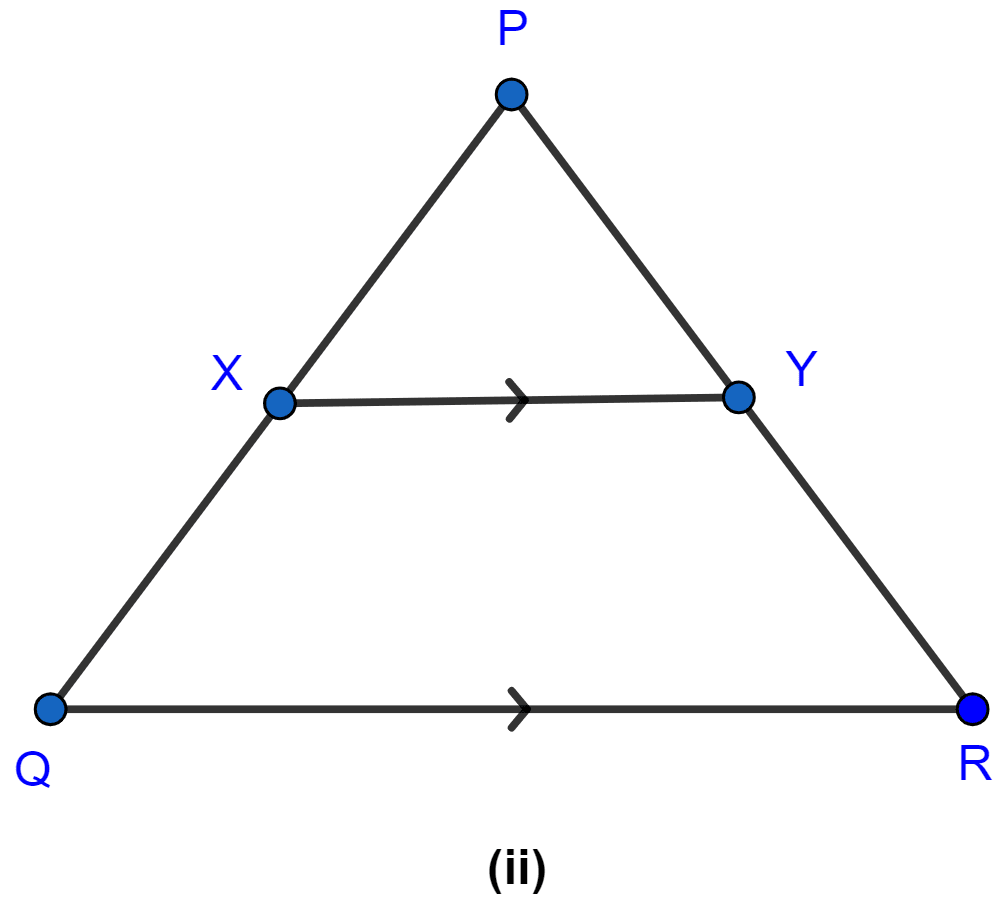
In the figure (iii) given below, if XY ∥ QR, PX = 1 cm, QX = 3 cm, YR = 4.5 cm and QR = 9 cm, find PY and XY.
Answer
Considering △PQR and △PXY,
∠P = ∠P (Common angle)
∠PXY = ∠PQR (Corresponding angles)
So, by AA rule of similarity △PQR ~ △PXY. Since ratio of corresponding sides is same,
∴QXPX=YRPY⇒31=4.5PY⇒PY=34.5⇒PY=1.5
As triangles are similar so ratio of corresponding sides is same,
∴QRXY=PQPX⇒9XY=1+31⇒XY=49⇒XY=2.25
Hence, the value of PY = 1.5 cm and XY = 2.25 cm.
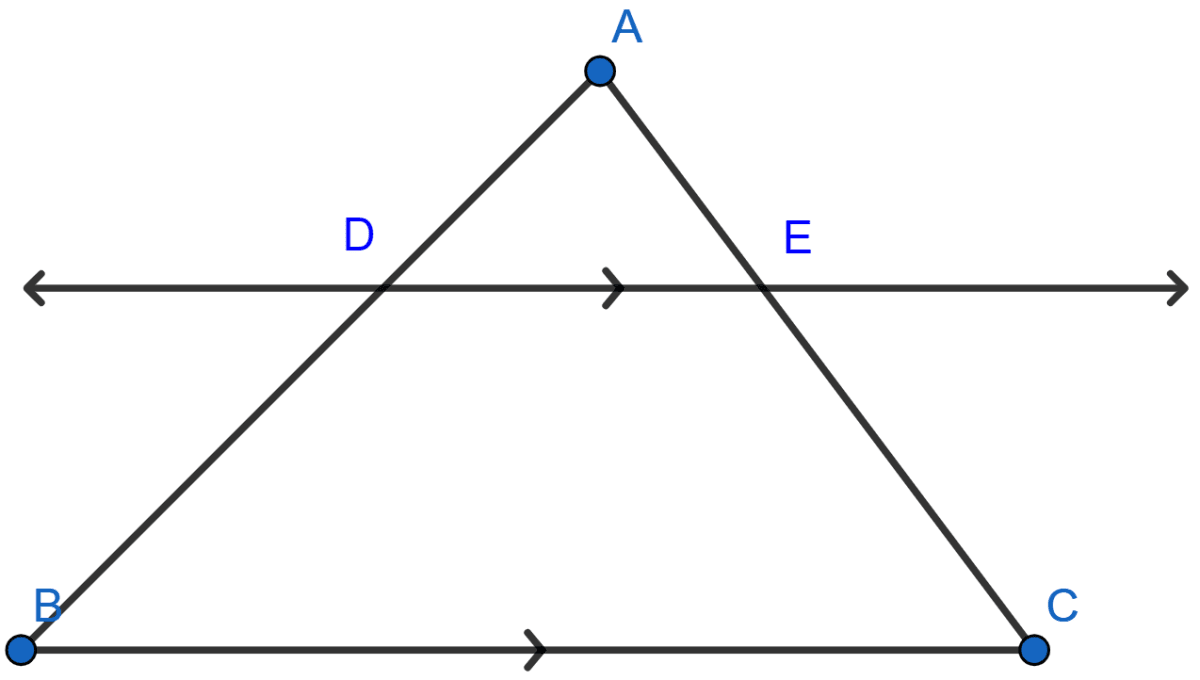
In the adjoining figure, DE ∥ BC.
(i) If AD = x, DB = x - 2, AE = x + 2 and EC = x - 1, find the value of x.
(ii) If DB = x - 3, AB = 2x, EC = x - 2 and AC = 2x + 3, find the value of x.
Answer
(i) Considering △ABC and △ADE,
∠A = ∠A (Common angle)
∠ADE = ∠ABC (Corresponding angles)
So, by AA rule of similarity △ABC ~ △ADE. Since ratio of corresponding sides is same,
∴ABAD=ACAE⇒AD+DBAD=AE+ECAE⇒x+x−2x=x+2+x−1x+2⇒2x−2x=2x+1x+2⇒x(2x+1)=(x+2)(2x−2)⇒2x2+x=2x2−2x+4x−4⇒2x2−2x2+x+2x−4x=4⇒−x=−4⇒x=4.
Hence, the value of x = 4.
(ii) Since, triangles are similar so, ratio of corresponding sides is same,
∴ABAD=ACAE⇒ABAB−DB=ACAC−EC⇒2x2x−(x−3)=2x+32x+3−(x−2)⇒2xx+3=2x+3x+5⇒(x+3)(2x+3)=2x(x+5)⇒2x2+3x+6x+9=2x2+10x⇒2x2−2x2+9=10x−9x⇒x=9
Hence, the value of x = 9.
E and F are points on the sides PQ and PR respectively of a △PQR. For each of the following cases, state whether EF || QR.
(i) PE = 3.9 cm, EQ = 3 cm, PF = 8cm and RF = 9 cm.
(ii) PQ = 1.28 cm, PR = 2.56 cm, PE = 0.18 cm and PF = 0.36 cm.
Answer
(i) So, according to question two triangles will be formed PQR and PEF.
Comparing ratios of corresponding side we get,
⇒PQPE and PRPF⇒PE+EQPE and PF+FRPF⇒3.9+33.9 and 8+98⇒6.93.9 and 178⇒6939 and 178.
Since, both ratios are different hence, EF and QR are not parallel.
(ii) The triangles are shown in the figure below:
Comparing ratios of corresponding side we get,
⇒PQPE and PRPF⇒1.280.18 and 2.560.36⇒12818 and 25636⇒649 and 649.
Since, both ratios are same hence by converse of basic proportionality theorem triangles are similar and so EF and QR are parallel.
A and B are respectively the points on the sides PQ and PR of a triangle PQR such that PQ = 12.5 cm, PA = 5cm, BR = 6 cm and PB = 4 cm. Is AB || QR ? Give reasons for your answer.
Answer
Checking the ratios in order to check the similarity of triangles PAB and PQR.
⇒PQPA and PRPB⇒PQPA and PB+BRPB⇒12.55 and 4+64⇒12550 and 104⇒52 and 52
Since, both ratios (PQPA=PRPB) are same hence by converse of basic proportionality theorem triangles are similar and so AB and QR are parallel.
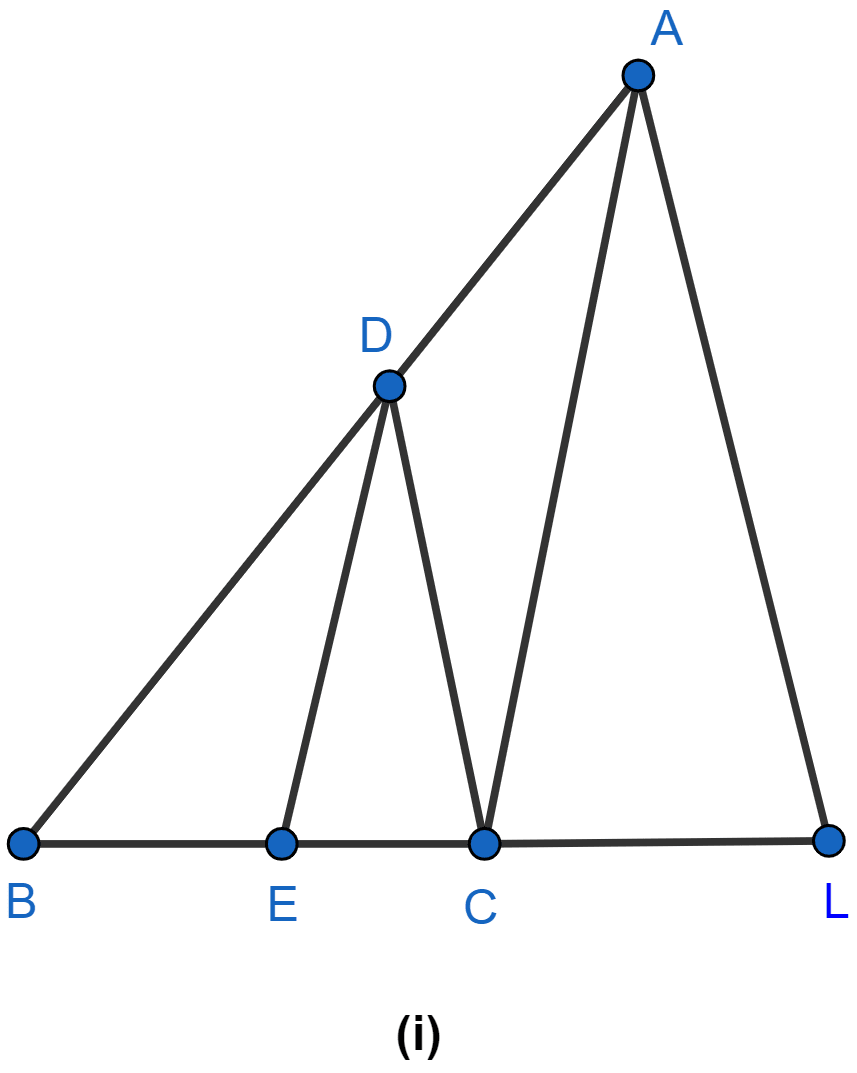
In the figure (i) given below, CD || LA and DE || AC. Find the length of CL if BE = 4 cm and EC = 2 cm.
Answer
Considering △ABC and △BDE,
∠B = ∠B (Common angle)
∠DEB = ∠ACB (Corresponding angles)
So, by AA rule of similarity △ABC ~ △BDE. Since ratio of corresponding sides is same,
⇒BCBE=BABD⇒BE+ECBE=BABD⇒4+24=ABBD⇒64=ABBD[....Eq 1]
Considering △ABL and △BDC,
∠B = ∠B (Common angle)
∠BDC = ∠BAL (Corresponding angles)
So, by AA rule of similarity △ABL ~ △BDC. Since ratio of corresponding sides is same,
⇒BABD=BLBC⇒BABD=BE+EC+CLBE+EC⇒BABD=4+2+CL4+2⇒BABD=6+CL6[....Eq 2]
Solving Eq 1 and Eq 2 we get,
⇒6+CL6=64⇒36=4(6+CL)⇒24+4CL=36⇒4CL=36−24⇒4CL=12⇒CL=3.
Hence, the length of CL is 3 cm.
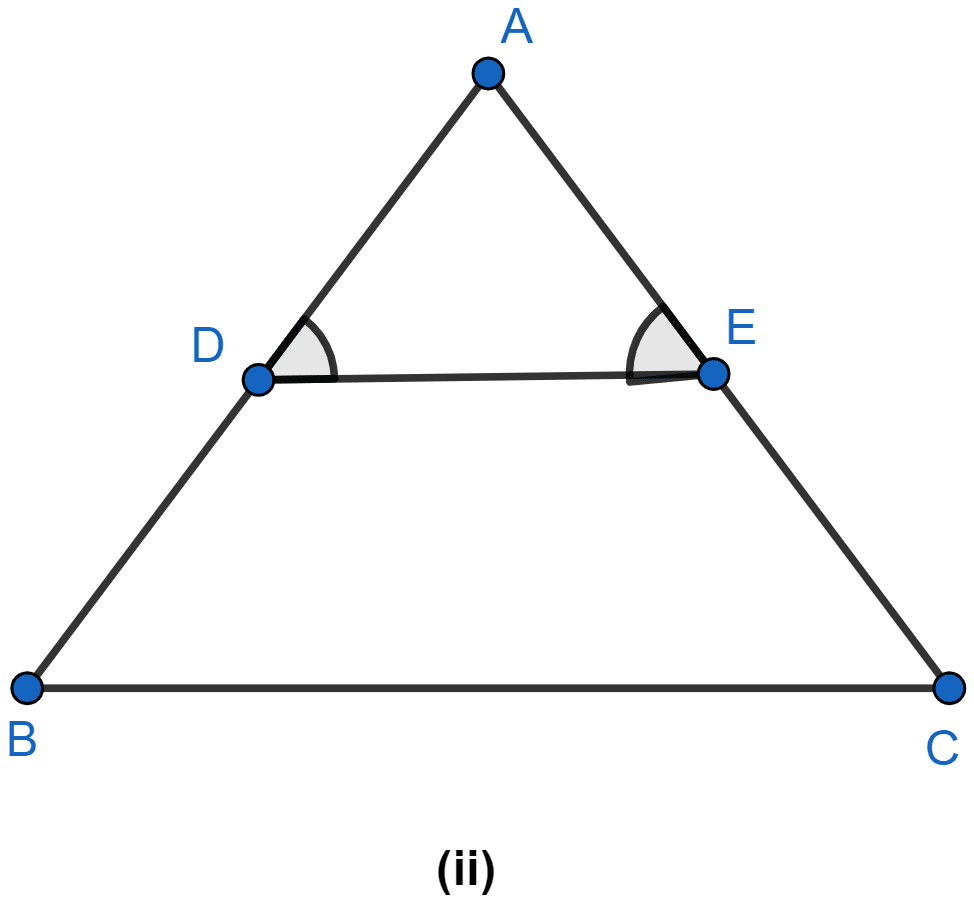
In the figure (ii) given below, ∠D = ∠E and DBAD=ECAE. Prove that ABC is an isosceles triangle.
Answer
Given, ∠D = ∠E
So, AD = AE [Sides opposite to equal angles]
Given, DBAD=ECAE[....Eq 1]
Hence, by basic proportionality theorem, DE is parallel to BC.
As AD = AE so in order to satisfy Eq 1, DB = EC.
AB = AD + DB = AE + EC
and AC = AE + EC.
Hence, AB = AC which means ABC is an isosceles triangle.
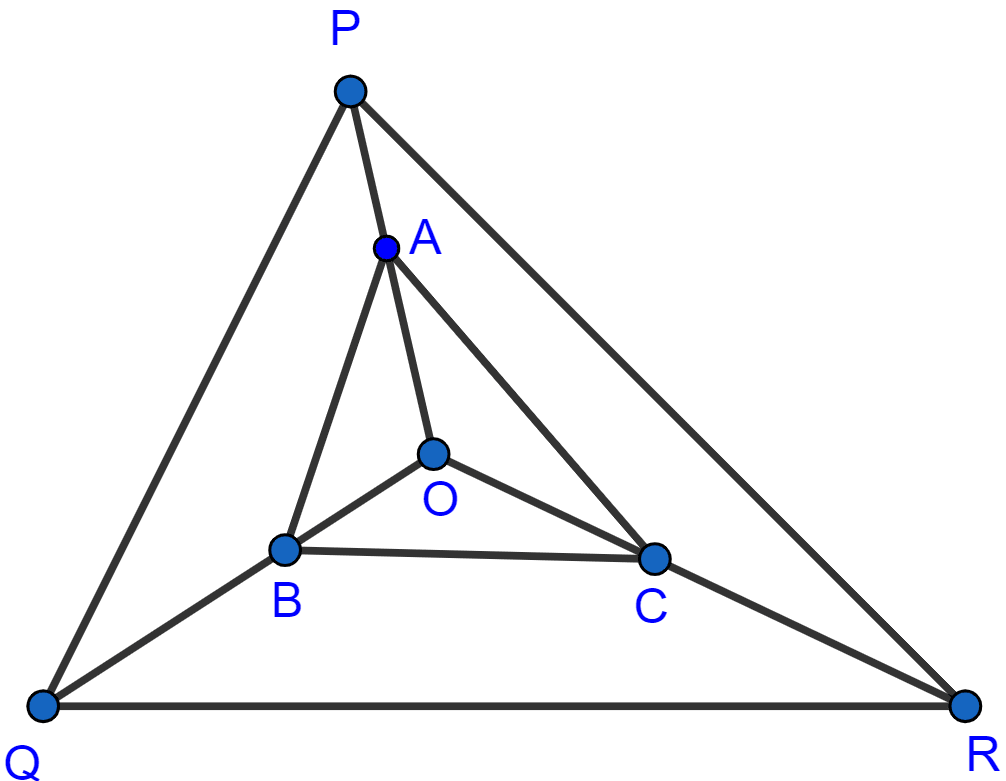
In the adjoining figure, A, B and C are points on OP, OQ and OR respectively such that AB || PQ and AC || PR. Show that BC || QR.
Answer
Consider △POQ
AB || PQ ....[ Given ]
So, By basic proportionality theorem,
APOA=BQOB[....Eq 1]
Then consider △OPR
AC || PR ....[ Given ]
So, By basic proportionality theorem,
APOA=CROC[....Eq 2]
Comparing Eq 1 and Eq 2 we get,
⇒BQOB=CROC
Hence, by basic proportionality theorem BC || QR.
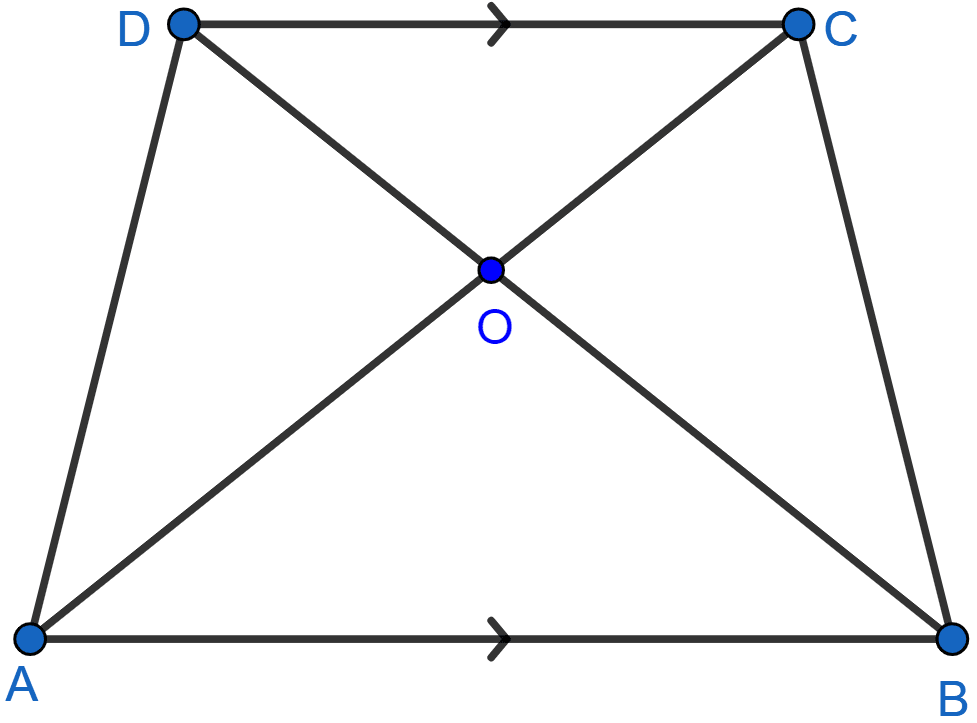
ABCD is a trapezium in which AB || DC and its diagonals intersect each other at O. Using Basic Proportionality theorem prove that BOAO=DOCO.
Answer
Trapezium ABCD is shown in the figure below:
Consider △OAB and △OCD,
∠AOB = ∠COD [Vertically opposite angles are equal]
∠OBA = ∠ODC [Alternate angles are equal]
∠OAB = ∠OCD [Alternate angles are equal]
Therefore, by AA rule of similarity △OAB ~ △OCD,
⇒COAO=DOBO⇒BOAO=DOCO (On cross-multiplication)
Hence, proved that BOAO=DOCO.
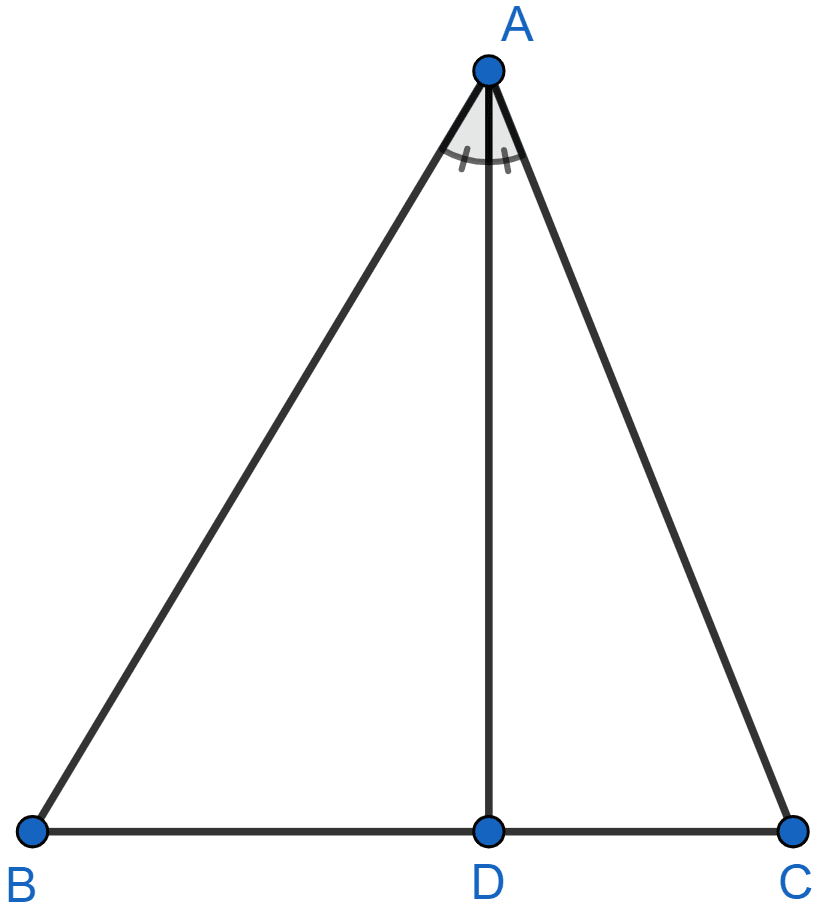
In the adjoining figure, AD is bisector of ∠BAC. If AB = 6 cm, AC = 4 cm and BD = 3 cm, find BC.
Answer
We know that,
The internal bisector of an angle of a triangle divides the opposite side internally in the ratio of the sides containing the angle.
∴DCBD=ACAB.
Putting values in above equation we get,
⇒DC3=46⇒DC=63×4⇒DC=612⇒DC=2 cm.
BC = BD + DC = 3 + 2 = 5 cm.
Hence, the length of BC = 5 cm.