KnowledgeBoat Logo
|
OPEN IN APP

Chapter 13

Similarity — Exercise 13.3

Class - 10 ML Aggarwal Understanding ICSE Mathematics


Exercise 13.3

Question 1

Given that △s ABC and PQR are similar. Find :

(i) the ratio of the area of △ABC to the area of △PQR if their corresponding sides are in the ratio 1 : 3.

(ii) the ratio of their corresponding sides if area of △ABC : area of △PQR = 25 : 36.

Answer

(i) We know that, the ratio of the areas of two similar triangles is equal to the ratio of the square of their corresponding sides.

Area of △ABCArea of △PQR=(1)2(3)2=19=1:9.\therefore \dfrac{\text{Area of △ABC}}{\text{Area of △PQR}} = \dfrac{(1)^2}{(3)^2} \\[1em] = \dfrac{1}{9} \\[1em] = 1 : 9.

Hence, the ratio of area of △ABC to △PQR = 1 : 9.

(ii) Let the corresponding sides be in ratio x : y.

We know that, the ratio of the areas of two similar triangles is equal to the ratio of the square of their corresponding sides.

Area of △ABCArea of △PQR=x2y22536=x2y2(56)2=(xy)2xy=56x:y=5:6.\therefore \dfrac{\text{Area of △ABC}}{\text{Area of △PQR}} = \dfrac{x^2}{y^2} \\[1em] \Rightarrow \dfrac{25}{36} = \dfrac{x^2}{y^2} \\[1em] \Rightarrow \Big(\dfrac{5}{6}\Big)^2 = \Big(\dfrac{x}{y}\Big)^2 \\[1em] \Rightarrow \dfrac{x}{y} = \dfrac{5}{6} \\[1em] \Rightarrow x : y = 5 : 6.

Hence, the ratio of corresponding sides of △ABC and △PQR = 5 : 6.

Question 2

△ABC ~ △DEF. If area of △ABC = 9 sq. cm, area of △DEF = 16 sq. cm and BC = 2.1 cm, find the length of EF.

Answer

Let the length of EF be x cm.

We know that, the ratio of the areas of two similar triangles is equal to the ratio of the square of their corresponding sides.

Area of △ABCArea of △DEF=BC2EF2916=(2.1)2x2916=2.1×2.1x2916=4.41x2x2=4.41×169x2=70.569x2=7.84x=7.84x=2.8\therefore \dfrac{\text{Area of △ABC}}{\text{Area of △DEF}} = \dfrac{BC^2}{EF^2} \\[1em] \Rightarrow \dfrac{9}{16} = \dfrac{(2.1)^2}{x^2} \\[1em] \Rightarrow \dfrac{9}{16} = \dfrac{2.1 \times 2.1}{x^2} \\[1em] \Rightarrow \dfrac{9}{16} = \dfrac{4.41}{x^2} \\[1em] \Rightarrow x^2 = \dfrac{4.41 \times 16}{9} \\[1em] \Rightarrow x^2 = \dfrac{70.56}{9} \\[1em] \Rightarrow x^2 = 7.84 \\[1em] \Rightarrow x = \sqrt{7.84} \\[1em] \Rightarrow x = 2.8

Hence, the length of EF = 2.8 cm.

Question 3

△ABC ~ △DEF. If BC = 3 cm, EF = 4 cm and area of △ABC = 54 sq. cm, determine the area of △DEF.

Answer

Let the area of △DEF be x sq. cm

We know that, the ratio of the areas of two similar triangles is equal to the ratio of the square of their corresponding sides.

Area of △ABCArea of △DEF=BC2EF254x=324254x=916x=54×169x=6×16x=96.\therefore \dfrac{\text{Area of △ABC}}{\text{Area of △DEF}} = \dfrac{BC^2}{EF^2} \\[1em] \Rightarrow \dfrac{54}{x} = \dfrac{3^2}{4^2} \\[1em] \Rightarrow \dfrac{54}{x} = \dfrac{9}{16} \\[1em] \Rightarrow x = \dfrac{54 \times 16}{9} \\[1em] \Rightarrow x = 6 \times 16 \\[1em] \Rightarrow x = 96.

Hence, the area of △DEF = 96 sq. cm.

Question 4

The areas of two similar triangles are 36 cm2 and 25 cm2. If an altitude of the first triangle is 2.4 cm, find the corresponding altitude of the other triangle.

Answer

Let the length of altitude of other △ be x cm

We know that, the ratio of the areas of two similar triangles is equal to the ratio of the square of their corresponding altitudes.

Area of first △Area of second △=(Altitude of first △Altitude of second △)23625=(2.4x)23625=5.76x2x2=5.76×2536x2=14436x2=4x24=0(x2)(x+2)=0x2=0 or x+2=0x=2 or x=2.\therefore \dfrac{\text{Area of first △}}{\text{Area of second △}} = \Big(\dfrac{\text{Altitude of first △}}{\text{Altitude of second △}}\Big)^2 \\[1em] \Rightarrow \dfrac{36}{25} = \Big(\dfrac{2.4}{x}\Big)^2 \\[1em] \Rightarrow \dfrac{36}{25} = \dfrac{5.76}{x^2} \\[1em] \Rightarrow x^2 = \dfrac{5.76 \times 25}{36} \\[1em] \Rightarrow x^2 = \dfrac{144}{36} \\[1em] \Rightarrow x^2 = 4 \\[1em] \Rightarrow x^2 - 4 = 0 \\[1em] \Rightarrow (x - 2)(x + 2) = 0 \\[1em] \Rightarrow x - 2 = 0 \text{ or } x + 2 = 0 \\[1em] \Rightarrow x = 2 \text{ or } x = -2.

Since length cannot be negative so, x ≠ -2.

Hence, the length of altitude of other triangle = 2 cm.

Question 5(a)

In the figure (i) given below, PB and QA are perpendiculars to line segment AB. If PO = 6 cm, OQ = 9 cm and the area of △POB = 120 cm2, find the area of △QOA.

In the figure (i) given below, PB and QA are perpendiculars to line segment AB. If PO = 6 cm, OQ = 9 cm and the area of △POB = 120 cm2, find the area of △QOA. Similarity, ML Aggarwal Understanding Mathematics Solutions ICSE Class 10.

Answer

Considering △QOA and △POB,

∠ QOA = ∠ POB (Vertically opposite angles are equal)
∠ QAO = ∠ PBO (Both are equal to 90°)

Hence, by AA axiom △QOA ~ △POB.

We know that, the ratio of the areas of two similar triangles is equal to the ratio of the square of their corresponding sides.

Let the area of △QOA be x cm2.

Area of △QOAArea of △POB=QO2PO2x120=9262x120=8136x=120×8136x=972036x=270.\therefore \dfrac{\text{Area of △QOA}}{\text{Area of △POB}} = \dfrac{QO^2}{PO^2} \\[1em] \Rightarrow \dfrac{x}{120} = \dfrac{9^2}{6^2} \\[1em] \Rightarrow \dfrac{x}{120} = \dfrac{81}{36} \\[1em] \Rightarrow x = \dfrac{120 \times 81}{36} \\[1em] \Rightarrow x = \dfrac{9720}{36} \\[1em] \Rightarrow x = 270.

Hence, the area of △QOA is 270 cm2

Question 5(b)

In the figure (ii) given below, AB || DC. AO = 10 cm, OC = 5 cm, AB = 6.5 cm and OD = 2.8 cm.

In the figure (ii) given below, AB || DC. AO = 10 cm, OC = 5 cm, AB = 6.5 cm and OD = 2.8 cm. (i) Prove that △OAB ~ △OCD. (ii) Find CD and OB. (iii) Find the ratio of areas of △OAB and △OCD. Similarity, ML Aggarwal Understanding Mathematics Solutions ICSE Class 10.

(i) Prove that △OAB ~ △OCD.

(ii) Find CD and OB.

(iii) Find the ratio of areas of △OAB and △OCD.

Answer

(i) Considering △OAB and △OCD,

∠ AOB = ∠ COD (Vertically opposite angles are equal)
∠ BAO = ∠ OCD (Alternate angles are equal)

Hence, by AA axiom △OAB ~ △OCD.

(ii) Since triangles are similar hence ratio of corresponding sides are equal,

AOOC=ABCD105=6.5CDCD=6.5×510CD=32.510CD=3.25 cm.\therefore \dfrac{AO}{OC} = \dfrac{AB}{CD} \\[1em] \Rightarrow \dfrac{10}{5} = \dfrac{6.5}{CD} \\[1em] \Rightarrow CD = \dfrac{6.5 \times 5}{10} \\[1em] \Rightarrow CD = \dfrac{32.5}{10} \\[1em] \Rightarrow CD = 3.25 \text{ cm}.

Similarly,

AOOC=OBOD105=OB2.8OB=2.8×10⁵OB=285OB=5.6 cm.\dfrac{AO}{OC} = \dfrac{OB}{OD} \\[1em] \Rightarrow \dfrac{10}{5} = \dfrac{OB}{2.8} \\[1em] \Rightarrow OB = \dfrac{2.8 \times 10}{5} \\[1em] \Rightarrow OB = \dfrac{28}{5} \\[1em] \Rightarrow OB = 5.6 \text{ cm.}

Hence, the length of CD = 3.25 cm and OB = 5.6 cm.

(iii) In part (i) we have proved that △OAB ~ △OCD.

We know that, the ratio of the areas of two similar triangles is equal to the ratio of the square of their corresponding sides.

Area of △OABArea of △OCD=AO2OC2=10252=10025=41=4:1.\therefore \dfrac{\text{Area of △OAB}}{\text{Area of △OCD}} = \dfrac{AO^2}{OC^2} \\[1em] = \dfrac{10^2}{5^2} \\[1em] = \dfrac{100}{25} \\[1em] = \dfrac{4}{1} \\[1em] = 4 : 1.

Hence, the ratio of area of △OAB and △OCD is 4 : 1.

Question 6(a)

In the figure (i) given below, DE || BC. If DE = 6 cm, BC = 9 cm and area of △ADE = 28 sq. cm, find the area of △ABC.

In the figure (i) given below, DE || BC. If DE = 6 cm, BC = 9 cm and area of △ADE = 28 sq. cm, find the area of △ABC. Similarity, ML Aggarwal Understanding Mathematics Solutions ICSE Class 10.

Answer

Considering △ADE and △ABC,

∠ A = ∠ A (Common angles)
∠ ADE = ∠ ABC (Corresponding angles are equal)

Hence, by AA axiom △ADE ~ △ABC.

We know that, the ratio of the areas of two similar triangles is equal to the ratio of the square of their corresponding sides.

Let the area of △ABC be x cm2.

Area of △ADEArea of △ABC=DE2BC228x=629228x=3681x=28×8136x=226836x=63.\therefore \dfrac{\text{Area of △ADE}}{\text{Area of △ABC}} = \dfrac{DE^2}{BC^2} \\[1em] \Rightarrow \dfrac{28}{x} = \dfrac{6^2}{9^2} \\[1em] \Rightarrow \dfrac{28}{x} = \dfrac{36}{81} \\[1em] \Rightarrow x = \dfrac{28 \times 81}{36} \\[1em] \Rightarrow x = \dfrac{2268}{36} \\[1em] \Rightarrow x = 63.

Hence, area of △ABC is 63 cm2.

Question 6(b)

In the figure (ii) given below, DE || BC and AD : DB = 1 : 2, find the ratio of the areas of △ADE and trapezium DBCE.

In the figure (ii) given below, DE || BC and AD : DB = 1 : 2, find the ratio of the areas of △ADE and trapezium DBCE. Similarity, ML Aggarwal Understanding Mathematics Solutions ICSE Class 10.

Answer

Considering △ADE and △ABC,

∠ A = ∠ A (Common angles)
∠ ADE = ∠ ABC (Corresponding angles are equal)

Hence, by AA axiom △ADE ~ △ABC.

Given AD : DB = 1 : 2.

ADABAD=122AD=ABAD2AD+AD=AB3AD=ABADAB=13AD:AB=1:3.\Rightarrow \dfrac{AD}{AB - AD} = \dfrac{1}{2} \\[1em] \Rightarrow 2AD = AB - AD \\[1em] \Rightarrow 2AD + AD = AB \\[1em] \Rightarrow 3AD = AB \\[1em] \Rightarrow \dfrac{AD}{AB} = \dfrac{1}{3} \\[1em] \Rightarrow AD : AB = 1 : 3.

We know that, the ratio of the areas of two similar triangles is equal to the ratio of the square of their corresponding sides.

Area of △ADEArea of △ABC=AD2AB2Area of △ADEArea of △ADE + Area of ⏢DBCE=1232Area of △ADEArea of △ADE + Area of ⏢DBCE=199×Area of △ADE=Area of △ADE + Area of ⏢DBCE8 Area of △ADE= Area of ⏢DBCE Area of △ADE Area of ⏢DBCE =18=1:8.\therefore \dfrac{\text{Area of △ADE}}{\text{Area of △ABC}} = \dfrac{AD^2}{AB^2} \\[1em] \Rightarrow \dfrac{\text{Area of △ADE}}{\text{Area of △ADE + Area of ⏢DBCE}} = \dfrac{1^2}{3^2} \\[1em] \Rightarrow \dfrac{\text{Area of △ADE}}{\text{Area of △ADE + Area of ⏢DBCE}} = \dfrac{1}{9} \\[1em] \Rightarrow 9 \times \text{Area of △ADE} = \text{Area of △ADE + Area of ⏢DBCE} \\[1em] \Rightarrow 8 \text{ Area of △ADE} = \text{ Area of ⏢DBCE } \\[1em] \Rightarrow \dfrac{\text{Area of △ADE}}{\text{ Area of ⏢DBCE }} = \dfrac{1}{8} = 1 : 8.

Hence, the ratio of the areas of △ADE and trapezium DBCE is 1 : 8.

Question 7

In the given figure, DE || BC.

In the given figure, DE || BC. (i) Prove that △ADE and △ABC are similar. (ii) Given that AD = 1/2BD, calculate DE, if BC = 4.5 cm. (iii) If area of △ABC = 18 cm^2, find area of trapezium DBCE. Similarity, ML Aggarwal Understanding Mathematics Solutions ICSE Class 10.

(i) Prove that △ADE and △ABC are similar.

(ii) Given that AD = 12\dfrac{1}{2}BD, calculate DE, if BC = 4.5 cm.

(iii) If area of △ABC = 18 cm2, find area of trapezium DBCE.

Answer

(i) Considering △ADE and △ABC,

∠ A = ∠ A (Common angles)
∠ ADE = ∠ ABC (Corresponding angles are equal)

Hence, by AA axiom △ADE ~ △ABC.

(ii) Given AD = 12\dfrac{1}{2}BD

AD=12(ABAD)2AD=ABAD2AD+AD=AB3AD=ABADAB=13AD:AB=1:3.\Rightarrow AD = \dfrac{1}{2}(AB - AD) \\[1em] \Rightarrow 2AD = AB - AD \\[1em] \Rightarrow 2AD + AD = AB \\[1em] \Rightarrow 3AD = AB \\[1em] \Rightarrow \dfrac{AD}{AB} = \dfrac{1}{3} \\[1em] \Rightarrow AD : AB = 1 : 3.

Since triangles ADE and ABC are similar so, ratio of their corresponding sides will be equal

ADAB=DEBC13=DE4.5DE=4.53DE=1.5\therefore \dfrac{AD}{AB} = \dfrac{DE}{BC} \\[1em] \Rightarrow \dfrac{1}{3} = \dfrac{DE}{4.5}\\[1em] \Rightarrow DE = \dfrac{4.5}{3} \\[1em] \Rightarrow DE = 1.5

Hence, the length of DE = 1.5 cm.

(iii) We know that, the ratio of the areas of two similar triangles is equal to the ratio of the square of their corresponding sides.

Area of △ADEArea of △ABC=AD2AB2Area of △ADEArea of △ABC=1232Area of △ADE=19× Area of △ABCArea of △ADE=19×18Area of △ADE=2 cm2\therefore \dfrac{\text{Area of △ADE}}{\text{Area of △ABC}} = \dfrac{AD^2}{AB^2} \\[1em] \Rightarrow \dfrac{\text{Area of △ADE}}{\text{Area of △ABC}} = \dfrac{1^2}{3^2} \\[1em] \Rightarrow \text{Area of △ADE} = \dfrac{1}{9} \times \text{ Area of △ABC} \\[1em] \Rightarrow \text{Area of △ADE} = \dfrac{1}{9} \times 18 \\[1em] \Rightarrow \text{Area of △ADE} = 2 \text{ cm}^2

Area of trapezium DBCE = Area of △ABC - Area of △ADE = (18 - 2) cm2 = 16 cm2.

Hence, the area of trapezium DBCE = 16 cm2.

Question 8

In the given figure, AB and DE are perpendiculars to BC.

In the given figure, AB and DE are perpendiculars to BC. (i) Prove that △ABC ~ △DEC. (ii) If AB = 6 cm, DE = 4 cm and AC = 15 cm, calculate CD. (iii) Find the ratio of the area of △ABC : area of △DEC. Similarity, ML Aggarwal Understanding Mathematics Solutions ICSE Class 10.

(i) Prove that △ABC ~ △DEC.

(ii) If AB = 6 cm, DE = 4 cm and AC = 15 cm, calculate CD.

(iii) Find the ratio of the area of △ABC : area of △DEC.

Answer

(i) Considering △DEC and △ABC,

∠ C = ∠ C (Common angles)
∠ ABC = ∠ DEC (Both angles are equal to 90°)

Hence, by AA axiom △DEC ~ △ABC.

(ii) Since △DEC ~ △ABC, so, ratio of their corresponding sides will be equal

ABDE=ACCD64=15CDCD=15×46CD=10 cm\therefore \dfrac{AB}{DE} = \dfrac{AC}{CD} \\[1em] \Rightarrow \dfrac{6}{4} = \dfrac{15}{CD} \\[1em] \Rightarrow CD = \dfrac{15 \times 4}{6} \\[1em] \Rightarrow CD = 10 \text{ cm}

Hence, the length of CD = 10 cm.

(iii) We know that, the ratio of the areas of two similar triangles is equal to the ratio of the square of their corresponding sides.

Area of △ABCArea of △DEC=AB2DE2Area of △ABCArea of △DEC=6242Area of △ABCArea of △DEC=3616Area of △ABCArea of △DEC=94.\therefore \dfrac{\text{Area of △ABC}}{\text{Area of △DEC}} = \dfrac{AB^2}{DE^2} \\[1em] \Rightarrow \dfrac{\text{Area of △ABC}}{\text{Area of △DEC}} = \dfrac{6^2}{4^2} \\[1em] \Rightarrow \dfrac{\text{Area of △ABC}}{\text{Area of △DEC}} = \dfrac{36}{16} \\[1em] \Rightarrow \dfrac{\text{Area of △ABC}}{\text{Area of △DEC}} = \dfrac{9}{4} \\[1em].

Hence, the ratio of the area of △ABC : area of △DEC = 9 : 4.

Question 9

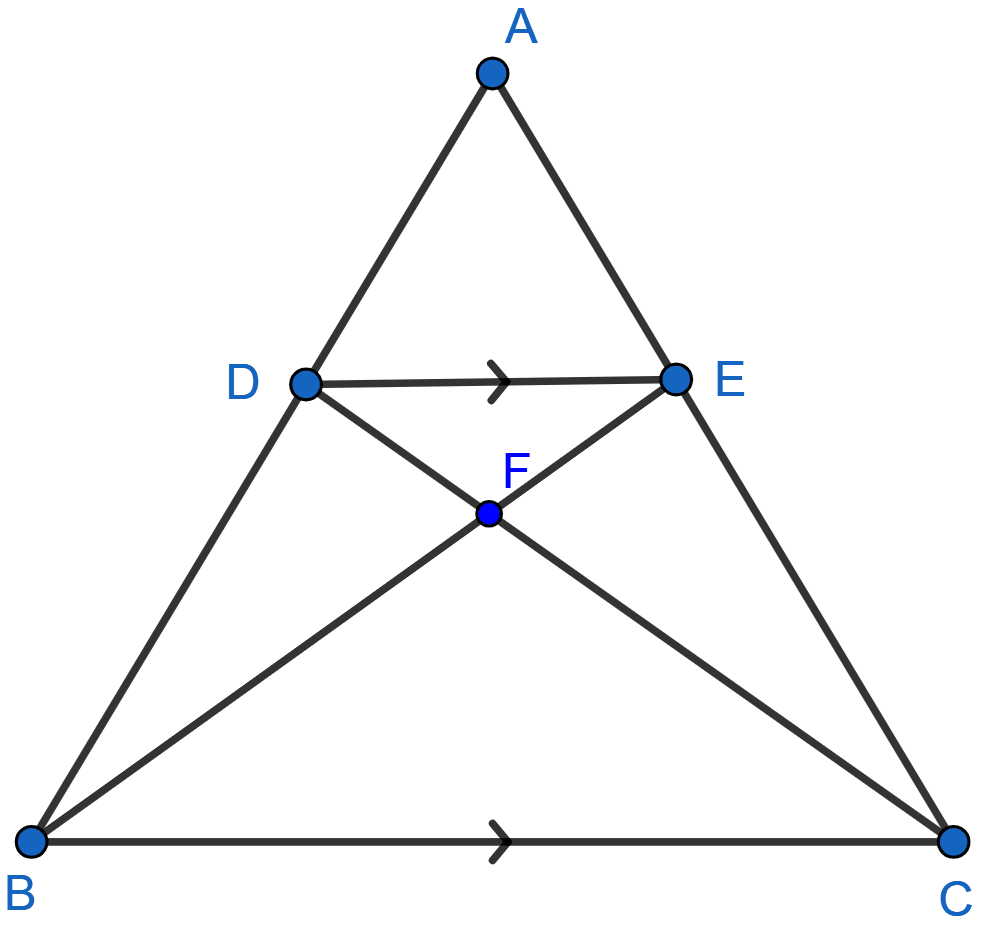
In the adjoining figure, ABC is a triangle. DE is parallel to BC and ADDB=32.\dfrac{AD}{DB} = \dfrac{3}{2}.

(i) Determine the ratio ADAB,DEBC.\dfrac{AD}{AB}, \dfrac{DE}{BC}.

(ii) Prove that △DEF is similar to △CBF. Hence, find EFFB.\dfrac{EF}{FB}.

(iii) What is the ratio of the areas of △DEF and △CBF ?

In the adjoining figure, ABC is a triangle. DE is parallel to BC and AD/DB = 3/2. Determine the ratio AD/AB, DE/BC. Prove that △DEF is similar to △CBF. Hence, find EF/FB. What is the ratio of the areas of △DEF and △CBF? Similarity, ML Aggarwal Understanding Mathematics Solutions ICSE Class 10.

Answer

(i) We need to find ADAB\dfrac{AD}{AB},

Given,

ADDB=32ADABAD=322AD=3(ABAD)2AD=3AB3AD5AD=3ABADAB=35.\dfrac{AD}{DB} = \dfrac{3}{2} \\[1em] \Rightarrow \dfrac{AD}{AB - AD} = \dfrac{3}{2} \\[1em] \Rightarrow 2AD = 3(AB - AD) \\[1em] \Rightarrow 2AD = 3AB - 3AD \\[1em] \Rightarrow 5AD = 3AB \\[1em] \Rightarrow \dfrac{AD}{AB} = \dfrac{3}{5}.

Hence, the ratio ADAB=35\dfrac{AD}{AB} = \dfrac{3}{5}.

Considering △ADE and △ABC,

∠ A = ∠ A (Common angles)
∠ ADE = ∠ ABC (Corresponding angles are equal)

Hence, by AA axiom △ADE ~ △ABC.

Since triangles ADE and ABC are similar so the ratio of corresponding sides will be equal.

DEBC=ADABDEBC=35.\therefore \dfrac{DE}{BC} = \dfrac{AD}{AB} \\[1em] \Rightarrow \dfrac{DE}{BC} = \dfrac{3}{5}.

Hence, the ratio DEBC=35\dfrac{DE}{BC} = \dfrac{3}{5}.

(ii) Considering △DEF and △CBF,

∠ DFE = ∠ BFC (Vertically opposite angles)
∠ EDF = ∠ FCB (Alternate angles are equal)

Hence, by AA axiom △DEF ~ △CBF.

Since triangles are similar hence the ratio of the corresponding sides will be equal,

EFFB=DEBCEFFB=35.\therefore \dfrac{EF}{FB} = \dfrac{DE}{BC} \\[1em] \Rightarrow \dfrac{EF}{FB} = \dfrac{3}{5}.

Hence, the value of EFFB=35.\dfrac{EF}{FB} = \dfrac{3}{5}.

(iii) We know that, the ratio of the areas of two similar triangles is equal to the ratio of the square of their corresponding sides.

Area of △DEFArea of △CBF=EF2FB2Area of △DEFArea of △CBF=3252Area of △DEFArea of △CBF=925.\therefore \dfrac{\text{Area of △DEF}}{\text{Area of △CBF}} = \dfrac{EF^2}{FB^2} \\[1em] \Rightarrow \dfrac{\text{Area of △DEF}}{\text{Area of △CBF}} = \dfrac{3^2}{5^2} \\[1em] \Rightarrow \dfrac{\text{Area of △DEF}}{\text{Area of △CBF}} = \dfrac{9}{25}.

Hence, the ratio of the area of △DEF : area of △CBF = 9 : 25.

Question 10

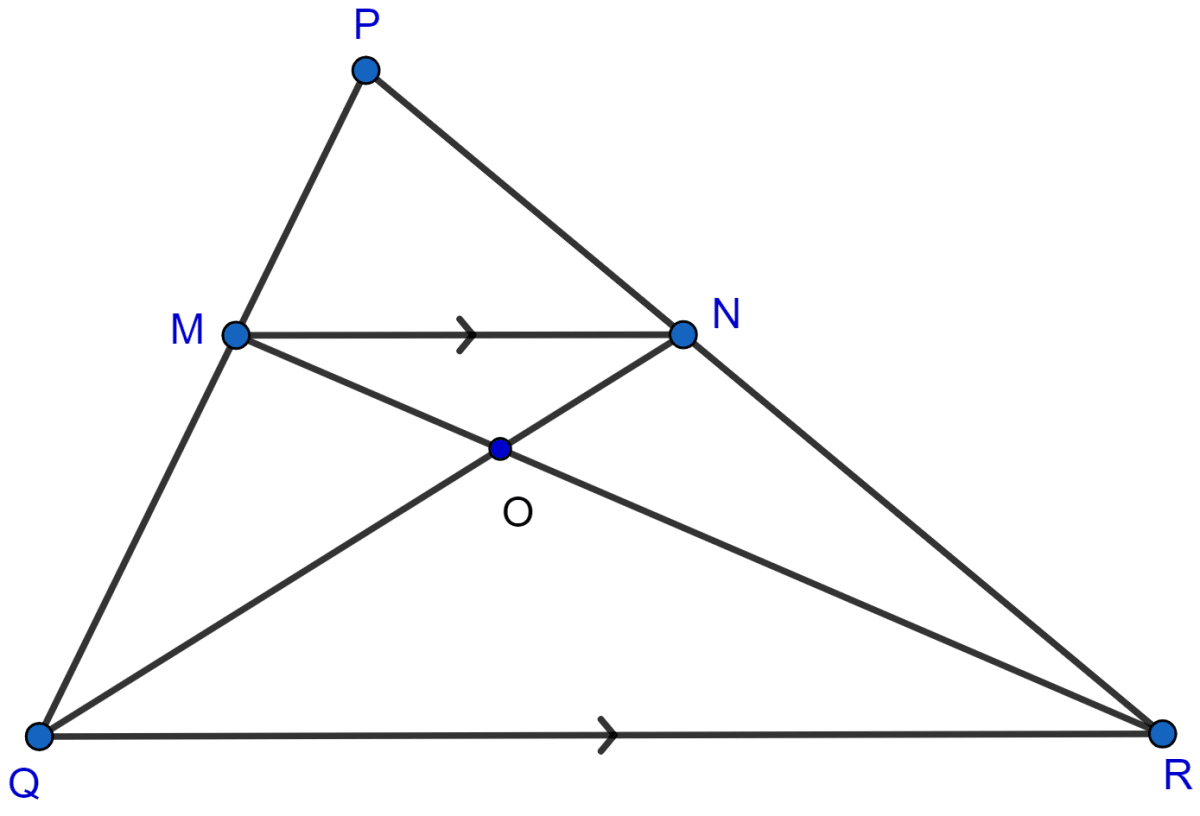
In △PQR, MN is parallel to QR and PMMQ=23.\dfrac{PM}{MQ} = \dfrac{2}{3}.

(i) Find MNQR\dfrac{MN}{QR}.

(ii) Prove that △OMN and △ORQ are similar.

(iii) Find area of △OMN : area of △ORQ.

In △PQR, MN is parallel to QR and PM/MQ = 2/3. (i) Find MN/QR (ii) Prove that △OMN and △ORQ are similar. (iii) Find area of △OMN : area of △ORQ. Similarity, ML Aggarwal Understanding Mathematics Solutions ICSE Class 10.

Answer

(i) Considering △PMN and △PQR,

∠ P = ∠ P (Common angles)
∠ PMN = ∠ PQR (Corresponding angles are equal)

Hence, by AA axiom △PMN ~ △PQR.

Given,

PMMQ=23PMPQPM=233PM=2(PQPM)3PM=2PQ2PM3PM+2PM=2PQ5PM=2PQPMPQ=25.\dfrac{PM}{MQ} = \dfrac{2}{3} \\[1em] \Rightarrow \dfrac{PM}{PQ - PM} = \dfrac{2}{3} \\[1em] \Rightarrow 3PM = 2(PQ - PM) \\[1em] \Rightarrow 3PM = 2PQ - 2PM \\[1em] \Rightarrow 3PM + 2PM = 2PQ \\[1em] \Rightarrow 5PM = 2PQ \\[1em] \Rightarrow \dfrac{PM}{PQ} = \dfrac{2}{5}.

Since triangles are similar hence the ratio of the corresponding sides will be equal,

MNQR=PMPQ=25.\therefore \dfrac{MN}{QR} = \dfrac{PM}{PQ} = \dfrac{2}{5}.

Hence, MNQR=25\dfrac{MN}{QR} = \dfrac{2}{5}

(ii) Considering △OMN and △ORQ,

∠ MON = ∠ QOR (Vertically opposite angles are equal)
∠ OMN = ∠ ORQ (Alternate angles are equal)

Hence, by AA axiom △OMN ~ △ORQ.

(iii) We know that, the ratio of the areas of two similar triangles is equal to the ratio of the square of their corresponding sides.

Area of △OMNArea of △ORQ=MN2QR2Area of △OMNArea of △ORQ=2252Area of △OMNArea of △ORQ=425.\therefore \dfrac{\text{Area of △OMN}}{\text{Area of △ORQ}} = \dfrac{MN^2}{QR^2} \\[1em] \Rightarrow \dfrac{\text{Area of △OMN}}{\text{Area of △ORQ}} = \dfrac{2^2}{5^2} \\[1em] \Rightarrow \dfrac{\text{Area of △OMN}}{\text{Area of △ORQ}} = \dfrac{4}{25}.

Hence, the ratio of the Area of △OMN : Area of △ORQ = 4 : 25.

Question 11

In △ABC, AP : PB = 2 : 3. PO is parallel to BC and is extended to Q so that CQ is parallel to BA. Find :

(i) area △APO : area △ABC

(ii) area △APO : area △CQO.

In △ABC, AP : PB = 2 : 3. PO is parallel to BC and is extended to Q so that CQ is parallel to BA. Find (i) area △APO : area △ABC (ii) area △APO : area △CQO. Similarity, ML Aggarwal Understanding Mathematics Solutions ICSE Class 10.

Answer

(i) Given,

APPB=23APABAP=233AP=2(ABAP)3AP=2AB2AP3AP+2AP=2AB5AP=2ABAPAB=25.\dfrac{AP}{PB} = \dfrac{2}{3} \\[1em] \Rightarrow \dfrac{AP}{AB - AP} = \dfrac{2}{3} \\[1em] \Rightarrow 3AP = 2(AB - AP) \\[1em] \Rightarrow 3AP = 2AB - 2AP \\[1em] \Rightarrow 3AP + 2AP = 2AB \\[1em] \Rightarrow 5AP = 2AB \\[1em] \Rightarrow \dfrac{AP}{AB} = \dfrac{2}{5}.

Considering △APO and △ABC,

∠ A = ∠ A (Common angles)
∠ APO = ∠ ABC (Corresponding angles are equal)

Hence, by AA axiom △APO ~ △ABC.

We know that, the ratio of the areas of two similar triangles is equal to the ratio of the square of their corresponding sides.

Area of △APOArea of △ABC=AP2AB2Area of △APOArea of △ABC=2252Area of △APOArea of △ABC=425.\therefore \dfrac{\text{Area of △APO}}{\text{Area of △ABC}} = \dfrac{AP^2}{AB^2} \\[1em] \Rightarrow \dfrac{\text{Area of △APO}}{\text{Area of △ABC}} = \dfrac{2^2}{5^2} \\[1em] \Rightarrow \dfrac{\text{Area of △APO}}{\text{Area of △ABC}} = \dfrac{4}{25}.

Hence, the ratio of the area of △APO : area of △ABC = 4 : 25.

(ii) In parallelogram PBCQ opposite sides are equal,

so, PB = QC. Hence, APQC=APPB=23\dfrac{AP}{QC} = \dfrac{AP}{PB} = \dfrac{2}{3}.

Considering △APO and △CQO,

∠ AOP = ∠ QOC (Vertically opposite angles)
∠ OAP = ∠ OCQ (Alternate angles are equal)

Hence, by AA axiom △APO ~ △CQO.

We know that, the ratio of the areas of two similar triangles is equal to the ratio of the square of their corresponding sides.

Area of △APOArea of △CQO=AP2QC2Area of △APOArea of △CQO=(APQC)2Area of △APOArea of △CQO=(23)2=49.\therefore \dfrac{\text{Area of △APO}}{\text{Area of △CQO}} = \dfrac{AP^2}{QC^2} \\[1em] \Rightarrow \dfrac{\text{Area of △APO}}{\text{Area of △CQO}} = \Big(\dfrac{AP}{QC}\Big)^2 \\[1em] \Rightarrow \dfrac{\text{Area of △APO}}{\text{Area of △CQO}} = \Big(\dfrac{2}{3}\Big)^2 = \dfrac{4}{9}.

Hence, the ratio of the area of △APO : area of △CQO = 4 : 9.

Question 12(a)

In the figure (i) given below, ABCD is a trapezium in which AB || DC and AB = 2 CD. Determine the ratio of the areas of △AOB and △COD.

In the figure (i) given below, ABCD is a trapezium in which AB || DC and AB = 2 CD. Determine the ratio of the areas of △AOB and △COD. Similarity, ML Aggarwal Understanding Mathematics Solutions ICSE Class 10.

Answer

Given, AB || DC and AB = 2CD.

ABCD=21\therefore \dfrac{AB}{CD} = \dfrac{2}{1}.

Considering △AOB and △COD,

∠ AOB = ∠ COD (Vertically opposite angles)
∠ OCD = ∠ OAB (Alternate angles are equal)

Hence, by AA axiom △AOB ~ △COD.

We know that, the ratio of the areas of two similar triangles is equal to the ratio of the square of their corresponding sides.

Area of △AOBArea of △COD=AB2CD2Area of △AOBArea of △COD=2212Area of △AOBArea of △COD=41.\therefore \dfrac{\text{Area of △AOB}}{\text{Area of △COD}} = \dfrac{AB^2}{CD^2} \\[1em] \Rightarrow \dfrac{\text{Area of △AOB}}{\text{Area of △COD}} = \dfrac{2^2}{1^2} \\[1em] \Rightarrow \dfrac{\text{Area of △AOB}}{\text{Area of △COD}} = \dfrac{4}{1}.

Hence, the ratio of the area of △AOB : area of △COD = 4 : 1.

Question 12(b)

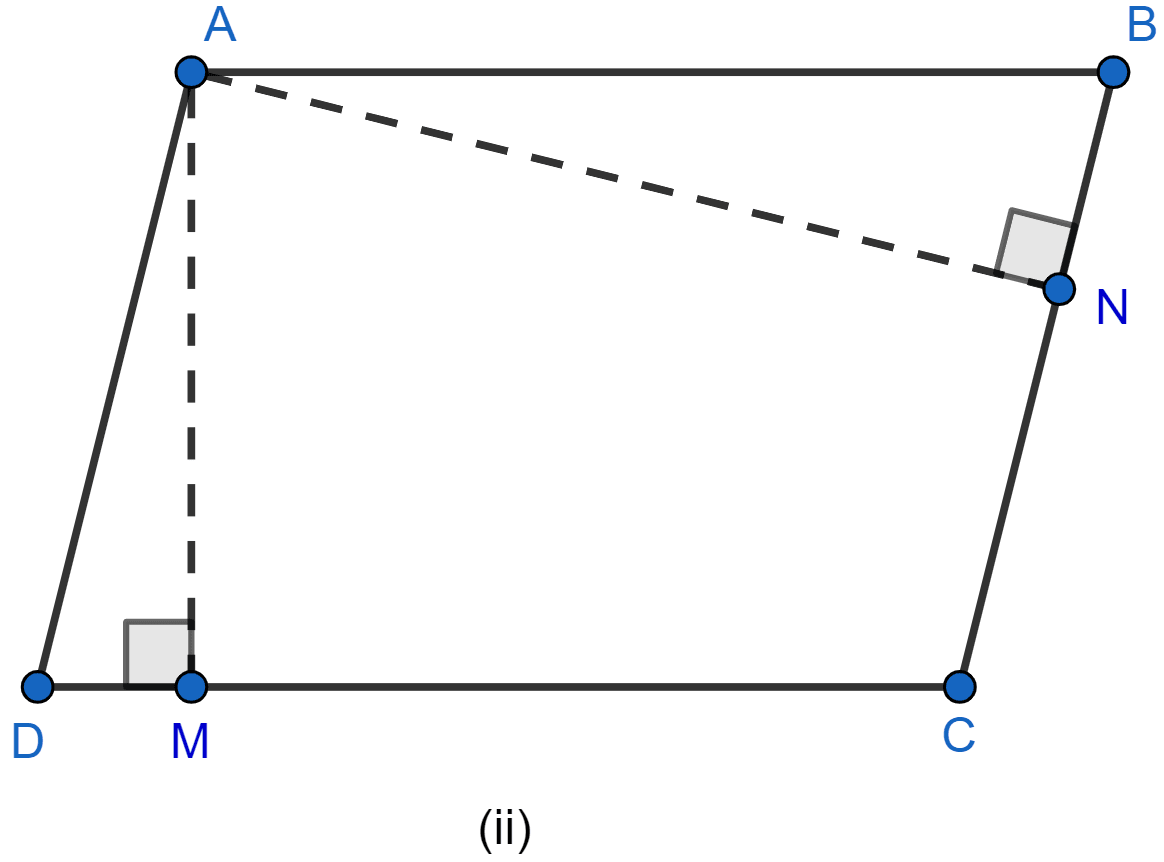
In the figure (ii) given below, ABCD is a parallelogram. AM ⊥ DC and AN ⊥ CB. If AM = 6 cm, AN = 10 cm and the area of parallelogram ABCD is 45 cm2, find

(i) AB

(ii) BC

(iii) area of △ADM : area of △ANB.

In the figure (ii) given below, ABCD is a parallelogram. AM ⊥ DC and AN ⊥ CB. If AM = 6 cm, AN = 10 cm and the area of parallelogram ABCD is 45 cm2, find AB, BC, area of △ADM : area of △ANB. Similarity, ML Aggarwal Understanding Mathematics Solutions ICSE Class 10.

Answer

(i) Given, AM = 6 cm and AN = 10 cm and area of parallelogram ABCD is 45 cm2.

Area of parallelogram = base x height = CD x AM = BC x AN.

AM×CD=456×CD=45CD=456CD=152CD=7.5\therefore AM \times CD = 45 \\[1em] \Rightarrow 6 \times CD = 45 \\[1em] \Rightarrow CD = \dfrac{45}{6} \\[1em] \Rightarrow CD = \dfrac{15}{2} \\[1em] \Rightarrow CD = 7.5

In parallelogram AB = CD = 7.5 cm.

Hence, the length of AB = 7.5 cm.

(ii) Given, AM = 6 cm and AN = 10 cm and area of parallelogram ABCD is 45 cm2.

Area of parallelogram = base x height = CD x AM = BC x AN.

AN×BC=4510×BC=45BC=4510BC=4.5\therefore AN \times BC = 45 \\[1em] \Rightarrow 10 \times BC = 45 \\[1em] \Rightarrow BC = \dfrac{45}{10} \\[1em] \Rightarrow BC = 4.5

Hence, the length of BC = 4.5 cm.

(iii) Considering △ADM and △ABN,

∠ ADM = ∠ ABN (Opposite angles of a parallelogram are equal)
∠ AMD = ∠ ANB (Both angles are equal to 90°)

Hence, by AA axiom △ADM ~ △ANB.

We know that, the ratio of the areas of two similar triangles is equal to the ratio of the square of their corresponding sides.

Area of △ADMArea of △ANB=AM2AN2Area of △ADMArea of △ANB=62102Area of △ADMArea of △ANB=36100Area of △ADMArea of △ANB=925\therefore \dfrac{\text{Area of △ADM}}{\text{Area of △ANB}} = \dfrac{AM^2}{AN^2} \\[1em] \Rightarrow \dfrac{\text{Area of △ADM}}{\text{Area of △ANB}} = \dfrac{6^2}{10^2} \\[1em] \Rightarrow \dfrac{\text{Area of △ADM}}{\text{Area of △ANB}} = \dfrac{36}{100} \\[1em] \Rightarrow \dfrac{\text{Area of △ADM}}{\text{Area of △ANB}} = \dfrac{9}{25}

Hence, the ratio of the area of △ADM : area of △ANB = 9 : 25.

Question 12(c)

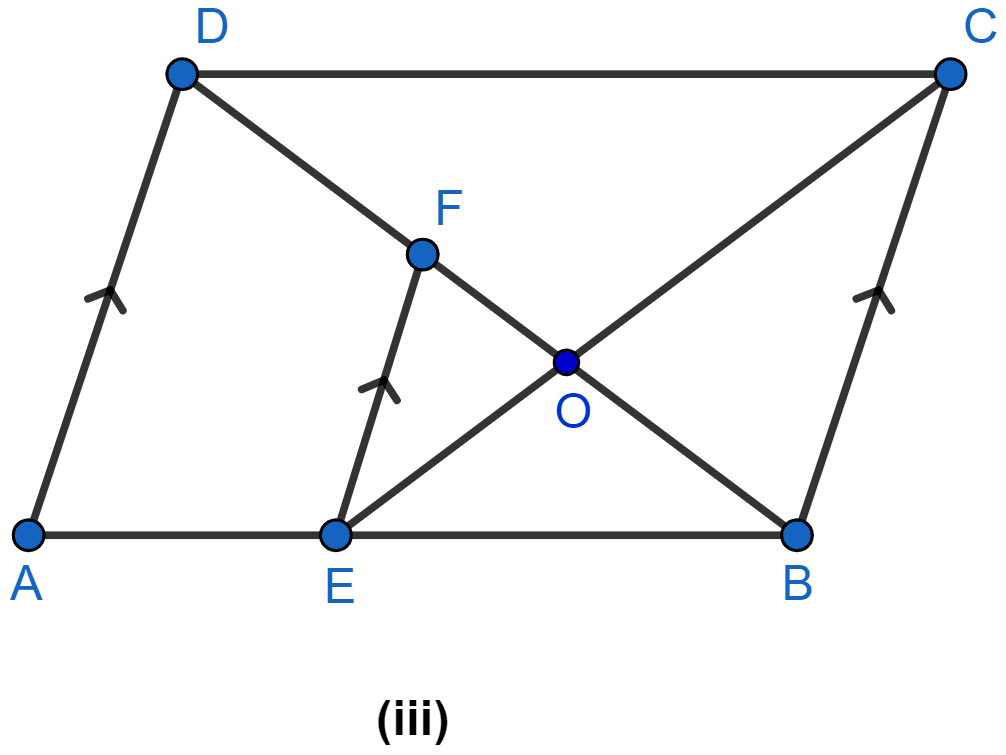
In the figure (iii) given below, ABCD is a parallelogram. E is a point on AB, CE intersects the diagonal BD at O and EF || BC. If AE : EB = 2 : 3, find

(i) EF : AD

(ii) area of △BEF : area of △ABD

(iii) area of △ABD : area of trap. AEFD

(iv) area of △FEO : area of △OBC.

In the figure (iii) given below, ABCD is a parallelogram. E is a point on AB, CE intersects the diagonal BD at O and EF || BC. If AE : EB = 2 : 3, find (i) EF : AD (ii) area of △BEF : area of △ABD (iii) area of △ABD : area of trap. AEFD (iv) area of △FEO : area of △OBC. Similarity, ML Aggarwal Understanding Mathematics Solutions ICSE Class 10.

Answer

(i) Considering △ADB and △EFB,

∠ B = ∠ B (Common angles)
∠ DAB = ∠ FEB (Corresponding angles are equal)

Hence, by AA axiom △ADB ~ △EFB.

We know that when triangles are similar the ratio of the corresponding sides are equal,

ABBE=ADEFEFAD=EBAB\therefore \dfrac{AB}{BE} = \dfrac{AD}{EF} \\[1em] \Rightarrow \dfrac{EF}{AD} = \dfrac{EB}{AB} \\[1em]

Given, AEEB=23\dfrac{AE}{EB} = \dfrac{2}{3}.

ABEBEB=233(ABEB)=2EB3AB3EB=2EB3AB=2EB+3EB3AB=5EBEBAB=35.\Rightarrow \dfrac{AB- EB}{EB} = \dfrac{2}{3} \\[1em] \Rightarrow 3(AB - EB) = 2EB \\[1em] \Rightarrow 3AB - 3EB = 2EB \\[1em] \Rightarrow 3AB = 2EB + 3EB \\[1em] \Rightarrow 3AB = 5EB \\[1em] \Rightarrow \dfrac{EB}{AB} = \dfrac{3}{5}.

Since, EFAD=EBAB=35.\Rightarrow \dfrac{EF}{AD} = \dfrac{EB}{AB} = \dfrac{3}{5}.

Hence, EF : AD = 3 : 5.

(ii) Considering △ABD and △BEF,

∠ B = ∠ B (Common angles)
∠ DAB = ∠ FEB (Corresponding angles are equal)

Hence, by AA axiom △ADB ~ △BEF.

We know that, the ratio of the areas of two similar triangles is equal to the ratio of the square of their corresponding sides.

Area of △BEFArea of △ABD=EF2AD2Area of △BEFArea of △ABD=3252Area of △BEFArea of △ABD=925.\therefore \dfrac{\text{Area of △BEF}}{\text{Area of △ABD}} = \dfrac{EF^2}{AD^2} \\[1em] \Rightarrow \dfrac{\text{Area of △BEF}}{\text{Area of △ABD}} = \dfrac{3^2}{5^2} \\[1em] \Rightarrow \dfrac{\text{Area of △BEF}}{\text{Area of △ABD}} = \dfrac{9}{25}.

Hence, area of △BEF : area of △ABD = 9 : 25.

(iii) From (ii) we get,

Area of △ABDArea of △BEF=259\therefore \dfrac{\text{Area of △ABD}}{\text{Area of △BEF}} = \dfrac{25}{9}

⇒ 9 x Area of △ABD = 25 x Area of △BEF
⇒ 9 x Area of △ABD = 25 x (Area of △ABD - Area of trapezium AEFD)
⇒ 9 x Area of △ABD = 25 x Area of △ABD - 25 x Area of trapezium AEFD
⇒ 16 x Area of △ABD = 25 x Area of trapezium AEFD

Area of △ABDArea of trapezium AEFD=2516\therefore \dfrac{\text{Area of △ABD}}{\text{Area of trapezium AEFD}} = \dfrac{25}{16}

Hence, area of △ABD : area of trapezium AEFD = 25 : 16.

(iv) Considering △FEO and △OBC,

∠ FOE = ∠ BOC (Vertically opposite angles are equal)
∠ FEO = ∠ OCB (Alternate angles are equal)

Hence, by AA axiom △FEO ~ △OBC.

We know that, the ratio of the areas of two similar triangles is equal to the ratio of the square of their corresponding sides.

Area of △FEOArea of △OBC=(EFBC)2\therefore \dfrac{\text{Area of △FEO}}{\text{Area of △OBC}} = \Big(\dfrac{EF}{BC}\Big)^2

Since, in parallelogram opposite sides are equal so, BC = AD.

Area of △FEOArea of △OBC=(EFAD)2Area of △FEOArea of △OBC=3252Area of △FEOArea of △OBC=925.\Rightarrow \dfrac{\text{Area of △FEO}}{\text{Area of △OBC}} = \Big(\dfrac{EF}{AD}\Big)^2 \\[1em] \Rightarrow \dfrac{\text{Area of △FEO}}{\text{Area of △OBC}} = \dfrac{3^2}{5^2} \\[1em] \Rightarrow \dfrac{\text{Area of △FEO}}{\text{Area of △OBC}} = \dfrac{9}{25}.

Hence, the ratio of the area of △FEO : area of △OBC = 9 : 25.

Question 13

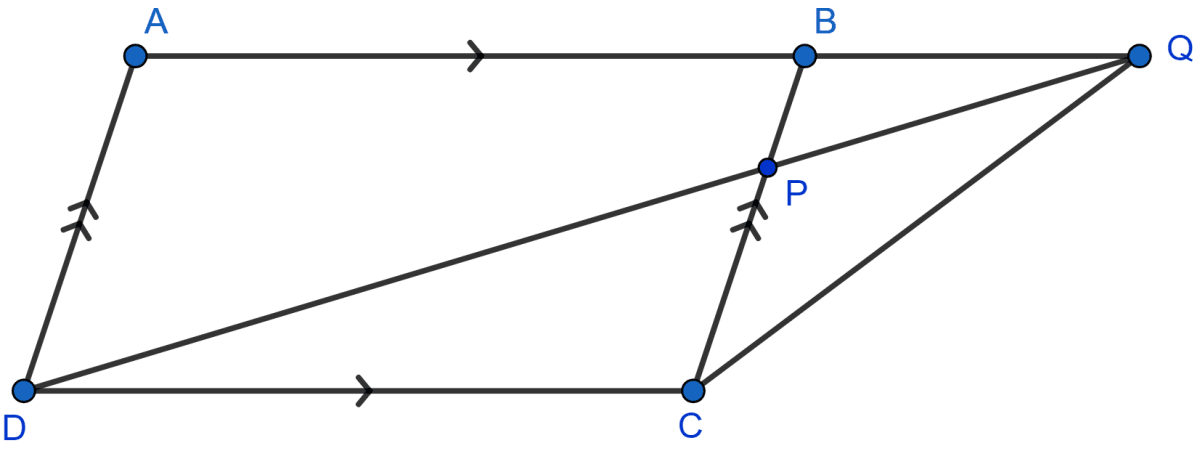
In the adjoining figure, ABCD is a parallelogram. P is a point on BC such that BP : PC = 1 : 2 and DP produced meets AB produced at Q.

If area of △CPQ = 20 cm2, find

(i) area of △BPQ.

(ii) area of △CDP.

(iii) area of ||gm ABCD.

In the adjoining figure, ABCD is a parallelogram. P is a point on BC such that BP : PC = 1 : 2 and DP produced meets AB produced at Q. If area of △CPQ = 20 cm<sup>2</sup>, find (i) area of △BPQ. (ii) area of △CDP. (iii) area of ||gm ABCD. Similarity, ML Aggarwal Understanding Mathematics Solutions ICSE Class 10.

Answer

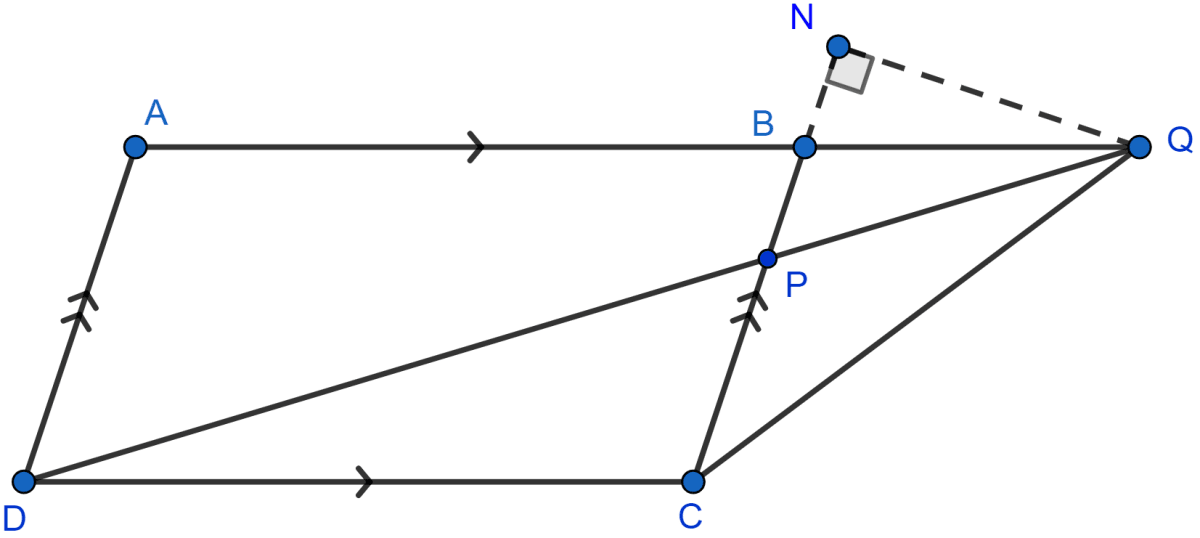
(i) Draw QN ⊥ CB as shown in the figure below:

In the adjoining figure, ABCD is a parallelogram. P is a point on BC such that BP : PC = 1 : 2 and DP produced meets AB produced at Q. If area of △CPQ = 20 cm<sup>2</sup>, find (i) area of △BPQ. (ii) area of △CDP. (iii) area of ||gm ABCD. Similarity, ML Aggarwal Understanding Mathematics Solutions ICSE Class 10.

Area of △BPQArea of △CPQ=12BP×QN12PC×QNArea of △BPQArea of △CPQ=BPPCArea of △BPQArea of △CPQ=12Area of △BPQ=12Area of △CPQ=12×20=10cm2.\Rightarrow \dfrac{\text{Area of △BPQ}}{\text{Area of △CPQ}} = \dfrac{\dfrac{1}{2} BP \times QN}{\dfrac{1}{2} PC \times QN} \\[1em] \Rightarrow \dfrac{\text{Area of △BPQ}}{\text{Area of △CPQ}} = \dfrac{BP}{PC} \\[1em] \Rightarrow \dfrac{\text{Area of △BPQ}}{\text{Area of △CPQ}} = \dfrac{1}{2} \\[1em] \therefore \text{Area of △BPQ} = \dfrac{1}{2}\text{Area of △CPQ} = \dfrac{1}{2} \times 20 = 10 \text{cm}^2.

Hence, the area of △BPQ = 10 cm2.

(ii) Considering △CDP and △BQP,

∠CPD = ∠QPB (Vertically opposite angles are equal)
∠PDC = ∠PQB (Alternate angles are equal)

Hence, by AA axiom △CDP ~ △BQP.

We know that, the ratio of the areas of two similar triangles is equal to the ratio of the square of their corresponding sides.

Area of △CDPArea of △BQP=PC2BP2Area of △CDPArea of △BQP=2212Area of △CDPArea of △BQP=41\therefore \dfrac{\text{Area of △CDP}}{\text{Area of △BQP}} = \dfrac{PC^2}{BP^2} \\[1em] \Rightarrow \dfrac{\text{Area of △CDP}}{\text{Area of △BQP}} = \dfrac{2^2}{1^2} \\[1em] \Rightarrow \dfrac{\text{Area of △CDP}}{\text{Area of △BQP}} = \dfrac{4}{1}

∴ Area of △CDP = 4 × Area of △BQP = 4 × 10 = 40 cm2.

Hence, the area of △CDP = 40 cm2.

(iii) Area of ||gm ABCD = 2 Area of △DCQ (As △DCQ and ||gm ABCD have same base and are between same parallels)

=2(Area of △CDP + Area of △CPQ)=2(40+20)=2×60=120 cm2.= 2(\text{Area of △CDP + Area of △CPQ}) \\[1em] = 2(40 + 20) \\[1em] = 2 \times 60 \\[1em] = 120 \text{ cm}^2.

Hence, the area of ||gm = 120 cm2.

Question 14(a)

In the figure (i) given below, DE || BC and the ratio of the areas of △ADE and trapezium DBCE is 4 : 5. Find the ratio of DE : BC.

In the figure (i) given below, DE || BC and the ratio of the areas of △ADE and trapezium DBCE is 4 : 5. Find the ratio of DE : BC. Similarity, ML Aggarwal Understanding Mathematics Solutions ICSE Class 10.

Answer

Given, ratio of the areas of △ADE and trapezium DBCE = 4 : 5.

Area of △ADEArea of trapezium DBCE=45Area of △ADEArea of △ABC - Area of △ADE=455 Area of △ADE=4(Area of △ABC - Area of △ADE)9 Area of △ADE=4Area of △ABCArea of △ADEArea of △ABC=49.\therefore \dfrac{\text{Area of △ADE}}{\text{Area of trapezium DBCE}} = \dfrac{4}{5} \\[1em] \Rightarrow \dfrac{\text{Area of △ADE}}{\text{Area of △ABC - Area of △ADE}} = \dfrac{4}{5} \\[1em] \Rightarrow 5 \text{ Area of △ADE} = 4 (\text{Area of △ABC - Area of △ADE}) \\[1em] \Rightarrow 9 \text{ Area of △ADE} = 4 \text{Area of △ABC} \\[1em] \Rightarrow \dfrac{\text{Area of △ADE}}{\text{Area of △ABC}} = \dfrac{4}{9}.

Considering △ABC and △ADE,

∠ A = ∠ A (Common angles)
∠ ADE = ∠ ABC (Corresponding angles are equal)

Hence, by AA axiom △ADE ~ △ABC.

We know that, the ratio of the areas of two similar triangles is equal to the ratio of the square of their corresponding sides.

Area of △ADEArea of △ABC=DE2BC249=(DEBC)2DEBC=49DEBC=23.\therefore \dfrac{\text{Area of △ADE}}{\text{Area of △ABC}} = \dfrac{DE^2}{BC^2} \\[1em] \Rightarrow \dfrac{4}{9} = \Big(\dfrac{DE}{BC}\Big)^2 \\[1em] \Rightarrow \dfrac{DE}{BC} = \sqrt{\dfrac{4}{9}} \\[1em] \Rightarrow \dfrac{DE}{BC} = \dfrac{2}{3}.

Hence, the ratio of DE : BC is 2 : 3.

Question 14(b)

In the figure (ii) given below, AB || DC and AB = 2DC. If AD = 3 cm, BC = 4 cm and AD, BC produced meet at E, find

(i) ED

(ii) BE

(iii) area of △EDC : area of trapezium ABCD.

In the figure (ii) given below, AB || DC and AB = 2DC. If AD = 3 cm, BC = 4 cm and AD, BC produced meet at E, find (i) ED (ii) BE (iii) area of △EDC : area of trapezium ABCD. Similarity, ML Aggarwal Understanding Mathematics Solutions ICSE Class 10.

Answer

(i) Given, AB = 2DC or, ABDC=21.\dfrac{AB}{DC} = \dfrac{2}{1}.

Considering △AEB and △EDC.

∠E = ∠E (Common angles)

∠EDC = ∠EAB (Corresponding angles are equal)

Hence, by AA axiom △AEB ~ △EDC.

Since triangles are similar, hence the ratio of the corresponding sides will be equal

AEED=ABDCAD+EDED=213+EDED=213+ED=2EDED=3.\therefore \dfrac{AE}{ED} = \dfrac{AB}{DC} \\[1em] \Rightarrow \dfrac{AD + ED}{ED} = \dfrac{2}{1} \\[1em] \Rightarrow \dfrac{3 + ED}{ED} = \dfrac{2}{1} \\[1em] \Rightarrow 3 + ED = 2ED \\[1em] \Rightarrow ED = 3.

Hence, the length of ED = 3 cm.

(ii) Since, △AEB ~ △EDC. Hence the ratio of the corresponding sides will be equal

BEEC=ABDCBC+ECEC=214+ECEC=214+EC=2ECEC=4.\therefore \dfrac{BE}{EC} = \dfrac{AB}{DC} \\[1em] \Rightarrow \dfrac{BC + EC}{EC} = \dfrac{2}{1} \\[1em] \Rightarrow \dfrac{4 + EC}{EC} = \dfrac{2}{1} \\[1em] \Rightarrow 4 + EC = 2EC \\[1em] \Rightarrow EC = 4.

BE = BC + EC = 4 + 4 = 8 cm.

Hence, the length of BE = 8 cm.

(iii) We know that, the ratio of the areas of two similar triangles is equal to the ratio of the square of their corresponding sides.

Area of △EDCArea of △AEB=DC2AB2Area of △EDCArea of △AEB=1222Area of △EDCArea of △AEB=14Area of △EDCArea of △EDC + Area of ⏢ABCD=144Area of △EDC=Area of △EDC + Area of ⏢ABCD4Area of △EDCArea of △EDC= Area of ⏢ABCD3 Area of △EDC= Area of ⏢ABCD Area of △EDC Area of ⏢ABCD=13.\therefore \dfrac{\text{Area of △EDC}}{\text{Area of △AEB}} = \dfrac{DC^2}{AB^2} \\[1em] \Rightarrow \dfrac{\text{Area of △EDC}}{\text{Area of △AEB}} = \dfrac{1^2}{2^2} \\[1em] \Rightarrow \dfrac{\text{Area of △EDC}}{\text{Area of △AEB}} = \dfrac{1}{4} \\[1em] \Rightarrow \dfrac{\text{Area of △EDC}}{\text{Area of △EDC + Area of ⏢ABCD}} = \dfrac{1}{4} \\[1em] \Rightarrow 4 \text{Area of △EDC} = \text{Area of △EDC + Area of ⏢ABCD} \\[1em] \Rightarrow 4 \text{Area of △EDC} - \text{Area of △EDC} = \text { Area of ⏢ABCD} \\[1em] \Rightarrow 3 \text{ Area of △EDC} = \text { Area of ⏢ABCD} \\[1em] \Rightarrow \dfrac{\text{ Area of △EDC}}{\text { Area of ⏢ABCD}} = \dfrac{1}{3}.

Hence, the ratio of area of △EDC : area of trapezium ABCD = 1 : 3.

Question 15(a)

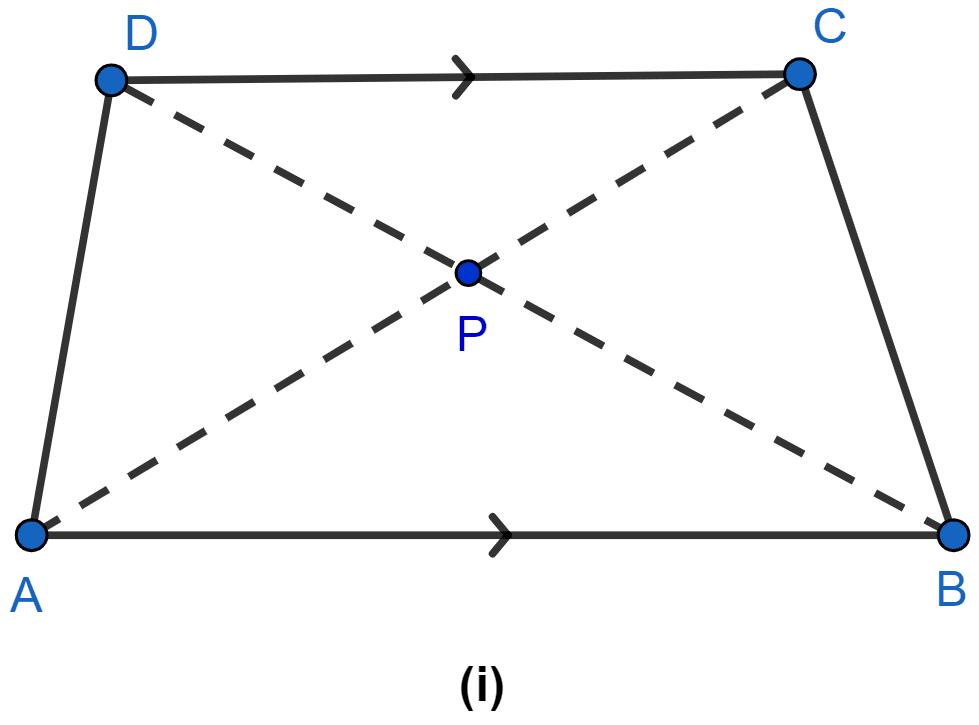
In the figure (i) given below, ABCD is a trapezium in which DC is parallel to AB. If AB = 9 cm, DC = 6 cm and BD = 12 cm, find

(i) BP

(ii) the ratio of areas of △APB and △DPC.

In the figure (i) given below, ABCD is a trapezium in which DC is parallel to AB. If AB = 9 cm, DC = 6 cm and BD = 12 cm, find (i) BP (ii) the ratio of areas of △APB and △DPC. Similarity, ML Aggarwal Understanding Mathematics Solutions ICSE Class 10.

Answer

(i) Considering △APB and △CPD.

∠APB = ∠CPD (Vertical opposite angles are equal)

∠PAB = ∠PCD (Alternate angles are equal)

Hence, by AA axiom △APB ~ △CPD.

Since triangles are similar, hence the ratio of the corresponding sides will be equal

BPPD=ABCDBPBDBP=96BP12BP=966BP=9(12BP)6BP=1089BP15BP=108BP=10815BP=7.2 cm.\therefore \dfrac{BP}{PD} = \dfrac{AB}{CD} \\[1em] \Rightarrow \dfrac{BP}{BD - BP} = \dfrac{9}{6} \\[1em] \Rightarrow \dfrac{BP}{12 - BP} = \dfrac{9}{6} \\[1em] \Rightarrow 6 BP = 9(12 - BP) \\[1em] \Rightarrow 6BP = 108 - 9BP \\[1em] \Rightarrow 15 BP = 108 \\[1em] \Rightarrow BP = \dfrac{108}{15} \\[1em] \Rightarrow BP = 7.2 \text{ cm}.

Hence, the length of BP = 7.2 cm

(ii) We know that, the ratio of the areas of two similar triangles is equal to the ratio of the square of their corresponding sides.

Area of △APBArea of △DPC=AB2CD2Area of △APBArea of △DPC=9262Area of △APBArea of △DPC=8136=94.\therefore \dfrac{\text{Area of △APB}}{\text{Area of △DPC}} = \dfrac{AB^2}{CD^2} \\[1em] \Rightarrow \dfrac{\text{Area of △APB}}{\text{Area of △DPC}} = \dfrac{9^2}{6^2} \\[1em] \Rightarrow \dfrac{\text{Area of △APB}}{\text{Area of △DPC}} = \dfrac{81}{36} = \dfrac{9}{4}.

Hence, area of △APB : area of △DPC = 9 : 4.

Question 15(b)

In the figure (ii) given below, ∠ABC = ∠DAC and AB = 8 cm, AC = 4 cm, AD = 5 cm.

(i) Prove that △ACD is similar to △BCA.

(ii) Find BC and CD.

(iii) Find area of △ACD : area of △ABC.

In the figure (ii) given below, ∠ABC = ∠DAC and AB = 8 cm, AC = 4 cm, AD = 5 cm. (i) Prove that △ACD is similar to △BCA. (ii) Find BC and CD. (iii) Find area of △ACD : area of △ABC. Similarity, ML Aggarwal Understanding Mathematics Solutions ICSE Class 10.

Answer

(i) Considering △ACD and △BCA.

∠C = ∠C (Common angles)

∠ABC = ∠DAC (Given)

Hence, by AA axiom △ACD ~ △BCA.

(ii) Since triangles are similar, hence the ratio of corresponding sides will be equal

ACBC=ADAB4BC=58BC=4×85BC=325BC=6.4 cm.\Rightarrow \dfrac{AC}{BC} = \dfrac{AD}{AB} \\[1em] \Rightarrow \dfrac{4}{BC} = \dfrac{5}{8} \\[1em] \Rightarrow BC = \dfrac{4 \times 8}{5} \\[1em] \Rightarrow BC = \dfrac{32}{5} \\[1em] \Rightarrow BC = 6.4 \text{ cm}.

Similarly,

CDCA=ADABCD4=58CD=4×58CD=208CD=2.5 cm.\Rightarrow \dfrac{CD}{CA} = \dfrac{AD}{AB} \\[1em] \Rightarrow \dfrac{CD}{4} = \dfrac{5}{8} \\[1em] \Rightarrow CD = \dfrac{4 \times 5}{8} \\[1em] \Rightarrow CD = \dfrac{20}{8} \\[1em] \Rightarrow CD = 2.5 \text{ cm}.

Hence, the length of BC = 6.4 cm and CD = 2.5 cm.

(iii) We know that, the ratio of the areas of two similar triangles is equal to the ratio of the square of their corresponding sides.

Area of △ACDArea of △ABC=AD2AB2Area of △ADCArea of △ABC=5282Area of △ADCArea of △ABC=2564.\therefore \dfrac{\text{Area of △ACD}}{\text{Area of △ABC}} = \dfrac{AD^2}{AB^2} \\[1em] \Rightarrow \dfrac{\text{Area of △ADC}}{\text{Area of △ABC}} = \dfrac{5^2}{8^2} \\[1em] \Rightarrow \dfrac{\text{Area of △ADC}}{\text{Area of △ABC}} = \dfrac{25}{64}.

Hence, the ratio of area of △ACD : area of △ABC = 25 : 64.

Question 16

In the given figure,
∠ PQR = ∠ PST = 90°, PQ = 5 cm and PS = 2 cm.

(i) Prove that △PQR ~ △PST.

(ii) Find area of △PQR : area of quadrilateral SRQT.

In the given figure, ∠ PQR = ∠ PST = 90°, PQ = 5 cm and PS = 2 cm. (i) Prove that △PQR ~ △PST. (ii) Find area of △PQR : area of quadrilateral SRQT. Similarity, ML Aggarwal Understanding Mathematics Solutions ICSE Class 10.

Answer

(i) Considering △PQR and △PST.

∠P = ∠P (Common angles)

∠PQR = ∠PST (Both are equal to 90°)

Hence, by AA axiom △PQR ~ △PST.

(ii) Area of △PQRArea of △PST=PQ2PS2=5222=254\dfrac{\text{Area of △PQR}}{\text{Area of △PST}} = \dfrac{PQ^2}{PS^2} = \dfrac{5^2}{2^2} = \dfrac{25}{4}

or,

Area of △PQRArea of △PQR - Area of SRQT=254\Rightarrow \dfrac{\text{Area of △PQR}}{\text{Area of △PQR - Area of SRQT}} = \dfrac{25}{4}

⇒ 4 Area of △PQR = 25 Area of △PQR - 25 Area of SRQT
⇒ 25 Area of SRQT = 25 Area of △PQR - 4 Area of △PQR
⇒ 25 Area of SRQT = 21 Area of △PQR

Area of △PQRArea of SRQT=2521\Rightarrow \dfrac{\text{Area of △PQR}}{\text{Area of SRQT}} = \dfrac{25}{21}

Hence, area of △PQR : area of quadrilateral SRQT is 25 : 21.

Question 17

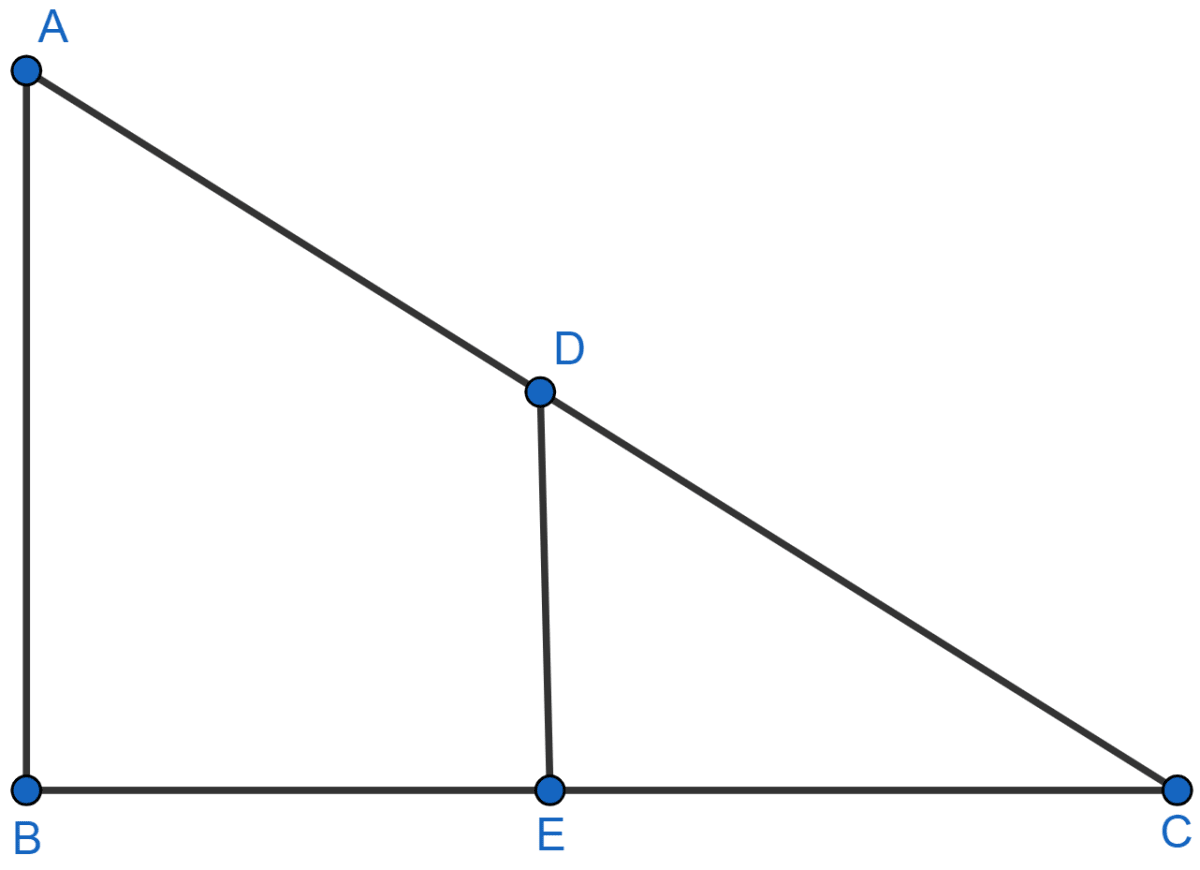
ABC is a right angled triangle with ∠ABC = 90°. D is any point on AB and DE is perpendicular to AC.

ABC is a right angled triangle with ∠ABC = 90°. D is any point on AB and DE is perpendicular to AC. Similarity, ML Aggarwal Understanding Mathematics Solutions ICSE Class 10.

(i) Prove that △ADE ~ △ACB.

(ii) If AC = 13 cm, BC = 5 cm and AE = 4 cm. Find DE and AD.

(iii) Find, area of △ADE : area of quadrilateral BCED.

Answer

(i) Considering △ADE and △ACB.

∠A = ∠A (Common angles)

∠AED = ∠ABC (Both are equal to 90°)

Hence, by AA axiom △ADE ~ △ACB.

(ii) △ABC is a right angled triangle.

By pythagoras theorem,

AC2=AB2+BC2AB2=AC2BC2AB2=13252AB2=16925AB2=144AB=144AB=12 cm.AC^2 = AB^2 + BC^2 \\[1em] AB^2 = AC^2 - BC^2 \\[1em] AB^2 = 13^2 - 5^2 \\[1em] AB^2 = 169 - 25 \\[1em] AB^2 = 144 \\[1em] AB = \sqrt{144} \\[1em] AB = 12 \text{ cm}.

Since triangles are similar hence the ratio of their corresponding sides are equal.

AEAB=ADAC412=AD13AD=4×1312AD=133AD=413.\therefore \dfrac{AE}{AB} = \dfrac{AD}{AC} \\[1em] \Rightarrow \dfrac{4}{12} = \dfrac{AD}{13} \\[1em] \Rightarrow AD = \dfrac{4 \times 13}{12} \\[1em] \Rightarrow AD = \dfrac{13}{3} \\[1em] \Rightarrow AD = 4\dfrac{1}{3}.

Similarly,

AEAB=DEBC412=DE5DE=4×512DE=53DE=123.\therefore \dfrac{AE}{AB} = \dfrac{DE}{BC} \\[1em] \Rightarrow \dfrac{4}{12} = \dfrac{DE}{5} \\[1em] \Rightarrow DE = \dfrac{4 \times 5}{12} \\[1em] \Rightarrow DE = \dfrac{5}{3} \\[1em] \Rightarrow DE = 1\dfrac{2}{3}.

Hence, the length of AD = 4134\dfrac{1}{3} cm and of DE = 1231\dfrac{2}{3} cm.

(iii) Area of a right angled triangle is given by

12×Base×Height\dfrac{1}{2} \times \text{Base} \times \text{Height}.

Area of △ADE = 12×AE×DE\dfrac{1}{2} \times AE \times DE

=12×4×53=103 cm2.= \dfrac{1}{2} \times 4 \times \dfrac{5}{3} \\[1em] = \dfrac{10}{3} \text{ cm}^2.

Area of quadrilateral BCED = Area of △ABC - Area of △ADE

=12×BC×AB103=12×5×12103=30103=90103=803 cm2= \dfrac{1}{2} \times BC \times AB - \dfrac{10}{3} \\[1em] = \dfrac{1}{2} \times 5 \times 12 - \dfrac{10}{3} \\[1em] = 30 - \dfrac{10}{3} \\[1em] = \dfrac{90 - 10}{3} \\[1em] = \dfrac{80}{3} \text{ cm}^2

Hence, area of △ADE : area of quadrilateral BCED is

=103803=10×380×3=18=1:8.= \dfrac{\dfrac{10}{3}}{\dfrac{80}{3}} \\[1em] = \dfrac{10 \times 3}{80 \times 3} \\[1em] = \dfrac{1}{8} \\[1em] = 1 : 8.

Hence, area of △ADE : area of quadrilateral BCED is 1 : 8.

Question 18

Two isosceles triangles have equal vertical angles and their areas are in the ratio 7 : 16. Find the ratio of their corresponding heights.

Answer

Let their be two isosceles triangles ABC and DEF.

∠A = ∠D (Given, vertical angles are equal)

Since, triangles are isosceles so,

∠B = ∠C = 180A2\dfrac{180 - ∠A}{2} and ∠E = ∠F = 180D2\dfrac{180 - ∠D}{2}.

Since, ∠A = ∠D so, we can say

∠B = ∠E.

Hence, by AA axiom △ABC ~ △DEF.

We know that, the ratio of the areas of two similar triangles is equal to the ratio of the squares of their corresponding altitudes.

Area of △ABCArea of △DEF=(Height of △ABC)2(Height of △DEF)2716=(Height of △ABCHeight of △DEF)2Height of △ABCHeight of △DEF=716Height of △ABCHeight of △DEF=74.\therefore \dfrac{\text{Area of △ABC}}{\text{Area of △DEF}} = \dfrac{(\text{Height of △ABC})^2}{(\text{Height of △DEF})^2} \\[1em] \Rightarrow \dfrac{7}{16} = \Big(\dfrac{\text{Height of △ABC}}{\text{Height of △DEF}}\Big)^2 \\[1em] \Rightarrow \dfrac{\text{Height of △ABC}}{\text{Height of △DEF}} = \sqrt{\dfrac{7}{16}} \\[1em] \Rightarrow \dfrac{\text{Height of △ABC}}{\text{Height of △DEF}} = \dfrac{\sqrt{7}}{4}.

Hence, the ratio of their corresponding heights is 7:4\sqrt{7} : 4.

Question 19

On a map drawn to a scale of 1 : 250000, a triangular plot of land has the following measurements :

AB = 3 cm, BC = 4 cm and ∠ABC = 90°. Calculate :

(i) the actual length of AB in km.

(ii) the area of the plot in sq. km.

Answer

(i) Since, the model of the triangular plot is made to the scale of 1 : 250000.

∴ K (Scale factor) = 250000.

Actual length of AB = k × (the length of AB in model) = 250000 × 3 = 750000 cm.

1 cm = 10-5 km.

∴ 750000 cm = 750000 × 10-5 km = 7.5 km.

Hence, the length of AB is 7.5 km.

(ii) Since the plot is a right angled triangle.

We know area of right angled triangle is given by

12× base × height.\Rightarrow \dfrac{1}{2} \times \text{ base } \times \text{ height}.

Hence, area of the model is,

=12×AB×BC=12×3×4=6 cm2.= \dfrac{1}{2} \times AB \times BC \\[1em] = \dfrac{1}{2} \times 3 \times 4 \\[1em] = 6 \text{ cm}^2.

We know that 1 cm2 = 10-10 km2.

Hence, area of model = 6 × 10⁻¹⁰ km2.

Area of the actual plot = k2 × (Area of the model)

Putting values in above equation,

=(250000)2×6×1010=625×108×6×1010=3750×102.=37.5 km2.= (250000)^2 \times 6 \times 10^{-10} \\[1em] = 625 \times 10^{8} \times 6 \times 10^{-10} \\[1em] = 3750 \times 10^{-2.} \\[1em] = 37.5 \text{ km}^2.

Hence, the area of the plot is 37.5 km2.

Question 20

On a map drawn to a scale of 1 : 50000, a rectangular plot of land ABCD has the following dimensions. AB = 6 cm; BC = 8 cm. Find :

(i) the actual length of the diagonal AC of the plot in km.

(ii) the actual area of the plot in sq. km.

Answer

Since map is drawn to a scale of 1 : 50000.

∴ k (Scale factor) = 50000.

Length of the diagonal AC of the rectangle can be given by pythagoras theorem i.e. AB2+BC2\sqrt{AB^2 + BC^2}.

Putting values we get,

AC=AB2+BC2AC=62+82AC=36+64AC=100AC=10 cm.\Rightarrow AC = \sqrt{AB^2 + BC^2} \\[1em] \Rightarrow AC = \sqrt{6^2 + 8^2} \\[1em] \Rightarrow AC = \sqrt{36 + 64} \\[1em] \Rightarrow AC = \sqrt{100} \\[1em] \Rightarrow AC = 10 \text{ cm}.

Actual length of diagonal = k × length of diagonal in model.

=50000×10=500000 cm=500000×105 km=5 km= 50000 \times 10 \\[1em] = 500000 \text{ cm} \\[1em] = 500000 \times 10^{-5} \text{ km} \\[1em] = 5 \text{ km}

Hence, actual length of diagonal = 5 km.

(ii) Area of the model ABCD = AB × BC = 6 × 8 = 48 cm2.

Area of the actual plot = k2 × (Area of the model)
= (50000)2 x 48
= 25 x 108 x 48
= 1200 x 108
= 12 x 1010 cm2

We know that 1 cm2 = 10-10 km2.

∴ Actual area of plot = 12 × 1010 × 10-10 km2 = 12 km2.

Hence, the actual area of the plot is 12 km2.

Question 21

A map of a square plot of land is drawn to a scale of 1 : 25000. If the area of the plot in the map is 72 cm2, find :

(i) the actual area of the plot of land.

(ii) the length of the diagonal in the actual plot of land.

Hint : (ii) 12\dfrac{1}{2} (length of diagonal)2 = area of square.

Answer

(i) Since, the model of the square plot is constructed with scale of 1 : 25000.

k (Scale factor) = 25000.

Area of the actual plot = k2 × (Area of the model of the plot)

Given, area of the model = 72 cm2. Putting values in above equation,

=(25000)2×72=625000000×72=45000000000=45×109 cm2.= (25000)^2 \times 72 \\[1em] = 625000000 \times 72 \\[1em] = 45000000000 \\[1em] = 45 \times 10^9 \text{ cm}^2.

We know that 1 cm2 = 10-10 km2.

∴ Actual area of plot = 45 × 109 × 10-10 km2 = 4.5 km2.

Hence, the actual area of the plot is 4.5 km2.

(ii) We know that,

12\dfrac{1}{2} (length of diagonal)2 = area of square.

Putting value of area of square plot = 4.5 km2 in above equation we get,

12 (Length of diagonal)2=4.5(Length of diagonal)2=9Length of diagonal=9 Length of diagonal=3.\Rightarrow \dfrac{1}{2} \text{ (Length of diagonal)}^2 = 4.5 \\[1em] \Rightarrow \text{(Length of diagonal)}^2 = 9 \\[1em] \Rightarrow \text{Length of diagonal} = \sqrt{9} \\[1em] \Rightarrow \text{ Length of diagonal} = 3.

Hence, the length of diagonal in the actual plot of land is 3 km.

Question 22

The model of a building is constructed with the scale factor 1 : 30.

(i) If the height of the model is 80 cm, find the actual height of the building in metres.

(ii) If the actual volume of a tank at the top of the building is 27 m3, find the volume of the tank on the top of the model.

Answer

(i) Since, the model of the building is constructed with scale 1 : 30.

∴ k (Scale factor) = 30

Height of building = k × Height of model of the building = 30 × 80 = 2400 cm = 2400100\dfrac{2400}{100} m = 24 m.

Hence, the height of building is 24 m.

(ii) Volume of the tank = k3 × (the volume of the model)

Given, volume of tank = 27 m3. Let volume of model be x m3. Putting value in above equation we get,

27=(30)3×xx=2730×30×30x=2727000x=11000.\Rightarrow 27 = (30)^3 \times x \\[1em] \Rightarrow x = \dfrac{27}{30 \times 30 \times 30} \\[1em] \Rightarrow x = \dfrac{27}{27000} \\[1em] \Rightarrow x = \dfrac{1}{1000}.

∴ x = 11000 m3=11000×(100 cm)3=10000001000 cm3=1000 cm3\dfrac{1}{1000} \text{ m}^3 = \dfrac{1}{1000} \times (100 \text{ cm})^3 = \dfrac{1000000}{1000} \text{ cm}^3 = 1000 \text{ cm}^3.

Hence, the volume of the model is 1000 cm3.

Question 23

A model of a high rise building is made to a scale of 1 : 50.

(i) If the height of the model is 0.8 m, find the height of the actual building.

(ii) If the floor area of a flat in a building is 20 m2, find the floor area of that in the model.

Answer

(i) Given, the height of the model = 0.8 m

Since, the model of the building is constructed with scale 1 : 50.

∴ k (Scale factor) = 50

⇒ Height of building = k × Height of model of the building = 50 × 0.8 = 40 m

Hence, height of building = 40 m.

(ii) The floor area of a flat = k2 x the floor area of a model flat

⇒ 20 = 502 x Floor area of a model flat

⇒ 20 = 2500 x Floor area of a model flat

⇒ Floor area of a model flat = 202500\dfrac{20}{2500} = 0.008 m2

Hence, the floor area of that in the model = 0.008 m2.

Question 24

A model of a ship is made to a scale of 1 : 200.

(i) If the length of the model is 4 m, find the length of the ship.

(ii) If the area of the deck of the ship is 160000 m2, find the area of the deck of the model.

(iii) If the volume of the model is 200 litres, find the volume of the ship in m3.

Answer

(i) Since, the model of the ship is made to the scale of 1 : 200.

∴ K (Scale factor) = 200.

Actual length of the ship = k × (the length of model) = 200 × 4 = 800 m.

Hence, the length of the ship is 800 m.

(ii) Area of the deck of the ship = k2 × (Area of the deck of the model)

Let area of deck of model be x m2.

160000=(200)2×xx=160000200×200x=4.\Rightarrow 160000 = (200)^2 \times x \\[1em] \Rightarrow x = \dfrac{160000}{200 \times 200} \\[1em] \Rightarrow x = 4.

Hence, the area of the deck of the ship is 4 m2.

(iii) Volume of the ship = k3 × (the volume of the model)

Given, volume of model = 200 litres = 2001000m3=0.2m3\dfrac{200}{1000} m^3 = 0.2 m^3.

Putting value in above equation we get,

=(200)3×0.2=8000000×0.2=1600000= (200)^3 \times 0.2 \\[1em] = 8000000 \times 0.2 \\[1em] = 1600000

Hence, the volume of the model of the ship is 1600000 m3.

PrevNext